
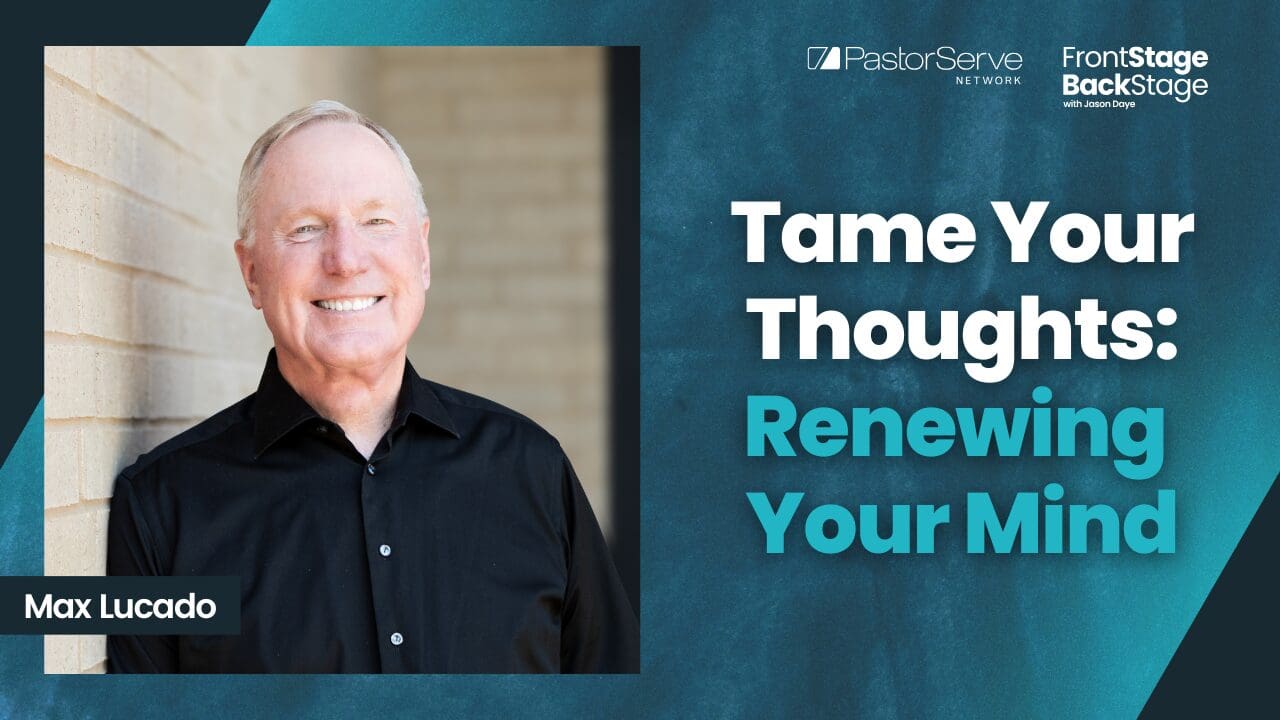
Are your thoughts shaping your life? Max Lucado shares three biblical and brain-based tools to help you tame your thoughts, renew your mind, and live with peace in Christ.
How do we tame our thoughts and renew our minds to experience lasting peace and transformation?
In this episode of FrontStage BackStage, host Jason Daye sits down with Max Lucado, pastor and America’s bestselling inspirational author, to explore the spiritual and practical journey of renewing your mind in Christ. Drawing from his latest book, Tame Your Thoughts, Max shares three biblical and science-informed tools to transform your thinking and shape a more Christ-centered life.
Together, they discuss how the mind can be retrained through the truth of Scripture, how neuroscience affirms God’s design for mental renewal, and how to move beyond simply resisting negative thoughts to actively replacing them with God’s promises.
They explore:
- The connection between faith, neuroscience, and spiritual formation
- How to hold every thought captive and redirect it toward truth
- The power of replacing lies with God’s promises
- Practical steps to renew your mind and transform your life
- Why mind renewal leads to deeper peace and lasting transformation
This conversation encourages each of us to partner with the Holy Spirit in the renewing of our minds, choosing daily to bring our thoughts under Christ’s truth and discovering the peace, clarity, and freedom that flow from a heart aligned with Him.
Looking to dig more deeply into this topic and conversation? Every week, we go the extra mile and create a free toolkit so you and your ministry team can dive deeper into the topic that is discussed. Find your Weekly Toolkit below… Love well, Live well, Lead well!
Connect with this week’s Guest, Max Lucado
Weekly Toolkit
Additional Resources
www.maxlucado.com – Check out Max’s website to explore his ministry, books, teachings, and helpful resources that will strengthen your walk with God.
Tame Your Thoughts: Three Tools to Renew Your Mind and Transform Your Life – Perhaps you were overwhelmed with the weight of worry, the fear of failing, or the grip of guilt. The way we think directly impacts our joy and peace. In his book, Max provides three biblical and practical tools to renew your mind and transform your life.
Ministry Leaders Growth Guide
Digging deeper into this week’s conversation
Key Insights & Concepts
- The alarming reality that 42% of teenagers live with pervasive hopelessness reveals a generation in crisis, demanding the Church respond with practical tools for mental and spiritual restoration rather than platitudes.
- Neuroplasticity confirms what Scripture has always promised: transformation through the renewing of our minds is not merely spiritual rhetoric but a biological reality that empowers genuine change.
- The belief that we inherit immutable thought patterns like we inherit eye color is a lie that keeps people imprisoned; our brains remain editable manuscripts throughout our lives, not completed publications.
- Every action begins with a thought, and every behavior with a belief, making the management of our thought life the most important work we can undertake for lasting transformation.
- The temptation to conform our thinking to worldly patterns comes from the enemy, while the Holy Spirit offers transformation through learning to think as Jesus thought—a battle for our minds with eternal consequences.
- Just because a thought enters your mind doesn’t mean it deserves a place at the table; practicing picky thinking means taking every thought captive and making it submit to Christ’s authority.
- Overreactions in life, whether spiraling spending, broken marriages, or uncontrolled anger, are rarely the root problem but symptoms of untruths that have taken root and produced false narratives.
- The enemy lives every moment hoping to deposit an untruth in your mind, making vigilance over our thought life not optional but essential for our spiritual well-being.
- Uprooting toxic thoughts without replanting truth leaves a vacuum; Scripture calls us not merely to empty our minds through meditation but to populate them with God’s Word.
- When guilt threatened to paralyze a young believer’s faith, a single verse, Romans 8:1, became the truth that replaced condemnation, illustrating why pastors must faithfully proclaim forgiveness from their pulpits.
- The exhaustion of ministry, whether from preaching, greeting, or pastoral care, creates fertile ground for toxic thoughts, requiring leaders to recognize their vulnerabilities and manage them with intentionality rather than letting them spiral into destructive actions.
- Declaring “I love Jesus but hate the church” may sound novel, but it fundamentally misunderstands that loving Christ means caring for His bride, with all her imperfections and challenges.
- The ruts in our brains are literal neural pathways that dictate habitual responses, but creating new ruts through deliberate practice of truth can transform anxiety into faith over time.
- Pastors never know which broken twenty-year-old version of someone sits in their congregation, making faithful proclamation of God’s grace and forgiveness an act of hope that reaches beyond what we can see.
- The toolkit for thought transformation, filtering through picky thinking, identifying the untruth>false-narrative>overreaction cycle, and uprooting to replant Scripture, offers the Church a practical pathway to address the mental health crisis with both spiritual power and psychological wisdom.
Questions For Reflection
- When I encounter the statistics about teenagers or adults living with hopelessness and contemplating suicide, what emotions surface in me? How might those feelings be shaping (or limiting) my response to the mental health crisis in my community?
- What toxic thought patterns have I inherited from those who raised me or mentored me in ministry? Am I willing to acknowledge that these patterns can be transformed rather than accepting them as unchangeable parts of who I am?
- On my most depleted days, what thoughts tend to dominate my mind? How am I managing those thoughts before they lead to unhealthy actions or words that wound others?
- Do I truly believe that my brain is “editable” and that transformation through the renewing of my mind is possible, or have I resigned myself to certain patterns of anxiety, negativity, or discouragement as permanent fixtures of my personality? How does my decision reflect what I believe about Jesus?
- When difficult thoughts enter my mind during ministry challenges, am I practicing “picky thinking” by taking those thoughts captive, or do I assume that every notion deserves space in my mental and emotional landscape? WHat are some examples of when I should practice picky thinking?
- What untruths about myself, my calling, or God’s character have taken root in my mind and created false narratives that are now driving overreactions in my ministry or personal life?
- Can I identify a specific moment when I’ve lashed out, made an impulsive decision, or spiraled into despair? Am I willing to trace that overreaction back to its root untruth and false narrative?
- What lies are the enemy consistently trying to deposit in my mind about my adequacy as a leader, the effectiveness of my ministry, or my worth before God? How have I dealt with these in the past?
- When I recognize a toxic thought pattern, do I stop at simply trying not to think about it, or am I actively replanting truth from Scripture in that mental space? What can replanting Scripture in my thought-life provide for me?
- Which Scripture verse do I need to memorize and repeat to myself, perhaps 100 times in a day, to combat the most persistent false narrative I’m currently battling?
- How am I equipping my congregation with specific, memorable Scripture verses that address their common struggles, rather than assuming they’ll extract practical tools from my sermons or teaching on their own? What can we do as a church to improve how we are equipping our people?
- In moments of personal guilt or shame about my past or present failures, what truth am I speaking to myself? Is it powerful enough to replace condemnation with the reality of Romans 8:1?
- When I hear someone say “I love Jesus but hate the church,” does something in me resonate with that sentiment? What does that reveal about my own wounds or weariness in loving Christ’s imperfect bride?
- How am I creating space in my own life to acknowledge when things feel out of control? How am I bringing those struggles honestly before God rather than pretending I have it all together or medicating my thoughts inappropriately?
- What would it look like for me to show Christ how much I love Him by the way I care for, remain patient with, and shepherd His bride, even when the church frustrates, disappoints, or exhausts me?
Full-Text Transcript
Jason Daye
Hey, friends, it’s Jason Daye. Welcome to another exciting episode of FrontStage BackStage. I’m always encouraged when I have the opportunity to sit down with today’s guest. We have Max Lucado with us. Max is America’s best-selling inspirational author, with over 150 million products in print, including his latest book entitled Tame Your Thoughts. Now, Christianity Today calls Max America’s pastor. Reader’s Digest refers to Max as the greatest, best preacher in America, but my new favorite comes from Dallas Morning News, which calls Max the Ted Lasso of pastors. But beyond all of that, Max is a devoted Christ-follower, an incredible shepherd. He’s a loving family man, a wonderful friend. At this time, I’d like to welcome Max Lucado back to the show. Max, good to see you, brother.
Max Lucado
Jason, great to see you. You look great. Thanks for this opportunity.
Jason Daye
Yeah, brother, you’re looking good, too. It’s always great to sit down and chat with you a little bit. You’ve been spending a lot of time recently, Max, exploring, kind of, our thought world, and what’s going on in our minds. You’ve been doing a lot of thinking about thinking. And I’m curious, Max, what’s kind of the catalyst that has led you to kind of jump into this world?
Max Lucado
I like that. Thinking about thinking. That would have been a good subtitle. There you go. Think about what you think about. Well, there are so many answers to that single question. I think the impetus to really dive in on helping people manage their thoughts came from reading some of the very alarming statistics that we’re reading today, not just about young people, but primarily about young people. 42% of teenagers say they live with pervasive negative thoughts of hopelessness. 42%, and those are teenagers, Jason. That should be the time when they’re having so much fun, they’re excited, and they’re making dreams about the future. There are many reasons for that. The other statistic for teenagers is that 22% have contemplated suicide in the prior six months, so that just sucks the air out of the lungs. We, adults, are not exempt. One out of five adults says they live with symptoms of depression. I don’t think that means they’ve been clinically diagnosed, but at least from their perspective, they feel like they’re depressed. They spend their day under the gray cloud of hopelessness or sadness. One out of five. That’s a lot of people. You think about walking into a grocery store, and every fifth person you see doesn’t want to get out of bed or doesn’t have much hope in their heart. And so those statistics really caught my attention. I think reading those made me think, is there something that we could do or say? All of my books come out of sermons. And so I had created a sermon series for the church, and it seemed to be well-received, so we turned it into this book,
Jason Daye
Yeah. That makes sense. And it’s true that we look around us, and there are a lot of challenges that people are having in their minds and the way they’re feeling about life. One of the things, as I was reading the book, Max, incredible, very, very helpful. One of the things that I thought about was some of the conversations that I’ve had, I’m sure other pastors, ministry leaders, probably you yourself, Max, have had with people around this idea of managing our lives by managing our thoughts. I’ve had people say something to the effect of, Well, Jason, you’re a hopeful person. You’re a positive person, right? You’re a ministry guy. That may work for you, right? That might come naturally for you, even, but I can’t control my thoughts. I have different experiences. Max, how do we speak into people’s lives who are kind of thinking, Well, you’re a positive person. That’s just how God made you. I’m different.
Max Lucado
That’s a tremendous question. I’ve heard the phrase, I’m a worrier. My mom was a worrier. I’ll always be a worrier. Or I’ll never make much out of my life. My dad didn’t, and I’m doomed to do the same. We behave sometimes like we inherit our thoughts, like we inherit our skin color or hair color, and that has a bit of truth in it in the sense that those who raise us have a huge influence, I mean, a huge influence, over our thought patterns, but that is never to say that they have complete control over our thought patterns. So two quick answers. One is, from a spiritual standpoint, we are promised through scripture that we don’t have to be conformed to this world, but that we can be transformed by the renewing of our minds. That’s Romans 12:2. It’s a familiar scripture, deservedly so, because it tells us there is an attempt to conform our thinking. And in the book, I point out that’s from the devil. He wants to conform our thinking to the patterns of society, but the Holy Spirit will transform our thoughts. He will transform our thoughts as we think, as we learn to think, more and more like Jesus thought. So that’s the spiritual approach to that question. But, and then there’s also a scientific approach to this question, and I’m quick to acknowledge I’m not a neuroscientist. No, I can barely comb my hair, much less treat someone’s brain. But, I did engage some neuroscientists, the help of several really respected neuroscientists, and they helped me understand the meaning of the phrase neuroplasticity. I think it’s becoming more and more of a common phrase, but in case a person has not heard it, it’s the idea that our brains are malleable, physically malleable. They change over our lives. Your brain is not a completed and published manuscript. It’s a book in progress. It’s editable. It’s changeable. And so when the Scripture says, Don’t be conformed, but be transformed, the apostle Paul never, I’m sure, had heard that phrase neuroplasticity. But a neurosurgeon would say, Okay, yeah, that’s a possibility because we’re not stuck with our thoughts and with our brain patterns. You see, our brains have ruts in them, and that literally is a technical term. There are ruts, and it’s through these ruts that the synapse is fired. And the reason I brush my teeth today with my right hand instead of my left hand is because there’s a certain crevice, there’s a certain indentation, and I’ve developed that. I don’t even have to think about it. Now, if I were to try to brush my teeth with my left hand, well, there’s no rut for that, and it would take me a while to create one. We call that learning a new habit. And so our thought patterns are basically habitual patterns, habits of thinking, in which a problem comes our way and somebody like Jason says, Okay, I’m going to be fine. I’ve dealt with this before, and a friend of Jason says, Well, that’s just the way you are. You just have that. And the right answer would be, well, that is the way you are, but that doesn’t mean you can’t be that way. And so that’s the hope of this book, that the Lord would use the book to convince people that just because you’re grumpy or a worrywart today doesn’t mean you’ll have to be that way the rest of your life.
Jason Daye
Yeah. And I love that, Max, because that is one recognizing that there are these patterns that we’ve developed, as you said, these ruts, these habits, but we’re not stuck with them. That we can indeed change and influence those, but it takes work, and that’s one thing to make a point of. It’s like, you have to commit to it. You have to be willing to put the work in. But if you’re willing to put the work in, then you can see these changes.
Max Lucado
And what work is more important? What matters more? So every action begins with a thought. Every behavior begins with a belief, and so if you want your actions to be better tomorrow, do your best to practice careful thinking today. Here’s a practical example, if I can. So, we’re recording this on a Tuesday. The toughest day of the week for me is a Monday, and the reason is because I preach three times on Sunday, and then I stand out in the foyer and I greet people, and people are surprised to know really I’m more of an introvert than an extrovert, and every time I’m chatting or conversing, I’m depleting my tank. It’s been that way for 40 years. I get it. I’ve always been that way. I’m more of an introvert. So, by the time Monday comes around, I’m kind of, sky looks kind of gray today. I don’t care how blue it is. My wife knows to expect it, and gratefully, I’ve come to expect it. Okay, so just yesterday, I felt kind of like I was slugging through the day. I don’t care. Good news didn’t feel as good. Bad news felt worse than bad. So, that’s just the nature of that day. Now I could, if I wasn’t careful, allow that to spiral and say some things, or lash out, make some choices, or treat my mood inappropriately with some chemical or something like that. That would be a bad decision. But, gratefully, I’ve learned, okay, those are just thoughts. I’m not going to let those thoughts turn into an unhealthy action. I acknowledge that. And there were times, maybe four or five times during the day, Jason, I said, Lord, I’m just really battling here. It’s not my best day, and my wife could tell, but I bit my tongue a couple of times when I was tempted to say something I shouldn’t. And so I’m 70 years old, so hopefully I have learned this by now, but we have to learn that there’s nothing more important than managing our thoughts because those thoughts are what lead to actions.
Jason Daye
Hey, friends, just a quick reminder that we provide a free toolkit that complements today’s conversation. You can find this for this episode and every episode at PastorServe.org/network in the toolkit. You’ll find a number of resources, including our Ministry Leaders Growth Guide. This growth guide includes insights pulled from today’s conversation as well as reflection questions, so you and the ministry team at your local church can dig more deeply into this topic and see how it relates to your specific ministry context. Again, you can find it at PastorServe.org/network.
Jason Daye
Yeah, that’s good. One of the things, Max, that I really appreciate in the book is you give this like toolkit, very helpful toolkit, with three different things that we can actually work on, practically bring into our lives and embrace, and I’d love it if you just take a few minutes to walk through these three different tools and explain how they work and why they’re important.
Max Lucado
Yes, absolutely. Okay, so we have these three tools, and they’re very practical, and they can be applied to whatever particular toxic thought pattern a person struggles with. Tool number one: practice picky thinking. And the subtitle would be, just because you have a thought, you don’t have to think it. Okay, so you practice picky thinking. And when a thought comes your way, you literally, as 2 Corinthians 10 says, take that thought captive. Take that thought captive. You literally say, Now, do I need to be thinking this? Is this a thought from God or not? Take it captive. Make it submit to the authority of Christ. So that’s the first tool. How practical it is that you teach your church this, or your youth group this. How practical. Because a lot of people think that just because a notion comes in their mind, it deserves a place at the table. Well, it doesn’t. It doesn’t. So practice picky thinking. Number two, and this is kind of fun. I call this UFO, not talking about aliens in Roswell, New Mexico. I’m talking about the untruth that leads to a false narrative that leads to an overreaction. As a pastor or a church leader, ministry leader, we find ourselves seeing people suffering from overreactions. By the time they come to see us or talk to us, a problem is full-blown. Their spending is out of control. Their marriage is in a downward death spiral. They can’t get their anger under control, and they feel constantly guilty. They beat themselves up. So they come to see us, and by then, things are out of control. Now, as a young pastor, I used to try to deal just with the overreaction, but I’ve learned what really helps somebody. We don’t say, don’t feel this way. We ask the question, Why are you feeling this way? What caused this? And so the untruth is some kind of lie that got embedded in the soil of their brain, and it gave birth to a weed. That untruth gave birth to a false narrative. Narrative is how we see ourselves and what we say to ourselves, and then that false narrative led to an overreaction. We lashed out against our kids, or we quit a job and stormed out in frustration. It led to an overreaction. So, if we can help people see, now, before you let this overreaction go full bloom, back up. What’s the untruth? And by the way, that untruth comes from the devil. He’s the great liar, and he lives every moment hoping to deposit an untruth in your head. So untruth leads to a false narrative, leads to an overreaction. That’s the second tool. We’ve got to identify those. You want me to move on to the third tool?
Jason Daye
Yeah, let’s move on to the third one.
Max Lucado
Well, while we’re talking about it. Because the third tool is uproot and replant. So now that you’ve identified that false narrative, that untruth, it’s not enough to say, I’m going to stop thinking about that. That’s helpful. That’s a first step. You’ve got to uproot it for sure, but you’ve also got to replant. Here’s where the scripture comes in. Instead of saying, My world is out of control, take that thought, pull it up by the roots, get out a good old-fashioned garden spade, dig deep, pull it out, and say, I’m not going to think that. Instead, I’m going to think, Hmm, all things work together for good, for those who love God and are called according to His purposes. Romans 8:28, and your mind just goes there. You deposit that truth. You deposit that truth. All things work together for good. You may have to say that verse to yourself 100 times in a given day if things are really out of control. In time, however, that truth will take root, and that root will create a new habit of thinking, a new way of thinking. So you won’t be conformed to the pattern of the world, but you’ll be transformed by the renewal of your mind in the power of the Holy Spirit. What you’re doing is you’re creating a new rut, a new way of thinking, and so that what used to be a common response of anxiety will increasingly become a common response of but God and faith. God’s in control, and your faith will develop, and your mind will physically change, and your thoughts will substantially change.
Jason Daye
At PastorServe, we love walking alongside pastors and ministry leaders just like you. If you want to learn more about how you can qualify for a complimentary coaching session with one of our trusted ministry coaches, please visit PastorServe.org/freesession. You don’t want to miss out on this opportunity. That’s PastorServe.org/freesession.
Jason Daye
Yeah. Absolutely love that, Max, because this toolkit is so practical. We got this idea of filtering our thoughts. I love the way you say, just because the thought comes doesn’t mean you have to think it, dwell on it, hold it, you know, you can let go of it. So, it’s the idea of filtering our thoughts and then identifying those things. And a lot of times, as you said, we’re further down the path. We’re overreacting to something, but backing up. And so what are we bleeding that false narrative, and what is really that untruth that’s feeding that false narrative that’s leading us here? So we’re filtering, we’re identifying, then we’re uprooting. But I love the point that oftentimes people stop there, right? Maybe they get there, maybe they’re like, Okay, I see these things that are damaging, I’m going to remove them. But you make the point of replanting, as you said, make the point of replacing that negative thing, that untruth, with something that is true from God’s kingdom, something that’s true from Scripture. How can we help encourage people that we’re interacting with, whether it’s our own family members, our parishioners, or those people God’s entrusted to us? How can we help encourage them to uproot and replant? What are practical ways that we can help people walk through that in kind of their own discipleship?
Max Lucado
Yeah, and that’s such a great question, Jason, because it is very common among mental health experts in mental health circles to talk about emptying our brains. Kind of the buzzword is meditation. We meditate, and traditionally speaking, meditation is clearing your brain, clearing your thoughts. Absolutely wonderful. Yet, Scripture calls us to not just clear our brains, but to manage the thoughts in our brains by putting truth in our brains. You remember Jesus when he was being tempted by the devil? The devil came with three specific lies. And Jesus could have said, I’m just not going to think on that. I’m not going to think on that. But he didn’t. Instead, you’ll remember that he said, But it is written. It is written. It is written. Such a beautiful moment here, the Word of God is quoting the Word of God, right? And he himself is meditating on Scripture. By nature, we’re meditators. We ruminate. We’re always thinking. We are. We’re always thinking. I find it very difficult if somebody says to me, Max, just don’t think about that. Don’t think about that. Well, dadgummit, I’m going to think about it. And when you tell me not to think about it, that’s going to make me think about it more. What I need is something better to think about, and that’s why Scripture does this. Here’s a great example. Guilt. When I became a Christian at the age of 20, I was a drunk. And, Jason, I was anything but the kind of guy you’d want your daughter to go out on a date with. I was just a bum, and I hurt people. I was disrespectful of women. I disrespected my parents. I was just a mess. I genuinely did not think God could forgive a guy like me, and that’s what kept me from Christ. Not the belief that Jesus did not empty the tomb, but the belief that God, He may forgive everybody, but I’m the exception to the rule. And by God’s grace, a pastor convinced me of God’s grace, and I came and accepted God’s grace. Still, however, I battled guilt. I battled guilt. I thought, man, what I did in that night, or what I did with those guys. I couldn’t get it out of my mind. What helped me was not to stop thinking about that, but to begin thinking about verses like Romans 8:1. So there is now, therefore, no condemnation for those who are in Christ Jesus. I remember a pastor teaching on that scripture, and it meant so much to me. Really? There’s no condemnation for those who are in Christ Jesus? Well, that’s what I needed. By the way, pastors, that’s why we preach. That’s why we declare this from pulpits. We never know. We never know what 20-year-old version of Lucado is sitting out there. And I’ve preached that passage or taught that truth hundreds of times, but there are people who’ve not heard it once. So, just to decide, that’s why we teach, why we preach, and why we proclaim the forgiveness of God. So, basically, you’re equipping your church with a scripture, just a single scripture. They don’t have to memorize the whole book of Romans, or the eighth chapter of Romans, but give them that one verse. Maybe have the whole church recite it out loud. Maybe project it on the big screen. Maybe have it on a handout card and say, Memorize this verse this week. Do something and help them go from trying to vacate their brain to populating their brain with truth, with scripture, and I think their lives will change as a result.
Jason Daye
Yeah, I absolutely love that. Absolutely love it. Max, it is always a joy to have you with us. I want to give you a bit of a last word as we’re closing down this conversation. Again, you have the eyes and ears of brothers and sisters who are serving in the front lines of ministry. What words, Max, of encouragement would you like to leave with them today?
Max Lucado
Yeah, and this may sound like it’s coming out of the blue, but I read an article, it was a month or so ago, about a prominent thought leader saying, I love Jesus, but I hate the church. Jesus, yes. Church, no. And this person is a relatively young person, and I know they’re probably thinking they’re novel in their thoughts. But that’s been around forever. It’s been around forever. And maybe there’s another little trend going on. We don’t like the church. Hey, I get it. I get it. I don’t like the church either. But let me tell you something, dear friend, the church is the bride of Christ, and you’ve been called to love the Bride of Christ. And so don’t align yourselves with those who want to say, I want all the benefits of being a Christian, but none of the challenges of loving Christians. That’s just not what we signed up for. So God bless you as you love the church, as you love the church. By the way, since the church is the bride of Christ, if you want to really show Christ that you love him, you care for his bride, you be patient, you be instructional, you be pastoral, and you be practical, because the way you love them is the way you love him.
Jason Daye
Thank you so much, brother. Appreciate you. For those who are watching or listening along, if you want to learn more about Max’s latest book, Tame Your Thoughts. You can go to PastorServe.org/network, and you can download the toolkit for this episode, which includes all kinds of resources, including a Ministry Leaders Growth Guide that you can use for yourself and ministry leaders at your local church that digs more deeply into the conversation that Max and I just had about taming your thoughts. Brother, I appreciate you. Love you. So grateful for your ministry and your friendship. Thank you so much for taking time to hang out with us today.
Max Lucado
You’re really kind, Jason, and all the best to you and your wonderful audience.
Jason Daye
Thank you, brother. God bless you.
Jason Daye
Here at PastorServe, we hope you’re truly finding value through these episodes of FrontStage BackStage. If so, please consider leaving a review for us on your favorite podcast platform. These reviews help other ministry leaders and pastors just like you find the show, so they can benefit as well. Also, consider sharing this episode with a colleague or other ministry friend. And don’t forget our free toolkit, which is available at PastorServe.org/network. This is Jason Daye, encouraging you to love well, live well, and lead well.
Recent Related Episodes
-

Posted On: November 5, 2024
-
Posted On: January 14, 2025
-
Posted On: May 2, 2022
Right-click, then select “Save Image As…” to download one of the social graphics.