
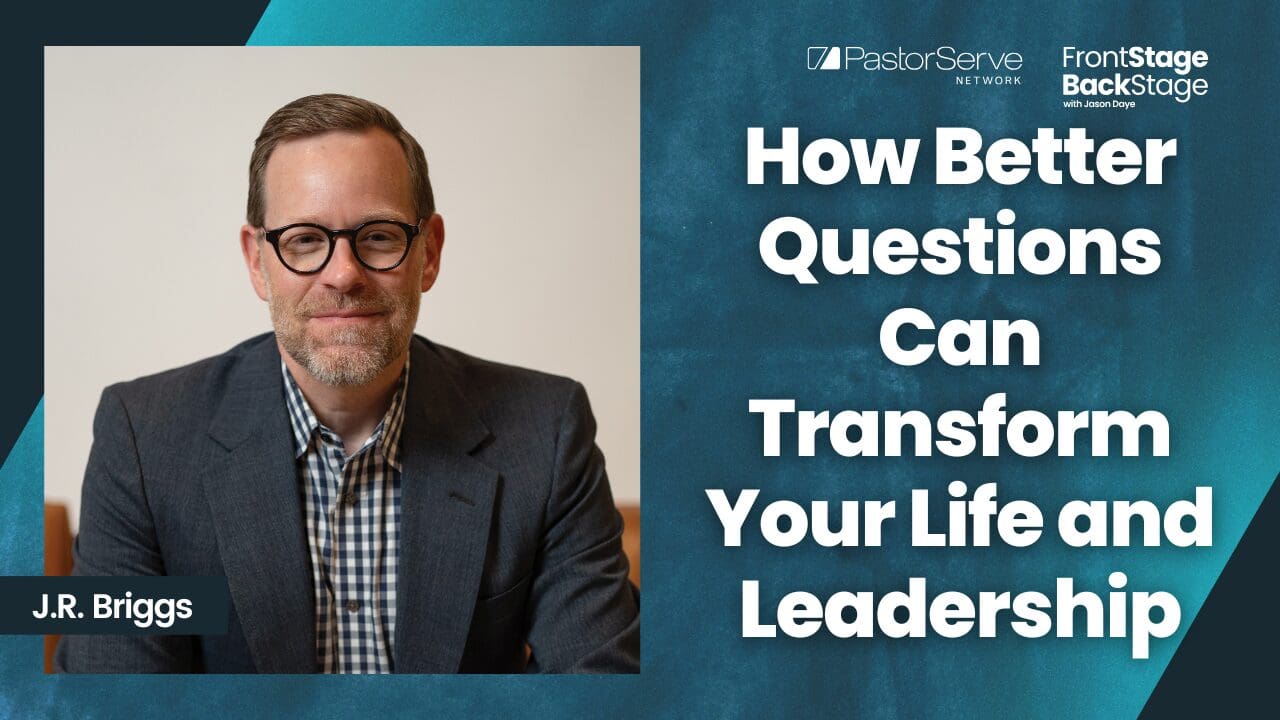
Learning to ask better questions can deepen your relationships, strengthen your leadership, and draw you closer to God. Discover how curiosity and humility can transform the way you lead and live.
What happens when we learn to ask better questions? How might that shape our leadership, our relationships, and even our walk with God?
In this episode of FrontStage BackStage, host Jason Daye sits down with J.R. Briggs, founder of Kairos Partnerships and author of The Art of Asking Better Questions, to explore how thoughtful questions lead to healthier leaders and more authentic relationships.
Together, they discuss the spiritual and relational impact of asking great questions that open space for growth, curiosity, and deeper connection. Looking at how God used questions in the Old Testament and how Jesus made them central to His teaching in the Gospels, J.R. and Jason reflect on how thoughtful questions invite genuine conversation rather than one-sided proclamation.
They explore:
- Why asking better questions helps people become healthier, more self-aware leaders
- How Jesus used questions to teach, connect, and transform lives
- The power of conversation over proclamation in ministry and relationships
- How better questions lead to deeper relationships
- Practical ways to grow as a better asker of questions
- How curiosity, humility, and attentiveness form the heart of healthy leadership
This conversation invites viewers and listeners to embrace the art of asking better questions, cultivating curiosity, investing intentionally in others, and discovering how.
Looking to dig more deeply into this topic and conversation? Every week, we go the extra mile and create a free toolkit so you and your ministry team can dive deeper into the topic that is discussed. Find your Weekly Toolkit below… Love well, Live well, Lead well!
Connect with this week’s Guest, J.R. Briggs
Weekly Toolkit
Additional Resources
www.kairospartnerships.org – Visit J.R.’s website for more about his ministry, his books, his services, and tools that will support and deepen your relationship with God.
The Art of Asking Better Questions: Pursuing Stronger Relationships, Healthier Leadership, and Deeper Faith – In his book, J. R. offers a thoughtful exploration of how intentional, well-crafted questions can transform relationships, leadership, and spiritual growth. Guided by the wisdom of Jesus as the ultimate question-asker, this book introduces four levels of questions designed to address different purposes and provide practical tools to improve your conversations.
www.freshexpressions.com – We partner with churches and faithful risk-takers to unleash new forms of Christian community in the wild and wonderful spaces of everyday life.
Ministry Leaders Growth Guide
Digging deeper into this week’s conversation
Key Insights & Concepts
- The most interesting and wise people in the world are marked not by their eloquence or knowledge, but by their capacity to ask great questions that point attention outward toward others rather than themselves.
- Jesus, as the Way, the Truth, and the Life, asked over 300 questions in the gospels, and is 40 times more likely to respond with a question than an answer, revealing a teaching methodology that provokes thought rather than merely dispenses information.
- Ministry thrives on trust and connection, which are cultivated not primarily through proclamation but through the relational currency of thoughtful questions that demonstrate genuine care.
- The distinction between questioning and question-asking is critical; asking questions deepens our knowledge of God and Scripture without undermining their validity or authority.
- Jesus’s ministry was wildly inefficient but massively effective, challenging the modern conflation of efficiency with effectiveness and inviting leaders to embrace short-term slowness for long-term fruitfulness.
- Wisdom opens and closes like an aperture, enabling leaders to zoom out and ask what matters eternally while also zooming in to discern what demands attention today.
- Pastors experience both personal and professional loneliness, making it essential to cultivate relationships with people who don’t need us—spaces where we can be known, seen, and held accountable.
- The brilliance of Jesus as a question-asker extends beyond what he asked to encompass how, where, when, and with whom he asked, demonstrating a deftness that demands our careful study.
- Jesus employed three types of field trips in his teaching—literal journeys into real-world settings, emotional journeys through stories, and mental journeys through provocative questions—a model that challenges contemporary preaching methods.
- Many pastors inhabit question deserts, perpetually expected to ask questions of others while rarely experiencing the dignity of being asked meaningful questions themselves.
- Seminary curricula emphasize homiletics but rarely include training in asking better questions, revealing a significant gap in equipping leaders for the relational dimensions of ministry.
- The practice of havruta, asking 100 questions about a Scripture passage without providing answers, pushes us deeper into the text and cultivates curiosity that transforms how we engage with God’s Word.
- One of the highest compliments a pastor can receive is being told they listen well, a skill most powerfully demonstrated through asking genuine questions and attentively receiving responses.
- God, who knows everything, still chooses to ask us questions not for information but for relationship, demonstrating that we are immensely valued and pursued by the Creator of the universe.
- Operating from our belovedness rather than our productivity requires letting the truth of God’s pursuit flow through our whole lives, not just residing in our theological knowledge.
Questions For Reflection
- When I reflect on my upbringing and early influences, who modeled the art of asking questions for me? How has that shaped the leader I’ve become today?
- Am I more comfortable being seen as intelligent and knowledgeable, dispensing facts and truths, or am I willing to embrace the vulnerability that comes with asking genuine questions of others? What does this say about me?
- In what areas of my life and ministry am I prioritizing efficiency over effectiveness? What would it look like for me to embrace Jesus’s “wildly inefficient but massively effective” approach?
- Do I find myself living in a “question desert” where I’m always asking questions of others but rarely experience someone asking meaningful questions of me? Who in my life truly asks about me?
- When was the last time I asked God to make me a better question-asker? What might change in my relationships if I prayed this regularly?
- How often do I approach Scripture with curiosity and questions rather than immediately seeking answers? What might I discover if I sat with 100 questions about a single passage?
- What is my honest motive when I teach or preach? Am I seeking to connect people with God, or am I also trying to impress them with my knowledge and seminary education? How can I process my desire for acceptance in a healthy way?
- Where am I finding my identity? In what I produce for God’s kingdom, or in simply being God’s beloved child? How does this distinction show up in my daily ministry?
- Am I cultivating a “with-God life” through reflective questions like “What in me are you celebrating?” and “What in me are you mourning?” or am I too busy facilitating others’ experiences with God? What will it take to shift this focus?
- How would the five people I spend the most time with rate my question-asking ability on a scale of 1 to 10? Am I brave enough to actually ask them?
- In our ministry, do we give our people permission to ask questions, or have we created environments where they feel they must simply receive our answers and teachings? What changes might we need to make in this area as a ministry?
- What would change in my hospital visits, counseling sessions, and elder meetings if I approached them thinking about tennis: hitting the conversational ball back and forth, rather than running down the field with it?
- When I consider the three types of field trips Jesus used in teaching (literal, emotional through stories, and mental through questions), which am I neglecting most in my own communication? How can I better incorporate this in how I preach and teach?
- What question is God currently asking me in this season of my life? Am I courageous enough to sit with it rather than rush to an answer? How am I sitting with it? What am I experiencing?
- As I think about legacy, what does it mean for me to honor God beyond productivity and output? How might asking better questions be part of that lasting impact?
Full-Text Transcript
Jason Daye
Hello, friends, and welcome to FrontStage BackStage. I’m Jason Daye, your host. Each and every week, I have the privilege of sitting down with a trusted ministry leader, and together, we dive into a conversation to help you and pastors and ministry leaders just like you really thrive in both life and leadership. If you’re joining us on YouTube, please give us a thumbs up. Drop your name and the name of your church or ministry in the comments below. We love to get to know our audience better. We’ll be praying for you. And whether you’re joining us on YouTube or your favorite podcast platform, please be sure to subscribe and follow so you do not miss out on these great conversations. Really excited about today because I have JR Briggs joining me. JR is the founder of Kairos Partnerships. He also serves on staff of Fresh Expressions. He’s written a number of books, including his latest, entitled The Art of Asking Better Questions. JR, welcome to FrontStage BackStage.
JR Briggs
Thanks for having me, Jason. Really looking forward to this conversation.
Jason Daye
I am too. I am too. You know, it’s interesting, as I’ve been reading through your book, The Art of Asking Better Questions, one of the first questions that came to mind for me, JR, was, what for you, personally, prompted you to kind of dive into this way of exploring the idea of asking better questions?
JR Briggs
Yeah, and by the way, that’s a great question to start with, Jason. So, one of the reasons was personal, one was biblical, and one was just observational. So, on a personal side, I grew up in a home where both my parents asked great questions, and I know that’s rare. Especially my father, which is why I dedicated the book to him. I just watched, at a young age, him ask questions, not just of other people, my mom, colleagues, and people at church in the lobby between services, but even of my brother and I. And it was so meaningful to me to feel valued, seen, heard, and to have conversations. Then I would just watch him, and to see him interact with adults, and the great conversations that resulted of seeing my dad just curious and genuinely caring for people, and the richness of the conversation. I assumed that was normal until I left for college, and other people said, Wait, your dad asks you questions? My dad never asked me questions. And so I just assumed, because that was my experience, everyone had the same experience. So I’m very grateful to have a father who modeled that really well. Number one. Number two, I began to notice observationally that the most interesting people in the world, the wisest people, the people of great depth, spiritual and relational depth, were people who asked really great questions of themselves, of other people, and they didn’t want the attention on themselves. They had the arrows pointing outward toward others, not on themselves, and it just seemed their world was full of purpose and meaning, and it was so rich. Conversely, I began to notice the people whose lives seem very uninteresting, shallow, they just didn’t live beyond themselves. These were people who just didn’t ask any questions. They didn’t even think to ask questions, and they talked a lot about themselves. And, Jason, I began to just notice, observationally, the kinds of people I wanted to be around and wanted to become, versus the people I didn’t want to become or be around. The difference was the kinds of questions that they asked. So, that was observational. And the third thing was biblical. A handful of years ago, realizing, wow, as Christians, we study Jesus’s miracles, we study his parables, we study his teachings, and his conversations, but we don’t study his questions, and yet, he asked a ton of questions. So maybe we need to think about not only studying that, but learning from Jesus, our master teacher, who was the master question-asker, that we ourselves can learn to ask questions like Jesus, too. So the personal, the observational, and the biblical all coming together, made me passionate about this topic, and it’s been a topic I’ve studied for the last 10 years.
Jason Daye
Yeah, wow. That’s fascinating. I love that response to see how those different elements in your life have come together, have prompted you to lean into this idea of learning to ask better questions, and how that impacts us. It’s interesting because as you talk about this idea of question asking and how that gains interest from others when you’re engaging with them. It’s fascinating, because I think of just in the realm of evangelism, over the past decade, probably, I’ve seen a massive shift from proclamation to conversation. And embedded in that is this idea of asking questions. So, JR, help us think through, when it comes to ministry, what is the value of getting more, maybe excited, or more interested in asking questions rather than what we are proclaiming? Not that proclamation is wrong, but in ministry, we’re often trained to share, to tell people things. So, talk to us a little bit about that.
JR Briggs
Yes, there’s a shift happening, but I want to see that shift happen even more when you think about the seminary courses, we take homiletics one, homiletics two. I don’t come across many seminary courses, and I used to teach at a seminary, where asking better questions is actually a part of the curriculum, not just a course, but not even a book, a unit, or a module on that. So, if we begin to see that, yeah, that shift is happening, we need proclamation. But here Jesus says, The Way, the Truth, and the Life. And Jesus asked over 300 questions in the gospels alone, one in the book of Acts. And you see the amount of life change that happens through his questions, we begin to say, if Jesus valued them, and he is the all-knowing second member of the Trinity, maybe we, as fallible, limited human beings, can learn some things, too. But also think about how ministry, so much a ministry, is about trust and connection. We, obviously, want people to connect with God, but before they trust God, they need to trust us, or other Christians who trust God. How do we do that by connection? How do we do that through trust? How is trust developed, oftentimes, through relationship? Which what greases the skids of every good, healthy relationship are questions. So there are lots of misnomers and obstacles that exist in our world as to why we don’t ask better questions. But I think ministry has to be there. I mean, that’s not just evangelism, Jason. Discipleship, our preaching, could be pastoral counseling, hospital visitation, resolution, or meeting with our elders. I mean, there are so many ways in which we can grow. In fact, I can’t think of a single area, not just in ministry, but in our lives, where improving our questions won’t enhance or improve the connection and trust we have with other people.
Jason Daye
Yeah, absolutely. And, JR, as I was reading through The Art of Asking Better Questions, I was thinking of just what you said there. All the different aspects of my life, all the different relationships, all the different places that I find myself, and how what you just said, the idea of improving the way that we ask questions makes relationships deeper, helps us have healthier leadership, as we are leading, however we’re leading, whether it’s in the home or in the marketplace. Obviously, pastors and ministry leaders here. So, this idea of asking better questions. There’s one point that you make in the book about the difference between asking questions and questioning people, and I thought that was very, very important, and I’d love for you to unpack that for us, JR.
JR Briggs
Certainly, yes. That distinction is really important, especially as leaders of faith, because what I am not suggesting is that we be people who are doubters. That we’re questioning our faith, questioning scripture, or questioning people’s motives. That distinction between questioning and question asking is important. And there are other books written on that. That’s not something I really want to unpack in terms of questioning faith or questioning existence. There are philosophers and theologians that can delve into that. But of really teaching people how to ask better questions, that distinction is important. So, oftentimes, I teach people that you can engage with scripture deeper by asking questions, and they immediately go, Are you questioning the validity of Scripture? And I go, No, no, no, not at all. We ask questions as a way of knowing the text and ultimately knowing God more deeply, not as a way of questioning its validity, but of going, Why is that there? I wonder if I were in the story, I wonder if I would be feeling this way. So there are lots of ways we can engage with others and with Scripture and with God in ways that we aren’t questioning God’s existence, but we might be questioning, where is God? Like we read about in the Psalms. So many of the psalms of lament, where are you, God? I thought you cared. I mean, those are rated R prayers. And yet, instead of God saying, Yeah, that guy was a fool. He said that guy, David, was a man after my own heart, which shows us that we have permission to actually ask even rated R questions of the God of the universe. He can handle those. He’s a big boy.
Jason Daye
Yeah. I love that. And I love the idea of thinking through. Oftentimes, when we are talking about a topic like this, of asking better questions, we’re thinking about this idea of, okay, relationally, as a pastor in the church, how do I ask better questions of my team, to help my team function better, help us grow, and help us be more effective in ministry. Or we’re thinking about our relationships with our kids, our spouse, or whatever it might be, which are all very, very important. But, one of the things that I love that you kind of highlighted was, yes, you go into great detail on the relational asking of questions, but kind of like you were touching on, I was thinking of like St. Augustine’s soliloquies, where he digs deeply, and he actually has this conversation between himself and reason, right? You know, spiritual reason, and digs deeply into his own spiritual formation, right? And it seems that I don’t want to say that. Oh, maybe I will say, it seems that that’s kind of lacking sometimes, whenever we think about what it means to be not only a devout and devoted follower of Jesus, but a ministry leader, or a pastor. Are we wrestling deeply with these questions? So, JR, how do we think about asking good questions about those deeper spiritual formation things in our own lives, and invite others to do the same?
JR Briggs
Yeah, well, I think the first thing is to know that there’s a capital P permission that is extended to us. I think there are a lot of us who maybe grew up with an unvoiced but strong theology taught in our churches that says, Well, you can’t ask questions. That’s not important. You can’t do that. Or if you ask questions, you might be revealing too much of yourself. And so the church should be a place where we should be able to safely ask questions of each other, encourage one another to ask appropriate questions of each other with the right motive, but we do swim in a culture that pushes against that. We live in an attention-seeking age. So, I think that’s one of the things. But I think we also are often afraid of what we might learn. I think if we ask questions of like, Why am I so angry, or What’s behind this, or Why have I been so joyless as a pastor the last few years? I think sometimes we’re afraid of what might happen if we actually learn the answer to the questions we’re asking. So, it’s just easier to distract ourselves, stay busy, or to do other things. It’s also inefficient, if I can say that. And in a world where ministry feels overwhelming and there are so many things pulling at us, we don’t often have time to sit down and process and think through questions like this. But, and I’ll say something that might seem heretical, but I’ll stand by it, that Jesus’s ministry was wildly inefficient, but he was massively effective. And I think we sometimes conflate the terms between efficiency and effectiveness, and so we think it’ll make us ineffective if we slow down to ask better or the right questions, the best questions. But if we slow down and are “short-term inefficient” in asking the right questions, it can be massively effective. And I don’t just mean effective of productive and making great progress. It can be fruitful, but I think it’s also incredibly healthy to just make sure we’re cultivating a with-God life and the richness that exists there, that then we have ministry out of the overflow of what we do, not just rushing off to the next thing and being frenetic and frantic like we often are in ministry.
Jason Daye
Yeah, absolutely. And I’d like to lean in a bit on that healthier aspect for those serving in ministry leadership, serving as pastors and local churches. Oftentimes, we feel like there’s more that needs to be accomplished than we can possibly accomplish. There’s a sense of urgency. And I think there’s a healthy sense of urgency when we’re thinking about, hey, we’re dealing with eternal questions, right? So, we can often let that push us into a place where we aren’t slowing down to dig a bit more deeply into our own relationship with Christ, our own makeup, and where we are. JR, how does asking better questions help us practically when it comes to being healthy ministry leaders?
JR Briggs
Yeah, the first word that comes to mind is wisdom, right? We’re told to pursue wisdom above all else, as the Proverbs say. That it’ll cost you all that you have. Purchase it. Possess it. And I think that wisdom is the aperture that opens up and closes. Aperture that opens up to be able to pull out and say, What matters most? Is this going to matter in 10 months, 10 years, for eternity? And also to zoom in and say, What should I be doing with my time today? And so that wisdom to know that aperture, or maybe, is it telescope, or is it microscope, to get really granular, or when to pull back. So, that’s the first one. The second one is our focus on where. There are too many priorities and not enough time. And so, how in the world are we to know where and how to spend our time? And the third is cultivating that with-God life, to say, God, what’s the invitation you have for me today? Jesus, what are we going to do together today? God, what in me are you celebrating now that I need to embrace? What in me are you mourning that I need to confess? I mean, these are fantastic questions that can really cultivate that with-God life even further. That we don’t just have all the right answers in our head, but it runs wild through our bloodstream in what we’re doing. And there are practices you can engage in, but those reflective questions, not just with ourselves or just with us and God, but even in community with other people and other pastors. That’s harder because relationships for pastors become a little bit more complex, as Henri Nouwen says, There are two types of loneliness. Pastors feel personal loneliness and professional loneliness, and we need people who don’t need us. So, if we can be in those spaces where people don’t need us and we can share openly and honestly around some of these questions, to be known, to be seen, to be held accountable, and to be encouraged and celebrated. That can be a beautiful, beautiful space where we live lives that we aren’t just allowing other people to have that experience with God, and we’re the facilitators of that. That we actually can be in on this God-life, too.
Jason Daye
Yeah, I love that. Absolutely love that. JR, I’m curious, as you have been spending the last decade of your life kind of exploring, doing deep dives into this idea of asking better questions, and even more recently, as you’ve been putting pen to paper and writing the actual book The Art of Asking Better Questions, has there been anything that has surprised you as you’ve been going through this process about question asking, right?
JR Briggs
Yes. I’m going to say this, and I think most pastors listening would nod their heads in agreement. But the more I study this, Jason, the more I realize just how brilliant Jesus is as a question-asker, not just what he asked but how he asked it, where he asked it, with whom he asked it, and when he asked it. I mean, if you look at that, so the process, and I did my Doctorate of Ministry work on equipping leaders to ask better questions. And so I studied all the questions of Jesus and asked, Who did he ask? Where did he ask? Why did he ask? Who else was there? And what was the impact that happened afterwards? And I began to realize, how did I miss this? It’s staring at us right in the face, the number of times. And if you look at the number of times that Jesus asks a question versus gives an answer. He was 40 times, 4-0, 40 times more likely to respond to someone with a question than he was with an answer. Now, here’s the Way, the Truth, and the Life respond with 40 times more. So it’s, I think, some of the amazing statistics that exist there. So, that’s the first thing that really surprised me. The second thing is realizing, sort of stepping back from Jesus’s teaching style, that he took all of his listeners on three field trips. He took them on literal field trips, teaching them in real-world settings, peripatetic ministry. He says, Look at the birds of the air. Look at the lilies of the field. Look at that woman putting in two mites in the treasury. So it’s out in life, number one. Real, literal field trips. Number two, were emotional field trips, of course, stories and parables. And number three, mental field trips, employing questions to provoke thought. And I thought about that, and what surprised me and challenged me in my own teaching and preaching, is that I tend to do the complete opposite of that. I sit people in a room, instead of telling stories, I give them phrases, and I give them truths and nuggets that are true, but they’re not stories. And then I give people information, but I don’t often ask questions, and then I sit around and wonder, Why is no one changing? And I thought, maybe, what if we flip it and we actually taught and communicated the way Jesus actually did with the three field trips he took people on? So, those are a few things. And of course, he used rebuking questions, ordinary questions, and incisive questions. Sometimes they were absurd questions, rhetorical questions, or questions that demanded a response. And so seeing how deftly Jesus drew from the different types of questions and asked different questions of different people and different audiences. Man, I’m just enamored, but I still am, Jason. I’ll never get to the bottom of it fully, but it’s the brilliance of Jesus as a question-asker that has surprised me more than anything else.
Jason Daye
Hey, friends, just a quick reminder that we provide a free toolkit that complements today’s conversation. You can find this for this episode and every episode at PastorServe.org/network. In the toolkit, you’ll find a number of resources, including our Ministry Leaders Growth Guide. This growth guide includes insights pulled from today’s conversation as well as reflection questions, so you and the ministry team at your local church can dig more deeply into this topic and see how it relates to your specific ministry context. Again, you can find it at PastorServe.org/network.
Jason Daye
Yeah, I love that. Absolutely love that. What an amazing example he has left for us. And interesting enough, that aspect, how we miss it so often, as you said. Rather than trying to model what he shared with us, we end up doing things in different ways. So, it begs the question, speaking of questions, JR, how do we practically engage as pastors and ministry leaders when we’re thinking of how we communicate the truths of Christ? I mean, even thinking about preaching sermons and teaching, how do we practically begin to bring questions, as Christ did, more into the way that we teach and preach?
JR Briggs
Yeah, I think the first one is an awareness of how often are we or are we not asking questions. What are our assumptions, or maybe our reservations or obstacles that keep us from asking questions? So, I think, we can’t change something unless we’re aware of something. So, I think that’s the first thing is, why do we have a propensity to do that? If I’m honest, Jason, there are times when I don’t want to ask questions because I want people to think that I’m intelligent, that I want to use my seminary education, or that I want to impress people. And so I think an important question for us in ministry is, what is my motive? And, of course, those are always mixed, right? We can have great motives to see people come to faith, but we also say, Yeah, but I want them to like me. I want them to think I’m funny or intelligent. So, questions, it’s harder to do some of those, and so it kills a little bit of our ego when we ask questions with the right motive. So, just being aware and even asking, What’s my motive? But, the last third of the book, I tried to get ridiculously practical on some ways that people can do that, and I think specifically is teaching people and giving our congregations permission to ask questions, too, and reminding them there’s a difference between questioning and question asking. And so, one of my favorite exercises I was taught by a Jewish rabbi when I studied at Jerusalem University College, Fall of my junior year of college. On Friday mornings, from nine to noon, I was taught by a rabbi who had a room full of evangelical Christian students for the semester over on Mount Zion in Jerusalem, and he taught us something called havruta. And havruta is where he said, I want you to just be in conversation about a passage of Scripture, but no answers. I just want you to ask questions about it. And we thought, Well, really? That’s interesting. He said, I know this is a new concept. And we looked at the story of Abraham sacrificing Isaac, and he said, Here’s your assignment for the next week. I want you to write down you to write down 100 questions that you have about the passage. And I went, 100? I could think of maybe six. And he said, I know this is going to be tough, but I want you to ask other people with you, and then you can share your answers. You’re not cheating. I want you to participate together and then bring them back. So literally, he said, I want you to put your name at the top, list 100 questions, no answers. That’s it. And it really pushed us. But it was a fascinating thing because we began to ask questions like, So, how old was Isaac when this happened? I was assuming he was like the squirrely third grader. Come to find out he’s a middle-aged man. So, then you go, ooh, why didn’t he overpower his dad? Or what did the servants who were carrying the supplies think? Or why, after that story, there’s no recorded interaction between Sarah and Abraham? How did that impact their marriage? So, all of a sudden, we’re being pushed into Scripture to ask things we never would ask if we had answers. And again, it’s not to doubt the text. It’s to simply dig into it more. So I think giving permission to your congregation is one thing. Another way of doing that. Even preaching to say, what are the 10 questions that I have about the text? What would 10 questions be of a Christian who is cynical or skeptical, and what would someone who is not a follower of Jesus have about this text if they have never read this text before and showed up to church on Sunday? I think that enhances our preaching tremendously. But I think one of the last things, I think one of the best compliments that someone can give to us, Jason, as a pastor, is to say you listen very well, and one of the ways you listen is by asking me questions and then listening to my response. And I just think that the idea of the ministry of presence comes out, not in our words and statements, as brilliant as that might be. I think more often they come out in being with people. I remember when I had knee surgery when I was 10 years old, and Tom Darnell, one of the pastors at our church, showed up at six o’clock in the morning. And I thought, Wow, a pastor showed up for me at 10 years old. I don’t remember a single thing he said. He prayed for us, and he read a scripture. I don’t remember any of that, but I remember Tom showed up, and I remember pastor Tom asked me a question, and that has stuck with me all these years later. It was just simply his presence. He listened, and he gave me a full-bodied yes in that process. And so that’s where I think that we can unlock the power of questions because it really allows for connection, new opportunities, and new ways of engaging with God and others.
Jason Daye
Yeah, that’s good. JR, let’s say some of us in ministry, we’re accustomed to talking. We’ve been trained and nurtured into people who speak and talk. Let’s say we struggle. We realize, as we’re listening to this conversation, as we’re reflecting on our lives, let’s say we struggle with asking questions. We struggle with listening. What are some practical things that we can do to help improve how we sit in this or our posture in this?
JR Briggs
Part of the awareness, Jason, is inviting other people around us to see things that maybe we don’t see. And so we may think, I’m a pretty good question-asker, but if you ask the five people that you spend the most time with in ministry, or maybe it’s your spouse, or others on your staff, to say, I need you all to be honest with me. But on a scale of 1 to 10, 1 is I don’t ask any questions, and I’m really bad at them. 5 is okay. 10 is great. What number would you give? And to really look for themes and patterns on that, and then to say, Okay, if I were to say it was a 5 out of 10, if I were to improve to be a 7 or 8 out of 10, what would have to happen? What would I need to do or stop doing? And so I’m a feedback junkie, and I think one of the best ways we grow is to have honest feedback loops and to simply ask people around us, How do you think I’m doing? Number one. Number two is to help us think in terms of tennis or pickleball. Oftentimes, we think we just need to take the ball and run down the field. And so instead of thinking about football, I want us to think about pickleball or tennis. The best conversations are what you and I are doing, and that’s where we’re hitting the ball back and forth over the net to each other, right? Those sorts of conversations are the best. And so just being aware of that. The third thing is to challenge yourself. What if the first thing out of my mouth isn’t a statement? Can I challenge myself to ask one or two, or three questions before I actually give an opinion or response that ends with a period? So I try to gamify it to say, in a conversation without them knowing, can I respond with a question more often than with a period? Or can I ask them an important question that they come back to me and go, Ooh, I never thought about that before. Or that’s a great question. And to just gamify that a little bit. You’re not telling them that you’re playing this game, but you’re just allowing yourself the chance to be aware and just stretch your question muscles just a little bit. So the awareness and feedback are the big things. And this is going to sound overly spiritual, but it’s so rare I have to say it. It’s actually regularly asking God to make you a better question-asker. It’s amazing how many people agree with that, but when I lead seminars or trainings on asking questions, I say, How many of you have ever prayed regularly that God would make you a great question-asker? Hundreds of people that I’ve been with, dozens of trainings, and I’ve had one person raise their hand. You know, ask, and it will be given to you. I think the Lord has a penchant to want to respond to a prayer like that. Lord, would you help me, not for my glory, but yours, to be a better question-asker, for the sake of the kingdom and for the sake of ministry? And, I think, those are just a few practical ways. There are others, but I’d start there for those who are interested in wanting to grow in that area.
Jason Daye
At PastorServe, we love walking alongside pastors and ministry leaders just like you. If you want to learn more about how you can qualify for a complimentary coaching session with one of our trusted ministry coaches, please visit PastorServe.org/freesession. You don’t want to miss out on this opportunity. That’s PastorServe.org/freesession.
Jason Daye
Yeah, I like that. What a challenge that is to us, each of us, to take that to God in prayer and really, really seek that. Love that, brother. So you wrote the book, right? The Art of Asking Better Questions. So, I think in the remainder of our time here, I think we’re going to flip the script a little, put me in the hot seat, and allow you to be the one who asks the questions. So, I’m putting myself at your mercy, brother. I trust you. But, yeah, let’s flip the script. I’d love to have you ask some questions.
JR Briggs
Yeah, thanks. Yeah. I would love to have you share a little bit more. I know you’ve been doing this podcast for a little bit here. I’m curious, if you’re willing to share, Jason, what are one or two of the best questions you’ve ever been asked?
Jason Daye
Yeah, that’s a great question. That will rank right up there. Maybe not one or two, maybe three. That might be the third-best question, JR, I’ve ever been asked. I would say just on a very kind of gut level, maybe heart level, is a simple question. But really, the question of how do you really feel about XYZ, whatever we’re talking about? Because that, for me, seems to one, slows the conversation down, and it makes me think that the person on the other side is really interested in, not just the quick response, but the deeper response. Really, how do I really feel about that? That’s been a powerful question. Of course, that’s happened in a number of different topics, or number of different ways. So, I’d say that’s probably one that comes to mind first. Another question that I appreciate, I should say. And again, this goes to, I asked a lot of questions in my role, obviously, as you can imagine. But, it’s always interesting whenever, and this happens a lot before we hit record when I’m talking with a guest, is they just sincerely ask about me. Them just taking a moment to say, Hey, tell me a little bit more about XYZ. Tell me a little bit more about now, where do you live again? How long have you been doing this? Or, you know, hey. It’s just that interest level takes me to a whole different place, honestly. And I would love to say it happens with every guest. No shade on any guests because lots of people are busy and they’re in back-to-back meetings, recordings, or whatever. But just when there is that little bit of, hey, you know, checking in on me, I so appreciate that.
JR Briggs
Yeah, thanks for sharing that, Jason, and I’m not sure if you feel this, but a lot of the pastors that I work with, and our organization works with, are in what I’d call question deserts. And what I mean by that is that they’re always the ones either asking questions or expected to ask the questions. But, if they’re really honest, deep down, they’re saying, You know what, nobody asks me questions, it hurts and it’s lonely, and they long for that. So, I think maybe this is a little bit more vulnerable than I was intending. But, I’m curious, do you feel like that is a ministry reality for you, and/or who are the ones that ask you questions regularly that make you feel seen, heard, and valued?
Jason Daye
Yeah, that is a great question, once again. I would say it is interesting. You know, the podcasting is just one sliver of the work that I do, obviously. So in this world, it does feel like I’m asking a lot of questions, naturally. because of the work. I’d say, stepping out of this in ministry, I’m blessed to have a good team at PastorServe that asks really, really great questions, and to slow down. Now, sometimes we all have to remind each other, whoa, let’s pause, and let’s ask, you know? But we’ve had some really, really sweet moments in a variety of settings where we’ve been able to be very open and vulnerable and very, just getting real. Setting aside the agenda for a moment, and saying, Hey, what are we wrestling with here? And I always appreciate that. One member on our team, Arthur Denyer. He oversees our Latin America region. He’s down in Costa Rica, and he is very gifted at asking me questions every time we meet about just Jason, personally, and life. Things that you’re wrestling with personally, separate from all the ministry stuff. We can get to all the ministry stuff. But he asks me some really, really good questions, and I really appreciate that.
JR Briggs
Yeah, that’s great. And Jason, I just want to affirm that you do ask really good questions. I know this is part of your role. You’ve asked me good questions today, and I felt incredibly valued. I’m curious, how did you get so good at asking questions? What is it you did in the past, or you currently do to cultivate a life, both a posture of asking good questions, but also the skill of it? Where did that come from? How did you get so good at it?
Jason Daye
I think I was a question-asker from a very early age. If you ask my parents or my grandparents, I was very curious. I think I have a natural sense of curiosity. I also like to learn, and I know that one of the best ways for me to learn is to ask questions of others, who, for example, you, JR, have spent a decade digging into this whole world of what it means to ask good questions, and so I can learn from you. So I think some of it is a bit innate. It comes naturally that I enjoy learning. I enjoy hearing about others’ experiences. What have they learned? What have they found? How can they pass it on? I think, to some degree, there is a bit of, I don’t know if it’s rebelliousness or this willingness, I think, to ask. I think back to even high school and college, the questions that I would ask. I remember I had this one high school teacher, for example, and she had a reputation of being a hard teacher, and people wouldn’t ask questions. And I remember even before going into that class in my junior year, me thinking, I’m not going to let that, whatever that is, keep me from asking questions. And so I did that, and people would get a little anxious, classmates would get a little anxious, and I wasn’t trying to challenge her authority or anything. I was actually trying to learn more deeply. And so there’s a bit of that, I think, streak in me, a little bit of like, hey, I want to dig a little deeper on this. I’m not going to take, necessarily, just what’s tossed out in front of me. But, yeah, I’d like to dig a little deeper. I’d like to learn a little more. What’s behind it? What’s underneath it? That’s kind of how I think.
JR Briggs
That’s great. And if I could just ask one more follow-up question to that. So, this idea of curiosity is so important. In fact, I don’t know how we ask a question without being curious. And it sounds like you are wired to learn and that you are a curious person, which is fantastic. Here’s the grand question that I’m thinking about for the last several years that I don’t know an answer to, but I’m curious for your opinion. Someone who doesn’t have, you have natural curiosity. Someone who doesn’t have natural curiosity, can you teach someone to be curious? Is it nature or nurture? I’m curious, what are your thoughts on that?
Jason Daye
That’s a good question. I haven’t given that a ton of thought. I think there is a bit of both. I think there are people who are just naturally that way, and they’re just going to run with it. I do think there’s a bit of nurture. And the reason I say that is that Monica and I are blessed. We have six kids, six amazing kids, different personalities, and all of our kids, I would say, are curious. But I would not say all of them are innately curious. I think there has been some nurture around that. That growing up in a home where there was a lot of interest in things and people pursuing different things and sharing what they’re learning about different things helped shape, I believe, some of those who maybe may not be as curious to be a little more curious. Now, they might be selectively curious. And I think we all are, to some degree, right? There are certain things that we’re really curious about. We’ll dive deep into that. And then there are other things we’re just kind of like, not so much. So, I do think that’s a little bit of both. I think there’s modeling around it. There’s a kind of invitation into curiosity. Not putting someone under the thumb, like, Hey, you need to be curious. But is curiosity something that can be caught to some degree, right? And I think there is a bit of that. I think if you’re around curious people, you become more curious.
JR Briggs
That’s great. And if I could, I’d just like to ask two last questions, and then I’ll take any direction you want. So, the quality of our lives is absolutely determined by the quality of the questions we ask God, ourselves, and others. So, I’m curious. This is Part A and Part B questions with God. Is there a question you sense God has asked you, either through scripture or a prompting or through a word from someone else? So, what is the most significant question you sense God has asked you? And then I’m also curious, what is a question you’re currently asking God in this season? And it could be through prayer, or through pain and groaning, or just curiosity. So, what has God asked you that’s been impactful? And what are you currently, is there a question or two you’re asking God in this season?
Jason Daye
Yeah, that’s good. So the first, I think one of the most significant things that God has been asking me, challenging me with, is a question around identity. And that is, and this is a question I’ve wrestled with throughout my life to some degree, but I think it’s the most significant one. It has shaped me, I think, more than maybe any other question. I, by nature, again, am kind of a driven person. When I was young and going off to college, I won’t bore you with my whole story, but very driven. Have my life all planned out. I thought that I was kind of letting God know what the plan for my life was because I thought it was a great plan, right? And God kind of intersected that in a pretty powerful way, and I wrestled with it for multiple years. And, as I said, there’s a whole story behind that. But getting to the place where God helped me see that my identity was really in knowing that I am a child of his. I’m his beloved, regardless of what I produce. We live in a culture, in a society, that’s high on production, that’s high on our output. And just really, in ministry, I think many of us wrestle with that over time, right? It’s like, we want to do our best for the Kingdom. We want to do our best for God. Sometimes we get caught up in, we say we’re doing our best for God, but really, we’re trying to do the best for us. You know, we’re trying to make sure we look good. And so this idea of resting in my true identity and God asking me, Really, where do you find your identity? Are you finding it in things you’re doing for me? Or are you finding it in me? I think that’s been the most significant question. As a question that I’m asking God, probably, and I’m not, you know, my kids are young adults now, and so I’m getting up there in age. But it’s not like I’m at death’s door. I hope not, right? So, I don’t want this to sound like, but I am thinking about legacy, which is interesting. I’m not really thinking about the dying. I’ve had this conversation with so many people. Like, I rarely think about dying. I don’t know if that’s a flaw of mine or not, but other people are like, You never think about that? Like, No, honestly, never. It never crosses my mind. But I have been asking God a lot more recently about legacy and just really, I want to honor God as best I can. And so what does that mean, beyond me and beyond, maybe a lot of things I thought it meant, to live a life that’s trying to honor God and to impact the world with the love and hope of Jesus Christ, right? Like we have a lot of things that we think about what that must mean. But really, God, what is that legacy? What does that look like, and what are you calling me into right now as a part of that legacy, that ripple effect of my little life, and how you’re using it? So, yeah, those are great questions. You do ask good questions, man. You should write a book about this because you ask great questions. Make me think really deeply. So, thank you.
JR Briggs
Thank you. Well, thank you for allowing. I appreciate those kind words, and I appreciate you allowing me to ask you questions, and for you being courageous, not just in conversation with me, but knowing there are other pastors who are listening to this. So yeah, thanks for that privilege to be able to do that. I didn’t mean to hog too much of the time, but I just loved hearing your story and your responses on that.
Jason Daye
Thanks, JR, I appreciate that. I’m going to give you now the final opportunity. You have the ears and eyes of pastors, ministry leaders, men, and women who are leading the front lines of ministry right now. JR, what words of encouragement would you like to leave with them?
JR Briggs
I think the most important thing is to remember that here’s a God who knows everything, and yet God, in the Old Testament, asked a ton of questions. Here is Jesus, the Way, the Truth, and the Life, and he asked a ton of questions. And before we learn how to do that with other people, to just pause and to remember that there’s a God who knows the answers before he even asks us questions, yet he still asks us questions, and he does that because he desires to be in relationship with us. And I just want to make sure that we don’t forget, as pastors, that we’re humans first before we’re pastors, and we’re humans immensely, madly loved by God, and one of the ways he loves us is by pursuing us, and one of the ways he pursues us is by asking us questions. And I just want us to reflect on the uniqueness and the specialness that we hold. That God who created the world, who could be doing a thousand other things, chooses to lean in with us, to get to know us, to ask us questions, even if he knows the answer, because it’s a way of drawing us. That means we have immense value. And I hope that me, you, and every other pastor who’s listening can remember that we operate out of our belovedness, out of being loved and pursued by the God of the universe, not, as you said, because of what we’ve produced, what we own, how much we make, or whatever it might be, but simply because we’re loved. And, man, we know that. We preach that. That’s in our heads, but if that can just run wild through all of our bloodstreams, and to realize that there’s a God who knows everything and still wants to pursue us through asking questions, because we are loved. That would be my encouragement. I know every pastor knows that, but it’s so important, I want to make sure we don’t forget it.
Jason Daye
Yeah, it’s a great reminder, brother. Man, this has been an incredible conversation, JR. So appreciate it. For those of you who are watching or listening along, we have our toolkit for this episode, just like we have for every episode. In that toolkit are tons of different resources to help you dig more deeply into this conversation. We’ll have links in the toolkit to JR’s newest book, The Art of Asking Better Questions. We’ll also have a number of resources, including our Ministry Leaders Growth Guide. You can find that toolkit at PastorServe.org/network. We encourage you to download it, to go through it for yourself, and with the ministry leaders in your local church or ministry. Again, really just dig more deeply into this topic of what it looks like to ask better questions. How does that make us a healthier leader? How does that deepen our relationships? So be sure to check that out at PastorServe.org/network. JR, as I said, it’s been an absolute joy. Appreciate you, brother. Thank you for making the time to join us here on FrontStage BackStage.
JR Briggs
Well, thanks. It’s been a real joy, and I appreciate your answers. Thanks for being willing to engage in the questions with me.
Jason Daye
Yeah, excellent, brother. God bless you.
Jason Daye
Here at PastorServe, we hope you’re truly finding value through these episodes of FrontStage BackStage. If so, please consider leaving a review for us on your favorite podcast platform. These reviews help other ministry leaders and pastors just like you find the show, so they can benefit as well. Also, consider sharing this episode with a colleague or other ministry friend, and don’t forget our free toolkit, which is available at PastorServe.org/network. This is Jason Daye, encouraging you to love well, live well, and lead well.
Recent Related Episodes
-

Posted On: July 3, 2023
-
Posted On: May 3, 2022
-
Posted On: November 8, 2022
Right-click, then select “Save Image As…” to download one of the social graphics.