
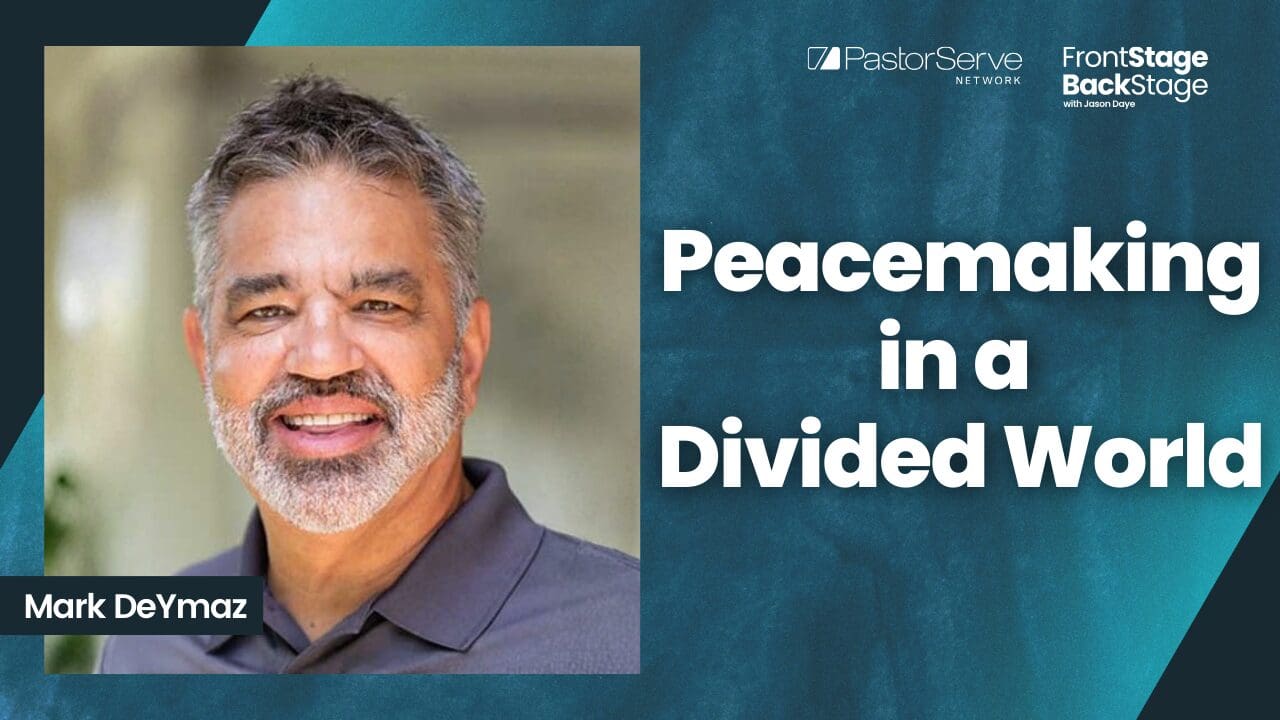
In a divided and contentious world, pastors and ministry leaders are called to lead as peacemakers. Mark DeYmaz joins Jason Daye to explore how Jesus-shaped faithfulness builds trust and witness over time.
What does it look like for pastors and ministry leaders to lead as peacemakers in a divided world while remaining faithful to who God has called them to be?
In this episode of FrontStage BackStage, host Jason Daye sits down with Mark DeYmaz, pastor, author, and longtime leader in the multiethnic church movement. Drawing from his latest book, Make Me an Instrument of Your Peace, Mark reflects on how ministry leaders can lean into peacemaking with clarity, courage, and compassion in contentious times.
Mark challenges pastors to resist the temptation to become politicians or pundits and instead remain faithful shepherds who care deeply for their people and communities. He shares why chasing likes, views, or applause can undermine trust, and why consistent and faithful obedience over time ultimately strengthens a ministry leader’s witness. Together, they explore how the Church’s credibility today is shaped less by what people say and more by what others see through faithful presence and loving action.
They discuss:
- What it means to lead as a peacemaker rather than a cultural combatant
- Why faithfulness over time builds trust in polarized contexts
- The danger of chasing visibility instead of pastoral integrity
- How Matthew 5:16 shapes Christian witness in the 21st century
- Practical and often overlooked ways pastors can lead in peacemaking
Connect with this week’s Guest, Mark DeYmaz
Weekly Toolkit
Additional Resources
MarkDeYmaz.com: Mark DeYmaz is a thought-leading author, pastor, and recognized champion of the Multiethnic Church Movement. He planted the Mosaic Church of Central Arkansas in 2001 where he continues to serve as Directional Leader. In 2004, he co-founded the Mosaix Global Network and today serves as its executive director and convener of the triennial Mosaix Conference. In 2008, he launched Vine and Village and remains active on the board of this non-profit focused on advancing the common good in Little Rock’s University District.
Make Me an Instrument of Your Peace: In today’s chaotic and polarized culture, many people quietly ask, “What difference can I make?” Instead of reacting with frustration or retreating in silence, what if you could reflect the peace of Christ in ways that ease tensions, inspire others, and encourage healthy conversations? In Make Me an Instrument of Peace, thought-leading pastor and author Mark DeYmaz challenges you to rediscover the radical power―and the deep blessings―of authentic peacemaking. Each chapter unpacks a single line of the famous prayer, commonly attributed to St. Francis of Assisi, for meaningful reflection and life application.
Find Mark at Tyndale
Connect with Mark: Alison@Mosaix.info
Ministry Leaders Growth Guide
Digging deeper into this week’s conversation
Key Insights & Concepts
- The Peace Prayer of Saint Francis is aspirational, but it does not provide specifics of how to live it out. Practically being an “instrument of God’s peace” requires pastors, ministry leaders, and churches to be responsive to their local contexts.
- Jesus met people’s empathetic needs. Part of meeting people at the bridge of Christ’s humanity involves meeting people’s real, physical, mental, and emotional needs in tangible ways.
- Advancing peace involves removing peace-disturbing factors from the lives of others.
- Theologically, the Church is called to meet people’s empathetic needs because Christians are meant to imitate Jesus as “little Christs” or “little anointed ones.” Matthew 5:16 and Isaiah 61 (paired with Luke 4) provide biblical basis.
- In the twentieth century, the Western Church often invited people to cross the bridge of Christ’s divinity through proclamation; today, many are more willing to approach the bridge of His humanity through tangible, embodied love.
- Many in today’s society have a favorable view of Jesus but often distrust Christians.
- When pastors, ministry leaders, and churches represent Christ well through tangible acts of love, their message is received with greater credibility.
- Local churches and communities are best served when pastors and ministry leaders focus on what God has uniquely called and designed them to do.
- Pastors and ministry leaders often experience pressure to comment on everything in contemporary culture, but this is not their primary role. While silence can be complicity, silence is often wisdom.
- Peace is found in the tension of walking through life, working, and worshiping God together as a diverse group of people who, though they have differences, are centered on Christ.
- Being a peacemaker requires first being at peace with God through Christ. Embracing the role and mission of being Christ’s ambassador must be rooted in personal identification and relationship with Christ.
- Listening to another person’s perspective, asking questions with genuine curiosity, pausing before speaking, and recognizing the complexities of conversation are helpful in building peace.
- Pastors and ministry leaders are encouraged to a life of faithful consistency with a longrange view.
Questions For Reflection
- What drew me personally to Christ?
- What do I find most engaging about Jesus’ humanity? What do I find most engaging about His divinity?
- How do I currently represent Christ in my actions? How are others seeing Jesus in me?
- What are the practical needs of the people in our local context (both in our church and in our community)? How could I help meet those needs? How could I encourage my church body to help meet those needs (whether those of other congregants or the surrounding community)?
- What do I believe about being a “little Christ”? What does that look like in my life?
- How am I discipling the people in our local church to represent Christ? In what ways does our church practically demonstrate the love, care, and peace of Christ to our community?
- Am I engaged with a diverse group of people? Who in my life do I disagree with on secondary issues but find unity with in Christ?
- Do I encourage diversity within our local church body? How am I helping those in our church experience peace, first with Christ and then with others?
- Practically speaking, what can peacemaking look like in my relationships? In our local church? In our community? What steps are needed to embody this peacemaking?
- How do I personally remain centered on Christ?
- How can I be aware of and shift appropriately with my current cultural context while also remaining steadfast in the unchanging truth of God?
- How can I help those in my local church remain centered on Christ? How am I encouraging my church body toward long obedience in the same direction?
- To what degree am I motivated by fear? How can I allow God to speak into this?
- How am I helping our local church body understand our identification as children of God and ambassadors of Christ? How am I helping our church body understand our role as the hands and feet of Jesus? What is needed to move our people from understanding to living as peacemakers?
Full-Text Transcript
Jason Daye 0:00
Hello friends. Welcome to another engaging episode of FrontStage, backstage. I’m your host, Jason Daye. Each episode, I have the privilege of sitting down with a trusted ministry leader, and together we tackle a topic to help you and pastors and ministry leaders just like you really thrive in both life and leadership. If you’re joining us on YouTube, please give us a thumbs up; and wherever you are joining us from, be sure to subscribe or follow so you do not miss out on any of these engaging conversations. I’m excited this week because I am joined by Mark DeYmaz. Mark is an author, a pastor. He is really a champion of the multiethnic church movement. He planted Mosaic Church in central Arkansas. It’s a thriving church that’s doing incredible ministry and community there. He’s also the cofounder of the Mosaix Global Network, and his most recent book is entitled, Make Me an Instrument of Your Peace. Mark, welcome to the show.
Mark DeYmaz 1:02
Hey, Jason, good to see you again. Thanks so much for having me.
Jason Daye 1:04
Yeah, brothers, always good to see you. I’ve got to tell you. And for those that watch the show or listen to it regularly, they know that I’m not I’m not trying to sell anything or pitch anything, but I have to tell you, brother, when I got my hands on your newest book, Make Me an Instrument of Your Peace, I was moved. Honestly. It was, it was powerful; it’s powerful. It’s so timely. And it’s just crazy how God works because we know a book doesn’t just pop up overnight, but to think about everything that we’re facing right now in our world, in our country, this book just resonated with my heart. And again, I don’t get any kickbacks. You didn’t ask me to pitch this. I’m not making a commercial, but this is one of those books that really touches on what we are wrestling with right now. And so Mark, I want to start with asking, how? Well, first, thank you for your faithfulness and your obedience to God in putting pen to paper for this. But how did this come about? What was stirring in your heart that led you to really this, this book Make Me an Instrument of your Peace?
Mark DeYmaz 2:17
Yeah, well, Jason, first, let me say thank you so much for that affirmation, and yeah, I didn’t pay you anything to say that. It means a lot to me, though, coming from you. I’ve known you a long time in Outreach Magazine, and I still write a column for Outreach. But it really does mean a lot, and it gives me encouragement because this is really the first book that I’ve written for really anybody–people in the pews, so to speak. Every book I’ve written prior to is really aimed at the upper echelons of the American church leadership, but this one is meant to be accessible to anyone. And so that really encourages me since it’s my first foray into trying to make it more accessible to people in the pew, so to speak, as well as leaders across the board. Yeah, I grew up Jesuit Catholic, and I was Catholic educated, Jesuit High School, altar boy–the works. And I was very familiar with this prayer growing up. We recited it, we sang it. It was just a part of our normal formation, I should say, as part of the Catholic Church. And when I then, at 19 years old, as a sophomore in college, began attending Protestant church, nondenominational church, where my faith really got more ramped up, it was like gas poured on my faith in Christ and and I began to grow from there. I have realized now in my 43rd year of fulltime ministry, that rarely in Evangelical churches, nondenominational, many even of the Protestant mainline churches are unfamiliar or do not often recite this prayer. They might know it, but it’s not a part of the rhythm of the life of the church, as it was in my formative years as a Jesuit Catholic. So all to say, fast forward now: in 2022, 2023, coming out of the pandemic, here in our own church, we we have had … Since 2001 we planted a church, a very outward facing church. We are heavily involved and engaged at meeting people at the Bridge of Christ’s Humanity: their real, their physical, their mental, their medical, emotional, empathetic needs. And So collectively as a church we’re very engaged in the work of peacemaking, if you will, representing Christ well in our community, being his hands and feet. But after the pandemic, of course, our church constituency changed. I mean, we had many people, you know, most people remained with us through that time, but there were many new people post pandemic that began coming into our church. We just weren’t really sure where they were. They’re coming from different backgrounds. Some are some that are not even Christians, they’re not saved. But all to say that in part of our own formation of our own church, in the first three years coming out of the pandemic, we’re still really in it, we just said, let’s just teach and focus on Jesus. No fancy series, none of that. Let’s just teach Jesus to ground our church in who he is and how he lived. And so this series, it came up in 2023. We have a teaching team of four people, so I suggested, let’s walk our way through this prayer, the prayer called the Peace Prayer, the Prayer of St Francis, and take it line by line, because the person who prays the prayer, who wrote the prayer–by the way, it’s an anonymous author; it was erroneously attributed to St Francis in the middle of the 20th Century, but no one really knows who wrote it. It was written, published in a French publication around 1910 or so. But all to say that that prayer, the person who wrote the prayer, it’s an aspirational prayer, but it doesn’t tell you how to live it out. So for instance, it says, “make me an instrument of your peace; where there’s hatred, let me sow love; where there is injury, pardon.” But it doesn’t tell you how to sow love in the midst of hatred, or how to express pardon after offense or injury, and that’s really what we wanted to address with our own church as part of our collective formation. And at the end of all that, we’re basically like, hey, everyone in our church, we know collectively, we are a peacemaking church. We are heavily engaged in advancing faith, hope, peace, love, pardon, all of those things as a church. But I looked at our folks and said, but I don’t know that that’s true for you as an individual, and you don’t really know if it’s true for me as an individual outside of this place. Let’s make sure that not only collectively as a church, we are practicing and walking in the steps of Jesus (Matthew 5:9, being a peacemaker), but let’s beef up and strengthen our own work and embrace that posture as individual peacemakers. So that’s where it came from, from my my history in Catholicism to modern times, and building this into our church. And then we recognize, man, this is a message as you noted, Jason, timely for the moment, probably needs to get outside our own church walls. And that led to NavPress graciously picking up the manuscript and now becoming a book.
Jason Daye 7:10
Yeah, I love that. And when we think this idea of peacemaking, I mean, it’s easy to look at it, you know, Sermon on the Mount what Jesus has to say about it. It’s easy for us to talk about this idea. It’s easy for us to pray, in some ways, the prayer of St Francis, this Peace Prayer. But the dirty work, right, of actually making peace is a challenge, and especially when we live in a time that there’s so much divisiveness, so much othering of other people. You know, the pushing people aside, people really want to, want to win, and point out that there is a loser. I mean, that’s kind of the the context that we live in right now. How do we lean into this idea of peacemaking in our local churches? What does that even look like? Where do we even begin when it comes to not only preaching and teaching, but really embodying this idea of of making peace?
Mark DeYmaz 8:07
Yeah, I’m a big believer in Simon Sinek, why, how, and what, right. So I always start with the why. The why is theological, right, and on two fronts. One is theological, one is sociological. So this Peace Prayer is rooted in Matthew Chapter Five, nine (Matthew 5:9). Christ, in all of the Beatitudes, you get something for what you do. Blessed, you know, are those who mourn, they will be comforted, or what have you. But in Matthew 5:9, it’s the only Beatitude in which you don’t get something for what you do. You are identified with someone for what you do and who you are. Blessed are the peacemakers, for they shall be identified, or called, the children of God. So there’s no closer identification to Christ that we can have as individuals than doing and following in his footsteps as a peacemaker. Now Isaiah Chapter 61 tells us about who this Anointed One would be and what he comes to do. Reading from Isaiah 61 for instance, it says he has sent me to heal the brokenhearted, to proclaim liberty to the captives and freedom to the prisoners, to proclaim the year of the Lord’s favor, to provide for those who mourn in Zion and give them a crown of beauty. And on and on it goes. It tells us about the work of this Anointed One, and what he would come to do in time, from Isaiah’s perspective, essentially to make peace. And peace, of course, there’s many things we could say about it, certainly not sitting around in your room and just being peaceful and meditation. It’s very active, as Christ was in Isaiah 61 in terms of forecast of who he would be. So it’s about, at the end of the day, it’s eliminating the peace-disturbing factors in people’s lives, and that can be from hunger, that can be from mental illness, that can be from addiction. Advancing peace is to remove peace-disturbing factors from individual lives. And again, a church can do that collectively, individuals as well. And so all to say, beginning from the why, it’s this theological understanding of who the Messiah was. Of course, Christ identifies in Luke 4 as I’m that guy. And if we’re going to identify with Christ, then we too are little anointed ones, right? That’s what it means to be a Christian. If Christ, the word, the title Christ, is the Anointed One, this Messiah. We are Christians. We are little a anointed ones, and we are to walk in the calling of the Anointed One, which is Isaiah Chapter 61. So removing peace-disturbing factors and being the hands and feet, so to speak, of Jesus in our communities, collectively as churches and individual lives of those we know and love. Sociologically, with that as a theological root, the act and work of peacemaking needs to be understood today, again, kind of in a why, to understand why we would want to advance peace. And in the 20th Century, think about it, in the 20th Century, we engaged people at what Barna Research calls the Bridge of Christ’s Divinity. In other words, we used words to describe, to explain, the gospel. We brought Billy Graham and Luis Palau to our cities, and they clearly explained the gospel with words, and people were receptive. We shared the Four Spiritual Laws, gave people More Than a Carpenter, you know, or Evidence That Demands a Verdict, in linear apologetic argument with words. People were receptive, and we won. You know, collectively, you know, I don’t know, millions. Who knows how many people came to Christ that way? But the 21st Century, the Bible says men of Issachar understood the times and knew what was right for Israel to do. Our time is very different than the 20th Century. I describe the 21st Century, Jason, as a Matthew 5:16 century. In Matthew 5:16 Jesus didn’t say, “Let them hear your good words.” He said, “Let them see your good works.” And with that as a basis, we have to understand it in our moment, in the 21st Century. It’s not enough. In fact, Barna Research shows that the vast majority of Americans have a favorable view of Jesus, but they do not trust Christians or the Church. There’s a disconnect. And what Christians generally are still trying to do, and churches are still trying to do, it’s they’re reading off a 20th Century playbook. They’re still trying to explain the gospel with words. They’re still trying to engage people at what Christ, at what Barna calls the Bridge of Christ’s Divinity. But in this century, we’ve got to back up to meet and engage people at the Bridge of His Humanity. And that, again, is meeting the empathetic needs of people in our communities, the people that we know and love. We’re feeding those who are hungry. We are helping to heal the sick. How do you do that? You engage in partnerships with medical clinics that come into your building and provide primary care, as we do here in Little Rock. It’s working with at risk kids and the immigrant. Literally right now, as we’re talking Jason, our Hope Center is open. That’s a place we engage opioid addicts, providing showers, laundry, hot meals on a weekly basis. We’re trying to scale that to five days a week and acquire a building next door to us to do that. But I don’t know. You know, there’s 60, 70, 80 people a day, and the vast majority, I can almost say 100% of them, are, we’re engaging them at the opioid nexus, loving them well, providing them clean clothes, showers, laundry, hot meals, and giving them a place to remove peace-disturbing factors in their life for a short time as they subsist on the streets, literally living and dying adjacent to our property. So when we understand the theology of peacemaking, and we reflect on the sociological moment that words do not cut it, we have to demonstrate–represent Christ well–to people at the Bridge of Christ’s Humanity, this will earn us the right, as Young Life said back in the 1950s and 60s, to be heard. And our hope, of course, is by engaging folks at the Bridge of Christ’s Humanity, it will earn us the trust, the credibility, the respect, the opportunity to gently guide. As we help to remove peace-disturbing factors in the lives of others, it will help them find a clear mind, heart, and be receptive, if you will, to the words we would use to lead them across the Bridge of Christ’s Divinity.
Jason Daye 14:21
Hey friends, just a quick reminder that we provide a free toolkit that complements today’s conversation. You can find this for this episode, and every episode, at PastorServe.org/network. In the toolkit, you’ll find a number of resources, including our ministry leaders growth guide. This growth guide includes insights pulled from today’s conversation, as well as reflection questions, so you and the ministry team at your local church can dig more deeply into this topic and see how it relates to your specific ministry context. Again, you can find it at PastorServe.org/network.
Jason Daye 14:59
Yeah, I love that, brother. I love the divinity in humanity. You know, fully divine, fully human, you know, embodiment of Christ and how that impacts the way we minister, the way that we serve. As you were sharing there about the statistics, and most of us in ministry have seen the statistics … and some people are shocked when they when they recognize that people are interested in Jesus and the teachings of Jesus, they just are skeptical of many who claim to follow those teachings, but what they see doesn’t seem to match up with Jesus. It, you know, goes back to, you know, Gandhi, “I like your Christ, but I don’t like your Christians. Your Christians are so unlike your Christ.” You know, Gandhi is famous for saying that, and it’s kind of the world we live in right now. This idea of letting people see our good works so that they can glorify our Father in heaven, Matthew 5:16: How do we help that come to pass when we are inundated with so many different messages? And, you know, whether it’s political, whether it’s, you know, social, these different things are pulling and tugging at the life of a pastor. And a pastor says, Mark, you know, it’s easiest for me just to kind of focus in and preach Jesus and not really get out into some of these peacemaking, you know, the how and whats of peacemaking? How do we encourage pastors and ministry leaders? How do we encourage ourselves to move beyond just maybe talking about it and into really living that out in the, you know, contentious world in which we live right now, where there’s a lot of outrage, there’s a lot of finger pointing, there’s a lot of, you know, othering. What does that look like?
Mark DeYmaz 16:58
Yeah, you know, such a great and deep question for pastors to engage. And you know, if I kind of roll the tape back, so to speak, I do believe it’s very good and important for pastors to know their calling, their gifting, to stay in their lane, so to speak. Far too many pastors, in my opinion, today have bought into the understanding or the argument that silence is complicity. Silence can be complicity. But according to Solomon, silence can also be wisdom. And according to James, silence can be moral discipline. So pastors, because of their position, we all feel a measure of responsibility to shepherd our flock, to guide our flock, to lead our flock. But the way that’s happening in the 21st is, of course, very different than the past with respect for the pastorate, for Christians, the church, institutions, we have to adjust to that. What’s going to win the day is not your comment on, you know, what’s happening politically or your opinion on this or that. That gets lost in the opinions of hundreds of thousands, millions of people. Nobody cares about your opinion in that sense, because it’s just one of hundreds. But what do you do best? Hopefully you represent Christ best. That’s your lane. You’re a shepherd. You’re a pastor. And focusing on that like Peter with blinders on in the boat, right. Not getting distracted to the left or to the right, but keeping my focus. What is it that God has called you to do? I think about for myself, for instance, you know, I wasn’t called to be a politician. If I want to get into the game of politics and make commentary and post reels on, hey, why don’t I just leave the church and just go be a politician? How about education? Whatever? No, I was called to pastor a church. And yes, you can say, Oh, well, that means this and that. But I’m saying you have to understand the times very different than times past. So the way we shepherd our flocks is a consistent, faithful walk in the way of Jesus, trying to express peace as he would–be the hands and feet as we’re, you know, talking about the book explains–and and stay in that lane, because that’s your voice. When I was a youth pastor, Jason, forever ago, in the 80s and then into the 90s, there was a day I realized, as we’re … that was way back when, we were starting to maybe put some lights on your, build a little stage and have a little band and put some lights on and you know, I’m talking about back in the 80s youth pastor. I very quickly realized I was not Michael Jackson. I mean, that was the era of Michael Jackson, and I realized I could, there is no way I could ever produce something for my students that would have the look, the feel of a Michael Jackson show. There’s just, I couldn’t do it. So it’s, what can I do? What am I good at? What am I best at? What am I, what is my passion? What is my calling? And stay, get in and stay in that lane, and because that’s how you build and find, ultimately, the fruit of long obedience in the same direction, people will trust you. They don’t need to come to church. They don’t want to hear their pastors wax eloquent on the latest political thing or conspiracy theory, whatever. They got plenty of people doing that online, and frankly, people that are probably better than you and me at that. There are things that you as a pastor, that nobody is as good as you at, there’s thoughts you have and understanding how it centered on Christ and the work of peacemaking. Stay in that lane. Here’s a very simple thing: in our church, when we started this church, Inner City Church, multiethnic by intention, in 2001, I had been a youth pastor eighteen years. Now I’m leading a church, again 50 or 60 people when we started. But nevertheless, it was, there was an election year, and I had people in the parking lot with Gore stickers, Al Gore, who ran for president, and George Bush, the junior, if you will, who ran. And I had, and for the first time in my life, eighteen years in a nondenominational church, I got Democrat and Republican people showing up to my church. I never even thought about it. I was a youth pastor, I didn’t have to think about it. So we had to think about, how are we going to handle that? And so we came up with a little line: “We don’t endorse people, politicians, parties or platforms, but we pray for everyone.” And to this day, that has been our stance. So during election season, I got a very diverse congregation, different politicians come, they typically want to be recognized, whatever. When a politician comes, they’re running for an office. We’re in a state capital here in Little Rock, we’ll say, Hey everybody, here’s Jason Daye. Hey, welcome Jason. You know Jason’s running for, you know, the Senate, or he’s running for Congress, or he’s running for county judge or whatever. And you know, we don’t support you, right, Jay? I’m sorry, right, Jason? Everybody laughs, right? But then we say, but don’t worry about it. We don’t endorse anybody, but we pray for everyone. That is a very concrete act of peacemaking. And it illustrates my point: stay in your lane. That’s what I do. They want to look to me. They want to look to this church. They want to look to our pastoral staff. They’re not coming to us for political commentary, to just continue to pour gas on these fires out there, to take a side or another. Christ died. Here’s another thing, if you’re listening pastors, to again frame kind of the why and how of your approach. Christ died with his arms outstretched–think about that–to the right and to the left. He didn’t drop the right to reach the left, and he didn’t drop the left to reach the right. He holds every one in tension. If I be lifted up, he said, I draw all people, not just some people, to myself. And that is the posture of a peacemaker. I want to position myself under the authority of Christ, walking in the shadow of his wing, a little anointed one, to do the work of Isaiah Chapter 61 on his behalf, his hands and feet, with holding people together in tension. Tension in this case, in this illustration, that’s where the unity is, that’s where the peace is found, actually in the tension, not the tension of this world, but the tension of walking and working and worshiping God together as one with diverse people who hold different opinions, different things, but staying centered on Christ, allowing space for them to share whatever they want. But for us, for our church, for me as a peacemaker, that’s the calling: to walk in the nuance of the tension of unity, which is keeping my arms outstretched for both sides. I want to reach, in terms of politics, we want to be here for the left as much as the right. My colleagues and I realized a long time ago, if you think about whether it’s politics, all these polarizing issues, people are on a scale. We’re on a continuum of zero to ten, right, whatever the issue is, you could talk about left or right, but there’s zero to ten. We realize we will never ever reach the zeros and ones, and we will never reach the nines and tens. Don’t even try. Our mission is to stay centered so that twos and threes and sevens and eights can actually hear what we are saying, can receive it, speaking on behalf of Christ, if you will, so that they move into that tension of four to six. And that’s our, that’s how we, that’s the lane we stay in, the game we play. And I encourage other pastors, particularly, and ministry leaders like know your space and stay in it, because nobody is as qualified as you to do it. And if you drift away, if you think I’m good in the pulpit, that somehow that gives me, I’m going to be good at politics and posting a reel. No, you’re not. Develop your strength and the passion of your gifting. Stay in it and become that tetherball pole, right? Did you play that game with a tetherball as a kid? Yeah, there’s this tether ball, this pole stuck in the ground. It’s fixed. It’s going nowhere. It’s cemented in the ground. And around it is a ball attached to a string, and it flies around back and forth, up, down. And if you can imagine a world right now, and the space we’re talking, Jason. We got plenty of tether balls flying all over the place, right, but very few tethered poles. Think about a lighthouse. That’s who you’re to be. That’s our mission is to be that lighthouse. Christ met empathetic needs. Christ spoke, but he acted in works, and people were drawn to him. And no matter who he engaged, no matter who he engaged, they were drawn to him, to his life, to his message, and they wanted more of him. And that is the game we should be playing, not just speaking out on every issue. Silence, again, can be complicity, but often it’s wisdom and moral discipline, and that’s what it takes for pastors to engage this game. You don’t have to be authority on everything; you want to to walk in the anointing of the Christ you serve
Jason Daye 25:51
At PastorServe, we love walking alongside of pastors and ministry leaders just like you. If you want to learn more about how you can qualify for a complimentary coaching session with one of our trusted ministry coaches, please visit PastorServe.org/freesession. You don’t want to miss out on this opportunity. That’s PastorServe.org/freesession.
Jason Daye 26:15
Yeah, Mark, absolutely love that. That’s so helpful to process. Because sometimes when we look at this idea of peacemaking, we think that means we’ve got to really be, you know, getting out there and finding out where the tension is, and then somehow making it not. Right? You know, somehow eradicating to that, that division. And yet you, through the book, Make Me an Instrument of Your Peace, and through the prayer, is this idea of how we stay centered and how we live out of that centeredness. One of the chapters in the book that just, I mean, they’re all powerful, but the idea of understanding, it’s part of the prayer. What does it mean for us to understand? And I think in our time and age, oftentimes we skip over this idea of attempting to understand others. We don’t sit there. Instead, we’re trying to, you know, tell them what we know or show them what we know or show them what’s best, as opposed to sitting back, listening, trying to understand where they are. Mark, can you help us better understand this idea, how it relates to peacemaking in our communities?
Mark DeYmaz 27:35
Yeah, before we can actually go do the work of peacemaking, peace has to be formed in us, right? And we’ve talked a bit about that. It’s centered in Christ, Matthew 5:9. We are his ambassadors. We are peacemakers. And we embrace that role of the little anointed ones, if you will, as we are Isaiah 61. So before we ever act to help try to remove peace-disturbing factors from others, we have to sit and let peace come to our lives in the form of Christ, accept our mission. I’m looking at a bookmark I made several years ago when we were doing this series here, Jason. And I actually wrote an article for Outreach called “Seven Guiding Principles for Promoting Peace Today.” And in terms of listening, of course, we know James, right? “Be quick to hear, slow to speak, slow to anger.” It is the complete opposite today. Let me think if I could do that, right? We are quick to what? To be quick to hear. So we’re quick to speak. Slow, you know; it’s the total opposite today, right? You said, right. So, of course, that’s what is. But active listening and to understand something you have to call a timeout. When I spoke of the men of Issachar who understood the times and knew what was right for Israel to do. There’s at least three things going on in that passage, right? Somebody called timeout: stop, and let’s think about things. And what did they think about? Their moment. And that recognizes their times are different than times past. And if you’re looking to times forward, that’s how you’re going to discern the best path ahead, as they did for the nation of Israel. So active listening and promoting peace in this way, to do what you’re talking about, these are just some of the principles that I’ve written and spoke about. Avoid dogmatic statements, right? This is a way to avoid those, because we make these declarative, authoritative statements. And how many people go out in front? I mean, there’s issues in our country right now, and people instantly, they watch video, they hear something, and instantly they make a dogmatic statement that supports a certain narrative. And inevitably, you know, I don’t know, anecdotally, nine out of ten times like, three weeks later, your entire narrative is going to fall apart. You don’t jump out and make dogmatic statements, right? You want to ask good questions. So like you said, instead of me … and pastors, we feel that, we’ve got to be the authority, everybody’s always asking us, what do we think; we talk, talk, talk, right? And I’m as guilty as anybody at that, but I’ve learned, and the older I get, right to ask good questions. That’s how you listen. Not just listen but ask good questions. And assume the best in others, right. Assume the best of others. I’ve always believed, Jason, that everybody is right about something. Everybody’s right about something. So if I’m a, you know, conservative theologian or conservative in politics, whatever, the left, the liberal, the progressive, they’re right about something. I may not agree with everything, but there’s something they see, there’s something they feel, there’s something they’re experiencing, and I need to be open to hearing what is it that I’m missing. And of course, you wish they would do the same on the other side. But the point is, everybody’s right about something. So I want to assume the best others, ask good questions to try to mine what that is, right, disciplining my tongue, pausing before I speak, and acknowledging complexities in every conversation, right? Because the very fact that things are polarized, just like with the Reformation, right, you know, or, just like simple things — you sprinkled or go under water, right? You know, immersion. I mean, these people have argued for centuries, and even today, we argue. The reason is, is because the issues are complex. They’re intersectional. And acknowledging these complexities, there’s no easy answers. You pull on one string, four others fall. And so we should acknowledge those and at the end of the day, whatever the discussion, always bring balance to it. Bring balance to the discussion. If somebody is saying this, gently say this, if somebody is over here. So to bring the balance, because at the end of the day, you want to help people think and speak with nuance, because that will dial down the temperature. You know, if I was king of America, I could maybe do one thing, I would help, I would just wave my magic wand, and everyone would begin to speak and think with nuance. When you hear about people dialing down the temperature, if you think about it, what does that really mean? It means that I would engage others. I would speak, I would listen, I would think with nuance. I would avoid dogmatic statements. I would believe the best in others. I would seek common ground and hold that space with others with whom I disagree, to build credibility, trust relationship that, in time, leads to others. And one other thing I’d say, Jason, think about this. People go out and they say, you know, kind of whatever’s on their mind, they say this. The very people that you ought to want to come to your side, so to speak, they can’t hear you because the way you speak, and the tone you use, and the words, you’re just playing to the choir. And we see this across the board, in the church, in politics, in our country, that people, they write something, they say something, and everybody likes and tweets or retweets or whatever it is. They heart it. But if you you said it, you told them, what. Well, it’s all the people who already think like you do.
Jason Daye 32:52
Right.
Mark DeYmaz 32:55
But the people that don’t think like you, they cancel you, they unfollow you, they don’t hear, and shouldn’t … Shouldn’t the goal, when we think about making peace and removing peace-disturbing factors. If I believe something, you know, vehemently, passionately, my goal should be to help someone who doesn’t understand or doesn’t think or believe as I do, to move them a little bit my way, right? But when you go out there and you play to the choir, and you don’t speak or think with nuance, you don’t ask good questions, you don’t believe the best in others, you just literally turn off everybody you should otherwise want to reach with your message. And you take the pats on the back in the moment, and then that fuels the fire, and the cycle repeats. So it’s not about getting more hearts or likes. It’s about faithful consistency, staying in your lane, practicing these guiding truths of principle both, and leading your churches to do that as well, and meeting people at the Bridge of Christ’s Humanity so that you can lead them to the Bridge of Christ’s Divinity, if you will. And to do all that from a posture of humility, of faithfulness, and playing the long game to ultimately see the fruit of a long obedience in the same direction. The winds shift, we know that. I’m 43 years now in fulltime ministry. I’m 64 years old, and winds shift. There’s always a dialectic. And the thing is, anybody can live in the moment, but you want to be able to posture and position yourself for the future. You can play for today or position yourself for the future, play the long game. That’s what I encourage the pastors today to advance peace in their communities and in their church.
Jason Daye 34:34
Yeah, I love that, Mark; it’s so well said. Just real practically speaking, if we could, if I’m a pastor or ministry leader watching this conversation and thinking, I know I need to introduce more of this peacemaking into the ministries of our local church, into our community. Mark, where would you recommend they begin? Or what are some practical steps, first few steps that they they could take?
Mark DeYmaz 35:08
Yeah, I mean, in a sense, I already said it, because again, before you go out to do something — what — you have to be formed inside. And one practical way to be formed inside, beyond things we’ve already talked about for a pastor, is you have to get over the fear of failure. You have to get over the fear of criticism. You have to get over the fear of losing people from your church. And you have to, we are supposed to be people of faith, not people of fear. But pastors so often, and again Jason, I’ve been in ministry 43 years. It has been my observation that there are far too many insecure pastors in leadership in the American church today, and that insecurity is driven by fear. What will people say? What will people think? Will people not like, you know, will they not like something I said? Will they leave our church, whatever? It’s all driven by faith, or fear. Where is your faith? Let faith form you. I would rather have a church of one hundred people who are committed to the cause of Christ as ambassadors of Christ, the embassy of the Church, walking in a step, peacemaking across diverse lines, multiethnic, if you will, than a thousand of all the same any day, and twice, you know, of the week and twice on Sunday. And I will show you, our impact will be greater in a community. And now, having said that, there is a very practical reason that pastors, among many reasons we don’t want to see people leave our church, and it involves money. I mean that’s the actual truth. I actually wrote a book called The Coming Revolution in Church Economics that will help, that helps pastors learn to leverage church assets to generate sustainable income for the congregation so that we are not solely dependent on tithes and offerings. And why that’s important for this conversation is because it’ll help you avoid compromise. See, because if I’m fearful of, you know, well pastor, like literally this week, there were people asking us and thinking we should make a statement on some things going on around our country. I pointed out in the life of our church, 24 years, we’ve made statements two times. Words mean nothing. The consistency of our daily engagement with the community, with the diverse people of our community, from undocumented immigrants to immigrants to the poor to opioid addicts to the wealthy, our consistent, faithful, long obedience in the same direction, that is speaking. Speaking out … One way to speak out is words. It’s a way; it is not the way. And the stronger. Remember, they used to say a picture is worth a thousand words, right? It’s true for our work as well. But again, there’s a very legitimate fear or concern that pastors have, and I want to, you know, I wrote a book to help you overcome that because I don’t want to compromise my message, so to keep a big giver in my church. I want to have multiple streams of income so that I can stay focused on Christ and the one person on the far left or the far right or whatever it is, whether it’s politics, whatever, and they come to you. And I have had this, and I’m sure pastors listening have, too. Somebody in your church has a deep pocketbook, believes in Jesus, loves you, loves the church, but they’ve come to you and they say, if you don’t do this, it’s going to ruin this church. If you don’t do this, something’s happened, and it’s a veiled threat that I’m going to leave this church if I don’t, if my experience, my personality, my preference is not matched. And when pastors give in to that, you’re just managing stagnation on your way to decline. And when I stay centered, and when I build multiethnic ministry in churches, and I have, we build the diversity in there, you have to understand it’s going to be a smaller number, but the number is potent. Christ did it with twelve, right? And I don’t need big numbers to have big impact. And I’d rather have, again, a centered group of a hundred people, diverse people, walking, working, worshiping God together as one, advancing the cause of peace, than a thousand people, all centered on one single argument. And and so again, the fear, you know, I could talk all day about this, Jason, I’ll just finish with this. Most churches in America today, in 2026, are still chasing 20th Century metrics: size over influence, expecting to be funded solely on tithes and offerings when you’ll need multiple streams of income given the economic reality of our days, homogeneity versus multiethnicity. You have to upgrade the operating system, and part of that will be getting over your own fears of when you’re centered, when you’re silent, when you advance peace and you don’t think anyone’s listening, and people leave, you stay that course because that … you will weather the storms that are temporary, and you will get to the other side. And when you get to that fruit of long obedience in the same direction, you’ll thank God, you’ll praise God, and you’ll realize he brought you through, and you become that tetherball in people’s lives that they need. That’s who you want to be. Who needs another ball swinging in the wind. Be the tether ball rooted in the rock that is Christ. Stay the course. Stay in your lane and trust that God will bring you through these temporary moments of people leaving, of concern about finance and fears, you stay the course and you’ll come out the other … you win if you don’t quit.
Jason Daye 40:35
Yeah, I love it, brother. I love it. It is always a joy to hang out with you, Mark. Love how God has shaped you. I love how God has used you to to shape so many others who are in ministry. Your ministry has been a blessing to me, personally, and I know to so many others. Really appreciate your newest book, Make Me an Instrument of Your Peace, this whole idea of peacemaking, what that looks like for us as individual, devoted Christ followers but also, what does that look like for us as a local church and ministry, and how that impacts our community. Absolutely fantastic book. Brother, if people want to connect with you and your ministry — whether it’s see what you’re doing there at Mosaic in Arkansas or Mosaix Global Network, those different things — what’s the best way for them to connect with you and learn more about all this?
Mark DeYmaz 41:24
Yeah, Jason, you know, the publishers of this book are the first one. I’ve never had a website for myself like, you know, but now I do because the publishers, hey, you need a website because that aggregates all your content, what you’re doing. So, I can simply say Mark DeYmaz — d, e, y, M, a, z — MarkDeYmaz.com. And that’s the website where a bunch of content’s all aggregated so you can find it all in one place, and the things that I’m into, and the things that we do here at Mosaic and through Mosaix Global Network. And I don’t mind telling you, Alison — a, l, i, s, o, n at mosaix.info — m, o, s, a, i, x, dot info (Alison@Mosaix.info). Alison and I have been together 31 years. She’s my work spouse, so to speak, and she books all my appointments. I’m super easy to, you know, I’m not; I’ll talk to anybody who wants to talk to me. So that’s the way to do it if you want to make an appointment, talk about these things further, or something I’ve said today. Alison with one l at Mosaix — m, o, s, a, i, x dot info (Alison@Mosaix.info) — or MarkDeYmaz.com.
Jason Daye 42:21
Awesome, brother. I absolutely love that, and I love your approachability. That’s just a hallmark of who you are and how you serve. So much appreciate that. For those of you who are watching or listening, if you couldn’t get all that noted down, we will have links in our toolkit for this episode. And we create a toolkit for this episode and every episode, you can find that at pastorserve.org/network. There we’ll have links to Mark’s book, Make Me an Instrument of Your Peace, to Mark’s website, to Alison if you want to reach out to her, and all those great things. Also in that toolkit, we create a ministry leaders growth guide, which includes insights from this conversation, including some questions for reflection that you can go through personally or lead your ministry team at your local church through to really dive more into this very important topic of what does it mean for us to be peacemakers in our communities? So we encourage you to check that out. PastorServe.org/network. Brother, love and appreciate you. Thank you for all that you are doing. Thank you for making time to hang out with us today.
Mark DeYmaz 43:22
You bet, Jay. And really, thank you so much for having me. And yeah, that book you talk about the questions, it can be used small groups, everything. There’s questions at the end of every chapter. NavPress, of course, a great, reputable publisher for spiritual formation in life. So thanks for not plugging the book. But it can be very helpful to you, I know, for you personally and others you know. So thank you so much for having me today, Jason.
Jason Daye 43:42
Absolutely, brother. God bless you.
Jason Daye 43:46
Here at PastorServe, we hope you’re truly finding value through these episodes of FrontStage BackStage. If so, please consider leaving a review for us on your favorite podcast platform. These reviews help other ministry leaders and pastors just like you find the show so they can benefit as well. Also consider sharing this episode with a colleague or other ministry friend, and don’t forget our free toolkit, which is available at pastorserve.org/network. This is Jason Daye encouraging you to love well, live well, and lead well.
Transcribed by https://otter.ai
Recent Related Episodes
-

Posted On: March 4, 2025
-
Posted On: August 18, 2026
-
Posted On: October 31, 2023
Right-click, then select “Save Image As…” to download one of the social graphics.