
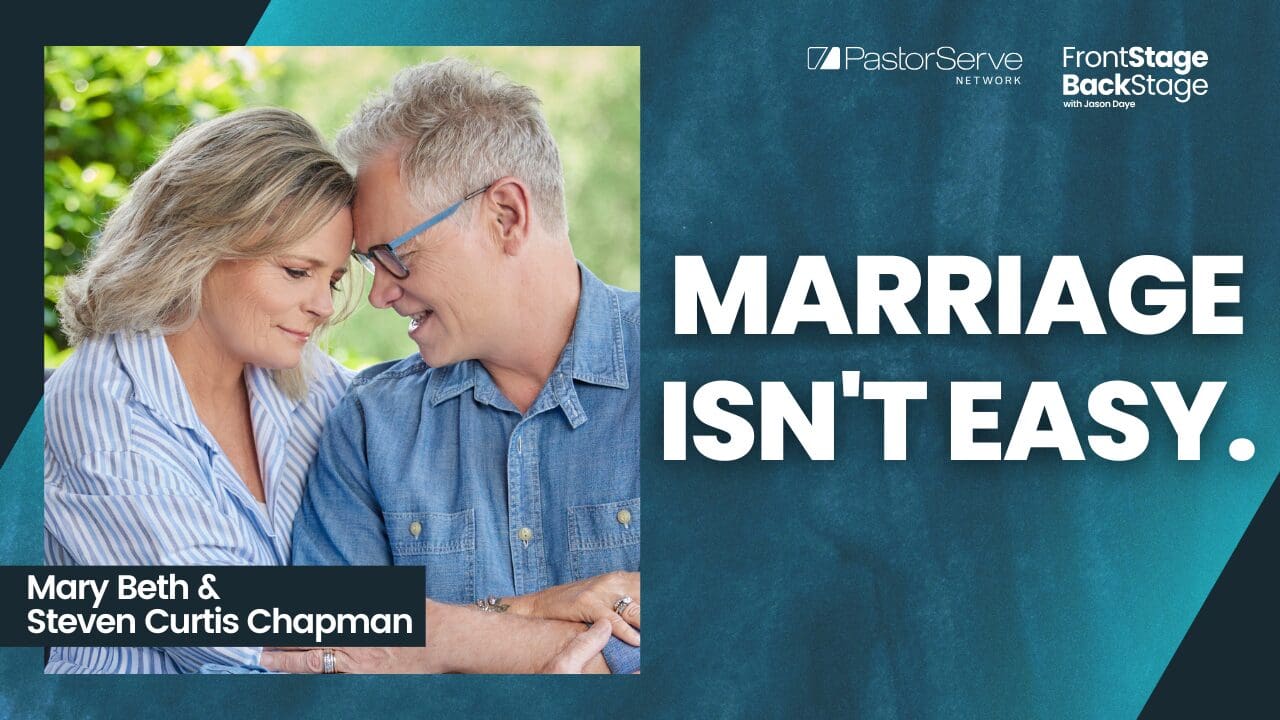
Marriage in ministry can carry pressure few people fully understand. Steven Curtis Chapman and Mary Beth Chapman reflect on forty years of marriage, the expectations placed on ministry families, and the grace that sustains relationships through hard seasons.
Marriage in ministry often carries pressures that few people see. Pastors and ministry leaders frequently feel an internal pressure to get marriage and family life right, while also navigating the expectations others place upon them. From the outside it can appear that leaders in ministry have everything together. But the reality behind the scenes is often far more complex.
In this episode of FrontStage BackStage, host Jason Daye sits down with multi-Grammy Award-winning singer-songwriter Steven Curtis Chapman and New York Times bestselling author Mary Beth Chapman. As they celebrate forty years of marriage, they reflect on the journey that has shaped their relationship, the mistakes they have made along the way, and the grace of God that has sustained them through it all.
With honesty, humility, and warmth, Steven and Mary Beth talk about the pressures ministry families face, the challenge of living faithfully both on the front stage and backstage of life, and how couples can come back together after seasons of regret, disappointment, or misunderstanding.
Mary Beth and Steven Curtis Chapman are the authors of the book Still Here: Life Together on the Long Way Home, which shares an honest portrait of their life and marriage together.
Together they discuss:
- The unique pressures that ministry can place on marriage and family
• Internal and external expectations faced by ministry leaders
• What happens when couples feel like they have gotten things wrong
• Navigating regret and shame in marriage
• How couples can come back together after conflict
• The tension between front stage ministry life and backstage reality
• Lessons learned through forty years of marriage
• The sustaining grace of God in difficult seasons
This conversation offers thoughtful encouragement for pastors, ministry leaders, and couples navigating the unique pressures of marriage in ministry. Steven Curtis Chapman and Mary Beth Chapman’s honesty about grace, humility, and perseverance provides a hopeful reminder that faithful marriages are not built on perfection, but on a continued commitment to love, forgiveness, and walking with God together over time.
Connect with this week’s Guest, Steven Curtis Chapman and Mary Beth Chapman
Weekly Toolkit
Additional Resources
Still Here: Life Together On The Long Way Home: An honest look at joy, struggle, loss, and the hope of redemption. Still Here is the Chapmans’ take on marriage, on parenting, on the lives we live and the promises we make. The Chapmans’ story, like all our stories, is one of total dependence on God’s grace and goodness, on His faithfulness and forgiveness, and on His readiness to redeem, in all of us, every outbreak of brokenness. It’s been more than forty years of that now, together, and they’re inviting you inside to see it, to feel it—not to show you how it’s done, but to show you it can be done. Come along on their journey, and see yourself on your journey, trusting God for His faithful mercies on all our journeys home.
https://www.marybethchapman.com: Mary Beth Chapman is a “New York Times” best-selling author, speaker, and the wife of GRAMMY® and Dove Award-winning recording artist, Steven Curtis Chapman. Steven and Mary Beth were married in October of 1984 and have six children. The Chapmans live in Franklin, Tennessee.
https://stevencurtischapman.com: In a career that has spanned more than three decades, Steven Curtis Chapman is the most awarded artist in Christian music history. With 60 Gospel Music Association (GMA) Dove Awards, five GRAMMY®Awards, an American Music Award, and a historic 50 No. 1 singles, he has sold more than seventeen million albums with ten RIAA-Certified® Gold or Platinum albums to his credit.
Ministry Leaders Growth Guide
Digging deeper into this week’s conversation
Key Insights & Concepts
- Ministry couples can often feel an extra sense of both internal and external pressure to “get it right” in marriage. While those in ministry have been entrusted with a platform and are held to high standards, they are as dependent on God and His grace as anyone else. Perfection is not a requirement for ministry; reliance on God is.
- Marriage is a union between two imperfect sinners. Expecting oneself or one’s spouse to be flawless is unreasonable. Instead, God has each person on a unique journey, and He is at work bringing sanctification and wholeness.
- Sometimes the very differences that attracted couples to one another become the things that most frustrate them about one another. Remembering that a spouse is not meant to make one complete nor happy can provide perspective and even levity in moments of frustration. More importantly, living in such intimate union with another person provides the opportunity to press into Jesus.
- Every individual and every marriage is unique; there is no one “right way” to do it. Advice from others is valuable, but no author, speaker, or marriage conference holds a formula for anyone else’s marriage.
- Marriage requires bearing with one another in love. This looks like daily showing up, continuing to choose to love another sinner, and trusting that God is working something out in both spouses. [*NOTE: There are situations in which spouses should not bear with one another.]
- Often the closer each spouse grows to the Lord, the closer they grow to one another.
- Ephesians 6:12 reminds believers that the battle is not against flesh and blood, but is spiritual. Those in ministry seem to be particularly targeted by the enemy. Remembering that there is an enemy, and that one’s spouse is not the enemy, is valuable in marriage.
- Repentance is key in marriage. When a spouse has sinned against or hurt the other, asking for forgiveness and intentionally seeking restoration and reconciliation demonstrates godliness. Couples with children can model this posture of humility and repentance by admitting to their children when they have been wrong, extending forgiveness to one another, and walking in grace.
- Shame and regret are tools the enemy uses against believers. When wrestling with regret, it can be helpful to lay it at the Lord’s feet, recognize that He teaches, trains, and redeems, and intentionally speak truth. Spouses can also speak the truth of God over one another.
- Community is vital. The enemy often uses isolation and loneliness to discourage and trip up believers. Those in ministry are especially susceptible. Fostering and remaining engaged in genuine fellowship, relationships in which one can be honest, vulnerable, known, and love, requires intentionality.
- Having a “frontstage” presence brings extra temptation to hide the “backstage,” yet the two need to be integrated and consistent. Honesty and authenticity take intentionality, but are as simple as “being real.”
- When those in ministry share about what God is doing in their own hearts and lives, it’s powerful. Ministry does not come from a place of perfection, but from a place of brokenness in which God is doing His work. Testifying to this encourages others and points them to Christ.
Questions For Reflection
- What are my beliefs about the purpose of marriage? How do these beliefs align with what God says about marriage?
- What are my expectations of my marriage? How do I currently view my spouse? How do I view my role as a spouse?
- What does it look like in my life, practically, to press into Jesus? How am I intentionally investing in my personal relationship with God? Where am I growing closer to Him?
- How am I relying on God in my marriage? How is He equipping me to bear with my spouse in love? How am I receiving His love through my spouse?
- How do I tend to approach marriage advice? What marriage advice have I received? What advice has been useful? What have I heard from others that does not apply to my marriage?
- In what ways do I support the unique journey of my spouse? How am I encouraging my spouse in the Lord? How am I seeing my spouse grow in Christ? How am I supporting that growth as a loving partner? Is there anything I might need to change (an attitude, behavior, practice, etc.)? Do I need to have a conversation with my spouse about this?
- How do I express repentance in my marriage? How often do I admit my sins to my spouse? How do we model this for our children or even to younger married couples? Do we need to have a conversation about how we express repentance and forgiveness to ensure we’re on the same page?
- How often do I recognize the spiritual battle around me? What tactics of the enemy am I most susceptible to? What might I need to do to stand firm in the Lord? Who can help me in this?
- Am I currently experiencing isolation or loneliness? If so, what do I need to do to start building or re-engaging with community? If not, what do I need to continue doing to deepen community connection?
- Am I currently wrestling with shame or regret? What might I need to do with this? Is there someone I can tell about my struggles? Is there something I need to make right? Is there a truth I need to be reminded of? Who can encourage me?
- How do I support my spouse in the midst of spiritual warfare? How can I speak truth over my spouse?
- What conversations might I need to have with my spouse after listening to this podcast? What resonated for each of us? How do we view one another as brothers and sisters in Christ? How are we each growing closer to God and relying on Him? How are we growing closer to one another?
- How is God using us in one another’s lives? How is He using us together for the good of others? Are there areas of our marriage that need an extra layer of focus in this season?
- What works well for us, and how can we keep building into that? Where are we struggling, and what can we do about it? How can we pray for one another and for our marriage?
- How can I help those in our church in their marriages? What support do we provide for couples? What expectations are we setting about marriage?
- How are we modeling bearing with one another in love beyond marriage and into the entire family of believers? Who might I need to invite to process these questions with me?
- What couple will I share this episode with who would be encouraged by this conversation?
Full-Text Transcript
Jason Daye 0:00
Hello friends and welcome to another amazing episode of FrontStage BackStage. I’m your host, Jason Daye, and each episode, I have the privilege, the honor really, of sitting down with trusted ministry leaders, and together we tackle a topic in an effort to help you, and pastors and ministry leaders just like you, truly thrive in both life and leadership. If you’re joining us on YouTube or your favorite podcast platform, please be sure to like, subscribe, follow, share, do all of the things so that you do not miss out on any of these great conversations. Now I’m really excited about today’s conversation because I’m joined by not one but two amazing guests: New York Times best selling author Mary Beth Chapman is joining us, and she has been kind enough to bring along her husband, multi Grammy Award winning singer-songwriter Steven Curtis Chapman, and together, they are giving us a sort of behind the curtain peek at their marriage. They’re celebrating a milestone of 40 years of marriage, and they have a new book out entitled Still Here, and we are so excited to have them with us here this week. And at this time, I’d like to welcome Steven and Mary Beth to the show. Steven and Mary Beth, welcome!
Steven Curtis Chapman 1:25
Hey everybody. Good to be with you.
Jason Daye 1:27
Yes, it is so good to have you with us. Thank you for making the time to hang out with us. Now, I’ve got to tell you, as I was reading the book early on – it might have even been in the introduction, but, but – I read this, and I chuckled to myself, right? So I was reading, and you shared that it was a challenge for you guys to stay on the same page, let alone, oftentimes, on the same bookshelf, without possibly wandering onto the true crime section, right? And when I read that, I laughed. I laughed probably because my beautiful wife, Monica, and I, we probably resonate with that comment, right? So what’s so fun about that is just the reality behind that and the reality around marriage and so often, Mary Beth and Steven, in ministry, whether it’s, you know, speaking in front of large crowds and leading worship or singing in an arena, or whether you’re preaching in a local church, whatever it might be, oftentimes, we feel somewhat in the spotlight in our marriages, you know, whether it’s, you know, as husband and wife or as parents, and we sense kind of a little bit of that pressure of, you know, getting it right. And some of that pressure, I think, is internal pressure we put on ourselves. Some of that pressure, honestly, is external pressure others put on us. And I would love for you to share with us a little bit, if you could, how have the two of you, over the past 40 years, learned to navigate both those internal and external pressures of you know this idea of getting it right in marriage?
Mary Beth Chapman 3:10
Yeah. Well …
Steven Curtis Chapman 3:15
Where do we begin? It’s funny when you when you mention that, that little bit in the book … and sorry, I’m getting over something, so I may have to clear my throat and cough and hack a few times … but we, I always loved this. I know it was sort of funny and joking, but I think, Mary Beth, you were the one that actually pointed this out when you read it, because it was so encouraging when Ruth Graham was asked, have you and Billy Graham ever considered divorce? And she said, divorce – never; murder – often. And I know that was obviously said with a with a smirk and a smile. But you know what? She wouldn’t have said it if there wasn’t some truth to it that we can drive each other crazy. And you can’t imagine Billy Graham and Ruth Graham, now I knew Billy a little bit, not Ruth at all, but she obviously was a very strong woman to be able to endure what she did, and Billy clearly a very strong called man. And so as you know, I love that we’re speaking to called men and women in ministry, because, you know, there is a … we already bring our own stuff, you know, baggage, bags of our stuff, into a marriage, and then we’re on the platform. We’re in the spotlight. If you preach a sermon, or if I sing a song like I Will Be Here, people automatically assume that you’ve got something figured out because you wrote the song I Will Be Here. You know, you guys have a good enough marriage to give birth to that song. And it must be, you know, you must have, you know, have some things figured out that maybe the rest of us don’t. And I got to believe pastors feel the same way and, if you know, preach sermon on marriage, but so often, I mean the songs are written, and I would venture to say many of the sermons are probably written, out of your own journey of trying to figure it out and struggle. And this is what I need to be true. I’ve often said that my songs, if you could find one word, probably I use more than anything. And Mary Beth certainly say it. It’s not really a word. It’s a contraction of two words. Want to, it’s wanna. It’s the word wanna. You’ll see me use that word so many times. I want to. I want to, you know, Love You With My Life was one of my early songs. You know, it’s like, these are all Lord. I’m writing these songs and saying these things because I really want this to be true, because it’s what I’m, you know, shooting for. It’s what I’m called to. It’s what your word, you know, invites us into, to love each other, to bear with each other, and love to all the things that we talk about in the book.
Mary Beth Chapman 5:53
How quickly I can say, you wrote a song, I Will Be Here. But why are you there all the time? You’re there.
Steven Curtis Chapman 6:01
You’re not here. Yeah, nice song, buddy
Mary Beth Chapman 6:02
You’re not here. I think, isn’t it interesting? You know, I think growing up, I you know, a lot of us have heard that, well, the honeymoon is over. The honeymoon is over. And how mysterious it is that God brings you to your spouse. I think more times than not, we marry someone that is so essentially different than us, because it’s attractive. It’s attractive that, oh man, you’re more of a free spirit, I live by a calendar. You’re more of a creative, I’m more of a by the book. All these things that are so, so, so attractive, and you just can’t wait to complete yourself with that person. And then the honeymoon is over, and you go, I mean, it didn’t take us very long to go, this is going to be a long life. Boy, this is going to be interesting. And then what does then? What is the opportunity there? And what is it that God is calling you to? And you’ll hear us say this many times, Steven’s usually one that says it, is one of our favorite pastors to listen to, still, even though he’s with Jesus now, is Tim Keller, and he talks about, what if marriage is more about making you holy, not happy? And so, you know, we have this incredible opportunity. You all of a sudden, wake up one day and go, that person has the potential to irritate the living stew out of me. And now, what am I going to do with it? And it was super important, I think from the very beginning of the … we’ve been asked off and on pretty much since I Will Be Here has been written, and we were so young then, and it was written out of a deep, deep pain of his parents divorcing. Is why it was kind of a surprise to us that it became such a song of commitment and a wedding song, because it was out of such pain of us losing something that we thought would never happen, but now I just lost my train of thought. But what was I saying anyways? Well, let me go back. Oh, shoot, I had a good point.
Mary Beth Chapman 6:50
Yeah, it’ll come back to her.
Mary Beth Chapman 7:50
But yeah, we’re talking about how marriage makes us holy rather than happy.
Mary Beth Chapman 8:08
And how the opportunity to how when we when we, you know, again, when we are married early, that person is so attracting to us because it’s so essentially different. But then we wake up, we say, okay, this person has the ability to drive us crazy. But then what are we going to do with that? And then, how is that an opportunity, then to to press in to the one who truly can, you know, make us happy, and that’s Jesus and in so, yeah.
Steven Curtis Chapman 8:38
Yes, yeah, I think that is probably the reason why we decided now, after this many years, to go ahead and sit down and put some of our story and thoughts in a book like this. We’ve been asked over the years to do that, and we always felt like,
Mary Beth Chapman 8:38
I remembered my thought. Okay, I’ll come back to it. This is also a podcast for old people.
Mary Beth Chapman 9:01
This is old people. Where was I?
Mary Beth Chapman 9:04
Oh, no, I’m going to lose it again. See …
Steven Curtis Chapman 9:07
Did you lose it again? See how we are?
Mary Beth Chapman 9:11
I didn’t mean to interrupt.
Jason Daye 9:12
I love this. It’s real.
Steven Curtis Chapman 9:14
Yes, yes, if it comes back, you go. Sorry, sorry. I threw you, I threw a curve. I think we waited long time to write the book for that reason, because we would be asked, you know, would you guys write a book? And we’d always just say
Mary Beth Chapman 9:27
because we, this is it, because we didn’t want to write a how to book. We can’t. We can write a book in spite of, in spite of, and what not to do, but we cannot write a book on what to do.
Steven Curtis Chapman 9:41
Yeah, that’s it, exactly.
Jason Daye 9:42
That’s it.
Steven Curtis Chapman 9:43
We’re seeing, we’re seeing … and yet, why then, so why now, you know, because we still haven’t figured it out. It’s not like, okay, at 41 years we suddenly got the answer. We, you know, we uncovered it. It is more, I think because what we are learning. Learning, and I say learning because we still are, is that it actually is, you know, the process of laying down our our lives, our ideals of what, oh, this was supposed to be. If we could just go to the right marriage counselor, if we could just get the right book, we’d go to the right marriage conference. Because we’ve been to a bunch of them as we talk about throughout the book, and we usually end up within the first, you know, few pages or the first few minutes of the conference, going well, we failed, we flunked.
Mary Beth Chapman 10:31
We usually end up at a movie.
Steven Curtis Chapman 10:33
We’re like, I don’t know, I think we need to just go get some popcorn and watch a movie and just hold each other’s hands and just be together, because we just feel like we’re losers, we failed, but so much of it is like, man, we didn’t do that right. We haven’t done that right. And again, not taking anything away from all those good things that point us in the right direction. But I think so often I am, anyway, very, very guilty this, and I think my wife is too, you know? If I read
Mary Beth Chapman 11:01
Hey, watch it
Steven Curtis Chapman 11:01
you know, well, this is what James Dobson says we’re supposed to do, then that’s how we’re supposed to do it, because he’s the expert. And so many times it’s like, well, wait a minute, every one of us, we’re so complex. We’re so unique. God has us on our own journey. We’re bringing our own baggage, our own pain, our own trauma, our own stuff, into this, and our own sin. And so can we just show up and keep loving another sinner and trusting that God’s working something out in both of us? And that sort of seems to be bearing with one another, and on that journey, and trusting God seems to be the secret, if there is one, and that’s just a daily showing up thing, and it is worth it. And I think that’s why, at 41 years, we’re like, you know what, we can write that book. The last chapter is, it’s worth it, because it’s just staying on this journey, even when it would have been so easy, and even had, you know, the professionals probably encouraged us, giving us permission to, you guys are probably just too, you know, this is such a mess we can’t figure this out. And probably you can’t either, not even sure the Lord can.
Mary Beth Chapman 12:07
But, and Jason, I think to your point, speaking to fellow pastors and ministers, we do put that external pressure on ourselves. We felt so, we felt so many times we felt unworthy of like, we can’t, you know, you shouldn’t have this platform. I, I shouldn’t have this platform if we can’t get this together. But like, okay, it’s 2026 everybody has pretty much an Instagram account, but nobody puts real on their Instagram. They put the you know, you know, I show the beautiful moments I get to spend with my grandchildren or the happy things. You know, rarely do you put if he puts the toilet paper on backwards one more time, whatever it is
Steven Curtis Chapman 12:49
which I don’t, I’d like to point out, I’m really good at putting, can I just
Mary Beth Chapman 12:53
After 41 years he puts it on the right way.
Steven Curtis Chapman 12:55
I put it on backwards more often than not. Like, what the heck it was like,
Mary Beth Chapman 13:00
I blame it on a grandchild that was over. I blame the granchildren.
Steven Curtis Chapman 13:04
Blame the grandkids. That’s a great thing
Mary Beth Chapman 13:08
Anyways, you know, you see, we we put that pressure on ourselves that we have to have it all together, and we have to, and boy, the last thing I would ever want anybody to think of us, you know, a woman who’s frustrated with her husband, or a man who’s frustrated with his wife, they go, we need to be like Steven Curtis or Mary Beth or whatever. And it’s like, no, no. You know, we have our own, we’re sinners and we’re married to imperfect people. And so yeah, the whole that’s … this book can be written in one sentence. But then that wasn’t long enough. So we had to it was just bear with one another in love. And again, I always want to say in these interviews, there are certainly situations, and so for people who are listening that are in a situation that is not something you should bear with one another in love you, not talking about those situations like I want to just make sure that that’s clear. I don’t want to misguide anybody.
Jason Daye 14:05
Hey, friends. Just a quick reminder that we provide a free toolkit that complements today’s conversation. You can find this for this episode and every episode at PastorServe.org/network. In the toolkit, you’ll find a number of resources, including our ministry leaders growth guide. This growth guide includes insights pulled from today’s conversation as well as reflection questions, so you and the ministry team at your local church can dig more deeply into this topic and see how it relates to your specific ministry context. Again, you can find it at PastorServe.org/network.
Jason Daye 14:42
Yeah, yeah, I appreciate that, Mary Beth, you know, it’s interesting because, I mean, just you sharing that, and just you being real, and just you writing, you know, the book Still Here, and I think as it’s a breath of fresh air for those of us in ministry. Because it almost is this idea of giving us permission to be human right and say we don’t always get it right and we don’t always get figured out. So I would love to hear Mary Beth and Steven from you when you do get it wrong. Let’s say yeah, like Mary Beth when Steven isn’t living up to the lyrics of one of his songs. Do you put that song on repeat and turn the volume up really loud and play it for Steve? I mean, how do you guys handle, seriously, how do you handle when someone gets it wrong? How have you guys learned to, you know, really process through that in a healthy way?
Mary Beth Chapman 15:39
Yeah, well, gosh, in a podcast of true confessions in raising you know, most people that are listening to this know we have six children. I call them three natural, three supernatural by the gift of adoption. But when Emily and Caleb and Will, our biological children were young, is when Steven was probably doing the most intense touring and all of the things. And, you know, I didn’t do it, right. You know, I was angry a lot. I was like, trying to figure out, how do we do this? Like, we have three small children, you’re gone, coming. And he was doing his best to go, Gosh, when I tour, do I stay gone? Do I do this in weekends? And, you know, and you have to remember, again, old as dirt people here, there were, there wasn’t texting, and there wasn’t cell there was even cell phones. When, when I remember getting our first cell phone, we were married, and so like, no computers, no internet, you know, so you’re talking, calling home from a pay phone and checking in. And so I had so much to learn about trusting the Lord and trusting Jesus had us in this together. This wasn’t a his thing and my thing, but that I was stationed at home, he was stationed on the road, and I was angry for a lot of it, and so I didn’t do it right. There was, there was, you know, our children are telling us, there was arguments, loud arguments about, you know, just all the things like, how are we going to do this? If you’re there and all that, I will say that as the years have gone on, yes, there’s been times that I’ve played in the song, just push, you know, push play. Did you write that? Because I, let me get this straight, no, I don’t think somebody else wrote, I don’t think there was a cowriter on this song. So when you say no, to just really begin then to allow the Lord to go, you know what? I’m not. It didn’t matter how loud I am, or how quiet I am, or a silent treatment. I need to give this to the Lord, and I need to continue to give it to the Lord. And I think I talk about this in the book. We talk about it together, about this triangle. And I know this is super cheesy, but like, I feel like I can visualize this, Steve over here, and I’m over here on the bottom, opposite of the triangle. But as we just really trust the Lord over the years with our relationship, and growing closer to the Lord, we, you know, began to grow closer to each other. And so learning, I think he would tell you that the last, the twilight part of our marriage has been much more palatable to just try to Hey, are you hearing me? Are you seeing, you seeing this? Because we need, we need to talk about this. Yeah, and still, calendar is still off limits. We can’t talk about the calendar too much. We just have to
Steven Curtis Chapman 18:18
Still, still a challenge.
Mary Beth Chapman 18:21
We’re still butting heads about that.
Steven Curtis Chapman 18:23
I think, the I think, and again, I’m sure we it’s probably a whole chapter about this, because there’s one, I know there’s, it’s a fight, and the fact that we’re fighting not against flesh and blood, but against and especially, again, in ministry, we have targets, because, you know, the every time the enemy can take down a, you know, someone in ministry, there’s one more opportunity for, you know, to be kind of written off as see, it doesn’t work. It’s not true. It’s not real, whatever, God’s not, you know, trustworthy. And I think recognizing that we’re not each other’s enemy.
Mary Beth Chapman 19:01
And there is an enemy.
Steven Curtis Chapman 19:03
But there is an enemy, and then, you know, man, that’s that. It’s all, it’s all. Funny, it’s all in the Scripture. It’s actually all right there. In repentance and rest is your salvation. I believe that is another one of those. You could hang that over over marriage and say, if we can truly keep repenting, if our kids learn anything from us , it is repentance. I mean, repentance. How many times did they heard us say, yeah, guys, we blew it. We sat them down and go
Mary Beth Chapman 19:30
If it, yeah, if it went south and we didn’t do it, quote, unquote, right? Or we weren’t honoring the Lord in the way in which we were disagreeing. What was the main thing that was important for our children was to see us circle back, sit them down and say, Okay, we are two very imperfect people living in a small, confined home, and we need to, you need to hear us ask each other to forgive each other. And our son wrote, was asked to write, our oldest son, Caleb, was asked to write a blog on us as parents. I was like, Oh, you sure, like that. But we have a great relationship with all of our kids. Praise the Lord. Just none, there are none finer humans on the planet. But one of the things he said in this, and it really struck Steven and I, was, you know, there is a real enemy. I would like to say, even with the loss of our youngest daughter, I think the enemy tried to take a fatal blow at our entire family. And yet, he would say that my parents hobble, but they hobble well. They hobble well through life, and they are very aware of their shortcomings, very aware of their sin, and very aware of, you know, repenting and making it right in front of us. And so I was like, okay, okay, yeah, can write that about his mom and dad. You know, we’re going to take that as a win.
Jason Daye 20:55
Yeah. Yeah. I love that. I love that. Um, one of the things that you mentioned about, you know, going to a marriage conference and, you know, or listening to one of those things and realizing, oh, man, well, we we missed. We missed it here, we fell short here, there there. And whenever you sense those things, how do you not, you know, devolve into a sense of, you know, regret and shame, and, you know, we just kind of suck. And, you know, what are we doing here? You know, how do you keep your hearts kind of centered and focused and not devolve into that state? Because, I mean, that’s another tool the enemy uses against us, right, to try to drag us down. What are some things that you have found to help you not get into that kind of deep place?
Steven Curtis Chapman 21:46
Well, um
Mary Beth Chapman 21:48
I kind of, I, that’s a really hard one for me.
Steven Curtis Chapman 21:51
It is, yeah, because
Mary Beth Chapman 21:52
I have a lot of of regret.
Steven Curtis Chapman 21:55
Yeah
Mary Beth Chapman 21:56
Man, it is not rare for me to call, I called her last week, my oldest daughter turned 40. Shouldn’t I be 40? I should be 40, although I tell your listening audience that I was 39 when I delivered her to college. So I was a young mom
Jason Daye 21:56
There you go.
Mary Beth Chapman 21:56
Yeah, but anyway, Emily turned 40 last week, and I called her around her birthday. No, it might have been on her birthday. And I just said, Look, you are the firstborn, and there was a lot of experimenting on you, and I am just deeply, deeply sorry for the ways in which I failed you, and I’ve lived with some regret. She is an amazing human, in spite of us. I mean, I remember, I remember when they were like, Okay, you can go home from the hospital. I’m like, with with a human? Like, we got to keep a human alive?
Steven Curtis Chapman 22:52
Seems like a very bad idea.
Mary Beth Chapman 22:55
Bad Idea, like, okay, but anyways, I mean, we laugh, but like, I have a lot of regret because, and I asked the Lord a lot about this, because all in the twilight … These last 10 years or so, I will find myself going, Man, I’ll have these aha moments. And it’s like, why didn’t I experience this 30 years ago? Like, how I’m feeling about it now, right? But I think again, I think the Lord just has … we’re constantly learning and teaching, and, you know, he’s teaching us things and growing. And so I try, if I, if I, if I convict myself or find myself, Hey, this is something the Lord’s brought to mind that I have regret about. I try to, honestly, I try to address it, because most of my regrets come with my with my children, since I was the one that was with them. But, but it’s sweet, right? Because, man, there’s nothing like a child going, Mom, you know, you’re, you are exactly who God meant you to be, and, you know, I, I love you so much, or I forgive you, or whatever. And I remember early on in Emily — this is before Emily was married — she wrote what we like to call, we always, we always dubbed it, the epistle. It was just a letter to us, and it was tough. It was places where she felt like dad had failed her, being gone a lot, I had failed her. Just failed her, mom. Dumb mom stuff.
Steven Curtis Chapman 24:19
It was some counselor’s idea.
Mary Beth Chapman 24:23
It was some counselor’s idea; you should write this out
Steven Curtis Chapman 24:27
Love you counselors, but that was not a good idea.
Mary Beth Chapman 24:28
and share this with your parents. And I was like, she’s, you know, college student at Baylor — sick ’em Bears — and, man, it was, wow. It’s like, you know, Rex from Toy Story: “Great, now I have regret.” You know, just all of these, the sense. But I’ll tell you what, she got married and had her first baby, and we got epistle number two, where she recanted epistle number one,
Steven Curtis Chapman 24:50
We’re all on a journey.
Mary Beth Chapman 24:54
We’re all on a journey. She called me last week and she said, Mom, I am so sorry. I did not realize how hard it is to be a parent and a mom. And she’s, she’s parenting three little girls with her husband Tanner. And so we’re on a journey. And, you know, again, I hate to say what goes around comes around, but in terms of the regret that we live with, I quickly kind of go, Lord, you were teaching me something through that. I’m going to try to lay this down at your feet and not beat myself up. As our pastor, Scotty, would say, “Don’t should on yourself.” You should on yourself too much. I should have done this, and I should have done that. And this one right here is one gift to me in that area. Is he reminds me all the time, all the time. He speaks truth over me, and he speaks, when I get in that place of man, I just, I blew it here, or I did the, I shouldn’t have done it this way, or whatever, he speaks truth over me. So I’m trying to learn quicker to speak that truth back over him. Yeah.
Steven Curtis Chapman 25:55
I think, I think having, the thought that came to mind, too, to add to that, it’s just community. We need, you know, we, again, one of the enemy’s great tools, and he’s used it against us, weapons, is isolation, and especially when you’re in ministry that’s the thing. I mean, you would not, we say this in the book actually, you know that. And we hope when the book, after the book comes out, we’re going to get invited to 10,000 small groups. Because we’re like, you know, we never get invited to Bible studies, to small groups. Everybody’s, you know, we got friends go, yeah, we’re going to a Bible study group, you know, with other couples. And I’m like, why don’t? We never get asked. And it’s because people assume, well, I mean, they’re in ministry, they got, they got 1000, right? And, and so you, the isolation and the loneliness that comes with being in the position that you are … and some of it is even, you know, self inflicted, because you do withdraw, because you need time, and you need to,
Mary Beth Chapman 26:22
You’re only home so long, too
Steven Curtis Chapman 26:32
Yeah, you’re only away. And then when you’re on that platform and you’re shaking hands and you’re seeing everybody, then you need to, you know, regroup. But then it’s easy to get isolated. So all of your interaction, and how many ministries have we seen crash and burn because the isolation, you know? And then all the people around that you are interacting with are people working for you or saying yes to you or whatever, but not really people that you can go, man, I am a, I feel like an absolute loser, and I feel like I’ve just completely blown it. And people that could just go, Yeah, you know, you blown it. And yeah, you know what, you’re also awesome, and we love you, and let’s just pray together. And, man, we, I blew it, too. And, I mean, I think if at times, Scotty Smith, my pastor and friend, you know that we have sat with him and, you know, bluh, and here it is. He can kind of come back and go, Well, let me tell you our bluh. And you go, Oh, wow, you too. Okay, we’re not, we’re not as alone. And then the enemy loses that, that power, you know, which is. So just community, the body, and make, being so intentional to keep kicking those doors open, you know, and throwing open the windows and saying, Man, this is … having those safe places where you can say we’re really, I feel like a real failure, but I need somebody to just talk to
Jason Daye 28:10
At PastorServe, we love walking alongside of pastors and ministry leaders just like you, if you want to learn more about how you can qualify for a complimentary coaching session with one of our trusted ministry coaches. Please visit PastorServe.org/freesession. You don’t want to miss out on this opportunity. That’s PastorServe.org/freesession.
Jason Daye 28:32
Yeah, that’s so good, so good, Steven. That’s so true that that isolation is a killer, and one of the things the enemy tries to use against us.
Steven Curtis Chapman 28:42
Yeah.
Jason Daye 28:42
As we’re kind of winding down this conversation — it’s been great. I wish we could hang out for a couple hours and talk because this is such, such great stuff. But, so the name of our podcast is FrontStage BackStage, and it’s named that because we know in ministry we have, we have a frontstage. And as humans, we have a backstage right? We have the frontstage where people see us. You know, we’re speaking to a crowd, or we’re leading worship, or whatever it might be. But then we all have a backstage. We have our life, our personal life, our marriage, our kids, whatever it might be. Mary Beth and Steven, I would love for you to share some encouragement to pastors and ministry leaders around the idea of, how do we, how do we hold our frontstage and our backstage together with integrity and honor, God, you know, across, across both?
Steven Curtis Chapman 29:33
Yeah.
Mary Beth Chapman 29:36
Well, I well,
Steven Curtis Chapman 29:36
You can start
Mary Beth Chapman 29:37
obviously the first thought that came to mind if, if someone who is in an audience watching our frontstage couldn’t come back to the backstage and see the same person, then there’s obviously a problem, right?
Steven Curtis Chapman 29:52
That’s good.
Mary Beth Chapman 29:53
And we also have to have our places of privacy bubble.
Steven Curtis Chapman 29:57
Right.
Mary Beth Chapman 29:57
But I think it’s just super … it has always been super important to me. Managed remember all the early years of, we were so young when we got married. I was 19 and he was 21, and then, you know, then Steven Curtis Chapman kind of entered, entered the picture. And it was pretty much acceleration, pretty much out of the gate. And just remember those early years at the Grammys, or early years at the Dove Awards, or early years and it was hard for me to be the wife of, you know, be the supporter of, always felt not enough, um, always, probably still do to a point. But what, one thing that has always been important to me is to do my best to be who I am. If I’m out in front of people, then who I am when my, I don’t, like. I was just thinking about it just now, if friends watch this podcast, friends who really know us, they need to be able to say that Steven and Mary Beth, that’s exactly who they are. They’re not saying anything they wouldn’t say to us or to anybody that, you know, that knows them deeply. And so I think you have to have those checks and balance. You have to have people speaking into your life. You have to pray a lot. And I’m probably the great corrector, like and he is the great director of me in love. But I think it’s important to just be real, just to be. And I know that is kind of
Steven Curtis Chapman 31:35
It seems obvious
Mary Beth Chapman 31:36
Seems obvious
Steven Curtis Chapman 31:36
But it’s not.
Mary Beth Chapman 31:37
But I definitely think there’s
Steven Curtis Chapman 31:39
It’s a, it’s, you have to be intentional about it.
Mary Beth Chapman 31:43
Yeah
Steven Curtis Chapman 31:43
because it doesn’t happen naturally, you know. When you think about, think in Scripture. I’ve said this many times, the scriptures that are so precious to me, have given me so much hope, and us so much hope, are the places in Scripture that I’m pretty sure, had most editors or publishers I know been working with the Bible in the first draft, they might have left out. Like, really? I think we might ought to, I think that ought to go to the editing room floor.
Mary Beth Chapman 32:12
I think the masses might not … I think, yes
Steven Curtis Chapman 32:14
I think, you know, I love that, you know, let’s give David the, you know, man after God’s own heart. The whole Bathsheba thing and the whole Uriah thing.
Mary Beth Chapman 32:21
You ought to leave the murder part out
Steven Curtis Chapman 32:24
but that is, you know. And then, and then, and it seems almost schizophrenic. How long ,oh Lord, are you gonna, you know, forget me forever? And then, but your love is better than life. And you get to see this. I didn’t see so much of this until even our journey with losing Maria. And suddenly the Psalms this, the just the back and forth of so much of that became so real, because I felt like that. It’s like you feel this, you know this. You feel what you feel, you know what you know, and you acknowledge both and then the honesty in that. Because, as we know in, you know, God resists the proud, He gives grace to the humble. Humble yourselves, you know, before him. You know, humility, the living in that place. And I have thought over the years, the most impactful people in my life, sermons, pastors, messages, you know, have not been the greatest sermons, the greatest, you know, five points, the greatest. It’s when I feel like even the person that is ministering is honest to say, you know what this is? This is the struggle. This is where I’ve failed. This is where I missed it. But guess what? This is where God’s grace met me, met my wife and me, met us in this. And so let me just share that with you, because that’s all we’re doing. We’re like, what is it that, you know, the best ministry we’ll ever do is one beggar telling another beggar where he found bread. Man, I found some bread. I’m starving. And look, I found this. You know, that’s the greatest ministry we’re ever going to have. And so as the more and more we can do that in our ministry, and keep in mind, yeah, I’m a sinner, I am on the journey, I’m in process, and, but let me tell you about the process that God’s doing in my own heart, and what he’s showing me and teaching me. And that’s going to have the greatest impact, and it’s going to keep us, and with integrity. Because integrity, you know, in in integral, you know, we’re, we’re the backstage and the frontstage, you know, we’re, they’re integrated. That’s what integrity is. And so the more we bring that backstage to to the frontstage, and this is a reality, and yet, boy, look at, look at what God’s doing in the process of this.
Jason Daye 34:38
That’s, I love it. I love it, and that’s what you guys have done. And Still Here, amazing, amazing book. Thank you for taking time to be with us today. Certainly appreciate it. It’s been a pleasure. It’s been a joy. Thank you for sharing your story through Still Here and your journey.
Mary Beth Chapman 34:56
Yes, thank you, Jason.
Steven Curtis Chapman 34:56
Thank you, Jason.
Mary Beth Chapman 34:57
Yes, thank you.
Jason Daye 34:58
Appreciate you guys. God bless you.
Steven Curtis Chapman 34:59
God bless you, buddy.
Mary Beth Chapman 35:01
God bless.
Jason Daye 35:01
Here at PastorServe, we hope you’re truly finding value through these episodes of FrontStage BackStage. If so, please consider leaving a review for us on your favorite podcast platform. These reviews help other ministry leaders and pastors just like you find the show so they can benefit as well. Also consider sharing this episode with a colleague or other ministry friend, and don’t forget our free Toolkit, which is available at pastorserve.org/network, this is Jason Daye encouraging you to love well, live well, and lead well.
Transcribed by https://otter.ai
Recent Related Episodes
-

Posted On: May 2, 2022
-
Posted On: August 14, 2023
-
Posted On: February 13, 2024

Right-click, then select “Save Image As…” to download one of the social graphics.