
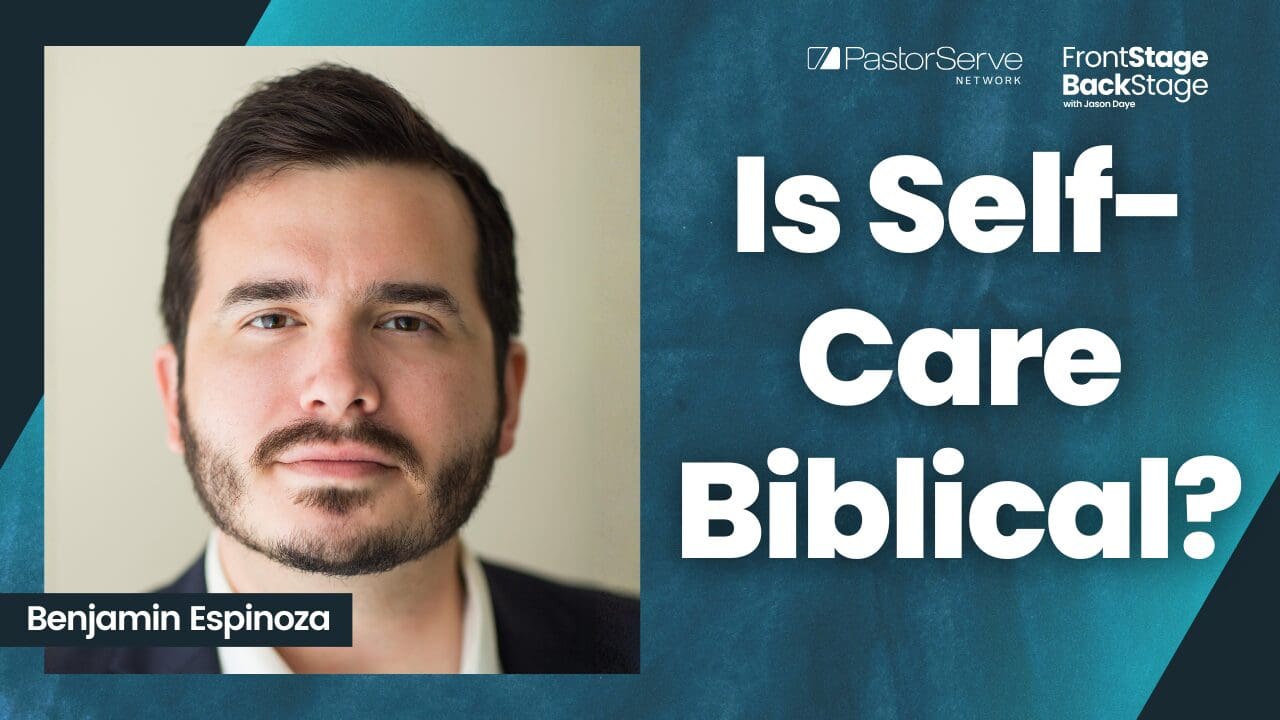
Pastor burnout rarely happens overnight. Benjamin Espinoza joins Jason Daye to explore why so many faithful ministry leaders find themselves depleted and whether self-care is not selfish, but a matter of biblical stewardship.
What happens when pastor burnout quietly takes root in the midst of faithful ministry?
In this episode of FrontStage BackStage, host Jason Daye sits down with Benjamin Espinoza, pastor, leader, and author of Good News About Self-Care, to explore the reality of pastor burnout and the deeper theological questions surrounding self-care in ministry. With years of pastoral experience and a heart for the health of ministry leaders, Benjamin offers a thoughtful and biblically grounded perspective on why so many faithful leaders find themselves running on empty.
Rather than treating exhaustion as a badge of honor, Benjamin invites pastors to reconsider whether caring for their souls is actually part of their responsibility before God. Together, they reflect on how ministry leaders can discern the difference between healthy sacrifice and unhealthy self-neglect, why burnout often grows unnoticed, and how a biblical understanding of stewardship reframes the conversation around rest, limits, and long-term faithfulness.
In this conversation, they discuss:
• Why pastors are especially vulnerable to burnout
• The difference between sacrificial ministry and self-neglect
• How self-neglect became spiritualized in church culture
• What it means to see your life and energy as entrusted by God
• Practical first steps for leaders who already feel depleted
If you are a pastor or ministry leader who feels stretched thin, this conversation will help you think more clearly about your limits, care more intentionally for your soul, and pursue a kind of faithfulness that is sustainable over time.
Connect with this week’s Guest, Benjamin Espinoza
Weekly Toolkit
Additional Resources
www.benespinoza.com – Visit Ben’s website to see his ministry in action, learn about his book, and access resources designed to help you grow deeper in your relationship with God.
Good News About Self-Care: How Nurturing Your Soul, Your Self, and Your Sanity Honors God – In his book, Benjamin takes us beyond the surface-level indulgences that dominate today’s self-care culture, presenting self-care as a deeply Christian practice rooted in our relationships with God, others, and society. He reframes it as an act of faithfulness and stewardship, showing that true self-care goes beyond pampering and instead fuels our mission to love God and neighbor wholeheartedly.
Ministry Leaders Growth Guide
Digging deeper into this week’s conversation
Key Insights & Concepts
- Pastors and ministry leaders often carry a desire to lay down their lives for the work of ministry. While this can be reflective of Christ’s love, it can also lead to unhealthy self-neglect.
- Pastoral ministry involves competing expectations, from the pastor himself as well as those within the church and in the surrounding community. Those expectations, mixed with growing skepticism of pastors within society, can contribute to burnout.
- Contemporary culture pushes toward ever-increasing productivity, but that is not a biblical standard. Following God includes receiving rest.
- Being aware of one’s own tendencies when stressed or living out of self-neglect is often the first step in appropriate self-care. Asking trusted others in one’s life for signs of unhealth, such as overwork, sleeplessness, over- or under-eating, attitude/mood shifts, and the like, can be a useful tool for increased self-awareness.
- As image-bearers of God, humans have inherent value, dignity, and worth. Caring for one’s body, mind, soul, and spirit as an image-bearer are necessary aspects of loving God and loving others.
- Contemporary culture often starts the conversation about self-care with the self. From a biblical perspective, appropriate self-care begins with one’s relationship with God.
- A right understanding of who God is, who oneself is in Christ, and the biblical truth about humanity are foundational to a right understanding of self-care. This understanding involves not just knowledge, but intentional investment in personal relationship with God and personal spiritual growth.
- Ultimately, self-care is a matter of stewardship that begins with God, not with self.
- Self-care involves self-awareness and consideration of relationships in four key areas: God, self, society, and others.
- Both work and play are important aspects of life. Having fun and investing in hobbies matters.
- Sabbath can be a form of resistance to societal pressures that seek to devalue and dehumanize. Similarly, solitude, including time apart from technology, can be a useful practice to separate from social forces that seek to do harm and that lead to division.
- Cultivating a relationship with God apart from the work of ministry is vital. While ministry work is part of one’s relationship with God and a way of loving Him, it is not the only part of relationship with God.
- Pastors and ministry leaders need to have interests, activities, and relational connections outside of their church.
- Self-awareness of one’s mind, heart, physical body, and relationships help prevent burnout. Systems of accountability and support help ensure this self-awareness and invite appropriate help from others. Built-in structures, such as planned times of vacation and study, are also useful.
- Receptivity to constructive feedback from trusted people in one’s life aids self-awareness. Cultivating honest, vulnerable relationships, both within and outside one’s church, is key in maintaining health.
Questions For Reflection
- What is my view about self-care? How does my view relate to a biblical understanding of self-care?
- What is my current state of health? What signs in my life indicate health or unhealth? Am I currently headed toward burnout? If so, what do I need to do about it?
- How am I intentionally investing in my relationship with God apart from the work of ministry? When and how do I receive rest and fill from God? How am I personally growing in Him?
- Who in my life sees me as I am, loves me as I am, and is willing to speak truth to me? Who in my life do I look to for honest, constructive feedback? With whom do I share my burdens? When did I last have a meaningful conversation with any of these trusted people? Is there someone I need to reach out to this week?
- How often do I evaluate my relationship with God? with myself? with society? with others? Are there structures or systems I need to put in place to help increase my self-awareness?
- How is my current physical health? What habits do I have to help me steward my body well?
- What are my current relationships like? Are there any relationships in my life currently that I need to let go? Are there any relationships I need to seek out?
- Is my personal understanding of God’s call on my life and ministry accurate? Do I accept the limitations of humanity? Are my personal expectations in line with God’s truth? How would I know? What might I need to pray about? Who might I need to invite to help me with discernment in life and ministry?
- How do I currently handle the competing expectations that come with ministry? Is there anything in my current ministry that needs to change? What might I need to delegate, stop, start, or have a conversation with someone else about? Who can help me discern those areas?
- What does my life outside the church walls look like? What hobbies or interests do I have? How do I personally experience play, and how often do I engage in it?
- What is my relationship with my elder board and congregation like? Do I feel safe to be honest with them? Do I allow myself to be held accountable to them? Do they encourage me to have healthy life rhythms, including appropriate boundaries for the work of ministry? Does anything in our current structure need to change?
- How can I help members of my church have a biblical understanding of self-care? How can our church help disciple one another in what it means to be an image-bearer of God? How can we foster a stewardship mindset when it comes to self-care?
- How can our church resist the cultural messages that dehumanize? How can our church resist the cultural messages that make the self a god? What impact would doing so have on our church? What impact would it have on our local community?
- How can our church demonstrate the importance of both work and play? How can we point to rest in Christ as well as the invitation into His kingdom work?
- What does our church’s current approach to ourselves, God, and others show about who we believe God to be? How can we live in ways that demonstrate His abundance and love? How can we accurately reflect who God is through the ways we approach God, care for ourselves, and invest in one another?
Full-Text Transcript
Jason Daye
Hello friends and welcome to another episode of FrontStage BackStage. I’m your host, Jason Daye. I have the privilege, the honor, of sitting down with a trusted ministry leader and really engaging in a conversation to help you, and pastors and ministry leaders just like you, truly thrive in both life and leadership. If you’re joining us on YouTube, please give us a thumbs up. Drop your name and the name of your ministry in the comments below. We love getting to know our audience and praying for you and for your church or your ministry. And whether you’re joining us on YouTube or your favorite podcast platform, please be sure to follow or subscribe so you do not miss out on any of these great conversations. I’m excited this week because I will be joined by Ben Espinoza. Ben has served in a number of executive level roles at Roberts Wesleyan University. He currently serves as lead pastor at Avon Wesleyan Church in Avon, New York. His most recent book is entitled Good News About Self-Care. At this time, I’d like to welcome Ben to the show. Welcome Ben.
Benjamin Espinoza
Thanks so much, Jason. It’s a joy to be here. Just FYI, so my church’s name is now Riverstone. Wesleyan Church. We just changed the name a little while ago. So
Jason Daye
All right, congrats!
Benjamin Espinoza
I’m sorry about that and everything, but yes, that’s who we are, Riverstone.
Jason Daye
No worries. Okay, good to hear. That’s always exciting when you take a church through, you know, renaming, and I’m sure you’re going through all that visioning and all that fun stuff. So exciting, we’ll be praying for you. Riverstone, it is?
Benjamin Espinoza
Yeah, Riverstone.
Jason Daye
Riverstone, awesome, Ben, thank you. Oh brother. Super excited about today’s conversation. I really think it’s going to be a great benefit and encouragement to all of you who are tuning in. Super excited. Ben, I would love if you could kind of start for us by sharing a little bit of your own experience. When did you first realize that kind of your own approach, how you were engaging in ministry, wasn’t sustainable, that there was something amiss? Can you tell us that story?
Benjamin Espinoza
Absolutely, Jason. First of all, such a pleasure to be here with you. Big fan of PastorServe. But really, the self-care journey starts in 2020, right? Everybody’s favorite year. So let me tell you about the very beginning of my 2020, Jason. So my wife and I were finishing up our PhDs at Michigan State University. My wife was pregnant with our second son. I was just offered a big administrative role at a Christian university overseeing online education. We moved in with my in-laws because the university was literally in the town that my wife grew up in. So I start, you know, commuting back and forth between Michigan and New York, and then in March 2020, the pandemic happens. Right? Everything gets thrown about. No one knows what’s happening, mass hysteria, mass confusion. And around this time, I got really, really stressed because of all these things that were happening. So in April, I started to get these bumps on my hands. And like any mature, wise adult, you know, I go to Doctor Google, WebMD, to self-diagnose, right? Come to find out that these are stress bumps, right? I just put some cream on them. It’s okay. They’re going to go away. And then the next month, I start to get these eye twitches, which I started to really catastrophize and say, Okay, what is this? What is happening to me? Something really wrong must be happening to me. And then the month after that, I started to get this intense back pain, which just emanated all across my body. Before you know it, Jason, I wasn’t able to sleep. I was hardly able to work these kinds of things. We had the global pandemic, trying to figure things out. I was so stressed out. And I don’t know if you’ve gone more than a couple days without sleeping, Jason, but if you go more than a couple days without sleeping, like reality and your imagination start blending to get blending together. So my body was just depleted. And I was like, you know, I have to go get some help. So I go see my doctor, and he runs a bunch of tests. He examines me, and he’s like, Ben, you’re healthy. There’s nothing wrong with you. And I’m like, Are you kidding me? Like, literally, like, I hope you’re doing your job here, man. Because, like, I am literally in pain. But what he said is, like, look, look at your life. You’re finishing up your doctorate, you got this big administrative job, you’re having your second kid. We’re just trying to figure out what’s going on with this pandemic thing. It’s like you have a lot of good stuff going on wrapped up in a global pandemic. So I started to get some therapy, get some spiritual direction, and that just led me to this journey of self-reflection, Jason, and thinking, you know, how come I couldn’t handle those challenges, right? So I started to just examine my life, and just saw this pattern of ambition and drive and this desire to achieve, and how that really took its toll on me, like I really didn’t know how to take care of myself. So really, well, I wrote this book because it’s a journey that I was on, it’s a journey that I’m still on, and I want to help people better learn how to steward the gift that God has given the world in us as His image bearers. So that’s the origin story of this book.
Jason Daye
Yeah, yeah. Absolutely love it, Ben, thank you for sharing. One of the things that I’d like to spend a little bit of time on is this, this idea that it seems that we as ministry leaders are somewhat, in some ways, more vulnerable to moving into these periods or seasons of depletion.
Benjamin Espinoza
Oh, yeah.
Jason Daye
Why, why is it that we are challenged in this way, or maybe miss it, or don’t recognize it, like you say, this idea of depletion,
Benjamin Espinoza
Absolutely, so I think there’s a few different reasons. You know, whenever you get into ministry as a pastor, your desire is to preach, to teach, disciple, to grow the church, to watch people come to faith in Christ, you know, just follow Jesus, start evangelizing, equip the saints, these kinds of things. This is your vision. And a lot of us tend to be a little bit more romantic and idealistic, right? You know, Christ has laid down his life for the church. He’s given his life for many; I’ve got to do the same, if Jesus is my example. But when you get into ministry, you know, a few different things are happening. And let me just touch on this, too, Jason. So number one, the one of the things that I see right, as I mentioned, is these expectations that you have. I got into ministry because I believe there’s a call on my life to do these very specific things. But then you get into church and realize that other people have a call on your life, too, right? So you got to be the CEO, the vision caster, the storyteller, the activist, the community organizer, the scholar, the thought leader, the TED talker, right? They want somebody who can be in the office nine to five every single day, managing the church while simultaneously somehow being in coffee shops, meeting with people, leading people to Christ, right? So you have this juxtaposition, really, is contradiction of expectations that people have for our lives. I think another thing, too, is, as you see in our culture today, there really is a skepticism toward ministry leaders. I think it was a Barna poll or a Gallup poll. I can’t remember, but I saw that only 27% of American adults trust pastors, whereas in the early 2000s, it was like 56% or something like that. So you have these competing expectations of what a pastor supposed to do. You have a rise in skepticism toward the pastoral role. And then finally, you have pastors who are thinking, Well, you know, life would be just a lot easier if I was able to get out, get a secular job, get my bills paid for, and I could do ministry on the side. So you have not only this desire to lay your life down, but you have all these different competing cultural and religious forces outside as well. And I think that this creates a recipe for burnout, and you see it time and time again. Jason, I don’t need to rehearse all the statistics out there about how many ministry leaders in the past year, the past few years, have said to themselves, I might want to leave ministry. I believe God has a plan for my life that I would be in ministry, but I just can’t handle it anymore. So I think it’s a personal commitment that we have to lay down our lives to serve, to pour out ourselves for the sake of the church and seeing many come to know Christ, but you also have these competing forces that make it very difficult to have a long-term ministry.
Jason Daye
Yeah, absolutely. And I can imagine those watching and listening are all nodding their heads as I was nodding my head with you, right, like, like, this is real. This is true. This is life, this is life. So Ben, help us understand when or how do we maybe notice when we’re moving from kind of healthy, faithful ministry and service to this, this, this place of unhealthy sacrifice.
Benjamin Espinoza
That’s good. So, so one of my therapists told me, you know, I was taking on a different kind of role, and my therapist was like, you know, Ben, what I want you to do is, I want you to talk to some people in your life and ask them when Ben Espinoza is at his worst, he looks like this and he does this. Ben Espinoza gets cynical, he gets tired, he gets cranky, those kinds of things. I think that pastors need to ask themselves and ask people around them, you know, when I’m not functioning in a healthy space, what are the signs, right? So for me, you know, I had this conversation about a year ago with my team, and I was like, Okay, I see a trajectory right here in the future. It’s not today, but I see a trajectory where I’m heading toward those signs. I’m starting to feel it right now, so I need to do some self-evaluation. So I would say, Jason, you know, pastors just need to be self-aware about what their tendencies are. Is it toward overwork? Is it towards sleeplessness? Is it toward overeating or not eating at all? Right? You know, when you get out of whack in ministry, you know, how are you going to get back into whack? I guess you could say. So, pastors just need to be self-aware of their own tendencies, and that is a lot of self-reflection and having some very honest conversations with your leadership team, with your board, and saying, Look, I’m seeing some things in my own life that concern me, and I don’t want to bring the church down with me. But here is what I’m going to need. And that takes so much humility, because, as you know, Jason, you know, pastors are put on this pedestal by so many people, and we don’t want to let people now know, and we have a hard time with vulnerability as it is. I have to have my life together. I’ve got to be above reproach. I need to be able to lead the flock of God. I have to be holier than everybody else. People are expecting that of me, right? But I need to be self-aware and say, Look, I’m a human. I depend on the grace of God. And here are the signs where I could tell that, that I’m just not in a healthy place.
Jason Daye
Yeah, that’s good, that that’s super helpful. Then, you know, it seems that at some point this idea of self neglect almost became spiritualized, right in parts of our church culture. Ben, I’m curious, how do you think we got to that place where we almost normalized or spiritualized even the idea of self neglect?
Benjamin Espinoza
Oh, wow, that’s a that’s a really good question. I would say, you know, going back to what I was saying earlier, Jason, that there, there’s so many expectations out there placed on the pastor, right? And part of it, I think, is people have these visions of what pastoral ministry needs to be and what it needs to look like. You know, I always tell people, you know, to be a politician or a pastor or to be like a school principal, like, those are the jobs where people know how to do your job better than you, yeah. So I think it comes from, okay, we’re paying our pastor a lot of money. We’re giving he or she all these different kinds of resources here, I want to make sure I’m getting a return on my investment here. Is the church growing? Is it healthy? You know? Do we have more presence? You know? Am I hearing about the church in the news, doing good things, those kinds of things. So I feel as though, you know, consumerist, capitalist culture, you know, we are, we are pushed to produce more and more and more and more. And we don’t have a lot of people in the church or in ministry leadership saying no or resisting that, you know, whereas when you look in Scripture, you know, God institutes Sabbath. It’s like you’re not going to work, neither are the people working for you. Your animals aren’t going to work, and the land’s not even going to work too, because I don’t want you to burn out. So when, when you look at, you know, the Israelites in Egypt, I mean, they’re, they’re working day and night, day and night, and the gods of Egypt were the ones that basically said that this was okay. Pharaoh said this was okay. He had a very dehumanizing theology. And yet God comes along, Yahweh comes along and says, Look, you know, you are created in my image. You are my image bearers, and I’m not gonna let this happen anymore. You’re gonna have a Sabbath. But we don’t have a lot of folks in our churches and our in our community saying no to that posture there. So that that’s one theory that I would have, sort of like the rise of, you know, celebrity pastors that are out there. I want the church to grow. I want to see it succeed. My pastor has to lay down everything for the sake of the church. But then also, we don’t have a lot of folks who are pushing against that and saying, No, we don’t want to see that happen to our pastor. We don’t want to see it happen to our church. That’s one theory I have.
Jason Daye
Yeah, yeah, no, that makes sense. And we’ve all probably seen that. We’ve all, you know, probably felt that to some degree as well. Goes back to those expectations we talked about. One of the things that I love that you bring up in Good News About Self Care, your new book, is how you kind of reframe this idea of self care, because sometimes this idea of self care, it can be taken in one direction. You know, we’re talking about hanging out the spa and being pampered, right? Yeah, so it can be taken and so sometimes we resist it, because, you know, that’s where our mind is going, and we’re like, hey, we only have one life to live, one life to give. We’re in this for the cause. You know, all of those things. But you you begin to help us reframe the idea of self care, around stewardship and around faithfulness, then I’d love for you to kind of unpack that a bit for us, and help us think through this in some healthy ways.
Benjamin Espinoza
Absolutely. So one of the things I talk about in the very beginning of the book, Jason, is just the idea of how we are created in the image of God. We are image bearers. We are worthy of dignity, love, honor. We have value to God. And in a sense, we are gifts, right? So one of the things I talk about is when you look in the garden, you know, God creates human beings to to tend the garden, to govern it, to steward it, right? You fast forward to the like, the fact that God has created his church to be his witness, his representative to the world, right? So if we are image bearers, and we are looking to the perfect image of God, Jesus Christ, then it makes sense that we also need to steward the fact that we are created in the image of God. And we have to recognize that that we have value, we have worth, and without caring for ourselves, we can’t possibly care for other people either. You know, I, I say this in the book. You know, the two greatest commandments are to love God with everything that you are, but then also love your neighbor as you would love yourself too. We say love God, love neighbor. We also forget that love yourself piece, right? So it really is a matter of stewarding this gift that God has given us, which is our bodies, our minds, our souls, our strength, right? And how are we using that to effectively love God more and love our neighbors as ourselves? Because if we’re not stewarding what we have here, we can’t love God effectively, and we can’t love others effectively either. So that’s my own theological bent in this book is self care as a matter of really good Christian stewardship of our bodies, minds, and souls.
Jason Daye
Yeah, that’s, that’s good. So how do we then resist the potential temptation to kick it into cruise control? Right? Because that’s, that’s the other extreme. One is burnout. Other is just kind of coasting and making it happen. So, so where do we find balance in that?
Benjamin Espinoza
Yeah, so it’s interesting, you know, I think in the Christian world, there are a couple different perspectives here. I think one is, you know, you don’t really need self care. You’re a sinner. You got to repent, give your life to Jesus and be selfless, right? And then you also have, like the spa days. You know, self care is an active resistance, and I have to care for my body, because that’s more important than anything else. And I think we have to to find a middle ground where it’s like I have spiritual needs, but I also have physical needs as well. And I think in our churches, you know, we tend to lean more toward the spiritual right. We don’t think about overeating or under eating, we don’t think about rest, or we don’t think about work-life balance a whole lot. If we have a good relationship with God, everything’s going to work out there. And I partially agree with that, but I think and sometimes we create this dualism, as I mentioned, as you mentioned, Jason, right? So the way that I conceptualize it in the book is that there’s four relationships that you have to be attentive to. First one is your relationship with God. And that sounds so simplistic, but when you look at self-care literature out there, a lot of it, which is good, starts with the self, a lot of self exploration, a lot of self reflection, self awareness, and that’s good from a Christian perspective. That comes second, you know, am I in God’s Word? Am I communicating with God in prayer? Am I living a life of worship and gratitude? If those things are out of whack, Jason, everything else is going to be out of whack, right? And then you start to look at yourself, you know? So the second relationship is relationship with yourself, right? So physical, am I taking care of my body, mind and soul, right? Emotional? Am I taking care of my emotional life, the anxiety, the worry, the stress, depression. I’m mindful of those things. Am I demonstrating a playful spirit? You know, the Lord created us for work, but also for play. And I coined this term, I think, in the book playlessness, right? Playlessness, you playfulness, but playlessness, you know, it’s like, it’s like, I mean, I’m not having any fun. I don’t have any hobbies. My wife gets on me all the time. Ben, you need hobbies. It’s like, well, I write books on the side. And, yeah, it’s not really a hobby. That’s not really a hobby, that’s work. And then you have to think about your relationship with society. So I talked about, you know, Sabbath as a form of resistance to these impulses that devalue us. And solitude, you know, limiting technology, disconnecting from social forces that would seek to do us harm and divide us, and then finally, about our relationships and making sure we have a healthy relationship with work, with our particular season in life, but also with the people around us. So I think the way that you bring this all together is by making sure that those four quadrants of your life are adequately cared for, right? Because I think a lot of us in the church would say, Okay, your relationship with God is what’s most important. Think others would say no, who you associate with that’s really important, or how you relate to society, that’s really what it’s all about. So people have that perspective, or really, it’s really all about here, what you’re doing kind of in your soul, just that really this me kind of centered self care. So the way I think you cut through the noise is you make sure that all four of those relationships are quality, they’re healthy, and it’s all founded on your relationship with God first and foremost.
Jason Daye
Yeah, it’s good. I love the way that you you break that down, very practical. And speaking of practical, Ben, let’s think of, you know, average week in the life of a local church pastor. What does healthy sense of self care look like in very practical terms for for a pastor? Not that this is a system or a formula.
Benjamin Espinoza
You know, I have it all figured out.
Jason Daye
Yeah, exactly, exactly.
Benjamin Espinoza
I really don’t. I really don’t. So one of the things that I, that I talk a lot about in the book, is, is really baby steps, right? I let me, let me talk specifically to pastors. Like, how tempting is it, Jason, to consider your sermon preparation as a devotional? Yeah, right. I’m reading this. I’m preaching through Luke right now, and it’s like, okay, this sort of functions as work, but also my devotional life, right? But in reality, it’s like the like, the two can be connected. You can love God with your mind through sermon preparation, amen. But I think there’s something to be said about having a strong devotional life, too. So for pastors, that’s got to be part of it. So when you say you’re going to pray for people, you have to actually pray for them and just pray to God and have a great relationship with God without any agenda. So you know, the more that you can do to cultivate a strong relationship with God in ministry, apart from the work of ministry, I think you’re going to be better off, because, as we know Jason, there are pastors out there who do a dynamite job in ministry comes out their relationship with God is is really out of whack. And as a result, everything else gets thrown into a tailspin. They burn out. They have a moral failure. So I think it’s really, really important for pastors to look at their devotional lives, their spiritual lives, their prayer lives, but also looking at their physical habits too. You know, it’s interesting. As pastors, you get invited out for meals all the time. And I’ve heard stories of pastors who just, you know, gain a lot of weight. They start to eat more of the delicious casseroles that their people make and everything, and that’s good. You have to have fellowship and all that, but you have to pay attention to what’s going on your body as well. And I would say too that another thing is that pastors do need to just have have a life outside of the church. You know, you need to have friends that you can talk with, friends that can hold you accountable. One of the things I talk about in the book at the very end is just how tempting it is for us in the church to say, Well, I’m called to love everybody, even the difficult people, even the people that don’t love me back, even the people that drain me. But as I started to research it, Jason, there’s a lot in Scripture about the kinds of relationships that you don’t want to have, and it’s just it just piles on right? So have a loving posture, peaceful posture, toward everybody you know. Be at peace with everybody, as much as depends on you, but there are certain relationships that you want to stay away from and that I think that requires discernment. Is this person draining me or depleting me? Am I letting that happen? Is there some way I can delegate this relationship to another member of my staff? What are the steps that I need to take to protect my soul? Is there accountability that I need to have? So it sounds cliche, Jason, but I’m going to say it over and over again. Pastors need to be self aware of what’s going on in their minds and their hearts and their bodies and their relationships, because if they’re not, you know that ecosystem can get more and more fragile and you can burn out, and you’re going to take the church with you. And that’s another thing I would say too, is if you’re not attentive to your soul, then the possibility of your church crumbling, just, you know, increases exponentially, right? I don’t have to rehearse it. Jason, like I said, pastors who grow ministries, who are successful in the eyes of the world, who have these priorities out of sync in their church and ends up going down with them. So those are the few things that I would say in the week of a pastor, you have to be honest with yourself and make sure that you’re cultivating strong relationships with God, with yourself, with society, with other people, almost apart from the actual work of ministry,
Jason Daye
Yeah, yeah. I like that. I like that. Man, that’s good. A couple things that you’ve said in this conversation, I want to kind of bring together. Earlier on, you’re talking about that, the idea of how you ask those who are close to you, What do I look like when I’m not at my best, right? And what are some of those signs? You know, those are some of those signs. And then we’ve just talked about this idea of, you know, the importance of self awareness. You know, in of ourselves, how do, how do we lean into self awareness? Because it does take humility. You’ve mentioned that it’s, it does take vulnerability. Oftentimes, in ministry, we feel like we’ve got, already got enough critics right now we don’t need to invite anymore into our lives. So, so what does that look like for us to really nurture and foster this idea of self awareness both internally, but also among those around us?
Benjamin Espinoza
Yeah, so, Jason, haters are gonna hate, right? You’re always gonna have your critics, right? But, you know, I would lean into people who have your best interests at heart. You know, you know, Ben, you have spinach in your teeth, right? I you know, as difficult as that might be to hear that you have something stuck in your tooth, it’s like, I don’t want you to embarrass yourself any further. So I think it’s having the right posture toward feedback. And I think pastors, you know, I know a lot of pastors who struggle with, you know, criticism and opening themselves up to people. I’ve seen pastors get vulnerable only for that vulnerability to get used against them. That’s happened to me, and just just a few different ways. But I think it’s, it means developing strong relationships with people who love you, who care about you, who want to see you succeed, who want to see the church succeed, and are willing to just have hard conversations with you. Some of the best conversations I’ve had with people in ministry are you know, Hey, Ben, I really love that you do these things. I wonder if you might consider doing something different here. And realizing, you know, it’s not out of malice, it’s not really out of, you know, any character fault of my own. It’s just something that that could make my ministry even stronger, right? It’s like, you know, like, if you’re playing sports, right? It’s like, help me. For instance, I’m a golfer, so it’s like, okay, you know, help me understand what’s wrong with my swing. Here are my hips kind of swinging out too fast, or am I not looking at the ball? Is my stance kind of messed up? It’s that kind of thing, right? I want you to hit a really, really good shot here. I’m going to give you some feedback, some things you might not be aware of right now, because I want you to hit the best shot of your life. And to me, that’s what it that’s what it comes down to, is having people in your life strong relationships, with people on your board, on your team, even outside of the church, that that you can go to and say, Okay, what are a few things that you you’d like to see me do? So some things that you’d like to see me work on? I think pastors tend to be workaholics, for better or for worse. So you know, you got to have people in your life that say, okay, Pastor Ben, I’ve noticed that I got this email from you at 1am something is wrong. Let’s talk about it. I’m not concerned about the issue that you sent. I think it’s good, we’ll talk about it. But why do you have to send that email at 1am? Those kinds of things. So it starts with relationship and just recognizing that there’s a difference between like a character criticism and like a performance criticism, and it’s the line is so thin, Jason like, it’s really difficult for a lot of people, myself included, to even differentiate. The better that you can get at differentiating between, you know, somebody an attack on your character, but also somebody who wants to to make sure that you’re performing at your best and your strongest because they love you and care about you, you have to discern where exactly that line is.
Jason Daye
Yeah, that’s good. And every pastor, every ministry leader, needs to find those people absolutely for their lives, right?
Benjamin Espinoza
It’s hard. And I’ll say this too, you know, I’ve heard some different schools of thought, of folks who would say, like, you can’t really have a lot of friends in church, you know. Or, you know, you have to be friendly with everybody. I don’t know where I land on that yet. I just, I pray Lord bring good people in my life, if they become great friends, great. If not, make that clear, you know. But it’s something I still wrestle with. It’s something that I haven’t, I haven’t perfected, of course, but I think that’s where you have to depend on the Lord to bring those people in your lives. And to make it really clear that this is a person who loves you enough to offer you some constructive feedback.
Jason Daye
Absolutely, yeah, I love that and that, and that’s that idea of again, being, being aware of even being aware of that need in your in your life, absolutely, that you need those key people in your life, and that it’s a blessing from God when you have the opportunity to journey with with those type of people. Ben, Ben, as we’re thinking about this idea of depletion in ministry that we can sense and we can feel when we’re neglecting that that self care. What would you say to the pastor who might be watching right now, listening right now who says, you know, honestly, I don’t even know what could replenish my my soul, my life right now?
Benjamin Espinoza
Yeah, that’s a good question. I would say, you know, at that point, talk to your board, talk to your team, because if you’re at that point of burnout and depletion, you haven’t had the right systems of accountability in place to help you avoid getting to that point. So I would be honest with your board, with your team, and say, you know, I’m feeling really burnt out, and I might need to take a short sabbatical, just a week or two off right now. But while I’m doing that, can we put together a plan in place that I don’t hit this block again, right? I think that it requires a lot of humility, because, you know, a lot of, and I’ll be honest here, there’s a lot of folks in secular professions who are like, well, I don’t have that luxury of telling my boss, Hey, I’ve worked too hard, you know, right? At the same time, and I was talking with with a parishioner like the other day, there’s, I think, just yesterday, I think, and she was saying, you know, people don’t understand, like the weight of pastoral ministry, right? You not only have to perform well, but you have agony for people in your care, about their holiness, their ability to understand God’s Word. You know, you’re responsible for their souls, right? And that’s weighty. You know, I spent a lot of time training assistant pastors who want to be lead pastors, and the first lesson that we say is, like, look, there is a weightiness, right? Going from, and I’m not ranking ministry positions here, but going from like the part time youth volunteer to the youth pastors, one jump, then going from like the youth pastor to the executive pastor is another jump, but then going from executive pastor to lead pastor, yeah, that’s a whole other level of things, right? So people understand the weightiness of of it. So I would just be honest with with a board who doesn’t get it, and say, Look, I have these burdens on my heart. I want to make sure I can care for my flock. I’m at my wit’s end. I need something from you right now. I need to take a sabbatical, something short, help me work through what that looks like, and then help me develop systems that we can rely on so that I don’t get to this place anymore. And I think most boards are going to feel good about that. Yeah, I think most boards, they don’t want to go through another pastoral search. They don’t want to fire a pastor, but they want to say, okay, how can we best love you and serve you. And I found in those kinds of situations, Jason, that the boards consider it an honor and a privilege, you know, that you’re so vulnerable with them. Whenever I’ve opened up to other pastors or board members, Jason, they’re like, Thank you for sharing that with me. You know it creates a bond, right? Because we’ve all felt experienced those things. But yeah, that’s what I would say, if you’re listening right now, if you’re burnt out at your wit’s end, you got to get help from people in your church. You have to start seeing a therapist. You got to get good spiritual direction. You need to work with people that can help you, keep that keep you accountable, and get the right systems in place so that doesn’t happen to you, and it doesn’t happen to the pastor after you, or another member of your staff.
Jason Daye
Yeah, yeah. No, that’s that’s good and and then as you’re talking about being vulnerable and opening up with your elders, with your church board, you know, with your team, whatever that looks like. Another thing that that I’ve noticed is that that really invites people to go to a deeper place, a fresh, healthy place. It gives it’s, it’s, it’s a way of of ministering in and of itself, just by opening up and being vulnerable. It’s a way of ministering to the leadership of your church and inviting them into that, right?
Benjamin Espinoza
That’s right, absolutely, yes. You know, I’ve always been a fan one of my therapists. I feel like I have many therapists I’ve seen a few therapists, right? I’ll put it out there. Said, you know, conflict creates intimacy, right? Or, you know, like you hear the term trauma bonding gets thrown around a little bit when you share the deepest parts of yourself, your struggles, your hurts, your pain, your trauma, with other people, it allows them to open up too. Jason, you know, I was speaking at a conference, you know, three or four years ago, and I was the vice president of the conference, so I was responsible for the conference theme and kind of opening things up. And I had this throwaway line about how, you know, many of us in this room are probably dealing with unhealthy coping mechanisms, and it wasn’t in my speech or anything. I just threw it out there, and I had like three or four people come up to me saying, Hey, thank you. I’ve really been struggling with this or that, and this is the first time I’ve been able to acknowledge it. So being open and vulnerable like you’re right, it invites those kinds of opportunities for ministry that the Lord’s going to use in powerful ways.
Jason Daye
Yeah, I love that. That’s good. You mentioned this idea of some systems of accountability, some things that to put into place that can help you so you do not get to this place of depletion, burnout, all this, but really embrace some healthy self care. I’d be curious, I’m sure that people listening might be curious as well, what are some of those systems that you have found maybe helpful in your own life, or you’ve seen in the lives of other pastors or ministry leaders?
Benjamin Espinoza
Yep. So you know, I think, first of all, you know, it’s less of a system and just more, like we talked about, like, openness, vulnerability with with your board. So every month, I write a report for my board. Here’s what’s happening in ministry. Here’s sort of my extracurricular as I serve on other other boards. I’m doing my my book project here, and I’m just honest about, like, a self like care check in, you know, here’s what I’m experiencing, here’s what I’m feeling. You know, a couple months ago, a few months ago, my son broke his leg, and it was a whole dramatic thing, and he was in a cast from his chest down to his toes for I felt, felt like forever, right? So that took, it was a different adjustment for our family, just the way that we set up our lives, and I was really honest with my board, and I said, you know, hey, I’m not going to be going to everything. I’m not going to be as involved as I normally am just because of this situation happening with my family. So just the act of writing a report and saying, here’s what I’m doing in ministry, here’s the extracurriculars, here’s how it’s going with my soul, I’m getting better and better at just sharing those kinds of things. The other thing I would say is make sure that you have the structural things in place, right? Making sure that your compensation package looks good. Money is always a hard thing to talk about for pastors, right? But you know, if you’re trying to do ministry and you’re worried about your finances, your ministry isn’t really going to be as effective. So I would encourage pastors to have open conversations with your board about compensation packages, and I would say part of that package is vacation time, or even, like a reading week, you know, a vacation time where you can go and, you know, enjoy time with your family, but have a couple weeks of just reading and studying. And nourishment, right? And really share with your board that this is where you get a lot of life, and this is where you can, you know, refresh your relationship with the Lord. The other thing that that I would say too, is, you know, be honest with your board, with your leadership team, about the other help that you’re getting, right, about therapists, about spiritual directors. So I would just be be honest about those things. So those are a few of the systems, right? And it’s nothing, nothing laborious, like, like, when I say, I’m like, Oh, these apps are open and everything, and these tabs, and here’s my blood pressure, here’s my cholesterol, all those kinds of things. It could get that granular. I think that’d be kind of interesting to explore, actually, but, but I think it comes ultimately, Jason, it just comes down to being honest about where you’re at, and inviting other people to be honest about where they see that you’re at. I have board members say, you know, Pastor Ben, you know, we have this interesting, this ministry opportunity, and I want to hear how this would affect you personally. And that comes with a strong relationship and just being open and honest. So I haven’t perfected it. It’s something I’m still working toward. But I do think that there’s something to be said for just that open dialog of communication with with your board about what’s happening, making sure you have like monthly accountability through like a report, making sure the package looks good, your time off, that those kinds of things are clear. And just be very clear that, hey, you know, before I can care for the church, I’ve got to care for me.
Jason Daye
Yeah, it’s good. That’s that’s those, those tools, those ideas, are super helpful. Then, as we’re kind of winding sounds been fantastic conversation, incredibly helpful. Thank you. You have the ears the eyes of men and women in serving in ministry, as you reflect on kind of your journey in ministry itself, but then also your journey in writing this book and putting all this together, processing through this idea of self care and the good news about self care and what that really means for us who are serving in ministry. What what encouragement or what insights would you like to be sure that you share with those who are serving in the front lines of ministry?
Benjamin Espinoza
That’s good. So one of the backbones of my book is looking at the life and ministry of Jesus. So Jesus is teaching, he’s preaching, he’s healing the sick, he’s feeding the poor, he’s announcing the kingdom. He’s equipping his disciples. But then you get these, these parts of Scripture where it says that he retreats and he spends time with his Father. You get these parts of Scripture where he’s at a wedding and he tops up everybody’s wine glasses. I’m not sure how kosher that is, with your audience, but he turns water into wine for people to celebrate. You see Jesus, you know, consorting with the tax collectors and the prostitutes and Levi’s home, right? He’s enjoying activity with them. And he’s also very aware of his limits, too. And Jesus is 100% God, 100% man. I don’t need to talk about the finer points of that, of that theology with your audience, Jason, but you know, he had a particular time on earth to do particular things. You know it says, you know, one of the Gospels, he tells his disciples, he says, I have many more things I could tell you, but that’s going to be the Spirit’s job. In the high priestly prayer, he said, I’ve I’ve cared for the ones that you have, you have given me, right? So Jesus understood limits to his ministry. So Jesus, like understands, I mean, he gets hungry, he gets tired, he weeps, you know, he drinks, he’s hanging out with people. He has a very limited time on Earth, and he understands the limits of his mission. If Jesus experiences all those things and he cares for himself, then you need to do that too. You are not Jesus. Jesus has gone before he’s defeated the powers that be. He has proclaimed victory on the cross. He rose again from the dead. He is sitting at the right hand of God, the Father. We are privileged to be a part of this ministry. We are not Jesus. So since we are not Jesus, you know, how much more do we need to care for our physical selves, our relationship with God, making sure that we’re spending time with prayer, making sure that we have the right limits on our work life balance the right limits on our on our ministry scope and our relationships. How much more do we have to care for ourselves if Jesus cared for himself the way that he did?
Jason Daye
Yeah, absolutely so good brother. Wow. It’s been a great, great conversation. I want to encourage everyone who’s watching, listening in, we do have a toolkit that accompanies this episode. In every episode, you can find that at PastorServe.org/network, in that toolkit, you will find links to Ben’s newest book, Good News About Self Care, other resources, a ministry leaders growth guide pulls insights out of this conversation and also questions for reflection that you can work through yourself, work through with the ministry leaders at your church, as Ben encourages us to do and have some of these important conversations so that we can take care of ourselves, so that we can care for the people God’s entrusted to us. So you can find that again at PastorServe.org/network. Ben, it’s been an absolute pleasure. Thank you for making time to hang out with us here on FrontStage BackStage.
Benjamin Espinoza
Thank you, Jason. It’s been a blessing. God bless, awesome.
Jason Daye
God bless you, brother.
Jason Daye
Here at PastorServe, we hope you’re truly finding value through these episodes of FrontStage BackStage. If so, please consider leaving a review for us on your favorite podcast platform. These reviews help other ministry leaders and pastors just like you find the show, so they can benefit as well. Also, consider sharing this episode with a colleague or other ministry friend, and don’t forget our free Toolkit, which is available at PastorServe.org/network, this is Jason Daye, encouraging you to love well, live well, and lead well.
Recent Related Episodes
-

Posted On: June 10, 2025
-
Posted On: January 7, 2025
-
Posted On: August 8, 2022
Right-click, then select “Save Image As…” to download one of the social graphics.