
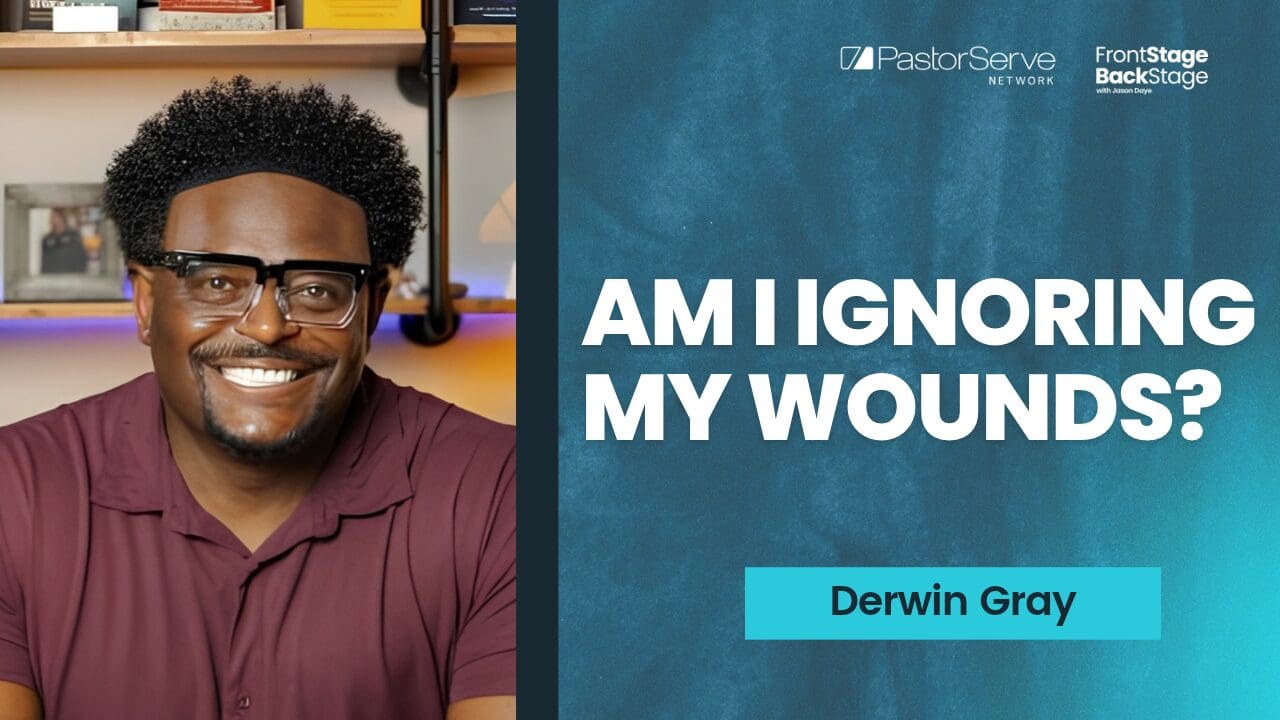
Pastor and bestselling author Derwin Gray explores how unresolved wounds can remain hidden beneath fruitful ministry, quietly influencing the way pastors lead, relate to others, and experience God’s healing.
Can pastors be genuinely fruitful in ministry while carrying unresolved wounds that are quietly influencing how they lead? What if the very ministry we’re pouring ourselves into is also helping us avoid the pain we haven’t addressed?
Ministry can become an unexpected hiding place for our wounds. We continue preaching, serving, caring for others, and seeing God work through our leadership, even as unresolved pain quietly influences our motivations, relationships, and responses to the people around us. And when ministry appears to be going well, we may have even less reason to recognize what’s happening beneath the surface.
In this episode of FrontStage BackStage, Jason Daye welcomes back pastor and bestselling author Derwin Gray to explore the connection between emotional healing, spiritual formation, and healthy pastoral leadership. Derwin is the co-founding and lead pastor of Transformation Church, a former NFL player, and the author of It’s Time to Heal. Drawing from his own journey, he shares why outward fruitfulness doesn’t necessarily mean we’re experiencing inward health.
Together, Jason and Derwin explore:
- Why the more fruitful our ministry becomes, the easier it can be to overlook wounds that still need attention
- What Derwin discovered about himself in the NFL that followed him into pastoral ministry
- How the desire for affirmation and approval can quietly influence what drives us as ministry leaders
- What our reactions to criticism, conflict, and being questioned might reveal about wounds we haven’t addressed
- Why becoming a better preacher or more effective leader may not be what our world needs most from pastors right now, and what it does need
- How the wounds we haven’t healed can quietly influence the way we shepherd others, and what begins to change when we lead from a place of healing
Pastors and ministry leaders can spend years helping others find healing while never recognizing how much of their own pain they’re still carrying. But the wounds we leave unattended don’t necessarily stay hidden, and they rarely affect only us. This conversation is an invitation to consider what may be shaping your leadership beneath the surface and how allowing Jesus to meet you in those places can change not only your own life, but the way you care for others.
Connect with this week’s Guest, Derwin Gray
Weekly Toolkit
Additional Resources
www.derwinlgray.com – Visit Derwin’s website to learn more about his ministry, books, and resources on emotional healing, spiritual formation, and living out your faith.
It’s Time to Heal: Four God-Given Steps to Restore What Life Has Shattered – In his book, Derwin explores how God meets us in our pain and restores what life has broken. Through biblical insights, personal stories, and practical guidance, he shares four steps toward healing: being honest about our wounds, expecting the challenges of healing, accepting our past without letting it define us, and learning to live from God’s love.
Ministry Leaders Growth Guide
Digging deeper into this week’s conversation
Key Insights & Concepts
- Ministry fruitfulness can hide unresolved wounds. The more gifted a leader is, the easier it can become to appear healthy while carrying wounds that have never been addressed.
- When pastors and ministry leaders do not allow Jesus, the Good Physician, to heal their wounds, that unresolved pain can spill into their families and the people they shepherd. Those closest to us often experience the consequences of wounds they did not cause.
- Ministry itself can become a way of avoiding our wounds. When leaders neglect their need for healing, they may turn to affairs, pornography, substance abuse, or overwork to cope with pain that only Jesus can truly heal.
- A pastor’s greatest calling is not to produce for God, but to walk with Him. Intimacy with Christ allows His love to overflow into marriage, parenting, relationships, and shepherding.
- Accomplishments cannot provide the identity or satisfaction that only Jesus offers. Derwin discovered this in the NFL, where achievement, financial security, and recognition could not satisfy his deepest longings. The same is true in ministry, where even a growing congregation cannot provide what only Christ can give.
- Pastors and ministry leaders can become so accustomed to helping others address their wounds that they neglect their own. Sometimes this reflects an unspoken assumption that God’s grace is for the people they serve rather than something they desperately need themselves.
- Trauma is not only what happens to us, but what happens within us. Painful experiences can leave lasting wounds that shape our relationships, reactions, and leadership long after the original experience. Healing requires more than simply telling ourselves to move on.
- Healing is part of the ongoing work of sanctification. Healthy leaders are not free from every wound, but are increasingly honest about their need for healing and open to Christ’s transforming work, learning to minister from healing rather than hurt.
- Exceptional gifting combined with emotional and spiritual immaturity can be dangerous in ministry. Unresolved insecurity can emerge as controlling, bullying, or abusive leadership. Grace and forgiveness do not eliminate the need for accountability or justify allowing leaders to continue harming others.
- Whatever remains unresolved within us can eventually spill out of us. Our anxiety, mood, reactions to criticism, presence with loved ones, and habits of numbing ourselves may reveal more about our inner health than our outward ministry accomplishments.
- Learning to say no and accepting that others may be disappointed are important expressions of freedom from people-pleasing. Healthy boundaries help leaders honor their closest relationships and responsibilities rather than sacrificing them to ministry expectations.
- Healthy leaders keep trusted people close who are not impressed by their position or accomplishments and who love them enough to speak honestly. Receiving correction with humility can expose unhealthy motivations and remind leaders that they are not responsible for doing God’s job.
- Healthy ministry cultures welcome honest correction, including of those in authority. When leaders model humility and accountability, they create an environment where people can speak truth in love without fear, recognizing that no one is above scrutiny.
- Sustainable ministry requires intentional rhythms of rest, relationships, and preparation. Derwin’s practices of weekly Sabbath, extended study breaks, and planning sermon series well in advance demonstrate how thoughtful rhythms can reduce pressure and support healthier leadership.
- Spiritual disciplines are not the source of spiritual transformation. Jesus is. Prayer, fasting, silence, and Scripture meditation are ways Christ forms us, not achievements through which we earn acceptance or manufacture spiritual maturity.
- The Church does not simply need greater preachers or more effective leaders. It needs healthier disciples of Jesus. Genuine fruitfulness flows from abiding in Christ and walking in the power of the Holy Spirit, just as an apple tree bears fruit without straining to produce it.
Questions For Reflection
- When I look honestly at my ministry, are there ways that fruitfulness, achievement, or staying busy might be helping me avoid wounds that still need attention? What might it look like to become more honest with Jesus about those places in my life?
- Who in my life knows me well enough to recognize when something is unhealthy and loves me enough to speak honestly about it? How did I respond the last time someone challenged my attitudes, decisions, or behavior? What might that response reveal about me?
- Where have I looked to ministry accomplishments, recognition, or growth to provide a sense of identity or worth? How have those experiences shaped my understanding of what it means to be loved and accepted by God?
- When I face a crisis, disappointment, or criticism in ministry, where do I instinctively turn for security or reassurance? What might help me become more rooted in Christ’s love during those moments?
- What habits or activities do I tend to turn to when I’m overwhelmed, discouraged, or emotionally exhausted? What am I hoping to experience or escape in those moments? What might these patterns reveal about what is happening within me?
- How would I describe my anxiety, emotional well-being, and ability to be fully present with the people closest to me right now? What might these things reveal about how my inner life is influencing my relationships and leadership?
- Where do I find myself seeking approval or struggling with the possibility of disappointing others? How has that affected my decisions or boundaries? What might greater freedom from people-pleasing look like in a specific situation I’m facing?
- How do I experience God’s grace in my own life, particularly when I fall short, feel inadequate, or recognize something unhealthy within me? Are there ways I find it easier to extend grace to others than to receive it myself? What might help me more fully receive the grace I so readily encourage others to embrace?
- When I consider my practices of prayer, Scripture, fasting, silence, or other spiritual disciplines, what expectations or motivations tend to shape how I approach them? How might my experience of these practices change if I approached them primarily as opportunities to receive Christ’s transforming work?
- If someone examined my calendar, commitments, and daily habits, what might they conclude about the place of intimacy with Christ, my closest relationships, rest, and ministry responsibilities in my life? Where might my actual priorities differ from the priorities I profess? What is one meaningful adjustment I could make?
- What rhythms of rest and renewal are currently part of my life, and how well are they serving me? What obstacles make it difficult to protect those rhythms? What would it take to make meaningful room for Sabbath and extended rest in the coming year?
- How comfortable are we speaking honestly with one another when we recognize unhealthy attitudes, behaviors, or leadership decisions, particularly when those concerns involve someone in authority? What have our actual responses communicated about whether that kind of honesty is welcome? How could we strengthen a culture of loving accountability?
- When we recognize concerning patterns in a staff member, volunteer, or ministry leader, how do we typically respond? What have we learned from situations where we addressed concerns early or allowed them to continue? How can we better balance grace, patience, accountability, and our responsibility to protect those we serve?
- What do our expectations, conversations, and evaluations communicate about what we value most in ministry leadership? How much attention do we give to effectiveness, productivity, and outward results compared with spiritual maturity, emotional health, and abiding in Christ? What might need to change in how we develop and support leaders?
- How do we currently respond when a pastor or ministry leader among us is struggling with emotional exhaustion, unresolved wounds, or painful experiences in ministry? What might make it difficult for someone on our team to acknowledge those struggles? How can we create greater safety and support for leaders to receive the care they need?
- When people come into our church or ministry carrying wounds from previous leadership experiences, how do those wounds sometimes influence their expectations of us or their responses to our leadership? How do we typically respond when we experience criticism, mistrust, or anger that may be connected to those experiences? How can we extend compassion while maintaining healthy boundaries and accountability?
Full-Text Transcript
Jason Daye
Hello, friends, and welcome. I am Jason Daye, your host, and welcome to FrontStage BackStage. We’re excited for another insightful episode. Each and every week, I have the privilege of sitting down with a trusted ministry leader, and together we dive into a conversation to help you and pastors and ministry leaders just like you really thrive in both life and leadership. Now, we’re blessed to be a part of the ministry of PastorServe, and at PastorServe, we have the honor of walking alongside pastors and ministry leaders, and our team has been doing this since 1999. We have the opportunity to coach. We do ministry consulting. We provide soul care. We do leadership formation, and we also do crisis support. Our team does this all across North America, Central America, South America, across the Caribbean, and even in Europe. And God continues to expand our ministry around the world. And it’s an honor to journey with literally thousands upon thousands of pastors and ministry leaders. If you’d like to learn more about PastorServe, you can find information online at PastorServe.org. Now, as we think about our lives as ministry leaders, what if we can be genuinely fruitful in ministry while still carrying wounds that we’ve never really addressed? I’m excited to welcome Derwin Gray back to FrontStage BackStage. Derwin is a pastor. In fact, he’s the co-founder, along with his wife Vicky, of Transformation Church. This is outside of Charlotte, North Carolina. He’s also a best-selling author. He’s a former NFL football player, and his newest book is entitled It’s Time to Heal. Now, together, Derwin and I will explore how unresolved wounds can quietly shape the way we lead, and what it looks like to minister from a place of healing rather than hurt. I’m excited to be welcoming Derwin back to the show. Derwin, welcome, brother.
Derwin Gray
Hey, man. Thanks. It’s so good to be with you. And just as you were doing that intro, pastors need pastors. Pastors need support. I tell people all the time. I didn’t grow up in the church. I didn’t know what being a pastor was. I got saved through the NFL. Had a teammate who shared Jesus with me for five years. Discovered the beauty and the love of Jesus. Came to him. Everything I would read, I had to share. It was changing me. And people would say, Well, you should be a pastor. I’m like, Well, what is that? Or you should plant a church. What is that? So, a lot of what I’m doing now is not something that I would have ever imagined. It was like God called me to it, and I often say to people, if I knew how emotionally taxing it was, how difficult sometimes people can be, I’m like, I think I would have spent another five years in the NFL because knocking down 300 pound offensive linemen is oftentimes easier. I had no idea, man. I thought you just show up, and you preach, and it’s great. I had no idea that not only do we carry our own baggage, but then God’s sheep have trauma and baggage and filters. Like, I had no idea that sometimes I was talking to an angry congregant who was not mad at me. They were mad at the pastor, the pastor, the pastor, the pastor before, and I was just a filter who caught the bullets from that trigger. So, learning about what does it mean to actually walk with God, that the greatest thing I can do as a pastor is to walk with God, not produce for God, not my sermons, not my leadership, but to walk in His love, and for that love to overflow out of me as a husband, and as a father, and as a shepherd.
Jason Daye
Amen, brother. That’s so good. And, Derwin, what I appreciate about you, brother, is that you have been one of those voices in the church, just like you shared right there, who has just been really honest about your journey as a pastor, which has been so encouraging to so many other pastors because you keep it real, and you’re okay with saying, man, this is challenging stuff. It’s incredibly rewarding stuff in so many ways, was incredibly challenging stuff in so many ways, and it’s okay for us as pastors to say it’s challenging and we need one another, and I think that has opened up, in so many ways, for so many pastors to say that it’s okay to say we need each other.
Derwin Gray
Yeah, absolutely. So whenever I see another NFL player, even if they played in different eras on different teams, there’s this affinity because we know what it took to get there. We know the struggle, the pain. We know the grit. Well, when I see other pastors, there’s an affinity, a kinmanship, because of very similar traits. Let me preface this the right way. There has been and continues to be men and women of low character who are wolves in sheep’s clothing who have been abusive, and like you, of course, there’s forgiveness, but there’s also that you need to be out of a place so you can’t harm people anymore. So forgiveness and grace, but accountability and truth. So we live in a day and age where we can talk about church hurt, but if a pastor was to say, “I have church hurt,” I mean, they would just, for the most part, get beat up. And there are recent studies. I think one of them, his name is Dr. Sandage, and he did some surveys a few years ago. And pastors, many of them, had the same PTSD as soldiers returning from combat. I often tell our congregation, please, if you ever send me a text, don’t say, “Hey, pastor, we need to meet,” because I’ve gotten that text before, and you come to a meeting and you’re like, Oh my gosh, I have no idea what’s about to happen. I have been emotionally bullied. It’s hard loving God’s people. Now, I wouldn’t do anything else in the world. But I wanted to be a safe space for pastors to get help because here’s what’s happened, Jason, and you understand this. PastorServe understands this. If we do not allow God to heal our wounds, we’re going to bleed first on our families, and then we’re going to bleed on our congregations. And here’s what takes place when we don’t go to the good physician to heal our wounds to stop the blood. We will go to other things, such as affairs, such as porn, such as substance abuse, such as overworking. We begin to avoid. Sometimes, we use God, in the words of Pete Scazzero, to run from God, and so being a pastor or ministry leader is not our identity. Our identity is that we’re the beloved of the Father, because as Paul says, we are in Christ, and Christ is in us. And the favor that God shows His Son, He shows us, so therefore we can approach His throne of grace and mercy with confidence in our time of need and help. The most important thing I can do as a pastor is not preach effective sermons, not lead capital campaigns, but to be a man that continuously sits at the feet of Jesus and says, Give me life.
Jason Daye
Absolutely, that’s good. You know, Derwin, as I was reading through It’s Time to Heal, which is a powerful book, an absolutely powerful book. And again, you’re very open, honest, and encouraging throughout that book. Certainly appreciate it. One of the things that I was thinking through is, as pastors and ministry leaders, we’re really tuned into helping people process through their own hurt, right? And we tend to do a pretty good job at that in helping them identify their own woundedness, but somehow we often disconnect from our own. Why do you think we do a good job at helping others, but sometimes we can’t connect with our own woundedness?
Derwin Gray
Because we think too highly of ourselves. We think that God’s grace is for other people. We think that somehow our ministry position puts us at a higher status. So therefore, our job is to help other people, and then frankly, it’s a lot easier to address someone else’s wounds than to address our own wounds. Jason, one of the greatest blessings that God gave me was not only did I not grow up in the church, that has some problems, obviously. But not growing up in the church, I didn’t have this performance, you have to do more, and you neglect yourself. And then the other grace was being a former NFL player. Like I’m the king of self-help. Like my whole mantra. My whole mindset outside of Christ was self-reliance, and it worked really good until my first year in the NFL, and that self-reliance wasn’t good enough anymore. And by my third year in the NFL, the financial security, the beautiful wife, the fame. It was like there’s got to be more. There’s got to be more. There was never enough. Everything was always measured. And then I met Jesus. And when I met Jesus, metaphorically, he’s like, Son, get your little resume out of here. Like, do you think what you did is going to trump what I did? Now, think about it. Self-righteousness, self-validation, self-actualization is really saying, Jesus, let me come alongside you. And Jesus, like, no, no, no, no. I’m in a whole other realm. I’m in a whole other category that the only resume the Father accepts is mine. My sinless life, my death for you, my resurrection, my ascension, and the Holy Spirit now indwells you so that what’s true of me and my humanity is now true of you. You are fully loved. You are fully accepted. So those two grace gifts just overwhelmed me with God’s grace, and I’m on a mission to let ministry leaders know that what’s the best thing about you is not your mind, it’s not your sermons, it’s not your shepherding. It’s your Savior.
Jason Daye
Hey friends! Just a quick reminder that we provide a free toolkit that complements today’s conversation. You can find this for this episode and every episode at PastorServe.org/network. In the toolkit, you’ll find a number of resources, including our Ministry Leaders Growth Guide. This growth guide includes insights pulled from today’s conversation, as well as reflection questions, so you and the ministry team at your local church can dig more deeply into this topic and see how it relates to your specific ministry context. Again, you can find it at PastorServe.org/network.
Jason Daye
Yeah, I love that. I love that. Kind of along the same lines, you talk about and you write about this idea of like when you were in the NFL, you were letting kind of your accomplishments were allowing you to hide some of your insecurities within that. In ministry, I think we can do the same things. You know, the fruitfulness of our ministries, our sermons. Like you said, having a finely crafted sermon can kind of hide our insecurities. What would you say to pastors who might be living that sort of life, where we’re looking maybe even fruitful in ministry, or we’re looking effective, or we’re trying to polish things up, but it’s hiding some insecurities within our lives?
Derwin Gray
I would say you have a good father, and I want you to repent willingly, instead of forcibly. And let me start with the latter. We will have to forcibly repent when we exhaust ourselves and come to the end of ourselves using ministry to cover our wounds. Eventually, the blood, the guts will come out. I think that most affairs, substance abuse, and those things are people trying, ministry leaders trying, to use ministry to fill and fix the fractures in their own souls. And there’s this discrepancy that takes place when you realize, oh, this doesn’t work, and so all of a sudden you begin to chase lesser loves, and other things, and you get diluted. And so what I would say is this: the more gifted you are, the easier it is to hide your wounds. The more ministry success you have, the easier it is to hide your wounds. But listen, if you’re not satisfied with a church of 100, you’re not going to be satisfied with a church of 2000. You’re not satisfied with a church of 2000. You won’t be satisfied with a church of 20,000 because it’s the person of Jesus who satisfies and heals, not accomplishments. And so,we really have to ask the Holy Spirit to help us be renewed by the transforming of our minds to say, the most successful thing about me happened 2,000 years ago in a Jerusalem garbage dump with a crucified Savior who rose from the dead. That is, 1 Corinthians 1:30 says Jesus is my righteousness. He is my sanctification. He is my redemption. As Colossians 3:3 says, He is my life, and I am hidden in Him. Now, let me pause here because I know there’s some listening like, well, what are you supposed to do, nothing? Humbly, respectfully, I would say if you hung out with me for a day, you would be tired. I am more productive now at 55, and I feel better at 55 by God’s grace than 45. I’m able to accomplish a lot more because I’m a lot healthier.
Jason Daye
That health. What’s that health? Unpack that health.
Derwin Gray
Yeah. So it means this. It means that now, when there is a crisis, the first thing I do is begin to retreat into Christ. Lord, I am safe. I am yours, regardless of results. You’re going to work all things together for the good. Here’s a big one, Jason. A big one, and hey, your brother in Christ is finding freedom in this word. You ready? It’s a big word. No. So at the end of service, I’m always in the halls, and I’m giving people high fives, and people ask me questions like, this seems small. Someone would go, Pastor, did you receive my email? And years ago, I would be like, and I try to rack my brain, and I get like 100 emails a day. And now I say, you know what? I’m not sure, but my assistant will help me check. And if they get mad at me and say, Well, he doesn’t check his emails. Well, they don’t know the full story, but I can’t people please. Or if someone says, Hey, pastor, you know my daughter’s Quinceanera is in two weeks. Can you do it? You know what? I make plans months in advance. I’m grateful for the life God has given me, but my wife and my children are my priority, then Transformation Church as a whole, and I can’t make decisions in two weeks. Yeah, I’m finding freedom in saying no and being okay if people are upset with me. I’m finding freedom in saying things that may sound controversial, and people get angry and go, You know what? I would rather you be angry at me than disappointing my heavenly Father who gave His Son for me. So healthy rhythms. I’m consistent with my Friday Sabbath of fishing. My wife and I are consistent with dating and romance and friendship. Yeah, man, just really the biggest thing is people pleasing. I’m okay with someone being mad at me because my wife and kids come before.
Jason Daye
That’s huge, and that’s one of those things that, as you said, sometimes when we’re early in ministry, we have a lot of ambition, right? And a lot of it’s good intentions, right? Because, man, we feel called, we’re excited about it, so we have a lot of ambition. Where sometimes it takes a bit of time for us to grow into those rhythms and recognize how it is that God is calling us to be dependent upon Him. What were some of the key things for you, Derwin, that helped you kind of right-size some of those ambitions that were maybe elevating you a little more than you should have been elevating yourself?
Derwin Gray
Yeah, you know, the first thing I would say is a holy ambition is good, but it’s the rhythms of grace that make your ambitions in alignment with God’s heart. And so, probably one of the earliest things in the early days of planning Transformation Church was how quickly people would leave Transformation Church and go to another church down the street without even telling you. Like, maybe you see them at the grocery store, and so my wife and I had a conviction early on: we’re not going to neglect our intimacy with Christ. We’re not going to neglect our marriage. We’re not going to neglect our children. The church comes fourth. And so that was a big one. Another one that’s helped is this: is when I recognize red flags in staff, I address it immediately. I address those things immediately because I’ve had instances where I thought they’re young, let’s give them time to mature, and it got worse and eventually it caused damage and destruction. So now, you address even the slightest red flag to make sure. Yeah, so those are some big ones. Also, one that’s been helpful is from the beginning of Transformation Church, every summer, I take six to seven weeks off. It’s called my study break slash sabbatical break. So the first three weeks are just pure rest, recharging, reading books I want to read, passion projects, and then the next four weeks, I deal with the sermon series coming up for the next year. So I do my sermon series a year in advance, and then that alleviates stress on every ministry within the church. And so some people go, Wow, I wish I could take that much time off. Well, do you plan for it? Do you strategize for it? If not, then you’re not going to be able to. But that’s helped me to be healthy as well. But never, never, never, never neglect your family at the altar of ministry.
Jason Daye
At PastorServe, we love walking alongside pastors and ministry leaders just like you. If you want to learn more about how you can qualify for a complimentary coaching session with one of our trusted ministry coaches, please visit PastorServe.org/freesession. You don’t want to miss out on this opportunity. That’s PastorServe.org/freesession.
Jason Daye
Yeah, that’s good. That’s so key and important. I want to get back to this idea of what you talked about, becoming a wounded healer. You write about this in It’s Time to Heal. At PastorServe, one of the things we emphasize is the importance of ministering out of a place of healing rather than out of a place of hurt. We’ve seen how differently those two things can shape the way that someone pastors and someone leads. Derwin, how do you understand that distinction between trying to serve out of a place of hurt versus serving out of a place of healing?
Derwin Gray
Yeah, well, first of all, the term wounded healer is from a Catholic theologian psychologist named Henri Nouwen. So I got that from him. And so the idea is this: if you’re a human being, you’re gonna have some forms of trauma. Trauma is not just what happens to you; it’s what happens in you. Trauma leaves echoes in your nervous system, your amygdala. So trauma just isn’t okay, get over it; it gets in you. And so, salvation, as you know, is three tenses. I have been saved from the penalty of sin. I’m justified, declared righteous. I’m being saved from the power of sin, sanctification, and so the healing aspect is sanctification. I will be saved from the presence of sin, glorification, resurrection, new bodies, heaven and earth, right? So the sanctification part is God, am I ministering out of a place of insecurity, or am I secure in your love? God, am I ministering out of a place of hurt and pain? Because here’s what happens: whatever’s in us is going to spill out of us, and so you can have bullying, very controlling leaders, and they’re just insecure little kids who haven’t got the healing. One of the most dangerous things is to have an infantile heart and mind with a grown man’s adult gift, and I think we’ve seen incredibly gifted people who are still wounded little children on the inside. And so I think some of the ways you can tell if you’re ministering out of wounds or healing is what is my anxiety level? How do I feel about the person who sent me an email, am I subversively preaching to them because I’m mad at them? What is my mood like? How present am I when I’m with my wife and my kids? Am I present with them, or is my mind thinking about other things? Or ask this: What am I doing to numb myself? Some people numb through gaming. Some people numb through abusing alcohol. Some people numb through pornography. Some people numb through busyness. And so, really, as the ancient church fathers would say, examine your heart in light of grace. Now, I think they got out of grace a little bit. But we examine our hearts in light of being the righteousness of Christ. Does my life reflect that I am righteous in Christ? Am I thinking about my inadequacies more than I’m thinking about the adequacies of Jesus? And then here’s a big one: Have people around you who are not impressed with you and who’ll be honest with you. That will jack you up and be like, No, you’re wrong, man. Like that’s arrogant, or man, that’s really unhealthy. Like, why did you snap at them? About, I don’t know, four months ago, we were working through some staff things and just trying to help somebody get to the next level. And, for some reason, being made in the image of God, there are times that I think I’m God, and I was just frustrated. I mean, have I helped them? Did I do enough? Am I doing my part? And one of our staff, who I trust, he’s like, Man, you really seem snappy and edgy. And I said, You know what? You’re right, man. I need to repent. I am snappy and edgy because I’m trying to do God’s job and I fail miserably at it. Thank you for loving me enough.
Jason Daye
That’s huge. And you know, Derwin, you know what? That says two things. One, I think it’s important that we need to have those people in our lives. But something you shared, Derwin, that means that the culture you’ve created at your church among your leaders, you’ve created a culture where people can even call you out on that, which says a lot, Derwin. Honestly.
Derwin Gray
I mean, but shouldn’t that be normal?
Jason Daye
Yes, it should. It should. Unfortunately, it isn’t, brother. You know. I mean, we know this, right? It should be normal. But that says a lot because we need to develop cultures where we can speak honestly into one another’s lives. But oftentimes, as you well know, the leaders can speak into others’ lives, but there’s not always a culture where others feel they can speak that honestly into the leaders’ lives.
Derwin Gray
Yeah, well, we have tried to model that for 16 years. And surprisingly, it still happens where we have an open door policy, and still, it still takes place. So I don’t want you to hear that our culture is the greatest in the world because it’s a process of sanctification. But we sure are trying to have a culture of beauty and humility and love and encouragement from top down because what I tell our staff all the time is there are no nail piercings in my wrists so therefore, I am not above scrutiny, and neither is anybody else, and we do it in a loving and kind way. I also tell our staff this: Do not expect the congregation to give you the grace you give them if you mess up. Now, I’m not talking about big mess-ups. I’m talking about, you know, if I say something that someone doesn’t like against their politics. Within the last week, I’ve been told that you’re not standing up to the fascist Donald Trump, and then I’ve been told that you’re a godless Democrat going to hell. Like it was all on the same day.
Jason Daye
Right. You can’t win, right?
Derwin Gray
I was like, well, I’m not playing their games, so it’s not about winning, right? It’s just fascinating. I was like, I think I must be doing a pretty good job.
Jason Daye
Exactly. Exactly.
Derwin Gray
But people don’t give you the grace you give them, and I tell our staff, you’re called to a higher standard, so you got to walk in the spirit’s power because you’re not going to get the same type of grace you have given. And sadly, many church people come from other contexts, and the bullets from their triggers hit you, but you’re not even the one who hurt them. And that’s just a part of it. And so being emotionally and spiritually healthy is essential. I don’t think we need greater preachers in the pulpit and in ministry leadership. I think we need healthier disciples.
Jason Daye
Oh yeah, that’s so good. That’s golden, brother. For pastors who are watching or listening right now, who kind of resonates with what you’re saying, but they feel challenged because most of what has been shaping their ministry is a push toward improving as a pastor, improving as a communicator, improving as all these things. But they’re sensing, yeah, there’s this deeper peace. There’s this healing that needs to take place. What would you say to them as hey, these are the things, if you want to really develop as a leader in ministry, these are the core things? Like when you’re mentoring your team, when you’re mentoring those who you’re raising up, what are you saying are the core things that you really need to lean into?
Derwin Gray
Yeah, yeah. You know, by way of illustration. So back in the ’90s, when I played for the Colts, we would get these magazines because there was no internet. You know, people read magazines. And in these magazines, they would have sports cars that had like a Porsche body, but a four-cylinder engine. And so the idea was you can make people think you have an $80,000 Porsche or Corvette, but the engine would not be it. So often within the evangelical substructure, it’s okay if you look like a Porsche, but your engine is for a lawnmower. Just make sure the Porsche is shiny. And if I could say this as directly and as lovingly as I can, that is a lie from the greatest depths of Hell. So first thing is this: to be successful in ministry, you must receive the ministry of the Lord Jesus. And what I mean by that is really know His atoning work. Know what forgiveness means. Know what to be reconciled to God means. That you’re as righteous as a temple of the Spirit. Daily, I am constantly swimming in the sacred grace of His redemptive work. So I’m thinking about Him, so that’s upward. I want an upward gaze of the Father, the Son, and the Holy Spirit. Then inward, that begins to change my posture about myself. So loving yourself actually leads to humility because God loves you. So you become healthy, right? And so, just like the breastplate of righteousness, your ego, your heart, everything is protected because the righteousness of Christ is the filter. Then that moves you outward to love the people around you with compassion, and ultimately to love lost people. And so the abiding presence of God, the meditation of the work of God, and the power of the Spirit of God not just to do, but to be. So as you know, an apple tree never strains to produce apples. I’ve never been to an apple orchard and heard trees going “arrggh”. So when you and I are abiding in the Son, communing with the Father, walking in the Spirit, incredible fruit will fall, right? So that’s the posture. You can get all the spiritual disciplines, but work them through that posture. I have a love-hate relationship with spiritual disciplines because I feel like in our modern era, a lot of spiritual disciplines are actually Greek philosophy called virtue ethics. The more you do something, the more you become. And so instead of Jesus being the hero, fasting is the hero. Instead of Jesus being the hero, prayer is the hero. Instead of Jesus being the hero, silence is the hero. No, Jesus is the hero who forms you through fasting, who forms you through silence, who forms you through scripture meditation. So I am all about being hidden in Christ.
Jason Daye
Love that, brother. That’s solid. That’s so good. Man, I could sit and talk to you for hours, but I know you got a lot going on, my friend. But this is what I want to do to wrap this up. This has been so good. To wrap this up, I want to give you an opportunity. You have the ears and the eyes of brothers and sisters on the front lines of ministry. What words of encouragement would you like to leave with them, brother?
Derwin Gray
I would say this. Number one, you have a brother in Indian Land, South Carolina, that loves you deeply. That I am for you. More importantly, you have a God who says, I am for you, and not against you. That He gave up His Son. How will He not give you all things? That we have a High Priest who is sitting at the right hand of the Father, who is interceding for us, and nothing will ever separate us from His love. And you are more than a conqueror in Christ, who loves you. So listen, you don’t have to be the walking wounded. You can heal. It is time to heal, and you will be more joyful, and your ministry will be more powerful.
Jason Daye
Amen, brother. Amen. Love you. Appreciate you. Thank you for everything. For those of you watching, listening, Derwin’s latest book is It’s Time to Heal. It’s an absolute banger. I encourage you guys to grab a hold of it. We will have links to it in the toolkit for this episode. You can find that at PastorServe.org/network. There’s a toolkit for this episode, and every episode, which you can find there. In there you’ll find links to Derwin’s newest book, It’s Time to Heal, along with the Ministry Leader’s Growth Guide, which pulls insights and questions out of this conversation that Derwin and I just had that you can go through with the ministry team at your church or your local ministry to dive more deeply into this very insightful conversation. So you can find that at PastorServe.org/network. Lots of resources in there for you. So please check that out. Brother, it’s always a joy to hang out with you. Thank you again for making time to hang out with us. God bless you, my friend.
Derwin Gray
God bless you, brother. Take care.
Jason Daye
All right, you too.
Jason Daye
Here at PastorServe, we hope you’re truly finding value through these episodes of FrontStage BackStage. If so, please consider leaving a review for us on your favorite podcast platform. These reviews help other ministry leaders and pastors just like you find the show, so they can benefit as well. Also, consider sharing this episode with a colleague or other ministry friend. And don’t forget our free toolkit, which is available at PastorServe.org/network. This is Jason Daye, encouraging you to love well, live well, and lead well.
Recent Related Episodes
-

Posted On: April 23, 2024
-
Posted On: May 28, 2024
-
Posted On: October 8, 2024

Right-click, then select “Save Image As…” to download one of the social graphics.