
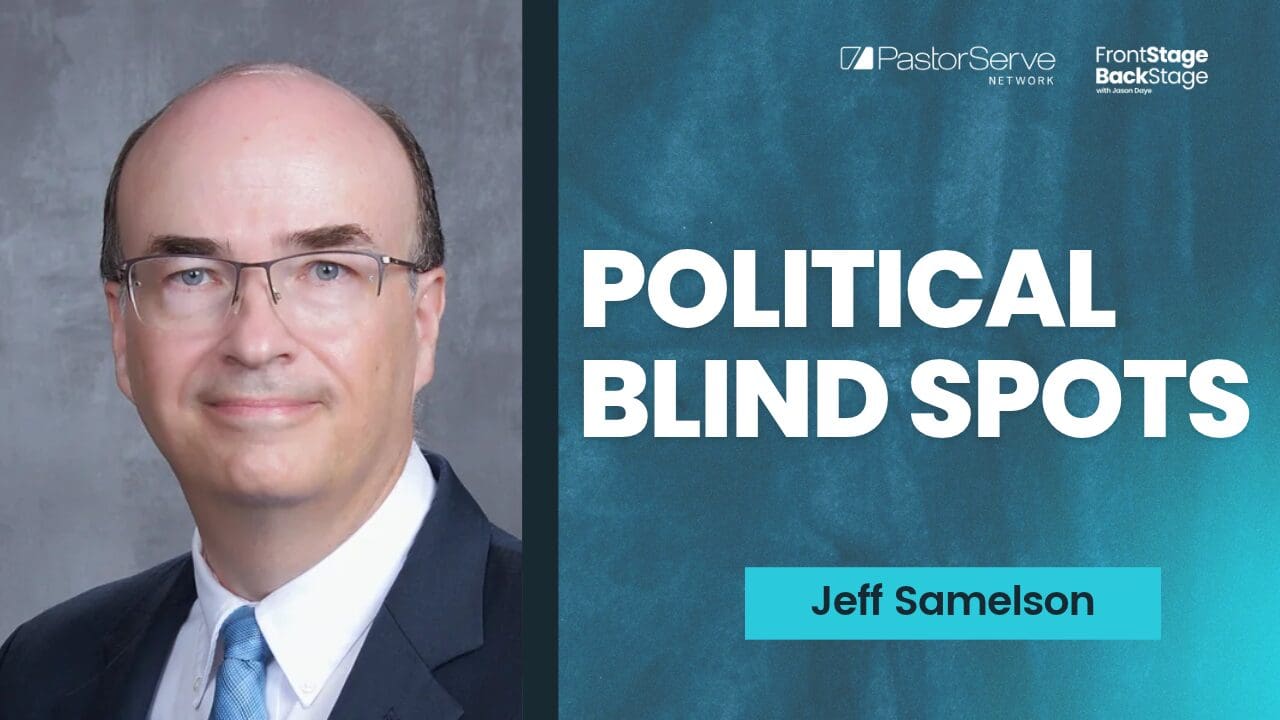
Former U.S. diplomat and pastor Jeff Samelson explores how political blind spots can quietly influence a pastor’s theology, leadership, and relationships, and how to shepherd faithfully without allowing political loyalties to overshadow Christ.
Could your political convictions be shaping the way you interpret Scripture and shepherd your congregation without you even realizing it? In this week’s conversation on FrontStage BackStage, former U.S. diplomat and pastor Jeff Samelson joins host Jason Daye to explore the political blind spots that can quietly influence our faith and ministry leadership.
As pastors, we want our understanding of Scripture to shape how we engage with politics and the world around us. But what happens when that influence begins flowing in the opposite direction? Cultural assumptions, political loyalties, and the voices we regularly listen to can affect how we understand biblical truth, relate to others, and lead the people entrusted to our care.
After serving in the U.S. Foreign Service, Jeff spent more than two decades pastoring a congregation near Washington, D.C. Drawing on those experiences and his book Walk This Way: Political Engagement for Bible-Believing Christians, he shares insights into the challenges of leading faithfully amid political differences.
Together they discuss:
- How political convictions can begin influencing our theology without our awareness
- Why it can be difficult to distinguish biblical convictions from our own cultural and political assumptions
- Why sincere Christians can reach very different political conclusions, and what pastors may be overlooking
- How our sources of news and information can create blind spots in the way we shepherd
- What helps pastors maintain their congregation’s trust when addressing politically charged issues
- How to respond when political loyalties and disagreements begin overshadowing Christ-like character
As pastors and ministry leaders, we’re called to help people see the world through the lens of Scripture. But how do we recognize when our own political assumptions are influencing the way we understand Scripture, relate to others, and shepherd those entrusted to our care? This conversation challenges us to examine some of the blind spots we may not even realize we have, and consider what it means to faithfully represent Christ in a world increasingly divided by politics.
Connect with this week’s Guest, Jeff Samelson
Weekly Toolkit
Additional Resources
www.jeffsamelson.com – Visit Jeff’s website to learn more about his book and insights on political engagement, biblical wisdom, and Christian faith.
Walk This Way: Political Engagement for Bible-Believing Christians – In his book, Jeff explores how Christians can approach political engagement with their identity as children of God at the center. Drawing solely from Scripture, he helps readers understand who they are in Christ, recognize the advantages their faith provides, and apply biblical wisdom to political questions across any nation, era, or political party.
Ministry Leaders Growth Guide
Digging deeper into this week’s conversation
Key Insights & Concepts
- Politics belongs within the larger context of Christian faith and life. When politics becomes the determining influence, we risk squeezing our faith into a political agenda rather than allowing our faith to shape our political engagement.
- It is a tragedy when brothers and sisters in Christ who hear the same sermons and sing the same hymns begin losing their warmth, patience, and compassion toward one another because of political differences.
- Before addressing political issues and disagreements, Christians need to return to the foundational truths of what it means to be children of God and disciples of Jesus Christ.
- Humility grows from remembering that we are redeemed sinners, and that the person who sees things differently is also someone in need of God’s grace. This shared reality should shape how we listen, respond, and relate to one another.
- Two pastors can approach the same issue from genuine love and compassion yet reach different conclusions because each is working with a different “piece of the pie,” shaped by different experiences, information, and assumptions.
- Christians can carry the certainty of their faith into their political commitments without recognizing the difference. Being convinced that Jesus is our Savior is not the same as being convinced that a particular political candidate or position is right.
- Sometimes faithful pastoral leadership means gently putting on the brakes when others are accelerating toward political conflict or outrage. This kind of intervention may be resisted and is often more effective through personal conversations than public correction.
- Some things Christians assume are biblical are actually shaped more by American culture and tradition than by Scripture. Distinguishing between cultural assumptions and biblical teaching requires continually returning to what God’s Word actually says.
- Relying exclusively on news and information from one political perspective can create blind spots, leaving pastors with an incomplete understanding of issues and the people they are called to shepherd.
- Being thoughtful about publicly sharing personal political affiliations and voting preferences can help pastors maintain the trust of people across political differences, giving them greater freedom to speak from Scripture without their words being filtered through assumptions of partisan loyalty.
- Spiritual formation happens through small, consistent steps. Helping people recognize and respond to specific sins, such as unknowingly sharing false information about someone online, can cultivate deeper discipleship over time rather than relying on a single sermon to bring about lasting change.
- It is often easier to recognize the unhealthy influence of social media on others than to acknowledge its influence on ourselves. Meaningful change begins when individuals honestly examine their own habits and take responsibility for the voices shaping them.
- Recognizing something wrong in the world does not require responding with outrage. Christians can approach troubling issues by praying, learning, evaluating them through Scripture, acting wisely, and trusting God with the outcome.
- Pastors can unintentionally treat others unfairly when they assume they already understand an issue or know why someone holds a particular view. Genuine humility requires recognizing the limits of our own understanding and being willing to listen and learn.
- Just as a pastor may need to speak for the marriage when counseling a divided couple, a pastor must speak for Christ when shepherding a divided congregation. Our responsibility is not to advocate for a political side, but to help people hear and understand what God’s Word says.
Questions For Reflection
- When I consider my own political convictions, how confident am I that my faith is shaping my politics rather than the other way around? What might help me recognize places where my political assumptions are influencing my understanding of Scripture or the way I shepherd and lead others?
- What beliefs or ministry practices have I assumed were simply “Christian” that might actually reflect my culture, upbringing, or political environment? How can I more carefully distinguish what Scripture teaches from what I’ve come to accept as normal or necessary?
- When I think about a brother or sister in Christ who holds political convictions very different from my own, what feelings or assumptions tend to surface? How do those responses affect the way I listen, relate to, and care for that person? Where might Christ be inviting me to grow in patience, humility, or compassion?
- Where do I typically get my news and information? How might those sources be shaping the way I understand people and issues? What perspectives or experiences might I be overlooking? What intentional changes could help me develop a more informed and balanced understanding?
- Think about a recent political or cultural issue that stirred anxiety, anger, or frustration within me. How did those emotions influence my conversations, decisions, or leadership? What might have been different if I had taken more time to pray, seek understanding, and consider my response in light of Scripture?
- Who in my life has the freedom to challenge my assumptions or point out when fear, frustration, or political loyalties may be influencing my leadership? How do I typically respond when that happens? What could I do to make those honest conversations more welcome?
- When have I assumed I understood someone’s political convictions or motivations without really listening to them? How might those assumptions have affected the way I treated, shepherded, or led that person? What would it look like to approach similar conversations with greater humility and curiosity?
- How have I communicated my own political convictions to the people I serve, whether intentionally or unintentionally? What effect might that have had on their willingness to trust my teaching, leadership, or pastoral care, particularly when we disagree? Is there anything I need to reconsider about how I communicate on political issues?
- Think about a time when I took a strong position or responded quickly to an issue, only to realize later that I lacked important information or perspective. What did that experience reveal about my assumptions or motivations? How could that lesson shape the way I approach similar situations in the future?
- How intentional am I about helping people connect the teaching of Scripture with the everyday attitudes, reactions, and choices that shape their lives? What small, consistent opportunities might I be overlooking to help those I lead and serve grow in Christlikeness, especially in how they respond to people and issues they disagree with?
- How are we helping the people in our church or ministry recognize the ways social media, news, and other cultural influences may be shaping their beliefs, attitudes, and responses to others? Where might we be overlooking these same influences in our own lives as leaders? What small, consistent steps could we take to help those we serve develop greater awareness and discernment?
- When people within our church or ministry hold strongly opposing political views, how do we respond as ministry leaders? What do our teaching, conversations, and leadership practices communicate about the importance of maintaining love, patience, and compassion across those differences? How might we more intentionally cultivate a ministry culture where biblical convictions are taken seriously without allowing political disagreements to undermine our relationships?
- When we reach different conclusions about a political or cultural issue, how well do we listen to one another and seek to understand the experiences, information, and assumptions shaping our perspectives? What tends to happen when those disagreements become uncomfortable? How could we cultivate greater humility, curiosity, and trust in the way we work through differences together?
- How confident are we that the people we lead and shepherd recognize Scripture, rather than our personal political preferences, as the foundation for our teaching and leadership? What might our public statements, conversations, or approaches to controversial issues be communicating, intentionally or unintentionally? Are there changes we could make that would strengthen people’s trust in our commitment to faithfully represent God’s Word?
- When political or cultural tensions arise within our church, ministry, or community, how do we understand our responsibility to speak for Christ rather than advocate for a particular political side? What would it look like for us to demonstrate that commitment through our teaching, relationships, and leadership decisions? How can we help one another remain faithful to that calling, especially when we experience pressure to take sides?
Full-Text Transcript
Jason Daye
Hello friends. Jason Daye here, and welcome to FrontStage BackStage, where every single week I have the privilege of sitting down with a trusted ministry leader, and together we dive into a topic to help you and pastors, and ministry leaders just like you really thrive in both life and leadership. We are blessed to be a part of the ministry of PastorServe. As pastors and ministry leaders, we spend a lot of time thinking about how our faith should really shape the way we engage with the world. This includes lots of things, including politics. But how often do we stop to consider the ways that politics might actually be shaping us? Shaping our character, our leadership, and even our understanding of what it means to follow Jesus. Now, my guest today is Jeff Samelson. Jeff brings a pretty unique perspective to this particular conversation. You see, Jeff spent years serving as a U.S. diplomat before becoming a pastor and spending more than two decades shepherding a local congregation. Jeff is an author. His most recent book is entitled “Walk This Way: Political Engagement for Bible-Believing Christians.” Together, Jeff and I are going to explore what it looks like to lead faithfully in the politically charged world in which we live, without allowing the pressures, the fears, and the loyalties of politics to pull us away from who Jesus is calling us to be. At this time, I would like to welcome Jeff to FrontStage BackStage. Jeff, welcome to the show.
Jeff Samelson
Well, thanks for having me. It’s a pleasure to be here.
Jason Daye
Yeah, so good to have you with us, Jeff. And as always, I’d like to thank you for making time to hang out with us here on FrontStage BackStage. Now, Jeff, you do have a very unique perspective, as I mentioned. You’ve had this fascinating journey from serving as a diplomat to spending over 20 years pastoring a local church, and I’m curious, Jeff, how these two experiences, you know, serving as a diplomat and then also your role as a pastor, really shape the way that you think about really the life of a Christ-follower and politics, and how they come together? How do those experiences really shape that?
Jeff Samelson
Yeah. I’ll give a little bit of my life story here, just because I think it helps a little. If you had asked me when I was in third or fourth grade, Jeff, what are you going to be when you grow up? I probably would have said a pastor. Probably because my grandfather, who I actually never knew, was a pastor, and the way that my mother spoke of him was just always so positive that I think it really made an impression on me there. But by the time I was finishing high school, it’s like, nah, I don’t think that’s what I want to do, and I got interested in the idea of being a diplomat. I thought this suits my interests and my skills pretty well. So I went to Washington University in St. Louis for a degree in political science. And was one of those kind of strange guys who knew what I was going to major in when I went there, knew what job I wanted when I got there, and I never changed the major, and I ended up getting the job that I’d been preparing for. And so politics was always right there, pretty important to me. But at the same time, by the time of my senior year or so of college, I was like, I don’t know, you know, is this really it? And so about halfway through my time in the foreign service, I’d gotten married by then, and was thinking, I’m not sure that this is really what I want to be when I grow up, and that led me then to go to seminary and become a pastor. But as the Lord would have it, I ended up in the D.C. suburbs, pastoring there, and pastored a congregation that was full of people who were in the military, people who worked for the government, people who worked for companies that worked for the government, and just generally speaking, everybody there was affected by what’s going on in the world, and so I wouldn’t say it was a very politically charged congregation, but the entire environment was. And what happened in politics affected people there, and so the way I often phrase it is that I spent most of my adult life at the intersection of politics and faith, and so it was something I had to think deeply about as time went by. And I came back to the Midwest, I guess it’s about five years ago now, and was thinking about it even more because of various things I was in. But I was compelled to write a book about this because I just saw what so many believers are dealing with, and it really frustrated me because I really felt that Christians just aren’t hearing the whole truth about politics from the sources that should be telling them the truth about it. And I’m not talking so much about the media here, or the party apparatus of Republican, Democrat, or whomever. Just the things that they’re not hearing from the pulpits, from Christian leaders, and things like that. And it’s not so much that I’m blaming people for telling lies; it’s more what’s being left out because there’s just people assuming everybody’s already on the same page. We don’t need to talk about this. Or sometimes it’s only kind of half of a truth instead of the whole truth, and all sorts of things like that. And I just really wanted people to have a book that would just give them the foundation that they need to be able to go out and engage with politics and do so with confidence and peace at the same time.
Jason Daye
Yeah, let’s focus in on this unique perspective that you have, because being someone who was a diplomat and someone who was also a pastor, many of us who are in ministry, pastors and ministry leaders, we think about how our faith should be shaping all aspects of our lives, including our politics. But I’m curious. It seems that sometimes our politics, we have lots of conversations with people. We see lots of people. Maybe our politics are sometimes shaping our faith, right? Sometimes we begin to see that our political convictions begin to shape the way that we preach or teach. The way that we look at scripture. I’m curious about your thoughts on that, Jeff. How can we begin to, and maybe this happens without even recognizing this, right? How can we begin to see maybe some of the warning signs? How can we ensure that as pastors and ministry leaders, we aren’t allowing those political convictions to begin to shape what really our faith should be shaping, right?
Jeff Samelson
Right, yeah. In fact, that’s kind of the logline. The way I sum up my book is: instead of what so many people are doing or are being told to do, which is to take your Christian faith and life and fit it into your politics, the purpose of Walk This Way is to put politics into the context of Christian faith and life, so that it’s one of the many things, rather than being the thing that determines everything else. I mean, it’s just such a tragic thing. You know, we pray, of course, this doesn’t happen in any of our congregations, but it does. You get the situation where you have brothers and sisters in Christ who believe the same things, hear the same sermons, sing the same hymns, and yet there’s this, like, do you see that bumper sticker she had on her car? And suddenly, the love isn’t there anymore. The warmth, the compassion, the patience disappears, and that’s not the way it should be. Not among the body of Christ. So it’s really important, I think, to go back to the basics on this. And instead of starting at the stage where we think, okay, well, we’re all here in terms of our understanding of what the political issues are and how we as Christians should be approaching them, need to start a little bit lower down on that in terms of, okay, what does it mean that you are a child of God? What does it mean that you are a disciple of Christ? Now, how do you take that and apply that to your life as a Christian citizen, as somebody who’s involved in society? Because too often, people are encouraged, and I imagine there are some pastors who mistakenly encourage this as well, to just kind of start at the top. It’s like, okay, we’re all Christians here, so we know that this is what we need to do, without doing the harder work, but the important work of establishing, okay, these are the principles that we get from Scripture, and this is why we have this position.
Jason Daye
Yeah, so if a pastor is wrestling with political convictions, and a pastor is looking at another pastor who has differing political convictions, right? So we’re wrestling with these things. How do we begin to resolve those things? How do we, as ministry leaders, as pastors, begin to have conversations with one another when we might have different political convictions?
Jeff Samelson
It’s difficult when it’s just between laypeople. It’s going to be even more difficult when it’s between pastors because, generally speaking, you think you have a lot more knowledge that you’re working with. You know, I’ve got more facts on my side, and so forth. And sometimes that’s true. Let’s assume that everybody listening or watching actually is smarter than the average. But I guess we start with that grace. We recognize, okay, I am a redeemed child of God. Okay, that means, first of all, that I am a sinner who has a corrupt, sinful nature. So I’m not perfect. Okay, there’s the humility of that as well. But then there’s also the wonderful good news that we have full and free salvation in Jesus Christ, and we are forgiven, and we have His righteousness. So this is our who I am. How am I going to deal with you, who, gee, you’re also the same, in the same situation? So we’re going to have a lot more of that patience and compassion. We think, for instance, of Paul and Barnabas when they went out on that missionary journey, and there was that strong disagreement about whether John Mark should go along. It wasn’t a political thing, at least as far as we’re told. But they were able, as brothers in ministry, who were both fully committed to the mission, to say, you know what? We’re together on this, but we can’t work together on this. There is this division here, and of course we know from later history that eventually that was resolved. The problems that were there were no longer a problem later on. But just dealing with a brother or brother pastor, we’ve got to have, first of all, that patience, and then I’d say the next thing we want to do is to be very open and ask a lot of questions. One of the things that I’ve been learning lately is how important it is to realize that we often are approaching things with a different set of facts and assumptions. And it’s not necessarily saying that my facts are right and your facts are wrong, or vice versa. It’s, you know, I’ve got this piece of the pie, and you’ve got that piece of the pie, and our views are being guided by that, but we’re not necessarily reaching the same place because we’re not starting with the same ideas. Just as a for instance, say the issue of homelessness. You know, one pastor could be thinking very much in terms of, well, gee, I’m on the streets regularly. I’m dealing with these people. These are people that Christ died for. I love them. Let’s do everything we can to help them. And this is why this is going to be really important. And I may even be, you know, suggesting to my people that this should be an important issue for them when they go to vote. On the other hand, you could have somebody who is very well-versed in the economics of things and the psychology and such, and he’s realizing, well, a lot of this homeless problem, what we think is compassionate, isn’t really all that compassionate because it’s not actually helping these people. We know from studies that this is what needs to be done to be the greatest help to this people. And to do the most to solve this problem of homelessness. Now, in both cases, we’ve got pastors who are starting from a position of love and compassion. They both have statistics and experiences and things that are guiding them, but they’re kind of leading them in different directions. And we want then, as pastors, just as Christians, to be able to appreciate that, okay, we’re coming at this from different directions. Both sides are probably going to feel, I’ve got the right approach here, and yours is not the right one. But we can at least have the respect to realize that, okay, we’re coming at this differently, and that’s going to allow you then to have that conversation and that dialog that hopefully will at least get you closer, if not actually get you into agreement.
Jason Daye
Hey friends, just a quick reminder that we provide a free toolkit that complements today’s conversation. You can find this for this episode and every episode at PastorServe.org/network. In the toolkit, you’ll find a number of resources, including our Ministry Leaders Growth Guide. This growth guide includes insights pulled from today’s conversation, as well as reflection questions, so you and the ministry team at your local church can dig more deeply into this topic and see how it relates to your specific ministry context. Again, you can find it at PastorServe.org/network.
Jason Daye
Yeah, that’s helpful. Something that stood out to me in Walk This Way, in your book, is the idea that Christ followers can become, I guess, so committed to a political outcome that they believe is good, that they begin justifying behavior that they would otherwise probably recognize as wrong. So they get caught up in that, right? And they begin to justify something that they probably otherwise wouldn’t justify. Jeff, why do you think that happens, particularly among people who genuinely love Jesus and really truly want to honor Him?
Jeff Samelson
I guess a large part of it is that we get kind of used to wanting to go all in with the things that we feel are right. And we kind of carry that over from our Christian life into our political life without doing the checking that’s required to say, okay, is this the same thing? Am I as convinced that this is the right candidate as I am convinced that Jesus is my savior? And that’s a wonderful thing. And very often, we are encouraged by the media, by our peers, by pundits and politicians and influencers to do exactly that. To go all in on things. And if the people that we’re around are also doing the same things, we get caught up in that. We’re human beings. It’s a natural kind of thing there, which actually ends up putting pastors sometimes into the position where you’ve got to try being the one who puts the brakes on things a little bit, which people are going to resist. I mean, anytime you’re going up against an acceleration, it’s going to take some work to slow things down. But perhaps that is something that a pastor is going to need to do. Probably more one on one than from the pulpit, but maybe in his preaching, to just kind of say, okay, you’ve all got the right motivations here, but let’s step back a little to make sure that you’re not actually stepping over the line that we as Christians should not be stepping over.
Jason Daye
Yeah, when you study the history of the church, we see that there are times when pastors have gotten swept up in the same thing, right? They get swept up into political movements, right? And they begin to go along with something that, when you step back and you look back across history, you go, Wow, how could that have happened? How is it that pastors and ministry leaders kind of get swept up into that as well, do you think?
Jeff Samelson
Again, we’re human beings like everybody else, and we tend to take for granted a lot of things that we probably shouldn’t be taking for granted. One of the things that I tried in Walked This Way was to write not just for an American context. I tried as I was writing to be thinking, okay, what about somebody who lives in United Kingdom? How are they going to take this? What about somebody in Pakistan or a Christian there who’s in a very different kind of situation? How do I write this so that it is going to be helpful for them, as well as for here in the United States? And one of the benefits for me in doing that, and I hope it’s something that helps other people as well, is you start being able to separate the things that you just assume, oh, that’s Christian, that are actually just well, no, that’s American, or that’s American Christian, but it’s not necessarily the word of God. This is the way it has to be. Just as kind of an illustration of that, there are a lot of churches that are run, and generally speaking, the ones in my denomination are run on a very congregational system with voting. All the members vote, and there’s a lot, over the years, of well, of course, this is the right way. This is the Christian way. Okay, where is it stated exactly the way that it is in the Bible? Well, it’s not. But because it’s the way we do things in our society, it’s just kind of assumed that that’s the way it should be. And so there are a lot of things that we just kind of assume. Well, this is what I’ve been, I’ve grown up with. This is the way it was back in our, whatever our golden age was. And we assume that that’s the way it has to be. Because Christians believed this and did this, it must be a Christian thing to do and believe, without actually doing the harder work of going back. It’s like, okay, where actually is the scriptural foundation for this?
Jason Daye
Yeah. So, Jeff, I’m curious, what are some practical ways that we can begin to check ourselves then, to make sure we’re not getting swept up in things that may not necessarily be, as you said, biblical, right? That may be more cultural. Or things where we’re not, you know, justifying something that may not necessarily be core or true.
Jeff Samelson
Yeah, a lot of it’s asking questions. Ask questions of yourself and ask questions of what it is that you’re consuming. Actually, that reminds me of, I think, one of the really important ones. If you are a pastor who tends to be into politics and such, is okay, where am I getting my news from? Now, that’s a really important question. There’s the liberal media. Okay, well, I’m not a liberal, so I don’t want to listen to the liberal media. Okay, what does that mean then? Does that mean that you only listen to the conservative media? And it could be vice versa too. We want to have the complete picture. If we’re going to have a good perspective on things, we want to see everything that we can. That’s a prayer we should be praying. If you think about that in the terms, in the context of Christian ministry, I mean, would you want to be pastoring a congregation when you’re only getting one side of an issue? I mean, no, you want to see the entire picture of things, and so think about that. If you normally watch just the conservative stuff. If your Facebook feed is only things on the conservative side, well, then allow yourself once in a while to dip into things that are coming from a different perspective to see oh, okay, this is where that’s coming from. This is why they believe that. That was one of the side benefits of ministering in the Washington, D.C. area because as most people know, the politics out there are generally on the liberal side, and that meant that I could not avoid seeing that perspective. And I still have a digital subscription to the Washington Post. It’s like you can see where they’re coming from on things. You may disagree with them on all sorts of things, but you see where they’re coming from. You understand it. You have a better picture of things. And I think that’s just kind of a basic level thing of being informed, not just about the issue as you care about it, but the issue also as other people care about it. It can be really helpful to keep you grounded and keep you from going overboard with things. Because the last thing any of us as a pastor wants to do is to get really, Oh, yeah, yeah, yeah, yeah, this is what it is that we need to do. Everybody, listen to me. Follow me in this direction only to find out sometime later, maybe that wasn’t quite right. Maybe that wasn’t what we really wanted to do, and you really don’t, as a pastor, and just even as a human being, especially as a man, want to say, Yeah, I was wrong. Forget about all that other stuff I said before. It’s not good for your ministry, and it’s not good for your ego either.
Jason Daye
At PastorServe, we love walking alongside pastors and ministry leaders just like you. If you want to learn more about how you can qualify for a complimentary coaching session with one of our trusted ministry coaches, please visit PastorServe.org/freesession. You don’t want to miss out on this opportunity. That’s PastorServe.org/freesession.
Jason Daye
Yeah. and the idea of grace. You mentioned grace earlier, and I think one of the challenges that we have, just as humans, is that we often recognize those tendencies pretty easily in people whose politics we disagree with much more readily than we’d be in recognizing those tendencies in ourselves. I like what you’ve said about exposing ourselves to whichever way we lean, exposing ourselves to the other side of issues, the other side of those convictions. What are some other practical ways that pastors specifically, ministry leaders specifically, should be looking at and being careful to help uncover maybe the blind spots that they might be carrying? Because I think this is important for us to help practice grace with others in the way that we serve.
Jeff Samelson
Yeah. Obviously, patience and prayer are a big part of this. You want to be praying that you see things as clearly as possible, and that you don’t get involved in things that are counterproductive politically and such. Looking around at your congregation and trying to see, okay, are the things that I am really committing myself to or getting interested in, are these things going to cause an issue in the congregation or in the community that we’re serving? Now, I am by no means saying we should never take a stand on something just because it might be controversial. But we’re also all well aware that there are times when you take a stand on a controversy that, in retrospect, really wasn’t necessary, and sometimes it’s just being wise about how. Okay, I can still say this thing, but, if I say it this way, it’s going to cause a problem. If I say it this way, it’s not going to. I’m still going to communicate the important thing, but I’m not going to say it quite the same way. I’ll just, as kind of an example. This is the way I did it. I’m not saying this is the way every pastor should do it, but I was careful as a parish pastor to never identify as I am a member of this party or that party, and I never said, Okay, this is who I’m voting for. I did that. I tried to be consistent with that, not because I thought it was important, or because I thought it was, or not because I thought it was not important, or because I thought that it was somehow improper for me to have a party or to support a certain candidate, but because I did not want anybody in my congregation, and we did have people on both sides of issues and in both parties, I didn’t want anyone to hear anything that I was saying from the pulpit, or as I was teaching a Bible class, to say, Oh well, he’s just saying it because he’s a “blank” supporter, or because that serves the interests of his party. And I think the people, as they got to know me, they probably had a pretty good idea where I stood, but because I was never making that an issue publicly, it gave me some kind of leeway. It gave me some room to work, so that when I did talk about issues that had a political valence to them, they would understand that okay, he’s not doing this, he’s not saying this, he’s not teaching this because he wants to get so and so elected, or because he wants to increase the power of that party. He’s talking about this because this really is something that Scripture has something to say about. This is really something that there is important stuff here. This is a political issue, but we as Christians will definitely have a position on this, and this is why. And that gave me, I think, the room to speak about those things without people automatically assuming that I had a political agenda. When in fact my agenda was much more of, hey, you’re Christians, you’re my people here. You should be thinking about this in a certain way because you are Christians.
Jason Daye
Yeah. So, it’s like focusing on the kingdom, right? So they’re not just putting you into one platform, one party or another, and then maybe dismissing you or championing you one way or the other, right? But helping them think critically about kingdom and kingdom first. And so as we’re thinking about that, pastors are obviously called help form people into the likeness of Christ. I mean, that’s what we’re called to do. And we think about this idea of how people are being formed by so many different things, and our heart is that they’re formed by Christ. And with all these competing voices, you mentioned this earlier about media or the echo chamber of the algorithm of our social media, right? Which just feeds us what we already want to hear because things we click, or things we read, or whatever, right? So, how can we, as pastors, especially in the political world, begin to help our people see and understand that they are being discipled, that something is competing to disciple them in the world, the media, the social media, the algorithm, all those things versus the limited time that we have with them on the weekend or maybe in a Bible study or life group or wherever it might be, and it’s hard to compete with that, right, Jeff? I mean, obviously, it’s bombarding them throughout the week. How do we raise that awareness amongst our people in such a way that it makes a difference? It makes an impact for them, right?
Jeff Samelson
Yeah, this is definitely one of those things where I think most people, if you ask them, does social media have a improper influence on people? Are some people way too deep into this? It’s, oh, absolutely, of course, I’ve seen so much evidence of it. The difficulty is like, and what about you? It’s not happening to me. No, no, it’s those other people. They’re way too deep into that stuff. They don’t know what they’re talking about. And I say, that’s the kind of thing that I think as pastors, we sometimes have this idea that it’s like, okay, if I preach just that one perfect sermon, just that one right study that’s gonna, I’m gonna do the whole thing and make the difference that’s gonna fix things. And I think the reality is that more often it’s the step-by-step incremental things that are gonna end up making more of the difference. That you’re preaching, you’re writing your sermon, and you’re making applications in it of these are sins that we’re guilty of in our live. And maybe some of those applications are that I got really upset about this thing that I saw on social media, but I wasn’t actually properly informed. And later on, I found out that I was bearing false witness against somebody as a result of this. Just one application out of many. But it’s the little kind of thing there that builds over time if you do this consistently, just pointing out that this is another one of the many areas of our lives where we need to be more careful. Where we need, as we’re building that life of discipleship, as we’re building Christian character, that we need to work on these things all the time. And instead of aiming for that Grand Slam, we’re going to knock it all out of the park, and everybody’s going to understand this after they leave church today. Just like the incremental, step-by-step little things. Okay, made an application this week. Two weeks later, made another application of a similar kind of thing, and slowly work the people through that so that they can understand, oh, okay, yeah, actually, going back to what I said, this is politics in the context of my Christian faith in life, rather than my Christian faith in life being part of my politics.
Jason Daye
Yeah, that’s helpful. You know, one of the things that social media and the media at large tends to do is stir up a lot of fear, anxiety, anger, right? And one of the things that you write about, Jeff, is the ways that fear, anger, anxiety can influence our political engagement. You touch on this in the book. I’m curious, Jeff, how might a pastor themselves recognize when these types of emotions are beginning to drive their leadership rather than a deeper confidence in Christ?
Jeff Samelson
Yeah, that’s hard because it’s the kind of thing that you often don’t realize until you’re pretty well gone down a particular road before you realize, Oh wait. I guess that’s one of the areas where it’s really helpful to have somebody that you trust who can point you in the right direction. For many of us, it’s going to be our wives, but maybe it’s another ministry leader or a trusted layperson in the congregation or something like that. But we’re not always going to have that. Sometimes they’re just as deep into whatever it is as we are. In the book, the last chapter of the book, I have what’s called a model for political engagement, and I won’t go into all the details of it. It’s a multiple-step process, but I’ll just mention it’s called the See It, Calm It Method, and I think it’s useful for anybody, even for pastors. Like, the sense of the first step of it is to see it. Okay, we see something that bothers us. Whether it’s the homelessness or the tax money being wasted, or whatever it is. It’s something that bothers us. We say this is wrong. So we don’t just ignore it. We notice it, we take it, and then the very first step after that I call centering. It’s basically that we pray about it, but the point is that we take this thing that’s bothering us and we bring it back, and we say, Okay, this is about my relationship with the Lord. This is where I’m going to start. And then from there, it’s a process of learning more about things, seeing what you actually know, what you don’t know, and measuring it against God’s word, and taking the slow step before you get to the point where you actually do something. And then after that is a really important part of, okay, now once you have done what God has given you to do, you trust the Lord. You put it in His hands. He has promised to work everything out for the good of those who love him, for his people, for the church, and we can count on that. And we also know that at the end of all things, everything’s going to be great for his people. So freaking out right now in the moment? Don’t really need to do that. It doesn’t mean that we don’t get that there aren’t things that require our immediate attention or action, but just kind of slowing that process down, of calming it, I think can really make a difference in so many issues and so many of these political things. To just if we feel ourselves starting to get anxious about whatever it might be, just to take that step back from whatever it is and say, okay, what am I really doing here? What’s the source of these thoughts and these feelings that I’ve got going on right now? And you bring it back to the Lord, before you take it out into the world or into your work as a pastor.
Jason Daye
Yeah, Jeff, I’m glad you brought up that because that See it, Calm it approach that you have in the book, I really appreciated that because I feel like, in so many ways, the approach that we see in our current day towards anything political is anything but See it, Calm it. It’s almost the exact opposite. It’s like see it and freak out about it. It’s like see it and you’ve got to be enraged about it. And even oftentimes, in the church, unfortunately, I see this more and more. Is if you see it, and if you’re not enraged about it for some reason, then you’re not really standing up, or you’re not really convicted about it, and yet that seems counter to what we see in Christ in so many ways. So I really appreciate, Jeff, that approach that you have. So I’m glad that you brought that up. Now, the See it, Calm it approach for you, Jeff, reflecting back as a pastor in your pastoring days, what was the greatest challenge for you as you were shepherding your people in politically charged times? What was the great challenge for you in helping your people process through that?
Jeff Samelson
Yeah, I think the “A” in the Calm it is for assess. That’s the point where you determine what you do and don’t actually know about an issue, and I think that, for me, was one of the biggest challenges because with my education and everything, I pretty much usually thought I knew everything already. So it was a challenge to me to say, okay, all right. Obviously, there’s a reason why she feels this way, why she’s taking this position, or whatever. And then also, I guess, it’s not quite part of that process, but also then the humility to be able to say, All right, as wrong as I think he is in the position that he’s taking, I have a responsibility as a pastor, as a shepherd here, to not deal with this person as an idiot, but rather to deal with this as a person who has come legitimately to whatever positions he or she has. They may still be wrong. There may still be things that I, as a pastor, think need to be corrected because there are untruths mixed in there with the truths. But to have the patience and compassion really to deal with those issues as they are. So yeah, just the instant assumption that I know everything that’s going on and everything, that was probably the biggest challenge for me.
Jason Daye
Yeah, I love to hear that because that’s something that I think, as pastors and ministry leaders, we have to remain people of grace, right? People of humility, but also people who are curious, right? And I think that you demonstrate that, Jeff, as you say that. As pastors, as shepherds, we have to, as we lead, we have to be living in that posture, that heart posture, because that’s what we see in Christ again and again and again, and that’s who we need to follow. Jeff, this has been a great conversation, brother, and timely conversation because we’re living in the thick of it here in our country, and I know so many others of you who are watching or listening in, in countries in which you find yourselves, you have your own challenges and struggles with politics as well. And I’m sure that this is a timely conversation for you as well. Jeff, as we’re wrapping up this conversation, I want to give you an opportunity. You have the eyes and ears of men and women who are serving on the front lines of ministry. What words of encouragement would you like to leave with them?
Jeff Samelson
I guess this actually was something that just occurred to me. When it came to marriage counseling, sometimes I found that you have the husband’s side. This is the wife’s side, and they’re each maintaining their position. And my job as a pastor, as a counselor in those situations, was very often, I was the only one who was speaking for the marriage, which was God’s institution. That was the important thing. They were speaking for themselves. I was speaking for the marriage. That’s what I was there to represent. We apply that to you know the kind of political situation. If you have these conflicts in your congregation, you’re going to have these people speaking for that side, those people speaking for the other side. As pastors, we want to make sure that we’re the ones speaking for Christ, that we’re the ones speaking for the Christian character that each of us should be taking out into the world. That we don’t want to end up in the situation where we’re taking sides over against the other. That we want to make sure that what we’re representing is the Word of God, as it is properly and truthfully and relevantly preached and taught, and so we want to be careful not to overstep that, and just make sure that we’re the ones that when our people look to us, that they can say, I know that’s the guy I can go to to hear what God’s word has to say about this.
Jason Daye
That’s good, brother. Excellent, excellent. Thank you so much for making time to be with us. Jeff Samuelson, his most recent book, Walk This Way. I encourage you guys to check it out. Now, for those of you who are watching or listening, we have a toolkit that complements this conversation that Jeff and I just had. You can find that at PastorServe.org/network. And in the toolkit, you will find links to Jeff’s book, Walk This Way, so you can order that. I encourage you to do that as well. In that toolkit, you’ll find a number of other resources, including our Ministry Leaders Growth Guide. That growth guide includes insights pulled out of this conversation, as well as questions that you can work through yourself or with the leadership team at your local church or ministry that come out of this conversation that we just had, so you can dig more deeply. Again, you can find that at PastorServe.org/network. So I encourage you to check that out. Jeff, thank you for making time to be with us here on FrontStage BackStage. We certainly appreciate it, brother.
Jeff Samelson
Thank you for having me. It was a pleasure.
Jason Daye
All right. God bless you, brother.
Jeff Samelson
You too.
Jason Daye
Here at PastorServe, we hope you’re truly finding value through these episodes of FrontStage BackStage. If so, please consider leaving a review for us on your favorite podcast platform. These reviews help other ministry leaders and pastors just like you find the show, so they can benefit as well. Also, consider sharing this episode with a colleague or other ministry friend, and don’t forget our free toolkit, which is available at PastorServe.org/network. This is Jason Daye, encouraging you to love well, live well, and lead well.
Recent Related Episodes
-

Posted On: December 27, 2023
-
Posted On: December 9, 2025
-
Posted On: July 11, 2023
Right-click, then select “Save Image As…” to download one of the social graphics.