
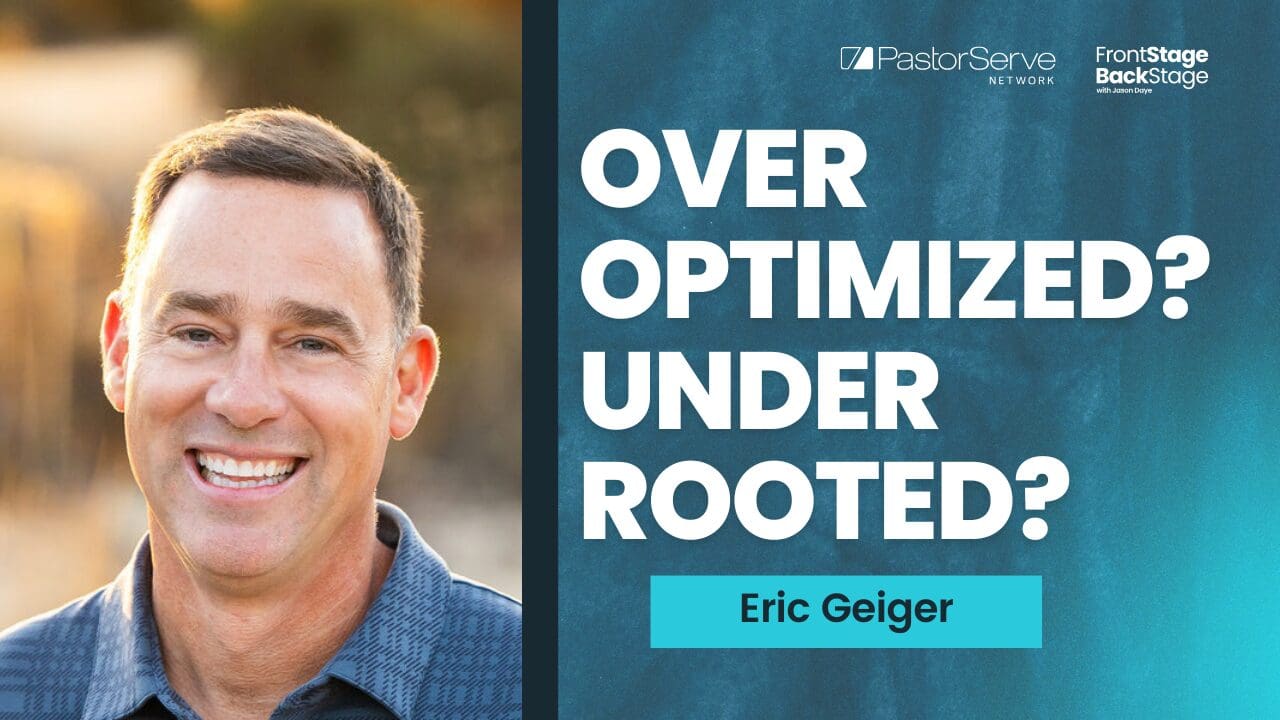
Can leadership be too optimized? In this week’s conversation on FrontStage BackStage, Eric Geiger joins host Jason Daye to explore why lasting leadership requires more than better systems, sharper strategies, and greater competency. Drawing from the story of Nehemiah and his book The Rooted Leader, Eric shares why our world desperately needs leaders whose vision, decisions, and leadership flow from deep roots of burden, belief, and dependence on God.
In a culture obsessed with optimization, many pastors and ministry leaders feel pressure to improve, refine, and maximize every aspect of their leadership. While growth and effectiveness matter, Eric offers a timely reminder that leadership can become dangerously self-reliant when competency begins to replace dependence on God. True leadership health is formed beneath the surface.
Together they discuss:
- Why burden and belief are the necessary roots beneath true vision
- How the pursuit of optimization can subtly move leaders from dependence on God toward confidence in their own abilities
- Why faithful leadership requires both perseverance in the fight and trust that God is fighting for us
- How healthy leaders embrace both restlessness for God’s mission and intentional rhythms of rest
- Why focusing only on the visible fruit of leadership can cause leaders to neglect the deeper roots that sustain long-term ministry
Eric also shares personal reflections on rest, family, and leadership sustainability, including how trusted leaders around him help ensure he cares well for himself and those closest to him. His honesty serves as a reminder of the importance of finding those who can help us care well for both others and ourselves.
If you are a pastor or ministry leader seeking to grow in leadership while remaining deeply dependent on God, this conversation offers both encouragement and challenge. Lasting ministry fruit is never produced by optimization alone. It grows from leaders who cultivate deep roots of faith, trust, conviction, and dependence on the One who ultimately builds His Church.
Connect with this week’s Guest, Eric Geiger
Weekly Toolkit
Additional Resources
www.ericgeiger.com – Visit Eric’s website to learn about his ministry and book, along with resources created to help you strengthen and deepen your relationship with God.
The Rooted Leader: Seven Rhythms of Leaders Who Bear Fruit That Lasts – In his book, Eric offers leaders practical insights on the roots beneath the surface that result in the fruit all leaders desire: vision, conviction, servanthood, perseverance, credibility, transformation, and resolve.
www.marinerschurch.org – Mariners Church is a community of ordinary people from all walks of life courageously trusting Jesus to do the extraordinary.
www.experiencerooted.com– Rooted Network is a church-wide 10-week small-group experience that helps your church build an Acts 2 discipleship culture—connecting people with God, the church, and their purpose.
Ministry Leaders Growth Guide
Digging deeper into this week’s conversation
Key Insights & Concepts
- A vision borrowed from another church or ministry will never be treated with the same care as one born from genuine burden for a specific people and place.
- True leadership fruit, whether vision, perseverance, or conviction, can only grow out of healthy roots that most people never see on the front stage.
- Christ-followers should be the most visionary people on earth, since faith itself is built on holding burden and belief together at the same time.
- Skill without sanctification is a dangerous combination, because a spotlight will eventually land on a leader who has outgrown their own character.
- There is a subtle danger in becoming so competent that you no longer sense your need for the Spirit of God to do the work through you.
- Self-awareness isn’t optional for growth, it’s the very thing that allows a leader to know both what to repent of and what skills still need sharpening.
- A leader’s burden should stay connected to the actual role God has placed them in, rather than stretching into concerns that belong to someone else’s calling.
- Real vision rarely starts in a polished planning retreat, it usually starts with something broken that won’t let a leader rest until it changes.
- Perseverance in leadership looks like holding two things together: a willingness to keep fighting and a deep trust that God is fighting on your behalf.
- Ministry can feel more challenging than building a physical wall, because so much of the outcome appears in places no one can tangibly see.
- Rest isn’t a reward leaders earn after the work is done, it’s a rhythm that has to be protected and even championed by the people around them.
- When a leader is surrounded by others who genuinely want them to care for their family and their soul, sustainable rhythms become far easier to keep.
- Optimizing every part of life can quietly become a way of outrunning the slower, harder work of actual spiritual formation.
- The temptation to walk away from ministry is real even for faithful leaders, and naming that honestly is far healthier than pretending it never crosses your mind.
- Staying faithful and staying on the wall, even when the work feels invisible, is itself a picture of God’s own faithfulness to the people being led.
Questions For Reflection
- When I think about the vision I’m currently casting for my ministry, is it something I’ve genuinely wrestled with and been burdened over, or did I borrow it from somewhere else? How do I know?
- What is currently breaking my heart in a way that feels connected to the specific role God has placed me in right now? What am I doing with that burden?
- Do I actually believe God can do something great in response to what burdens me, or am I only carrying the weight of what’s broken without any real belief attached to it? What would it look like to hold both at once?
- As we think about the vision our church or ministry is pursuing this season, how is it rooted in an honest burden for our specific people and community? How can we process this with our key ministry leaders?
- Where have I noticed my competence as a leader outpacing my actual spiritual maturity? What has that revealed to me about my own soul?
- Have I ever caught myself thinking I can handle ministry apart from being genuinely connected to Jesus? What did that moment teach me?
- Who in my life has the freedom and the relationship with me to point out my blind spots? Am I actually listening to them? If I don’t have that person in my life, when will I commit to engaging with someone to fulfill this role?
- What area of my leadership have I been avoiding growth in simply because I haven’t been honest enough with myself to name it? What would naming it actually look like?
- When was the last time I genuinely wanted to quit? What kept me on the “wall” instead of walking away?
- In what ways am I currently practicing the rhythm of fighting hard while still resting in the truth that God is fighting for me? Which side of that rhythm do I tend to neglect?
- How are we as a ministry team caring for the personal and spiritual health of our leaders, not just their output and performance? What would it look like to make that a stated priority rather than an assumed one?
- What rhythms of rest have I built into my own life that my church or ministry team actually knows about and supports? If I’m honest, do I feel permission to protect them?
- As I think about my own family, am I shepherding them with the same intentionality I bring to my ministry responsibilities? What needs to change there?
- Are we as a church creating pathways that move people from simply attending to actually experiencing real community and transformation? What evidence do we have that this is working?
- When I consider the work I’m doing that feels unseen or unappreciated right now, do I believe it’s actually significant and eternal? What would it look like for me to keep going faithfully even without visible results?
Full-Text Transcript
Jason Daye
Hello, friends, and welcome to another engaging episode of FrontStage BackStage. I am your host, Jason Daye. Each episode, I have the privilege of sitting down with a trusted ministry leader, and together we tackle a topic to help you, pastors and ministry leaders just like you, really thrive in both life and leadership. This episode, I am really excited because I’m joined by Eric Geiger. Eric is the lead pastor at Mariners Church in Southern California. Eric is a great ministry leader. He has led in both the marketplace and in ministry. He has served as a senior vice president of a publishing company. He’s been a consultant in business leadership and strategy. He has written and has shared a number of resources with the greater church. His most recent book is entitled The Rooted Leader. At this time, I would like to welcome Eric to the show. Eric, welcome to FrontStage BackStage, brother. So good to have you with us.
Eric Geiger
Jason, man, it’s an honor to be invited to be on. Thank you.
Jason Daye
Yeah. I’m very excited about this conversation. We are going to be talking about leadership, of course. Eric, you have recently written a new book called The Rooted Leader, and we were talking before we jumped on. This book is looking at leadership, and we’re looking at a character in the Bible that a lot of people have looked to when we talk about leadership. That is Nehemiah, and you and I both have probably preached plenty of sermons. We’ve probably heard lots of sermons. We’ve read books on this particular character in the Bible, Nehemiah. And I’ve got to tell you, when I read through the book, thank you for sending it over. Excellent book, by the way. But we kind of think about Nehemiah, and there’ve been a lot of sermons. We’ve probably done some Bible studies on Nehemiah and leadership. Eric, when you turned to Nehemiah and thought, “Hmm, let’s talk leadership. Let’s talk Nehemiah.”, what led you to go to Nehemiah for leadership?
Eric Geiger
Yeah, well, as you said, I’ve preached through Nehemiah, and what I found is that the leaders that I serve in Southern California in our church, we have so many marketplace leaders. They are really intrigued by Nehemiah because, if you use our modern-day nomenclature, you wouldn’t say Nehemiah is a pastor or a priest. He was a marketplace leader. He was the cupbearer in Persia to Artaxerxes, which can sound like a menial position, but it’s really like a chief of staff. Then he moves to Judea, where he’s a builder, a visionary builder, like a change agent. Then he becomes the governor, which is a part, Jason, I think there’s so much written about Nehemiah, but I think most of it focuses on the amazing task or feat of building the wall that was broken and causing such disgrace in the city, and it was rebuilt in 52 days, which is amazing. But I think the most amazing part of his leadership is really the end of Nehemiah, where people start to move back to the city. He repopulates Jerusalem. So, why I have loved looking at Nehemiah is the different phases of his leadership. It’s a raw, honest journal. I mean, Nehemiah is essentially his leadership journal. Now, those of us who are Christians, we’re like, this is God’s word, and 100% it is. But it’s also simultaneously just his recording of everything that he did, you know, and it’s raw and honest. I mean, he’s even sharing his struggles. So, I spent a lot of time with Nehemiah. I feel like we’re kind of friends. I mean, I have read his words so much, but I have also seen how marketplace leaders that I serve are intrigued, and also, wow, the Bible’s super practical for me. Man, I even see this that I can learn some lessons on leading up to my board, or leading up to my boss if I’m a second-tier leader, or leading up to the CEO if I’m whatever role the person’s in, because you see how Nehemiah skillfully communicates to Artaxerxes, a guy in Persia who gets the Persian king to be excited about Nehemiah taking a long leave of absence to go build a wall in Jerusalem. I mean, that’s some savvy leadership to get that kind of authority. There are a lot of leaders who’ll be like, My leader doesn’t trust me, or I don’t have enough freedom. Well, you should look in Nehemiah and see what he did to have such trust with his leader that he was able to go and really fulfill the vision that he believed God had given him. So, long answer, Jason, but I think, initially, just helping our people see that the Bible is so relevant to every decision they make as a leader in the marketplace, and you have a great example in Nehemiah.
Jason Daye
Yeah, I love that. I love that, and I have to say, in reading this book, Eric, you really provide a fresh take on Nehemiah, because, as I said, probably all of us listening in or watching along have read through Nehemiah. We’ve preached through Nehemiah. We’ve read some books on Nehemiah, right? I mean, that’s kind of leadership 101 when you look at the Bible, everyone’s got a take on Nehemiah. But you provide some really fresh insights, which I personally appreciated. One of the things that I love when we talk about leadership is, oftentimes, we talk about the fruit of leadership, right? And you touch on the fruit of leadership, but you also get really, really quickly to the root of leadership, and you carry both of those throughout. You’re talking about the fruit of leadership and the root of leadership, and you talk about this intermingling of the fruit. I’d like you to spend a little bit of time on that because, I think, that’s really key, because you’ve got this kind of both/and concept throughout the book that you carry through. So, talk to us a little bit about the importance of that when we look at our leadership, not only the fruit, because here on FrontStage BackStage we talk a lot about, and we see this in the church, and this is one of the things that’s a big struggle. Culture looks at this; they put this out because we know we can, on the front stage of our lives, show some fruit, right? But on the backstage of our lives, you know, in the roots, if we don’t have that character, we’ve got that struggle, and that’s why leaders in the church have scandals. That’s why they have these big moral failures, right? So, talk to us a little bit about that fruit, that root, that both/and thing that you’ve got going here in sharing Nehemiah.
Eric Geiger
Great. I’ll use one as an example throughout the narrative of Nehemiah. There are at least seven really compelling fruits that you see: vision, perseverance, servanthood, conviction, transformation, and those are all words that so many books have been written about for a leader. But what the Scripture provides us is not just this visionary sense of You want this fruit. Although we do want the fruit as leaders, and the people that we serve want that fruit in our lives. They want us to be healthy leaders. That the organizations we lead, the churches and ministries we lead, are flourishing. But for us to have the fruit, there’s got to be healthy roots beneath the surface, not just the front stage but the backstage, right? There’s got to be the roots down low. So vision will be an example. I think vision for a ministry leader is sometimes super overwhelming, and I’ve had so many people ask me, when you’re in a donor meeting, someone will say, so what’s your vision? What’s your vision for the next five years? Or you’re trying to recruit somebody to be on your team, whether it’s a volunteer or a key staff member. So, Eric, what’s your vision? What’s your vision? And that word can sometimes be so intimidating because we can have this wrong impression that, man, we got to go away into this whiteboard session on a vision retreat, and have this encounter where there’s smoke coming out of the room, and we write this amazing statement on the board, and then we walk out of the room and we unveil the statement, and we have a new logo and these keywords, and everyone’s like, “Oh my gosh, this is exactly what we’ve been longing for.” They start crying. There’s a standing ovation, and everybody runs after the vision. That’s never happened to me. That’s never how vision has worked in my life. And honestly, it’s not how vision worked for Nehemiah. Nehemiah did not begin with this slick brochure or a visionary statement. What started, and this is the roots beneath the surface, is his day was ruined. He was bombarded with a burden for the disgrace of people in Jerusalem, a city that he had roots to because of his heritage, but he had never been to. He’d never been to Jerusalem, and some people from his own country came and told him about the disgrace in Jerusalem, and he was so burdened by this. But he’s not only burdened; he also believes that, by God’s promise that God would bring people back to Jerusalem, that God could fix this. So, he had a burden like this is broken, this must change, but combined with belief that this can change. This can change. So the roots beneath the surface for vision are that it’s the intermingling of burden, this must change, and belief, this can change, and that’s the real roots when it comes to division. And what I’ve seen a lot of times, Jason, is if a leader develops a vision, let’s just talk about ministry leaders right now, because I know that’s the majority of the audience. If they’re like, I know I need a vision, so they scour other churches’ websites, and they grab a statement, and they borrow it, they change a couple words, it’s essentially a borrowed vision. That is a vision without real burden. It’s not a burden for this local city or this community or this season. And the problem with a borrowed vision is that when things are challenging, the leader is really likely to abandon that vision. The leader is just not going to treat that vision with great care. Similarly to when I rent a car, I don’t treat the car with the same care I treat my own vehicles, my wife’s car, my car, whichever one I’m driving. I don’t treat it with the same care, a rental car with the same care as I treat one of our cars. And a leader who borrows a vision or photocopies a vision from some other website without a burden for the local community, the people, or the season is gonna just not care about it. That leader will quickly move on to a new vision, which is honestly, Jason, what we see happen in so many churches. They constantly are changing directions. They’re constantly moving in a new thing. I think it’s because they haven’t done the deep, hard work beneath the surface of what is our burden for this season, for these people, for these cities, that we also have belief that God can do a great work. And really, ministry leaders, we should be the best at this. Christ followers should be the best at this because our faith holds both burden and belief at the same time. We know what it’s like to hold both. So we’re burdened that there’s sin in the world and darkness, and yet we believe that one day Christ will make everything new. Even coming to faith in Christ, we were burdened for our own sinfulness, and yet, ah, we believed that Jesus’s mercy was greater than all of our sin and all of our transgression. So, to be a great visionary leader, anybody, marketplace leader, ministry leaders, has got to be able to hold together at the same time burden and belief, and Christians should be the absolute best at holding both. So we should be the most visionary people because we believe our God is able to do immeasurably more than we ask or imagine, and at the same time, we’re burdened for the broken walls in our local cities.
Jason Daye
Hey, friends! Just a quick reminder that we provide a free toolkit that complements today’s conversation. You can find this for this episode and every episode at PastorServe.org/network. In the toolkit, you’ll find a number of resources, including our ministry leaders’ growth guide. This growth guide includes insights pulled from today’s conversation, as well as reflection questions, so you and the ministry team at your local church can dig more deeply into this topic and see how it relates to your specific ministry context. Again, you can find it at PastorServe.org/network.
Jason Daye
Yeah, I love that. I love that, Eric. I’d like to lean in a little bit, because to do that hard work, and not just borrow that vision, but to do the hard work of understanding what that burden is, and then attaching ourselves to the belief that that burden can be met through Christ and through what Christ is asking of the local church, the local ministry there. How does a pastor lead their church into that hard work? Lead their leaders into that hard work. What, practically speaking, is that hard work, Eric? If you’re talking to a pastor or a ministry leader, what is that hard work? How do you begin to engage in finding that burden?
Eric Geiger
That’s great, and I also am going to lower the pressure on a leader that you need to come up with a vision that’s going to be your vision for the rest of your time in your role. Vision can change every several years. I mean, for Nehemiah, it was the wall, and it was done in 52 days, and then he developed another vision to repopulate the wall. So sometimes leaders have used the word vision, and I think they confuse mission and vision, and they think I’ve got to come up with a statement of what I’m going to do for the entire 20-year tenure that I’m here, or the next 10 years. You don’t have to do that. A vision can be temporary. It should be connected to the mission of the church, which, whether you have a clear mission statement or not, you know it’s to make disciples. We are to make disciples. So the vision then can be temporary on here’s what that expression is going to be now, and so the hard work, Jason, really comes first, I believe. You do want to be able to lead the people to have that shared burden, but it really starts with the leader. I would look at your own role and your own experiences first. So, like Nehemiah, he was able to actually do something with the burden because he was placed in a position as cupbearer to Artaxerxes. So he could go to Artaxerxes, who was the king of Persia, and share his burden. And he was wise in how he did it. He didn’t say, “I want to go back to Jerusalem so we could worship Yahweh,” because he knew Artaxerxes wouldn’t care about that. He was savvy with his leader and said, “Hey, my ancestors are buried there, and it’s in disgrace.” Well, that would have mattered, according to historians, to Artaxerxes. So he was savvy in how he shared his burden. But the fact that he was in that position as cupbearer allowed him to analyze a burden that he could do something about. So why does that matter? Well, if you’re the youth pastor at a church, you shouldn’t get a burden for the senior adult ministry. I mean, I think your burden should be connected to your role. You know, if you’re the outreach pastor at a church, your burden should be connected to how you’re going to serve the local cities or what you’re doing globally. If you’re the discipleship pastor, your burden should be connected to your role. So, narrow your focus in terms of discovering what the burden is to the role that God has placed you in. And then Nehemiah’s history also, because his ancestors were in Jerusalem, he wasn’t praying about some other place that was disconnected from him; he had a burden for this place and these people. So look at your experiences, your background, the role that you’re currently in, and then get a little more practical on what breaks your heart. What are you overwhelmed with that you believe is from God, and then start praying about it more and more. Several years ago, two and a half years ago now, we launched a young adult service that I teach at on Thursday nights. It’s really the first service of the weekend, but it did not begin with a strategic plan of what’s the next service we’re going to add. That’s not a bad question, but that wasn’t how this began. It began with a burden from God for the young adults in our church and in our cities about them not having great community, and how do we help them connect? How do we help them have Christ-formed community, or community that really honors God? And so it began with a burden. I mean, I wrestled with it for a year before the strategy took shape that this would become a new service. The greatest visions I’ve been a part of, Jason, began with a problem that bothered us. Something that we saw that man, the wall’s broken. But we weren’t like people, and I say we because it’s not just me. I’ve got great leaders around me. It wasn’t, you know, the kind of leaders that are just negative. They’re always pointing out this is broken. This is broken. It begins with a sense of we must do something, but it doesn’t end with just the burden; it’s then connected to, man, God is going to do something awesome. We believe that God is going to move in a powerful way. If you don’t have the belief, if you only have the burden, then you’ll be a demoralizing leader. Like, you won’t inspire anybody because nobody will want to follow you for long because you’re only making them sad. You’re only pointing out how broken everything is. So I hope that’s helpful, Jason. I’d say look at your role, then start asking what you’re burdened by that’s from God, that’s connected to the heart of God, and let that form. Because you believe that God can do a gracious work and a great work, let that form what we’re going to run after for a season. You don’t even have to use the word vision. Sometimes vision is such a catch-all phrase that people are like, “Oh, here’s another one. Here’s another one. He went to a conference. She read a book.” No, instead speak to what you see that you really believe must change.
Jason Daye
That’s good. Yeah, I love that. That’s good, Eric. One of the things that really jumped out to me as well in the book, and I think it’s just because of the culture we live in right now, and everything that’s firing off on all the podcasts, and all the books that are being published, is the idea of optimizing everything. Even people optimizing their health, right? There are all these people who are like, okay, I’m optimizing my health to the highest degree. You know the guys who are doing all these things with their blood and all this other stuff. You know, it’s just craziness, right?
Eric Geiger
If you read all those blogs, I’m thinking how I don’t know how I would do everything. I don’t have enough hours in my day. Oh, if I do everything that I’m supposed to do, I would only do that.
Jason Daye
Exactly. So all you’re doing is making yourself live longer, right? So this whole idea of optimization, we’re obsessed with it. And you write in the book, The Rooted Leader, you kind of come up against this idea of how we can get so caught up in optimizing everything, and how that can actually be unhealthy for us in our leadership. I’d love you to speak into that because it has become such a buzzword in leadership and in how, as Christ-followers who are leading, whether leading in the marketplace, leading in our families, or specifically for us leading in churches and ministries, what do we need to be thinking about when we’re thinking about this idea of optimization, and what is Christ really inviting us into?
Eric Geiger
Yeah, it’s a great question. So we know spiritual growth is a long, arduous, slow process. In fact, I think all of us who’ve been following after Jesus probably, at times, are frustrated with the slow nature of our sanctification, you know? It’d be so much better if it were so much faster, we think, and obviously we do want to keep growing. But it’s God holding us to Himself and continually working in us. The wrestle for a leader is that the role is going to make you better. So whatever role you’re in right now, if it has some pressure to it, it’s actually making you a better leader. You’ve probably had to learn how to communicate in new ways, you’ve probably had to make some difficult decisions as a leader that you can then look back on 10 years from now and see the lessons that you learn from that. You probably, as a leader, are surrounded by some people who’ve made you better. So the role actually can make you a better leader. I think most of my growth as a leader has happened not from the reading that I’ve done, but from the work. The work does the work of developing people. So the challenge for a leader is that if we start optimizing, and I’m not against optimization, but if we forget our own sanctification, if we become very good leaders or better and better leaders, but our spiritual maturity is outpaced by our competence, we are really set up for a fall. So if you are more skilled than you are sanctified, all of a sudden you’re in a position where the spotlight is on you big time, and yet you don’t have the character, the integrity beneath the surface, to handle the weight of the responsibility. So, the caution would be if you start optimizing so much and becoming like the most, I mean, robotic leader there is, but beneath the surface or backstage, as you would say, the character’s not there, you’re really setting yourself up for a fall.
Jason Daye
At PastorServe, we love walking alongside pastors and ministry leaders just like you. If you want to learn more about how you can qualify for a complimentary coaching session with one of our trusted ministry coaches, please visit PastorServe.org/freesession. You don’t want to miss out on this opportunity. That’s PastorServe.org/freesession.
Jason Daye
Yeah, it’s almost like you get to the point where, and we see this, we’ve all seen this, and we’ve all probably even in our own journeys at some point, especially when we are less mature, get to that point where, as you said, your competency, and it can be subtle, where I can kind of pull this off without being dependent on God, right? It gets scary when you recognize that.
Eric Geiger
Oh, exactly. I agree. It’s scary. It’s good that you recognize it, but I would say, I don’t want to try to improve on what you said. I think you said it perfectly. You realize it, and it’s actually good that you realize it because you can cry out for mercy and grace. But it’s a scary place. You’re like, oh shoot, I can actually do this now apart from the Spirit of God, and that is not a good place to be. You don’t want to be able to do this apart from being connected to the vine.
Jason Daye
Yeah, and the hard part is that not everyone either has the self-awareness or has people around them who can point that out to them, right? And then you start believing your own press. You start doing your own thing.
Eric Geiger
The biggest disruption to somebody’s growth is a lack of self-awareness, and that’s true for growing in confidence or growing in leadership. It’s also true in your sanctification. Lord, help us to be self-aware because when you’re self-aware, then you do know what to repent of. But you also know, in terms of your leadership, what areas need to get better. You know, I do need to get better at timely communication. I do need to get better at being organized. I do need to get better at not always rushing to the first solution, but thinking things through. You know, self-awareness helps you grow. If you don’t have self-awareness, you really can’t grow. You need self-awareness.
Jason Daye
Absolutely. One of the things, Eric, that I appreciated throughout the book is this idea of rhythms. You look at it as rhythms, right? These seven rhythms. I’m curious, as you’re working through The Rooted Leader, as you’re looking at Nehemiah’s life and looking at these different things. What rhythms, for you personally, Eric, in your leadership journey, what rhythms have been most meaningful for you as you’ve grown as a leader?
Eric Geiger
Yeah. Well, when I study Nehemiah, the fruit and then the rhythms beneath the surface that have been most challenging for me, or most convicting, that I have grown from by reading and studying him, but also been like, man, I have got to get better at this, is the fruit of perseverance, and the rhythms beneath the surface are fighting, but also knowing that God is fighting for you. It’s this holy rhythm of, man, you are going to attack, but you are also going to not put all the pressure on yourself because you know that ultimately God’s the one who’s fighting for His sons and His daughters. I would say perseverance has been the challenging one for me because there are a lot of times, Jason, I’ll be honest, man, I’ve wanted to quit. And I look at Nehemiah, and there’s a chapter where he’s got all these people surrounding him, all these people groups, and they want to have a meeting with him. He’s like, I can’t come down from the wall. It’s a famous passage. Then they were wanting to threaten his life, and he tells the people, “Get ready! They’re going to attack us. Let’s fight! Fight for your sons, your daughters, fight for your families.” And at the same time, in the same chapter, he says, “Our God is fighting for us.” So, he’s willing to do the work, but he also is able to rest, and that God has his back. And I look at Nehemiah’s chapter there, honestly, Jason, I think sometimes, man, I don’t know, man. When I’ve kept going, I might have tapped out because I have thought about tapping out for less than what he endured. You know, he endured so much, and I don’t mean tapping out of my faith and tapping out of walking with Jesus. But there are times when I’ll drive home, and I’ll see the guys with the sign, you know, like pizza $5.99, or free cell phone. And I’ve thought, man, I want that job. I want to quit my job and do that job because I bet that guy doesn’t take the sign home with him. I bet that he’s able to leave the work at home. I mean, leave the work at work and not take it home. And I often take the work home. And I’ve thought, man, I just want to tap out. And then I read Nehemiah, and I mean, he endured much more than I, and he kept going. And the rhythm beneath the surface was a constant. I’m going to fight, but God’s fighting for me. I’m gonna fight, but God’s fighting for me. So it’s a rhythm of restlessness, but also resting, like holy restlessness. Like this burden is driving me. I’m gonna go after what God has in front of me. But ultimately, He’s got me. Ultimately, He’s fighting for me. So that’s been the most, for my own soul, as I was writing and studying, was what I needed.
Jason Daye
Yeah, thank you for that. And on that, Eric, how do you find, I mean, you pastor a dynamic church, doing a lot of great things, have a very meaningful ministry in a very exciting area of the country and of the world, Southern California. How do you personally find rest? How do you find rest in ministry?
Eric Geiger
I’m really thankful that I have leaders around me. So the elders that I work for. I mean, one of the annual goals I just went through my annual review for this last season, and then setting goals for this next season. And one of the goals is how do I take care of myself spiritually, emotionally, and physically? That’s goal one. And goal two is how do I shepherd my family? So I have like five big goals a year, but two of them are related to my own personal health, walk with Jesus, and shepherding my family really well. So, I know not every leader has that, but I am surrounded by people who care for that, which then makes it easier for me to have rhythms in my life because people aren’t viewing me as, oh, he’s not doing what we want by having those rhythms. People are like, no, that’s exactly what we want him to do. We really want him to take care of his own walk with God and his family. So for me, on my day off, it’s extra time in Scripture. It’s also a lot of time outside. I mean, you said I live in Southern California. It’s the absolute best, man. It’s the best. You know, stand-up paddleboarding, mountain biking, walks with my wife in an area that is just gorgeous and overlooks the ocean. We have loved living here. Still love living here. That’s been a part of the rhythm of rest for me.
Jason Daye
Awesome, awesome. That’s good, and that is a gift that you have people around you. You have a church that believes in that and encourages that. What encouragement would you have for pastors and ministry leaders? We’ve talked about a lot of things here. Pastors and ministry leaders who are looking to establish some of those rhythms in their lives. Who might look and say, you know what, I am feeling challenged right now in my role. I’m feeling challenged right now. I feel like whether it’s around, you know, vision and helping our church or our ministry lean into that vision. And what does that look like, and how do we have a sustainable way of approaching that? Whether it’s establishing some of those rhythms that I need in leadership, or I need in life myself, and understanding that balance between burden and belief, or that balance between restlessness and rest, those things together, those interminglings. What encouragement would you have to that man or woman who’s watching or listening right now and serving in ministry?
Eric Geiger
The famous verse in Nehemiah: “You are doing a great work. Don’t stop. Don’t come down from the wall.” You’re doing a great work. Sometimes, not sometimes, all the time, I think ministry is more challenging than building a wall because you can actually see the bricks go up, you know. And in ministry, so much of the work is unseen, but you are doing a great work. Don’t come down from the wall. Stay in the wall as long as you can. Stay in the game as long as you can. And, yes, you want to get better as a leader. And I hope that the book’s helpful. I do think there are some helpful tools in there that will help you become more effective, but most important is that you are connected to Jesus, who is divine. He’s the one who ultimately bears fruit. Stay faithful. Stay in the wall. Don’t come down. The work you’re doing is more important than you realize; it’s really significant, and it’s eternal. And you just continuing to be faithful gives the people that you serve a picture of God’s faithfulness, of His consistency.
Jason Daye
Yeah, I love that. Absolutely love that. It’s been a great conversation. Before we end this conversation, though, I did want to chat a little bit because I’ve had some exposure. I’ve been out to Mariners Church, and I’ve had some exposure to the Rooted Network, which is absolutely incredible. I remember when it first started launching many years ago. And for those who are unfamiliar, so your book is obviously The Rooted Leader, but there’s something beneath The Rooted Leader. The Rooted Network, which is this special formation, this discipleship network that has been birthed out of your church, and now it’s global. I’d love for you just to share a little bit, and this is like a completely separate resource that has been birthed from your church. If you could just share a little bit, and I know that we didn’t talk beforehand about this, but it’s just such an amazing resource, and I don’t know if all of our audience is familiar with it. And I would love for you just to share a little bit about The Rooted Network, if you could, so that our audience is aware. And again, we didn’t talk about this beforehand, so sorry to put you on the spot. But I know that this is something that you’re passionate about, so yeah, I would love for you just to share a little bit about The Rooted Network, if you could.
Eric Geiger
Great. So Rooted is a 10-week discipleship journey or course. You could say it’s a 10-week Bible study, but it’s probably more than a Bible study because we have experiences placed in there that really help a group who go through it unite together. It’s really beautiful, the community that has formed. Our church publishes Rooted, this 10-week discipleship journey, and we got the idea initially from partners that we have in Kenya, and we learned from them, and so we worked with them to develop this resource. It’s not only something that we provide at other churches, so we actually resource anywhere between 4000 and 5000 churches a year now with Rooted resources. But at our church, at Mariners, we invite people to go through Rooted three times a year. So you go through it one time, and then typically 90% of the groups that have gone through it become an ongoing life group, so it’s really the best tool that we have to move people from just attending a worship service to really being in community. And gosh, we see just amazing transformation happen. My wife, Kay, just led a young adult women’s life Rooted group that’s now become a life group. She just finished last week leading it, and I think of the 16 young adults in there, 8 of them confessed faith in Jesus and were baptized just last week. So we see amazing things happen. So, we aren’t just selling this. We smoke what we sell. You know, we use this, and it’s our primary way to onboard people into a discipleship pathway. It’s our primary way of launching new groups, and so Rooted is an incredible tool that we use. And then now, with The Rooted Network, we sell that 10-week resource to other churches. But we also have other Bible studies in The Rooted Network that churches will use, theology courses, and next steps based on the rhythms that you learned in Rooted. So, if you just look at Rooted Network online, you’ll see all the different Bible study options. But the starter one is that 10-week Rooted course.
Jason Daye
Yeah, it’s awesome. Yeah, super cool resource. Thanks for sharing that. Sorry, I didn’t mean to put you on the spot, but it’s just a resource I wanted people to have an opportunity to see. So, awesome, brother. Well, it’s been awesome to have you with us again. Your newest book is called The Rooted Leader, looking at the life of Nehemiah. Great stuff. Great conversation. Thank you so much for sharing with us. And for those of you who are watching or listening along, for this episode and every episode, we have a downloadable toolkit that accompanies the episode. It’ll have a bunch of resources that go along with the conversation that Eric and I just had. You can find that at PastorServe.org/network, and there you’ll find a bunch of resources, including links to Eric’s book and links to other resources that we discussed. You’ll also find a ministry leaders’ growth guide in there, which will have some different questions that you can go through yourself and with your team at your local church to dig more deeply into this conversation on The Rooted Leader. So, I encourage you to check that out at PastorServe.org/network. Eric, thanks for hanging out with us here on FrontStage BackStage, brother. God bless you.
Eric Geiger
Man, Jason, thanks for having me. Honor to be here.
Jason Daye
All right, God bless you, my friend. Thank you so much.
Jason Daye
Here at PastorServe, we hope you’re truly finding value through these episodes of FrontStage BackStage. If so, please consider leaving a review for us on your favorite podcast platform. These reviews help other ministry leaders and pastors just like you find the show, so they can benefit as well. Also, consider sharing this episode with a colleague or other ministry friend, and don’t forget our free toolkit, which is available at PastorServe.org/network. This is Jason Daye, encouraging you to love well, live well, and lead well.
Recent Related Episodes
-

Posted On: March 4, 2025
-
Posted On: December 9, 2025
-
Posted On: January 28, 2025

Right-click, then select “Save Image As…” to download one of the social graphics.