
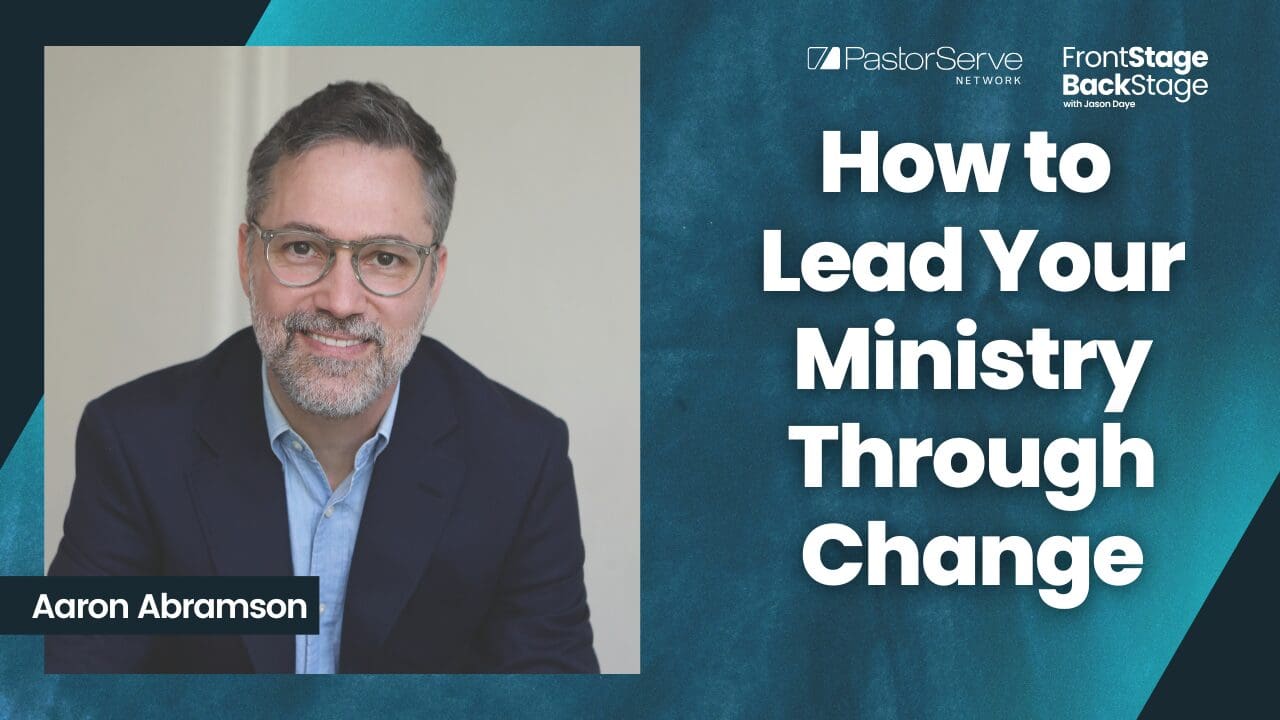
Change is inevitable in ministry. How leaders navigate it shapes both mission and people. Aaron Abramson shares wisdom on leading organizational and cultural change with clarity, faithfulness, and care.
Drawing from his experience helping guide a global ministry through transition, Aaron reflects on how design thinking can serve mission rather than replace it. He shares how intentional design, clarity of purpose, and faith-centered leadership can help ministries adapt wisely in changing contexts without drifting from what matters most.
They discuss:
- Why change is a normal and necessary part of ministry life
- How design thinking can support faithful mission and strategy
- Leading organizational and cultural change with wisdom and intentionality
- The importance of clarity, communication, and care during transition
- Encouragement for leaders navigating uncertainty and complexity
This conversation offers steady guidance for pastors and ministry leaders who are navigating change and seeking to do so in ways that honor God, serve people well, and strengthen the long-term health of their ministries.
Connect with this week’s Guest, Aaron Abramson
Weekly Toolkit
Additional Resources
Mission Design by Aaron Abramson is a timely guide for ministry leaders navigating the challenges of a volatile and rapidly changing world. With technological growth, societal shifts, and economic instability reshaping the landscape, traditional five-year plans feel out of touch. Yet, even amidst uncertainty, opportunities for meaningful kingdom impact abound.
Aaron Abramson was raised in an American Jewish family in Seattle. He was a teenager when his family relocated to Israel, where he attended an Orthodox yeshiva and served in the Israeli military. While traveling after his army service, Aaron had a life-changing encounter with God. His passion to see others’ lives similarly transformed led him to join Jews for Jesus in 2000.
Jews for Jesus helps Jewish people to explore Jewish life with faith in Jesus. Being Jewish and believing in Jesus were meant to go together. But many have never heard the good news of our Messiah. Learn more: https://jewsforjesus.org/
Ministry Leaders Growth Guide
Digging deeper into this week’s conversation
Key Insights & Concepts
- Everyone encounters change, and the pace of change in today’s society is quicker than that of the past.
- Pastors and ministry leaders can build an effective road map for change by starting with the why. Observing culture and asking, what if …?, can be an effective way to invite others to explore and adapt to potential changes.
- Effective ministry involves first understanding the needs of people, which requires a process of discovery. Rather than design a ministry to which to invite people, churches and ministries should first get to know the communities they are attempting to reach.
- The gospel does not change, but the various ways in which Christ-followers present the gospel can be contextualized based on cultural context. Effective ministries are aware of cultural realities and willing to shift when needed.
- Change comes with a sense of loss. Allowing people to grieve when change happens is important. So, too, is celebrating what God has done in the past. Doing something new does not mean negating the old.
- People react differently to change. Pastors and ministry leaders do well to not take these reactions personally.
- Effective leading through change involves highlighting tangible results of the new and celebrating the way God is working.
- A world of change requires adaptive leadership. Adaptive leadership requires taking on the posture of a learner.
- Mission design is not a one-time activity. Rather, churches and ministries consistently re-evaluate the way ministry is done.
- Pastors and ministry leaders can help create a culture of adaptability within their ministries. This is distinct from seeking innovation for the sake of it. Instead, adaptability involves knowing who the ministry is, what they are seeking to accomplish, and adjusting methods accordingly.
- Experimental change, the concept of starting small and testing the effectiveness of any proposed new method, is wise.
- Creating a culture where people are comfortable asking uncomfortable questions helps churches and ministries more quickly recognize the need for change and more easily be willing to explore and discover new ways of doing ministry.
- The Holy Spirit ultimately guides the process of change. Pastors and ministry leaders do well to avail themselves of the wisdom of general revelation and to actively submit those plans to the Lord.
Questions For Reflection
- What is my general mindset toward change? How do I usually approach the realities of change?
- What are some key changes I have personally experienced? How did I react in the midst of those changes? What have been the results of those changes in my life, not just practically, but in the makeup of my character?
- How might I empathize with those I lead in the midst of their reactions to change? What practical steps could I take to help the people in my church or ministry transition in the midst of current changes?
- What shifts in culture do I observe in my local community and/or ministry context? Where and how might these shifts impact the effectiveness of our current ministry methods?
- What is my general mindset toward the concept of adaptability? Do I tend to view issues as technical problems or adaptive opportunities? How does my attitude affect my church or ministry?
- Does our ministry have a clear grasp of our identity, our mission, and the community we are called to reach and serve? If so, how can I continue to integrate this identity into our culture? If not, how can I begin to help us better understand God’s design and call for us?
- How can I both plan with intention and be sensitive to God’s direction? What does this look like in practice?
- Are there particular ways of doing things that I hold as “precious”? How might this be impacting my church or ministry?
- Am I willing to ask uncomfortable questions? If not, how can I become more comfortable in this? If so, how can I help create a culture in my church or ministry that invites questions and re-evaluation? Where are uncomfortable questions currently being asked?
- What practical steps can I take to discover the culture around me so that I can better communicate the truth and love of God to people? How might I help those in my church or ministry do the same?
- What am I currently celebrating about the way God is working in my life? Do I take time to regularly pause to notice and celebrate His work? If not, what might help me do so?
- What stories does my church or ministry celebrate about how God has worked through us in the past? What do we celebrate about how He is currently working? How might I help my church or ministry honor the past, celebrate the present, and eagerly anticipate the future?
Full-Text Transcript
Jason Daye 0:00
Hello friends, and welcome back to FrontStage BackStage. I’m your host, Jason Daye. I have the pleasure of sitting down with trusted ministry leaders, and together, we tackle a topic to help you and pastors and ministry leaders, just like you, really thrive in both life and leadership. If you are joining us on YouTube, please give us a thumbs up and take a moment to drop your name and the name of your ministry in the comments below so we can be praying for you. And whether you’re on YouTube or a favorite podcast platform, please be sure to subscribe to follow so you do not miss out on any of these great episodes. I’m really excited for today’s guest as I’m joined by Aaron Abramson. Aaron is the CEO of Jews for Jesus. After a life changing encounter with Jesus, Aaron has been instrumental in revitalizing and redesigning, really the mission that Jews for Jesus is living out in our world. It’s a fantastic story, and I’m excited to welcome Aaron Abramson to FrontStage BackStage. Aaron, welcome to the show.
Aaron Abramson 1:09
Good to be here, Jason. Thank you for having me on the show.
Jason Daye 1:12
Yeah, absolutely. Now, Aaron, all of us in ministry experience change. We’re in changing churches, changing ministry organizations. The world around us is changing, and so one of the things we’re tasked with is, how do we manage that change in a way that is effective for all those involved, for the people that God’s entrusted to us, the ministry God’s entrusted to us … and you have experienced that yourself, Aaron, so much so that you’ve literally written the book on it – Mission Design – and we’ll get to that that in a moment. But share with us a little bit about your story, Aaron, how you have navigated change in your ministry organization. Thanks.
Aaron Abramson 2:01
Jason, yeah. So first of all, I grew up with – my wife has pointed this out a few times. We live in London, which I love your backdrop there. Feel I feel a kinship there. But I have moved a lot in my life. My wife grew up in the same neighborhood until she was, you know, completed high school and went to college. And I thought about that, I had a lot of change in my life. Both my parents moved, they moved countries. We immigrated from the US to Israel when I was in my teen years, and then moved back. And I’ve moved around on the mission field. I just feel like, personally, change has been very close to home, and I’ve also realized that that has given me some just skills of observation, of navigating change, culturally, learning new languages, having to figure things out in different contexts and places. And what I’ve realized is that change is kind of the thing we’re all going to encounter at some point in life, whether it’s our family status, whether it’s getting married, whether it’s having kids, whether it’s the loss of a loved one, change is just so part of life. You can’t get away from it. And I think that the world around us has changed radically. You know, we don’t … the world that my father looks back on is so radically different than the world that my kids are growing up in. It’s night and day really. And I think a lot of futurists and people that look at the world and culture and change and all those things would even say that the pace of change has picked up. And so, you know, technology, all these advancements and different things. I mean, a lot of what we’re seeing today just feels obsolete within two years, you know. And so I’m working in a ministry called Jews for Jesus. And Jewish people are, you know, they’re not a huge people group around the world. There’s between somewhere, let’s just say between 15 and 20 million Jewish people worldwide. They’re all over the place, but they’re not static. They’re moving. And I’ll give you an example. The war breaks out in Ukraine. There’s Jewish people living in Ukraine, and the next thing we know, we have a whole influx of Jewish refugees coming to Israel from Ukraine. You know, we’ve seen back when the fall of former Soviet Union, many came to Brighton Beach, Brooklyn, and New York. And, you know, living in New York, we suddenly had this whole influx of Russian speaking Jewish people that came to the city. And so we see cultural shifts and things. And so for a mission like the one I work for. We’d started in 1973 it was like, imagine an operating system in a computer. It works for a while, and it was working, I’d say, for a number of years. But in 2011 I moved back to the city of New York, and I lived there. Previously, I’d come on staff with Jews for Jesus in 1998 in the summer for a campaign where we did all this outreach in New York City. And I moved back with my family in 2011 to run the work of Jews for Jesus. And I just felt like the city was so different. It’s like people were interacting differently. People had less patience. They were more plugged in. You know, devices like this had phones and they had things that they were walking around with and paying attention. It just felt so different the landscape and what we were dealing with that we struggled, and we had this operating system that felt like it hadn’t been upgraded in a number of years. And, you know, a lot of us study, maybe you go to seminary, and you might study Greek and Hebrew, and you learn culture, and you learn all this kind of stuff about homiletics and hermeneutics and good things for ministry, right? But what I didn’t really know what to do nobody had trained me, was what happens when your methods aren’t working anymore? How do you navigate change? How do you bring a whole group of people that are dependent on you and look to you through that change into a place where they’re thriving and successful and really seeing God at work? So that process was something that I navigated along with our entire ministry over the course of a number of years.
Jason Daye 6:19
Yeah, that’s excellent and as you navigate that, Aaron, one of the big challenges that I’ve experienced over the years in ministry, a lot of the pastors and ministry leaders that I’ve had the opportunity to work with and coach and mentor and others on our team have the challenge is often, as you said, the world is accelerating. Change is accelerating around us. Oftentimes it feels like we’re always trying to catch up, but one of the pieces is that our people, whether it’s our team, right, or in a local church, our congregation, whatever that might look like, the idea of of change surfaces a lot of different reactions in people.
Aaron Abramson 7:06
Oh, yeah.
Jason Daye 7:07
Yeah. Can you talk to us a little bit about how we can name some of those reactions, and then some ideas around what we need to do to help better navigate, better lead. You know those around us through those kind of reactions that that pop up,
Aaron Abramson 7:24
Yeah, so some of us have maybe a little bit more vision around where things seem to be moving and the need for change. And I always felt like I was in that role within our ministry, even before I was in the CEO role. When I was running different teams, I was the one who was often kind of saying, Hey, I think that something’s happening and we need to … so I was kind of noticing some of this, but I then looked back and people were like, I don’t know what you’re talking about. I don’t really see it the same way. Or why isn’t what we’re doing already. I think it still works pretty well. And you know, why do we need to change it? I’m used to using that, so I think one of the roles for us as leaders isn’t just to kind of figure out where we need to actually go, but it’s really to build a road map, a way forward, and to help, kind of help them unpack and understand why that change is important. So there’s a lot of kind of wrestling through expectations. You know, sometimes people, they have a lot of preconceived ideas about things and change and the way things operated, and the way we’re used to doing things, and so really framing why change is important, why, you know, even take the risk of adapting your programs and testing out something that isn’t working. And I always try to start with really – and I know people talked about Simon Sinek’s book around Start With Why – But I really do, like, I think if you start with not, here’s the thing we’re going to change, but you start with, Hey, we’re seeing that we can have so much more impact because of the opportunities that we’re seeing over here, over here. What if, right? What if we were trying to address this, and you frame a why, like, we could actually see ministry happen far more, you know, impactful, than maybe we’ve been seeing if we … and the other thing is to test on a small front, you know, not to necessarily say everything that we were doing before we’re going to end right. And now we’re going to start this new thing, you know, day one. Most of the time, you don’t have to do that. Most of the time. You can gradually stick a toe in. You can start trying different things. And my philosophy within our team is, let’s try several new things all the time and see you don’t have to test in a massive capacity. You don’t have to spend a lot of money, but testing kind of if you’re sensing something and you’re seeing something that’s happening in the culture, in the community around you, to explore what that could mean, to explore. What that could look like. But going back to the reactions to change our ministry, you know, we started in the 70s, and we were doing a certain amount of our ministry had become routine, right? It was just, this is how you get Jewish leads, and this is how you follow up on Jewish contacts, and this is kind of how it looks. And what would you do when you’re not suddenly getting Jewish leads anymore, you know? And I didn’t have the answer to that. So what I did was I started to spend a lot of time. I went back to school, first of all, but I also jumped into this city labs that Redeemer, city to city was putting on. So Tim Keller wrote a book called Center Church, and I found some of the questions that he was asking there dovetailed a little bit with the questions I was asking, you know, like, how do you frame the gospel in the city you’re in, understanding what’s happening, you know, what? What’s the move of God in the city you’re in? And some other things he was framing there, but it got me thinking. And I was, you know, back in full time studies, I went to NYU to do a master’s of public administration to try to unpack this for my team. And what I discovered was the Jewish community was dealing with change that all these other NGOs and other, you know, social, you know, entities, whether they were nonprofits or, you know, churches, you know, ministries, whatever they were, all kind of figuring out, well, the world’s different now. What are we going to do? And a lot of nonprofits, they don’t have the money and the resources and the expertise and the man hours and stuff to be at the forefront of change and technology. So often you’ve got all this lagging kind of technology and lagging ideas and things, and so, you know, you might have a leader that’s read a Jim Collins book, or a Patrick Lencioni book, or, you know, some other leadership stuff. But what I discovered was a bunch of resources around human centered design, and what I really liked about design and user experience stuff and researching. It was a lot of these companies, they look at how people they don’t just look at what you say you believe. They look at what your activity is, what you click online. These companies are geniuses at knowing what you want before you know it. We’ve become so conditioned in this current, you know, day and age, because of companies like Amazon and, you know, and Apple and all these different companies where they’re kind of taking all of this time, rather than just design something and then try and market it at you they try to go back and say, what do people really want? What are we seeing? Over and over and over, the need being. Let’s design that, you know, product that meets that need. And I think that is that was a pivot point for us as an organization, once we kind of discovered, hey, you mean, we can go out and understand the people that we’re trying to minister to. What are their needs? Before we design programs and start, you know, create we’re gonna have a Tuesday night Bible study. Nobody was coming. Well, what are they really why weren’t they coming just kind of unpacking. That can be a vulnerable place to be, but it can be a life giving place where you’re just saying, Okay, let’s go into that discovery mode. So that for us was really a process. After 40 years, we sort of pivoted and started doing a lot of things differently.
Jason Daye 13:20
Yeah, I love that. Super helpful. And I like the idea that you unpack, and you unpack this in your book, Mission Design, the idea around understanding, like you said, where kind of people are, and that’s kind of where you start, instead of under, you know, trying to come at it from what you want to see happen. You kind of flip that. Aaron, help me out with this. How do you, how do you approach this, because, because this comes up a lot in ministry circles, and that is, well, now it seems we are placating people. We are we are taking this holy thing, right this, and then we are somehow turning it into and letting others dictate, you know, people just need to kind of understand what this holy thing is and then embrace it.
Aaron Abramson 14:10
I, I totally understand what you’re saying. And we all, we all push back, you know, to businessy language and concepts and marketing and all that. And, you know, we, we obviously want the Holy Spirit and God’s Word to be guiding us. And I believe those two things are not mutually exclusive. I do believe that, you know, it’s not like so our organization used to just hand out millions and millions of tracts. Okay? Paul, never once handed out a tract. Right now, maybe if he had a printing press, he would have just had a bag of tracts and done exactly what we were doing. What we realized is none of these methods are necessarily sacred. God gave us a lot of creativity. He gave us the ability to kind of try things and experiment and explore. And I think he wants us to use all of those gifts that He’s given us to be creative. I think the world is doing that. The world is doing as much as they can to flourish and be creative in all these different fronts. And I feel like he’s given us those same tools. And I look at our approach, and I go, none all these methods can be used and glorified by God, as long as they don’t, you know, contradict scripture, right? And so, you know, the Gospel doesn’t change the way we package it, the way that we get it to people, the way that we emphasize different parts of it, depending on the culture and where they’re at. We even see Paul pivoting at different times, even the apostles, in the Scriptures. And, you know, I love kind of diving in and seeing that from time to time. One example in the book that I bring up is, you remember, maybe the story of Moses and his father in law, right, the priest of Midian. And I just thought that was so interesting, because here’s this priest of Midian. He’s not really following the God of Israel, but he does pay homage and even make an offering. And Moses obviously brings this whole people that he delivers from, you know, they’re redeemed out of Egypt in this miraculous way. And he brings them to his father in law. His father in law watches what he’s doing, because he’s staying up until the morning till the night, dealing with all their problems. And he says, no, no, that’s not what you want to be doing here. And he gives them just straight up advice. It’s not advice that, like, you know, well, the Holy Spirit spoke to Moses and said, you need to set up officers over hundreds. And this, it was just kind of like this guy’s common sense. And he came out and he, he said, All right. And he ends up doing this. And we see later on even that God uses those, those, you know, those leaders over hundreds and over 1000s later on in the Torah, we see mention of that. But my thinking is that we can’t get precious around the methods. They’re going to keep changing. The world is going to keep designing new things. Let’s use the best of it, let’s see what’s out there. Let’s reject the stuff that doesn’t work for us. But I think that we have really very little to lose, a lot to gain by exploring some of these different techniques and tools and things that are out there. And so if you see something out there that might work for the gospel, by all means, let’s try it. Why not? That’s kind of our thinking, and it does put you in a place where you might feel a little uncomfortable at times. You might be wondering, are we compromising something? So you need to continue to put these things in front of the Lord, and you need to continue to pray as you go forward. But I wouldn’t see them as mutually exclusive ideas like, well, we’re following the world, and we’re following the Lord. It’s like the Lord uses paper and internet and he can work through any of it.
Jason Daye 17:48
Hey friends, just a quick reminder that we provide a free toolkit that complements today’s conversation. You can find this for this episode and every episode at PastorServe.org/network. In the toolkit, you’ll find a number of resources, including our ministry leaders growth guide. This growth guide includes insights pulled from today’s conversation as well as reflection questions. So you and the ministry team at your local church can dig more deeply into this topic and see how it relates to your specific ministry context. Again, you can find it at pastorserve.org/network.
Jason Daye 18:26
Yeah, yeah, no, that’s good. That’s good when it comes to change, I’m thinking of the people on our team, the people in our church, or whatever, those who are closest to it. And we begin to make shifts, like you said, we’re kind of inviting them into the what if, you know that curiosity like, Okay, well, what if? Which is important. But then inevitably, things begin to change. And then people are like, Well, I kind of liked the way it was before I was comfortable. There I was. And so you get to a little bit of pushback. How do you navigate those types of reactions when people are, you know, longing for, you know, at least in Egypt, we had food to eat, right? It’s the whole idea of, you know, how do we process, you know, how do we best lead our people in those in those times?
Aaron Abramson 19:21
Well, first of all, if you’re leading some kind of initiative that’s changing, it could be, you know, we’re changing our services. If you’re part of a church, it could be, we’re offering something different. It could be, you know, we’re going to pivot in terms of who we’re ministering, who’s who’s a key community that we’re focused on reaching or ministering to. And I think is we do that we need to first keep in mind that when you encounter that kind of a reaction to change from a colleague or a person, and you know, as they’re starting to see the writing on the wall, like, Hey, hang on a minute, just even understanding that there’s a perception sometimes of loss, like, I like doing it that way. You know, I used to like going out and talking to people on street corners, and now I’m online doing it, and I don’t know if I like that as much. So there’s that, that sense of loss there, but also when people get maybe even upset, I’ve had people get emotional. I’ve realized I’ve learned to not take it personal. Now, I know sometimes it might sound personal, but really in a lot of ways, what they’re reacting to is that things are different now, or things are moving in a different direction, and that leads people to feel anxiety, leads people to feel uncertainty. And I think identifying that and not reacting to it is really one of the key things that I learned, because I used to take it personally. Why are you upset? Like I’m trying to help us. You know, help me help you. You know, help this ministry if I do this. Fortunately, I had some champions. So I think as leaders, we can also champion those that are kind of coming up and saying, Hey, especially younger generations, and they come and they see things a little differently, naturally they will, rather than just stifling that and saying, that’s not what we do, you know, or what we’re doing works. Hey, let’s see what we can develop over here. Let’s allow that person to try and test something out. So the first thing when a person is really grappling with it is to just have that don’t take it personal. Try to be patient with them. You know, there is a sense of really bringing them into the look at what God is doing. They’ll hear and, you know, in some ways, when you can show some kind of tangible results as a result of the change, everybody feels better about it. You know, the real difficulty is when you change from something, but you’re not seeing the impact yet. Like, you kind of see that it could happen, but you’re not seeing the impact yet. And that is a real struggle for for people, because they’re going to go, Well, you know, even this thing that we had, that might have not been great, it was yielding some results. And now this thing that you’ve introduced, or this thing that we’ve introduced, it’s really sort of slowly, not really doing anything yet, and so really just walking people through that, trying to, you know, help people see where there is a bright spot, really kind of saying I want to and celebrating those bright spots, you know, like, hey, we said that we were going to see God work here. Okay, he’s starting to work here. Hey, let’s tell a story. And so, in many ways, you’re helping people process it, and then that takes a little bit of time.
Jason Daye 22:37
Yeah, that’s good. And so this idea, Aaron, this I’m hearing you, it’s that we want to celebrate those stories that are part of the change, because oftentimes we get caught up in just navigating, leading like, you know, okay, making sure everything’s going but we need to pause to celebrate those stories that are result of the change, to help those who might be lingering or those who might be a little more uncomfortable to see what’s actually happening in that change.
Aaron Abramson 23:05
Absolutely and even those that may be a little bit grieving, you know what? Right? Okay, like, we can allow them to grieve, and we don’t have to say, like, one of the things that I feel like would have been a mistake for me is, is to kind of go, oh, all of this was a mistake that we used to do it this way. You don’t need to do that. You could say God used some of the things that we were doing here, and look at what God did through that. Let’s celebrate that good. But we’re also seeing there’s new things that God is going to do, and let’s celebrate those as well. So you don’t have to kind of trash this thing, right? Say our services were terrible before. The way that we did ministry before was so, you know, it’s like no God used that for a season. Praise God, you know, let’s see what he does in this new season. And I also have this other mindset. I’m not so precious with an approach. And what I mean by that is, sure, we pivoted away a little bit from just doing street tracts and things like that. But we have certain contexts for that still works really well. We still minister to people, for example, in Russia and the Ukraine and places Jewish people still take all that stuff and they interact with us. So I’m not, I’m not saying to those guys, no, you can’t do any of that anymore. It’s like, hey, if it works, let’s do it. You know, if it, if it stops working and it becomes, you know, more challenging, then let’s pivot.
Jason Daye 24:24
Yeah, that’s good. That’s, I really like the idea of not just celebrating what God’s doing in the new thing, but like you said, celebrating what what God did in the past during that particular season, right? Totally, because that helps people see these the, you know, just how God’s at work throughout things, and not like you said, get caught up or make a particular method or a particular ministry within the church, or particular outreach or whatever it is. Precious. As you said, I love that word. Aaron, you alluded to this idea of adaptive leadership. Well, I thought about adaptive leadership. You’re talking about Paul, and how Paul changed his his methods, right? So Paul’s a great example of adaptive leadership. Share with us a little bit about why, especially in the world in which we’re living now, where as you, as you said, I think we all feel this change is accelerating around us. Why is adaptive leadership so key for those who are leading in ministry?
Aaron Abramson 25:28
Yeah, this was a concept that was developed by his I think it’s Ron Hafiz, or one of, one of the people who kind of pioneered some of these ideas. And there’s some other good material on this, not necessarily Christian, but some interesting stuff. And one of the ideas is like, if we approach problems just like technical, you know, you know this, this doesn’t work right now. So well, what do I do? A technical solution to it is I just, I just buy a new one, but a lot or I get this one fixed. But a lot of the problems that we’re solving are actually not just technical problems, you know, they’re personal, like they’re they’re problems that relate to how people interact. And so in some ways, the idea of solving a technical problem, and a lot of times we just approach problem solving like they’re all technical. And the problem with that is we often run over people as we’re kind of doing that, and we don’t realize that an adaptive problem is a problem that forces us to actually pivot in how we approach something, or how we think about something. So an adaptive problem might be, you know, like I have an aging relative. Like my grandmother’s aging and you know, she got into a car accident, because obviously, as she’s aging, it’s become more difficult for her to drive. Well, fixing the car is a technical problem, right? But the adaptive problem is really helping my grandmother navigate how she’s got to move from being independent to maybe relying on people differently. So that means she has to change, right? Well, we also, as leaders, need to be doing that. And I think adaptive leadership is is almost taking a posture where we’re we’re more of a learner, you know? I mean, look, we were experts on Jewish evangelism and Jews for Jesus, and I still like to think that we’re experts. But I will tell you, we actually had to go back into a learner mindset and say, maybe we don’t understand our people in the way that we thought, or what their objections were in the way that we thought we did. Let’s try and dig into that more. And I think we run the risk of maybe being too strident in what we believe the world to be like, and as the world changes, right? We got to be willing to maybe adapt our perspective as leaders and say, look the way that … I’ll give you an example. When we were working with boomers for a long time, we had this whole group of millennials come in and they were like, well, we don’t want to do these campaigns you’re doing, we don’t, we don’t like it. And I couldn’t. I was the Director of Recruitment. I couldn’t recruit anybody. It was like I was, yeah, I could recruit people that were 50. I couldn’t recruit anybody that was 20. I just couldn’t. And at the time, I literally thought to myself, they don’t have a heart for evangelism. That’s why, right? But what happened is, is I had more talks with them, right? My empathy was drawn out. I started to listen to them really. I understood. I was hearing their heart, and I was understanding that it wasn’t that they didn’t have a heart for evangelism. I mean, okay, fair enough, some of them may have not, but it was more that the way that they would interact with their generation is just different. And so I had to be open and say, Okay, well, what does that look like now? How does it feel different? And there were lots of nuances to that as I began to explore. But as a leader, I had to be willing to kind of adapt and adjust to who I was trying to work with and minister with, and who to and reach as well. And so that was a whole process that I think changed me in a major way, and I think has made me more adaptable as a result.
Jason Daye 29:11
Yeah, I love that. I love that. I’d love to just dive in a little bit to sure the idea of mission design, you know, what does that mean? Because you do an excellent job, I think, in the book of just kind of laying over, you know that this idea of, what does it look like to actually go through this process, like, like the book is, is inspirational, because you share some stories and some ideas, but it’s very practical for anyone in ministry who is navigating any sort of change. I mean, this is a super healthy thing, so help us understand just some of the core concepts and how it relates to a local church or a ministry that is seeking to not only be curious, but be adaptive and lean into what God’s ultimately calling us to do.
Aaron Abramson 30:13
Yeah, I appreciate you asking, and so the book is intentionally practical. I mean, there’s a lot of research on all these different topics. The book wasn’t trying to pioneer a brand new concept completely. It was trying to embed some of this way of thinking into a missiological framework, or into a ministry framework, and to kind of give people that maybe don’t have time or they’re not going to go out and start spending hundreds of hours, you know, trying to get a degree in this, or focus on this, or whatever, write a thesis on it, to sit down and to sort of say, Okay, give me some tools that can help me as I’m revitalizing my ministry, as I’m pivoting in my ministry, as I’m identifying some questions that I need to wrestle through in my ministry, or maybe I’ve been working with an old organization that does things a certain way for many, many, many years, and navigating change is tough. I need some handles, right? How do I do that? And I don’t want to have to go and spend hundreds of hours figuring it out. Here’s a book. Bam, you can. I wish I had had that tool, right? That was kind of what I put together for. And the book really takes you through a process, and a lot of that process is asking the right questions, right? It starts off really kind of saying, kind of, where is it that we’re going? Do we have clarity around what it is that we say we do, what it is that we we are trying to do as an organization, and, you know, so in a lot of ways, it kind of takes the analogy of a rocket, right? And it kind of sort of says, you know, you’ve got your launch. And nobody starts off launching a rocket into outer space without some coordinates of where they’re going to try to where are they going to Mars? Are they launching a telescope into space? Are they going to the moon? Are they just going to orbit like a satellite? Like, what is it that they’re doing? And the analogy, I don’t force it too hard, but the idea is, you’re trying to stop and try and identify just sort of the 50,000 foot like, if we could see change in our context, what would it be like? Why has God put us here? And what’s our what’s our heart? And who are we? It really takes that perspective of, who is it we are right? Like, in other words, if we have a real heart to sort of end, I don’t know, poverty and homelessness in New York City, and, you know, we are former, former drug addicts and people like that. We’re going to take a very different approach to a bunch of hedge fund guys that are like, we’re going to try and solve the problem differently, right? Because we’re coming with with different experiences, different resources, and who we are. So identifying who we are, where it is, we’re going like, what is it our ministry exists to do? Once we have a sense of that, right? That clarity, what I recommend is taking space to get out and basically the idea is to to get up in a way so you can kind of have some perspective on what the work you’re trying to do is. And that really necessitates you’re going into a discovery phase. It’s really kind of, I call it the orbit phase, where you’re kind of imagine you get out, you can see the world in a different perspective if you kind of get into orbit, right? And so in a lot of ways, taking that rocket analogy, getting outside really enables us to see 360 gets us out to where we can see everything. And so we’re really kind of able to kind of identify what’s happening and ask deep questions and really come alongside the communities that we’re trying to minister in. And the goal there is really discovery. Is learning, it’s exploring, it’s identifying things, and we do this as a team. The best way to do it is when it’s not just one person seeing everything from their perspective, but when you have a few other people that can help you kind of think through and see things right? And they might see it a little bit different, but the idea is to gain some of those observations, and then the third phase of the book. So the first phase is launching, then you’ve got this orbit phase, then you’ve kind of got re entry, which is kind of where you’re starting to bring it back together, right? You’re trying to kind of say, well, we’ve discovered, I think, some things, some needs in our community. We’ve identified change and where the opportunities may lie. And the book walks you through how to do that, and then it kind of says, okay, as we’re re-entering, what does this look like for us now? Like maybe that means we reposition our ministry. You know, as we’ve discovered this, we’re not going to do these things anymore. We actually want to build programs to do these things right. And then the idea is kind of sticking the landing as you come back in. Because that re-entry can be really as you’re coming in. It can be volatile, but the idea is really bringing it down to the ground. I don’t know if you’ve ever seen like, Pat Lencioni stuff on Working Genius?
Jason Daye 34:55
Yeah. Oh yes, absolutely.
Aaron Abramson 34:57
So, you know, he has that analogy of, like, you know. And you’re way up here with wonder. And if you’re in a meeting and you suddenly get tactical, it’s almost like imagine a plane jerking from 50,000 feet to 1000 foot right, right? So that last phase is really kind of testing things out, prototyping stuff, trying it, seeing fine tuning, what works. And the book walks you through that whole process, and also kind of talks through, like, how do you measure impact, especially in this intangible ministry landscape we’re in, how do you bring other stakeholders along and tell your story? How do you, you know, there’s just a few other tools, I think, in there that kind of try to help people as they’re going through this whole process. You know, how do you bring your board of directors along and things
Jason Daye 35:42
At PastorServe, we love walking alongside of pastors and ministry leaders just like you. If you want to learn more about how you can qualify for a complimentary coaching session with one of our trusted ministry coaches, please visit PastorServe.org/freesession. You don’t want to miss out on this opportunity. That’s PastorServe.org/freesession.
Jason Daye 36:07
Yeah, yeah. I thought was incredibly helpful, Aaron, because as I was reading through the book, what struck me is that I’ve seen many, many times ministries churches, they kind of get through the first first phase, and then they’re like, We did it right? They’re like, they, they’ll, they’ll rewrite their mission statement, right? Or they’ll, you know, refine their vision. And they’ll be like, okay, you know? And it kind of stops there, but, but your invitation is to say all that is, that’s, that’s important, because it’s foundational, you know, it’s giving you that, you know, orienting you to where you’re headed. But that’s just the very beginning of it. And then walks you through. How do you begin to, like you said, the discovery phase, and all those types of things, one of the things that you bring up, and this is towards the end, is that this idea of mission design really, truly should become a part of your culture, a part of who you are as a ministry or as a church. It’s not like something that you just kind of do and then you know, five years later or seven years later, or 15 years later, you’re like, let’s do it again, right? It’s one of those things where it’s like it becomes part of who you are. So share with us a little bit about that, that idea of how it how it needs to become just knit into the very fabric of of your church or your ministry.
Aaron Abramson 37:36
That’s a great question, Jason. I think the tendency is for us to want to fix something, right? So maybe something isn’t working like it was. It could be less people are in the service on Sunday morning. Or it could be, you know, our ministry has struggled, it could be a number of things to raise the necessary fund, like you can apply this to it’s all human centered problems, right, that you’re trying to solve. So you can apply this approach to almost anything, but what I’ve discovered in this process is you’re going to have to do this again, even if you go through this whole process and you find all the right answers and figure out how to redesign your entire ministry approach. Well, five to 10 years from now, or even three years from now, at the pace of change today, you’re going to have to start going back. So the way that I’ve even given the examples, I said it back in the day, we used to discard the rockets, right? The idea was a rocket went up for one time, and today, these rockets go back and forth. You know, they you can kind of relaunch. And so the idea is to have that kind of infused in your culture. And listen the best organizations out there, the ones that stand the longevity test of time are organizations, if you think about it, that have been able, and I’m talking about more in the corporate sector, but you do even in churches, are the ones that are able to pivot and actually take advantage of some of the change that’s out there. And, you know, one of the stories that I’m always fascinated with these kinds of stories, but it’s like the story, the example of, like Blockbuster, and Blockbuster kind of was innovative until it wasn’t. And Blockbuster basically, you know, doubled down on having 9000 stores in the United States, and then came along some of the little groups said, Well, what if we don’t have what if we don’t have stores? And they went, No, no, no, we have stores. And that’s how we do, you know, rent DVDs and all that. And they went, yeah, maybe we don’t. And they just did it differently. And I think that’s a great example of when you stop adapting and you stop pivoting, and you stop changing. Because, you know, they had a good business model for a while, but they just didn’t say, let’s continue to invest in where the future is going. And my mindset is, the stakes for us is so much higher in ministry, it’s literally life and death. You know what the work we do? If you’re a pastor, your work is so important. Like, we can’t afford to waste your time, you know. And so really kind of cultivating a culture that is comfortable asking uncomfortable questions and being okay with it and saying, Okay, maybe we need to actually re engage this process again. Maybe we need to explore and iterate. And some of the best companies, they do this thing, which is kind of iteration, where you’re kind of, you’re, you’re getting input, you’re, you know, that sort of, that cycle of things where you know, you’re kind of getting input, you’re, you’re testing out, and you’re adapting. And you keep that cycle going. And if you keep that culture within your organization, I think you can kind of refine things even better. You know, some of the things that we started doing, I thought they were the best thing ever. Months later, I was like, Oh my gosh, it’s so much better now, you know, so just kind of allowing ourselves to continue that, that culture of creativity and adaptability,
Jason Daye 41:00
Yeah, yeah. I love that idea of letting it be a part of our culture and the iteration bit, because the one thing that we don’t want to do is, you know, chasing shiny objects. And so we’re like, Hey, this is going to change the world. This is what we’re doing. You launch this whole thing, and then six months later, it’s like, okay, this is the big you know. And do that because people, you know, that’s, you know, people just get fatigued and exhausted by that, and then they stop following all together. So there is this idea that you that you share about how this can become a part of your culture in a very healthy way, right, Aaron?
Aaron Abramson 41:42
Yeah, that’s so good that you said that I, and I say this to our team, let’s not get precious with anything. I don’t want us to chase after anything shiny. What I want us to do is be pretty honest about what we’re actually seeing on the ground, you know. And listen, the results ultimately are in God’s hands. But there are some things that we can do to position ourselves so that, you know, we could say, well, all the results are in God’s hands. So I’m just going to sit on the couch and let him do all the work. It’s like, we don’t do that though. We go out, we try to find, you know, all these different ways to to really, you know, effectively, minister and to improve on what we’re doing. And I like to say to our team sometime, look, we might go out in the community. We might start to discover that, guess what works the best? Having T shirts and handing out tracts is the best way to do this. If I discover that, again, I’m not beyond going back to some old fashioned thing if it works. I think the main thing is really just to kind of really not be about innovation, but be really ruthless about what is it that ultimately we’re trying to build and what works? Let’s be honest about that, because I think if that’s our pursuit, then we don’t run into the shiny object thing. We run into the What Works thing, like, what if what we’re doing works, even if I don’t love it, all right, let’s keep doing it.
Jason Daye 43:03
You know, yeah, that’s good, Aaron, that’s so good. As you’re kind of winding down the conversation. This has been fantastic. Kind of winding down this conversation, I have one, one more, kind of big question I want to toss at you, Aaron, and that is a lot of a lot of our conversation today has been around, you know, some strategic things, even some tactical things. But talk to us a little bit, and feel free to share from personal experience or there at Jews for Jesus, the presence and activity of the Holy Spirit in the midst of all of these, you know, the design, the plan, the strategies that we’re working on. Talk to us a bit about that, if you could.
Aaron Abramson 43:48
That’s so important. And I think we need to recognize that the work that we do is holy work. It’s not just, I mean, I’m not saying that if you work in a non ministry environment that’s not holy work. I think it’s all work unto the Lord, and he, he can raise it and can, you know, can work through it all. I think you know, as we submit our plans before the Lord, He’s faithful to correct our paths. You know, is what the Scriptures kind of tell us. And you know, he’s, he’s the one who ultimately is going to direct our steps and move us to where we need to go. And I just keep I feel like I’ve experienced almost God’s joy as we’ve been asking and wrestling through some of these questions. And I’ll just give an example. I remember we were actually we went to the campus at Brooklyn College with our team. And you know, this is right when I moved back to New York, and we used to just do the same things all the time, hand out this tract and do this thing. And I remember just feeling like we need to stop. I don’t know what the answer is, but I feel like we need to just pray. And we just stopped as a team and just started praying on the sidewalk. I remember this. And as we were praying, all these Jewish people started walking up and go, What are you guys doing here? What’s this about? And we had one of the most effective afternoons of ministry that we’d had in a while. And I remember thinking to myself, it was almost like God showing me that it’s okay when you maybe don’t even know, and you’re not sure where you’re going, because there is this phase in every design process. This is another thing to anticipate where you just have no idea what to do. And, you know, imagine, imagine a linear line like this right, and this side of the chart is kind of like, how, how, how much sort of unpredictable and chaotic something is. This is very predictable down here, right? It starts off kind of predictable. We’re like, Hey, we’re addressing some questions. But then it’s like spaghetti over here, kind of like, you don’t know where you’re going to land, you know. And part of going broad and going wide is you want to allow yourself to ask crazy questions and really kind of explore what possibilities there may be. And then you start to come back in. And then, often, what happens? You come back in for a little while, you think you know what you’re doing, and then it gets crazy again. And then eventually you settle into what your new approach is going to be. But I think allowing God, especially in those moments where you’re like, we just don’t know what to do, Lord, but our eyes are fixed on you. He’s always faithful to … I’ll have a conversation with somebody or he … it just happens where you’re and I love the design process, because you’re going out, you’re talking to people, you’re engaging the community that you’re trying to minister to. Like a big part of this is really getting their insights. And God is so faithful to kind of I’d have so many times I’ve had these aha moments that I’m like, he’s probably been trying to say this to me for a long time, right? But for whatever reason, in that moment, it just clicked, and it stuck with me, and I was able to come back to the team and go, I think this is what I’m hearing. How about you guys? And then you’ll get confirmation over and over. And I think that’s the role of the Holy Spirit. I think Holy Spirit is in the midst of all this. And if you invite the Holy Spirit in, it’s as good as any planning process. None of them are perfect, right, right? They’re just our attempt to kind of really understand where God is moving. But I found that this one really, kind of opens up opportunity for God to really, to really, kind of, you know, speak into a situation. There is one caveat, and I’ll just mention this, Jason, quickly, we use logic a lot, you know, in making sense of things, and sometimes what God shows you doesn’t make any sense, yeah, and, and that’s okay, you know, there’s times when and prototyping and testing is kind of in a sense, where your fail safe is because when you try stuff out and you just do it, God’s going to show you if he wants you to keep doing something, you know. So sometimes you get a sense of something and it might not seem like it makes sense. As a rule of thumb, I don’t just say, yeah, go with plans that make zero sense all the time, right? I think he can still kind of direct your steps back, you know, to where he wants to be if you continue to seek him in this process.
Jason Daye 48:17
Yeah, I love that. I love it. Yeah, sometimes God does prompt us to do something that doesn’t seem to make sense from our perspective, but he knows what he’s I mean, we see example after example throughout Scripture, so you know, he’s still working that way today, but … he’s faithful
Aaron Abramson 48:32
so leaving room for that as a leader, even to just say, Look, I know that we’ve been talking about doing this, but I have a sense that we should just test this out. Try it. Let’s put it in front of the Lord. And that’s very biblical to test out before the Lord’s stuff and see if he’s in it.
Jason Daye 48:48
You know, right, right, right, right. And I love just the reminding ourselves of God’s faithfulness, that that he’s present, he’s at work, and he’s there for us. So, so there’s some freedom in that, right? It’s like we’re trying to seek God if we’re trusting him, you know, it’s not like he’s gonna let us blow the whole thing up. He’s he’s there with us, and it’s a beautiful, beautiful thing. Aaron, as we’re winding down, you have the eyes and ears of pastors, of ministry leaders are on the front lines of ministry all across the world. What words of encouragement would you like to share with them?
Aaron Abramson 49:29
I think that you guys are living in some of the most exciting moments in the history of the gospel. I mean, it’s amazing. We live in times where there are so many things that are fingertips and opportunities in front of us, it can be overwhelming. I encourage people to to sort of open up a dialog with their teams and to pray about this. I mean, obviously, you know, there … I think that we have such important work that we’re doing for the kingdom, that we have a lot to gain by going through this process together and allowing ourselves to even be uncomfortable and ask uncomfortable questions, like, could God be doing more through our ministry? Or are we really, you know, zeroed in on what he’s wanting us to do right now, or are there opportunities that we’re completely missing here? And walking through that process was one of the most life giving. It was also one of the most challenging, but in a good way, it grew us. I mean, growth is never without a little bit of pain and a little bit of challenge, you know. And you start to go, Okay, I feel a little as a leader. I felt a little awkward, like I didn’t know often if I was leading people in the right direction, but really, kind of setting off and testing small means you don’t have a lot you’re going to lose. And listen, if Jews for Jesus, a 50 — this year 53 — year old organization can successfully kind of re engage and, you know, kind of redesign from the ground up, its mission approach and how we engage Jewish seekers and all that kind of stuff, I think others can do it pretty easily. I really think it’s doable. And if anybody wants any encouragement, or they have a question or whatever, I love interacting around this stuff. Feel free to grab a copy of Mission Design. But you know, it’s not hard to reach me. Just go on our Jews for Jesus site and say, Hey, I have a question for Aaron perfect, try and do what I can.
Jason Daye 51:34
Yeah, yeah. I absolutely love that, brother. I love that. Thank you for making yourself available, and people do want to connect with you. Is that the best way through the Jews for Jesus website?
Aaron Abramson 51:43
Yeah, Jews for Jesus website is an easy way. I get lots of you know, might take a couple days, but usually things just get sent to me. I mean, I have other contact info, but that’s probably the most consistent. Okay, just to, you know, go on there and say, Hey, I have a message. You can find me on the website there. My emails on there too. It’s pretty easy. It’s just my name, basically, but you can, you can find, find out all that information on our site. And like I said before, there’s some resources, even in the book, some recommendations of other reading and video content and other things. If you’re looking for more help on this topic.
Jason Daye 52:18
Excellent brother. Love it. Thank you for making time to hang out with us here. And for those of you who are watching, are watching or listening, we’ll have links to Aaron’s newest book, Mission Design, that we’ve been discussing that helps, in a very practical way, walk you through this process for your church or your ministry. We’ll have links to those resources, along with our Ministry Leaders Growth Guide, which pulls insights and key questions for you to wrestle with, personally or with your ministry team from this conversation that we had. It’s all part of our toolkit. You can find that toolkit for this episode and every episode at PastorServe.org/network, so be sure to check that out. Aaron, it’s been an absolute pleasure. Thank you so much for making time really to hang out with us here on FrontStage BackStage.
Aaron Abramson 53:04
Absolutely. Thank you, Jason, for having me, and this is a great opportunity just to talk about something close to my heart. So thanks for that.
Jason Daye 53:10
Yeah, you’re very welcome. God bless you, brother.
Aaron Abramson 53:14
All right. God bless
Jason Daye 53:17
here at PastorServe, we hope you’re truly finding value through these episodes of FrontStage BackStage. If so, please consider leaving a review for us on your favorite podcast platform. These reviews help other ministry leaders and pastors just like you find the show so they can benefit as well. Also consider sharing this episode with a colleague or other ministry friend, and don’t forget our free Toolkit, which is available at pastorserve.org/network, this is Jason Daye encouraging you to love Well, live well and lead well.
Transcribed by https://otter.ai
Recent Related Episodes
-

Posted On: August 22, 2022
-
Posted On: March 3, 2026
-
Posted On: October 28, 2025
Right-click, then select “Save Image As…” to download one of the social graphics.