
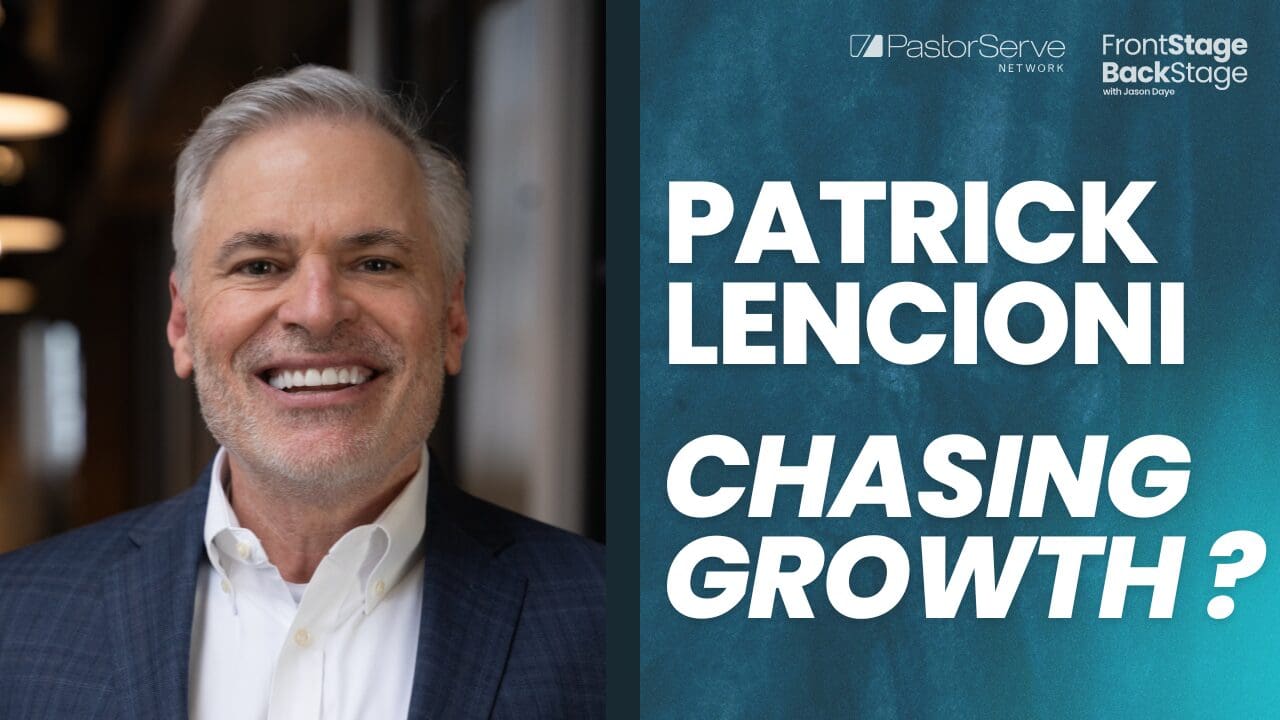
Leadership and organizational health expert Patrick Lencioni joins Jason Daye to explore how pastors can discern genuine ministry fruit, resist the pressure to chase growth, and build healthy teams rooted in humility, trust, and dependence on God.
How do you know if your ministry is actually bearing fruit? In this week’s conversation on FrontStage BackStage, leadership and organizational health expert Patrick Lencioni joins host Jason Daye to explore how pastors and ministry leaders can think differently about growth, effectiveness, healthy teams, and faithfulness to God.
Those of us in ministry want to see lives changed and people drawn closer to Jesus. But that good desire can quietly become a pursuit of growth, scale, numbers, or visible impact. And because those outcomes are often easier to quantify, they can begin shaping how we understand our own effectiveness, leaving us encouraged by apparent progress or discouraged when the numbers don’t reflect what we hoped to see. Patrick challenges us to examine what we are actually chasing and to consider the difference between the outcomes we can easily quantify and the genuine fruit God produces through faithful ministry.
Patrick is the founder and president of The Table Group and the author of thirteen books that have sold more than ten million copies worldwide, including The Five Dysfunctions of a Team, The Advantage, and The Motive. Drawing from decades of work with leaders and organizations, as well as his own faith, Patrick also shares why the health of the teams carrying out our ministry matters deeply.
Together they discuss:
- Why ministry growth and measurable outcomes are not necessarily the same as genuine fruit
- How pastors can evaluate ministry effectiveness without becoming driven by metrics
- What may be hiding beneath our desire to grow and scale a ministry
- Why humility and vulnerability are so essential to building healthy ministry teams
- The key action leaders can take to help their teams experience greater vulnerability and trust
- Why even the healthiest leaders and teams never outgrow their dependence on God
If you’re a pastor or ministry leader wondering how to faithfully evaluate whether your ministry is making a difference, this conversation offers a thoughtful way forward. Fruit matters. Team health matters. Effectiveness matters. But none of these require us to manufacture outcomes God never asked us to control. We can pursue healthy, effective ministry while remaining faithful to what God has called us to do and dependent on Him for the fruit.
Connect with this week’s Guest, Patrick Lencioni
Weekly Toolkit
Additional Resources
www.tablegroup.com – Check out Patrick’s website to discover practical resources and insights to help you become a stronger leader and build healthier, more effective teams.
The Five Dysfunctions of a Team: A Leadership Fable, 20th Anniversary Edition – In his book, Patrick reveals the five behavioral tendencies that go to the heart of why even the best teams struggle. He offers a powerful model and step-by-step guide for overcoming those dysfunctions and getting everyone rowing in the same direction.
Ministry Leaders Growth Guide
Digging deeper into this week’s conversation
Key Insights & Concepts
- Leadership rooted in faith is fundamentally an act of sacrifice, a willingness to die to yourself so that others can thrive.
- Humility is not thinking less of yourself; it’s simply thinking about yourself less, and that shift changes everything about how a person leads.
- Chasing metrics like attendance and giving can quietly turn a ministry into a consumer business, where pleasing people replaces speaking truth.
- Growth in ministry should be qualitative at its core, with numbers only serving to illuminate what’s already happening in people’s hearts, not the other way around.
- The call to scale a ministry has to be scrutinized honestly, because pride can disguise itself as vision, and bigger isn’t automatically better.
- True success isn’t measured by size or reach; it’s simply faithfulness to God’s will, and trusting Him to determine the outcome.
- People rise to high expectations far more often than they rise to low ones, and volunteers especially want their sacrifice of time to actually mean something.
- Teams break down not from disagreement but from the absence of trust, which is what makes people defend their position instead of searching together for the right answer.
- Real Christian love on a team doesn’t look like agreement; it looks like people who can argue passionately because they love each other and want the best outcome, not personal victory.
- Vulnerability has to start at the top, because a leader who won’t go first can’t expect a team to open up either.
- A fifteen-minute exercise of simply sharing where you grew up and what was hard about your childhood can dissolve years of surface-level familiarity and replace it with real understanding.
- Knowing your own weaknesses well enough to name them out loud to your team is its own form of confidence, not a liability.
- There’s an important difference between being vulnerable with a close team and being vulnerable from the pulpit, and confusing the two can tip into something manipulative or inappropriately needy.
- A healthy team is never a finished project or a utopia; it’s a group of people who keep crying out to God together, and that ongoing dependence is a strength, not a weakness.
Questions For Reflection
- When I think about why I became a leader in the first place, am I leading as an act of sacrifice for others, or has some part of me slipped into leading for attention and recognition? How do I know?
- Where in my leadership have I confused humility with a lack of confidence? Where have I confused confidence with pride? What would it look like for me to hold both rightly?
- Am I quietly measuring the health of our ministry by attendance, giving, or some other growth metric rather than by whether people are truly growing closer to Jesus? WHat am I looking at? What are the qualitative fruits that I can describe?
- What intentions am I bringing to my desire to grow or scale my ministry? Am I asking God to make it the size He wants, or am I chasing a size that would make me feel more significant?
- How are we, as a ministry team, treating our paid staff differently than our volunteers? Is that difference actually helping either group thrive?
- Do we expect enough from the volunteers who serve in our ministry? What message are we sending them about how much their time and sacrifice actually matters? How might we need to shift these expectations?
- When was the last time I was the first person on my team to admit I was wrong, ask for help, or acknowledge a weakness? What happened when I did?
- In what ways have I built a team culture where people are afraid to disagree with me? What would it take for me to invite honest pushback instead? How could an environment like this be cultivated in our ministry team?
- If I’m honest with myself, do the people I lead with actually know my story, the hard parts of my past, and not just the highlight reel? What would it look like for me to change that?
- What are the areas in which God has not naturally gifted me, where I do not derive energy or joy? Have I ever said that plainly to the people I lead alongside? How can our ministry team better understand one another’s giftedness and areas where we experience energy and joy? What difference could this make in the way we serve together?
- How are we building space on our team for real vulnerability, not just professional politeness, so that trust can actually take root?
- When conflict shows up on our team, are we avoiding it in the name of niceness, or are we willing to engage in the kind of loving conflict that actually leads to better decisions? What are some examples of how we have, or have not, processed this well?
- How am I responding when someone on my team struggles to be vulnerable or open up? Am I giving them room to grow, or am I quietly writing them off?
- When the hard seasons come, and it feels like we’re failing despite all our effort, are we able to see that moment as an invitation to depend more on God rather than proof that we’ve done something wrong? What did we learn the last time this happened?
- How does the health of our team help us understand the fruit of ministry? How is God’s faithfulness reflected in the way we serve together?
Full-Text Transcript
Jason Daye
Hello, friends, and welcome to another exciting episode of FrontStage BackStage. I am so excited about not only today’s guest but today’s conversation. If you are joining us for the first time, or if you’ve been with us all along our journey together, I believe you will be very blessed by today’s conversation. I’m your host, Jason Daye, and I have the absolute privilege of sitting down with some of the most trusted leaders, and together we tackle a topic to help you, and pastors and ministry leaders just like you, thrive in both life and leadership. We are privileged and blessed to be a part of the PastorServe Ministry, and the guest that is joining us today really doesn’t need much of an introduction, but I’m going to give you one anyway. This particular guest has had the opportunity to travel the world and has addressed literally millions of leaders in events and conferences. He has written 13 books that have sold more than 10 million copies and have been translated into over 30 different languages. He is one of the founders and the president of the Table Group. But more than that, he is a man of great faith. He loves his family, and he loves having an impact on people, on leaders, and just pouring into relationships. At this time, I’d like to welcome Patrick Lencioni to the show. Patrick, welcome to FrontStage BackStage.
Patrick Lencioni
It’s great to be here, Jason. This is not work for me. This is fun talking to people like you. I’m glad to be here.
Jason Daye
Oh, I love it, Pat! Really, I’m grateful that you’ve made time to hang out with us here on the show. And as we start out, I know one of the things that you’ve dedicated your life to is that you are really focused on helping people thrive in both work and life. And that’s one of the things that we do here on FrontStage BackStage, really focusing in on that with pastors and ministry leaders, those who are serving the Lord, and so I would like to start off our conversation really honing in on that intersection between life and leadership, and leaning in a little bit to ask you a bit of a personal question about that intersection for you. Pat, can you tell us a little bit about, over the years, as you reflect back across your life, how has your faith impacted and influenced your leadership?
Patrick Lencioni
Yeah, I think that it’s hard to imagine. I mean, I’ve grown, I believe, in my faith in great ways in the last 30 years of doing what I do. And I know that the more I grow, the further I know I am away from getting where I need to be. Which, this side of heaven, we’re never going to get there. But I think to separate those two things is impossible because, ultimately, deep down inside, I wrote my last book before I wrote a book called The Motive a few years ago, right when COVID came out, actually, so it’s been a while. And it’s like the question is, why be a leader? Why lead? And the answer is Jesus. I mean, the answer is because I am willing to suffer for others so they can thrive. To serve them and take the lower place. I mean, Jesus is the expert on all things. But the world has come to the conclusion that leadership is about yourself. It’s about that I get attention, I get accolades, money, fame, fun, and that’s a very dangerous thing. And I’ve slid into that before. So, how has my faith recognized this? I think, as I’ve gotten older and grown in my faith, I realize that leadership is a sacrificial activity where I choose to die to myself for others. Now, it’s most important that I do that first with my wife, then with my children, and then others in my life. But leadership is an extension of that. It’s a sacrifice, and once you know that, as a leader, you’re willing to do the things you need to do. But if you don’t think that’s true, you’re really either gonna be a very bad leader or you’re going to hate it.
Jason Daye
Yeah, you know, it’s so interesting, Pat, because oftentimes, if we look at a lot of the leadership literature over the years, it is this kind of alpha look at leadership. It is the bravado of leadership, right? And it’s like stepping on people to get to the top. And yet, as you’ve shared, and as you said, as you’ve matured over your leadership years and matured in your faith, we do see that shift in leadership and that humility of Jesus, understanding that true leadership isn’t who we can crush to get ahead, right?
Patrick Lencioni
Right, and you hit the word. It’s humility, and that’s a word that gets used more often than people understand it, I think. And humility is not to think that I don’t have something to offer or an undue lack of confidence. Humility is, I don’t know who said it. Somebody said that humility is recognizing that there is a God and I’m not Him. So who am I to think that I’m important? And C.S. Lewis said that humility is not thinking less of yourself; it’s thinking about yourself less. And so some people think, well, how can you be humble and be a leader? No, the only good leadership comes from that humility, and of course, Jesus, God’s Son, God incarnate, modeled that for us. And so, again, separating life and faith from leadership is just impossible. It’s not unlike separating faith from psychology and therapy, which happened for about 50 years in this country, and it led to such dangerous things. So, I recognize that whether you’re getting healing, or whether you’re leading, you’re working, or doing anything, if Jesus is not the focus of that, it just doesn’t make sense.
Jason Daye
Yeah, absolutely. I love that. As we move into- obviously, we’re talking to pastors and ministry leaders. That’s who spends a lot of their time with us, and we at PastorServe – that’s where we spend our time and our focus. We journey with a lot of pastors and a lot of ministry leaders. A lot of them, as they’re leading, one of the big things that we wrestle with is: how do we know that we’re making progress? Of course, your work over the years in organizational health- kind of pioneering a lot of work in that field. Making progress in ministry, in the spiritual realm, a lot of the metrics, a lot of the measurement around that, a lot of the quantifying of those outcomes, those things are really personal, oftentimes. And sometimes you don’t always see the progress that’s being made, and yet one of the things that you champion is that we don’t want to be fuzzy about our goals, so that we know that we’re making that sort of progress. So when it comes to things like ministry, when it comes to things that are very relational, very personal, what recommendations or suggestions do you have about us focusing in on how we measure these things? How do we set metrics? How do we set goals? But don’t let it become something that’s just transactional or just analytical. You know, we’re dealing with people, relationships, and things of a spiritual nature.
Patrick Lencioni
Yeah, I love this question. You know, I think that St. Thomas Aquinas said the answer lies in the middle. You know what I mean? And the truth is, I don’t like metrics because we assume that everything is quantifiable. So, on that extreme, I started my career at a management consulting firm, and it was like, oh, find a metric for everything, and that’s not how life works. On the other hand, the idea that, oh, I feel good about myself. I’m a teacher, and my kids can’t read, but I care. Darn it! And so don’t hold me accountable. And I think the biblical answer to this is there are fruits, right? You’ll know them by their fruits. So the question we have is instead of trying to find metrics, because then we can measure everything, and that’s very dangerous. But we do have to pay attention to: is this bearing fruit? And we have to prune sometimes, and we have to know, by the way, it’s not us; it’s God. We’re cooperating with the Holy Spirit, but we will see the fruits of that, and God, I believe, wants us to use our brains and our judgment. So, it’s an interesting thing when we go to a church. I think it’s very dangerous for pastors to measure success in terms of attendance, and giving, financial giving, and things like that. There’s a growth mentality. It’s like we have to grow, grow, grow. Well, oftentimes that comes at the expense of truth because now you’re building a consumer society where it’s like, well, I’m trying to please more people, and now you’re basically running it like a consumer business, trying to do what these people want, and how can I give that to them so more people come here, we become more well-known, we make more money. Or it’s just pride. It’s usually not money. It’s like, look at our church. So I’m very skeptical of that. But you know. We have to ask ourselves, how do we know if people are growing closer in their lives to Jesus as a result of being here? Is it resulting in- and this can’t be this week and this month. It has to be over a little period of time. Is this resulting in more people coming to know Jesus and changing their lives? And are there ways to notice that? Yes, but they’re usually slightly qualitative. I like to say, life is qualitative. Quantitative things help us understand the qualitative more. So you know what a church on fire is. And you know I’m Catholic. Pope Benedict said- he was two popes ago. He said the church will probably have to get smaller before it gets bigger, and if you think about Jesus, he wasn’t like, in John, he’s like, well, they’re walking away from me. I’m not going to change my teaching because of that. What about you guys? So I think what we have to do is ask ourselves first: Are we being obedient to God? And then, are we seeing the kind of fruits that would come from that? So I think it’s usually qualitative indicators that can be informed by quantitative measures. But if you’re relying on quantitative measures, it’s probably dangerous. So, it’s somewhere in the middle, and that’s not a very easy, satisfying answer. When somebody says, “Well, we have the same five people coming to my ministry over the last five years, but it’s my ministry. It’s like, no, that’s not producing fruit. I think we have to stop it. And they’re like, but it’s my ministry. It’s like, nah, your ministry, it’s about reaching others. And if somebody else says, well, I’m not sure that people are growing in their faith, but we’re certainly getting a lot more people to come, we have to ask ourselves: Are we doing that by cooperating with God, or are we measuring that ourselves? So, it’s that idea of holding up two things at the same time.
Jason Daye
Hey friends, just a quick reminder that we provide a free toolkit that complements today’s conversation. You can find this for this episode and every episode at PastorServe.org/network. In the toolkit, you’ll find a number of resources, including our Ministry Leaders Growth Guide. This growth guide includes insights pulled from today’s conversation, as well as reflection questions, so you and the ministry team at your local church can dig more deeply into this topic and see how it relates to your specific ministry context. Again, you can find it at PastorServe.org/network.
Jason Daye
Yeah, that’s good, Pat. And it is a challenge because the temptation is, as you touched on in the beginning, the temptation is, well, if a lot of people are showing up, then we must be doing it right. But that’s not always the case because there is that consumeristic piece of it, right?
Patrick Lencioni
Right, and we have to purify our intentions. Like, am I enjoying the fact that more people are coming because we’re getting well-known and we’re popular, or do I really believe? And would I be willing to say something that people might walk away from, but it’s the right thing to say?
Jason Daye
Yeah, right.
Patrick Lencioni
You know, it’s so dangerous. So, it’s not to say, like, Oh, let’s celebrate that less people are coming. More people coming is generally a good thing. If that’s because God is bringing them there, not because we are manipulating, marketing, and getting people in by telling them what they want to hear, which is very infrequently what God wants people to hear.
Jason Daye
Right, exactly. So that kind of leads into, and we’ve touched on this a little bit, the idea of scaling ministry, right? But maintaining impact, because again, ministry is relational, right? And so there’s that challenge. Like, how much can you scale discipleship, right? I mean, we look at Jesus’ example again. Jesus had his 12, right? So, when you look at this idea of scaling in ministry, what are your thoughts around that, Pat? Like, what does that actually look like? How do we think about that in a way that kind of honors the way that Jesus modeled it without us getting too… because we want to help people know Jesus, know Jesus well. I mean, that’s kind of the mandate is to share our faith. What are your thoughts on that?
Patrick Lencioni
My first is to go back to purify your intentions because pride is such a slippery thing, and it’s like, why do I want to scale this? Now, the right answer is because, well, it should be because I think God is calling me to. And if you’ve ever seen somebody, Mother Teresa once said something that was very powerful. She said, God doesn’t call us to be successful; He calls us to be faithful, and then what he does with that is his. And Francis Chan, who’s become a friend of mine over the years, which I love, he said he had a mega church, and he goes, one day he just said, “Oh, I think if Jesus came back, I believe this is what he said: my church would be bigger than his church. Because we get to this point where we think it’s about that scale, and I love it. It’s like Jesus didn’t go. Jesus, like, no, I’m here to do my… because people go, ” There are more people that want to talk to you here and to cure. And he goes, no, my mission is to go share the gospel with these people. And Bob Buford, I love. I’m one of these Catholics that’s had the privilege of knowing all these amazing evangelical people and priests, and I love it. And Bob Buford, God rest his soul, once talked about catch and release. But sometimes pride makes us want to catch people and hold them, and prove that they still are ours. So I think what we have to do is purify our intentions. Go, God, make this ministry the size that you want it to be, no bigger and no smaller. And if I really trust in your will, and you’ve called me to radically change the lives of 400 people, or 40 people, or 4 people, or 4000, let that be your will, not mine. And it is so easy and dangerous in this world to say, Well, it is kind of cool that we’re the biggest church in the tri-state area. So we just have got to be so careful that we’re always purifying our intentions and being faithful, and knowing that true success is just faithfulness to God’s will, and He does the rest.
Jason Daye
Yeah, that’s so good. That’s so good. Let’s get back to the healthy organization piece around teams because you’ve done so much. I mean, that’s one of the things that you are really, really well-known for. And so I’d love to tap in because so many ministries, so many churches, obviously, are working in that dynamic of teams. You have teams that might be hired, right? They’re on staff working, so it’s a paid team. But then also, obviously, a lot of churches, a lot of ministries have volunteer teams as well. So, you have that dynamic of some are paid, some are volunteers, and those are two.
Patrick Lencioni
Which is largely irrelevant.
Jason Daye
Okay, okay.
Patrick Lencioni
Which ought to be largely irrelevant.
Jason Daye
Okay, so help us out a little bit with that, Pat. Let’s talk a little bit about those dynamics between paid versus volunteer, how that shows up. When you say that should be irrelevant, what do you mean by that dynamic?
Patrick Lencioni
Yeah. So, I’m going to name-drop another pastor friend of mine, John Ortberg, who said nobody should work in a church that needs the job. And here’s the thing: we’re all volunteers, right? And what we do wrong, though, in churches or any nonprofit, but church being the most important, is that we think that we do this thing that seems logical, but it doesn’t make sense. So, we expect more of people that we pay, right? But we under-inspire them because we think the fact that they have a job there means that they’re already mission-driven because they came to work there. Then the people who are volunteers we expect less of because we don’t pay them, so we have lower standards for them. But we try to inspire them with, like, See, here’s how you’re going to make a difference. What we end up doing is we under-inspire our paid staff and treat them like it’s just a job, and we have low expectations for our volunteers, which drives away the best volunteers. I was on the board years ago of the Make a Wish Foundation, and the greatest thing about Make a Wish is they were like This is too important to do poorly. We have no tolerance for people not being on time or not having high standards. These are families in need, and their children are going through very difficult things. So we are going to hold you to the highest standard. And if you want to volunteer here, just know we will not tolerate lukewarm mediocrity. And do you know what that did? It means the very best volunteers in the world said, “I want to volunteer there”. Because we’ve all volunteered at a church or another nonprofit where they were like, “Well, you’re a volunteer, thanks. You don’t have to do a lot. And we’re like, “No, you don’t understand. I’m giving my time and energy. I want it to matter.” So what we ought to do is expect a lot of our volunteers and realize that the reason they’re doing it is to grow closer to God and serve their neighbor, and appreciate them, inspire them, and have high standards. And then we should manage our paid staff as though they were volunteers who needed to have the same level of motivation for what they’re doing because they’re not working for a paycheck, and just because they’re getting one doesn’t mean that’s their motivation. And so I think we have to kind of flip it upside down, you know? So I love talking about that because I think like, when I go to my church and volunteer, and the pastor asks a lot from me, it makes me want to do a better job and give more money. It’s the craziest thing. The people that give the most are the ones that volunteer the most, but it’s because they know that they’re actually doing something that matters, and they’re treated as though they were part of the staff.
Jason Daye
At PastorServe, we love walking alongside pastors and ministry leaders just like you. If you want to learn more about how you can qualify for a complimentary coaching session with one of our trusted ministry coaches, please visit PastorServe.org/freesession. You don’t want to miss out on this opportunity. That’s PastorServe.org/freesession.
Jason Daye
Yeah, that’s so good. That is so good, and that is important. And so true when you think about it: what you say in so many nonprofits, so many ministries, so many churches. That’s exactly how, because you feel like you’re asking too much of someone who’s giving up some of their time, right?
Patrick Lencioni
Right. And granted, you need to be flexible, right? But you need to realize they want to make a difference. So, now I do want to say something else that I was going to mention before we talked about the volunteer thing. The essence of teamwork though is, and it gets back to humility and vulnerability. Can people on the team admit when they’re wrong, when they don’t know something, ask for help, acknowledge a weakness they have, and apologize? Can they be totally human? And with all the things about productivity and everything else, at the base of teamwork is the people on my team will be completely human, and I know that they’re not going to try to pretend something that they’re not, and that changes everything. So humility, which is the antidote to pride, which is the root of all sin. And an author friend of mine, Matthew Kelly, wrote a book. He once said to me, Jesus was the… he was God incarnate, okay? But because he embodied humility in the truest sense, he was the most attractive person ever to walk the face of the earth. I love that. People were attracted because when you meet somebody who has that, you know? I love what he said about, was it Nathaniel? There was no guile in you. And when you work on a team with people where there’s no guile, and they’ll be the first one to go. Oh, wait a second! I was wrong, or hey, we should do it your way. When you work with people like that, it’s attractive. People are attracted to work on that team. They accomplish so much because it’s not about them; it’s about what they’re doing collectively. So, what we always say is you’ve got to start with humility and vulnerability, and that is where teamwork starts.
Jason Daye
Let’s spend some more time there, Pat, because I’d like to talk more about this idea of building these healthy relationships, these healthy environments, with ministry teams. What are some other ways? So humility, we start there. What are some other ways that we can really lean into building these really healthy environments for ministry teams to be working together?
Patrick Lencioni
Well, once you establish humility, and there’s a sequence here, and not that you’re ever done. You don’t go like we’re 100%, but the first thing you have to do is get people to trust one another, which means that they know that that other person is not going to say something that they don’t believe. Okay, and once there’s that trust, the purpose of that is so that they will do what churches don’t like, which is engage in good conflict. One of the biggest challenges of churches is that we falsely believe that Jesus commanded us to be nice to your neighbor as yourself, and love is rooted in kindness, not niceness. And that’s not an excuse for cruelty by any means. But it’s like, true teams that trust each other debate and argue in love, and they say things like, “No, no, no. This homily series or sermon series. I don’t think it’s going to work. I don’t think what you’re thinking is going to work.” And people aren’t offended by that. They’re like, “Thank you. Tell me why you think that. Let’s keep debating this.” Because all we want to do is the right thing that will serve God and His people, not I want to be right. But if a person is not humble and vulnerable, they’re going to defend themselves, defend their ministry, defend their position, and teams are broken down at that level. So, the reason why we have to be humble and vulnerable is so that we can argue without fear. See, because when you trust somebody, your spouse, arguing about your children is not because you want to win the argument; it’s because you want to figure out the best possible answer. And you know that the moment you say to your wife or your husband, “Hey, and something that’s compelling “, they’re going to say, “Oh, you’re right. Now you’ve convinced me. Let’s do it your way”, and vice versa. And on a team at a church, when you walk into a room and people are arguing, but they love each other, that’s a sign of true, true Christian love.
Jason Daye
So, Pat, how do you get to that place? Because you’ve got a group of people who’ve come together, and not every ministry team has been together for a decade, right? Like, you’re all usually, you know, you’ve got different people in ministry positions who are at different stages of life. They’ve been through different experiences. You’re all together in the same room trying to move down the same road together. How do you build this?
Patrick Lencioni
Well, what I love about your question is that it’s actually not the amount of time you spend together, because there are people who have worked together for 10 years that don’t have true vulnerability-based trust, and so they don’t really argue well, and they don’t do all the other things. And then there are other people who work together for a short period of time. So, it’s how intentional are you? So, the first thing I would say is the leader has to go first. A leader cannot build vulnerability and trust on a team that kind of leads to really good discussion, argument, and all those things if he or she doesn’t go first. So, if I’m the pastor of an organization, I have to be vulnerable first. And let’s keep in mind that’s what Jesus did. He humbled himself to die on a cross for us. The ultimate ask of vulnerability. They are going to mock me, make fun of me, lay me on a cross naked, and nail me to it. I’m going to be there in front of you. And if he could be that vulnerable for us, then we have to be willing to be vulnerable for one another. So, what does that look like, though? Well, there are a lot of ways to build vulnerability, and the two that I think can be done quickest, you can see a team go from a zero in vulnerability to seven quickly. You can see teams work together for years and stay at a two. So the two ways that we do this, assuming the leader is willing to be vulnerable, we start with the leader. We do an exercise called personal histories, which sounds so ridiculously simple, Jason. And it goes like this: It takes 15 minutes. We’ll sit together. I’ve done it with hundreds and hundreds of teams. We’ll go, Okay, we’re working. We’re a new team. We’re working together. Okay, let’s go around the table. Where’d you grow up? How many kids were in your family? Where were you in that order? And what was the hardest thing about being a kid for you? What was the biggest challenge of your childhood? Literally, everybody takes about a minute. Like they say, Here’s where I’m from. I’m the middle child of five. And when I was a kid, my mom drank, or we were very poor, or we moved all the time, or something happened, and it takes them two minutes. You go around the table. 15 minutes later, everybody on the team has gone, and they’re looking at each other like, oh my gosh, I never. And teams that have worked together for years will do this, and I will say to them, how many people learned something about people at the table they didn’t know? And every hand goes up. I had a guy once who had worked together for nine years with this guy, and at that session, the guy said, “Yeah, when I was 12, my 16-year-old brother was murdered, and that was really tough in our family.” And we always hear these amazing stories, and that’s all he said. And the guy said, “Oh man, I’ve worked with you for all this time. I never knew that.” He goes, “Yeah, I just never came up. We just never talked about it.” And when we do that, what happens is people suddenly look at each other, and whatever their title, their age, their rank in the organization doesn’t matter anymore. They’re looking at each other like human beings with wounds, with a past, and scars, and there’s this new sense of appreciation and respect and vulnerability. And they’re like, I just said something to somebody. It was a little bit of a risk. This is a small one because we’re not going into great depth. And they respect me more. These people will love me the more vulnerable I am with them, and it literally takes 15 minutes. And every time, people are like, “Wow, we have never talked to each other like that. And that’s just a tiny one. The next thing we do is this new thing we came up with called a working genius, which takes 10 minutes to fill out, and people get a report. And I have your results right in front of me, Jason. And so I know the things that feed you and give you joy and energy. Based on this, I also know the things that you don’t mind, and you’re okay at. I also know the things that crush you, that drain you of joy and energy. Knowing that and letting you go, hey, you guys, you should know this about me. I really don’t like to finish things because at the last part of things I’m ready to move on to the next thing, and I know I’ll leave things unfinished or I’ll get kind of bored and move on, and that tenacity part of things is not my strength, and you guys probably already know that, or you’re gonna know that about me, and I’m gonna try my best, but I just want you to know that’s not a gift God gave me. And then the other one is the gift, like you have wonder. It’s like, yeah, some people can ponder things for days and sit, and that’s a real gift from God, and it’s necessary. And I’m not like that. I kind of like, okay, that’s enough. Let’s move on. And when people know that you can admit the gifts that God didn’t give you, it makes you so much more vulnerable and trustworthy. They’re like, so can we, if we see you failing in that area or struggling, can we point it out to you? And you go, Yeah, of course you can. I mean, it’s right here. And suddenly they’re going. So I could go to the pastor and say, Hey, Jason, you forgot to finish that thing again, and there are a whole bunch of people waiting for you. And I know you’re moving on to this other thing, and I love you, and that’s why I’m saying this to you. But either you need to get somebody else to do that, or you have to power through. Think about how different life is when people can say things to one another. And on the counter to this, when they know what your geniuses are, because, as it says right here, that you love to galvanize people, like you love to get in front of people, and come on, you guys, we can do it. You love to rally the troops, and you love coming up with new ideas. You’re what’s called an IG, which, by the way, is called an evangelistic innovator, and you get energy when people go, “Hey, remind us why we’re doing this again. Can you inspire us?” And there are other people, pastors and others, who hate doing those things. And when everybody on a team can look around and go, Oh, say you hate those, but you love those. You hate those, and you love those. It changes. Suddenly, they’re vulnerable, and they’re humble. They’re like, I’ll admit what I’m bad at. I’ll admit what I’m good at because confidence is humility, too. So, anyway, that’s how you do it. And in literally 90 minutes, you can take a team from a one to a seven in humility-based trust.
Jason Daye
Yeah.
Patrick Lencioni
We’ve seen it. It’s crazy. Unless the leader is not willing to admit the truth about himself, or unless there’s somebody on the team, and occasionally you find somebody that just goes, “Listen, my wounds are too deep. I’m not going to open up to you guys.” And when that happens, you need to love them enough to give them a chance, and you might have to love them enough to let them go to an organization where they don’t have to be vulnerable. Keeping them around when they can’t be humble, vulnerable, and trustworthy is not good for them or anybody else. It’s cruel, and churches do it. Oh, churches feel so bad about letting people go. And so what ends up happening is they either don’t do it, and then that person suffers, and then they let them go quickly because they just weren’t like, okay, we’re done, and then that person leaves without dignity. And it’s so much better to go to somebody and say, hey, you know something? We love you, and worshiping here is a good thing, but working on the staff, we need a little bit more from you, and it’s okay if you can’t do that. And there are other places you can work, and we still will love you, but it’s up to you to opt in or not.
Jason Daye
Right.
Patrick Lencioni
We’re going to give you every opportunity to do that, but if we don’t think you can, we’re going to help you transition. And that’s just a hard conversation in any company, but in a church, it’s like, and a pastor will say, ” But I’m their spiritual shepherd.” It’s like, yeah. So don’t let them suffer.
Jason Daye
Yeah, that’s good. Man, that’s super helpful.
Patrick Lencioni
I’m all over the map here, and I’m talking too much, Jason.
Jason Daye
No, that’s good. I love that. Those vulnerability pieces, because establishing that trust is really the foundational piece in developing that healthy baseline where everything else grows out of, right?
Patrick Lencioni
Yes. I want to make something very clear, Jason, because as you were just saying that. This is vulnerability with your team.
Jason Daye
Right.
Patrick Lencioni
The challenge is appropriate vulnerability from the pulpit, or in public, and by the way, even that is good. But you have to understand that going out in your sermon or your homily and being vulnerable is a very different context. Because with your team, you have a close relationship with them. And sometimes pastors will, either out of woundedness or maybe in a performativeness, which is very dangerous, go out and be more vulnerable than is appropriate. And that can either come across as inappropriately needy or inappropriately manipulative, so we have to be careful. We’re talking about with your team, right?
Jason Daye
Yeah, yeah, absolutely. Yeah, there’s a difference between being kind of real and relational and trying to connect versus being completely transparent.
Patrick Lencioni
Yes, absolutely. And again, it’s not that if that person then came and met with you and you were counseling them, you might share something with them in that room. Hey, you should know something. I’ve struggled with this as well.
Jason Daye
Right. Right.
Patrick Lencioni
But it might not very well be the right thing to go up, ladies and gentlemen, I’m here to tell you I have a problem with pornography. Now, again, I don’t know all. We purify our intentions and ask the Holy Spirit to lead us. But we need to be prudent.
Jason Daye
Yes.
Patrick Lencioni
But on a team, when we’re talking about developing a family-like relationship, if it’s going to be a real team of trust, we’re going to have to be very vulnerable.
Jason Daye
Yeah. That’s excellent. That’s excellent. So it’s been fantastic, Pat. As we’re kind of winding down this conversation, other thoughts around developing within the team, just a healthy environment. Are there other things that you would say Hey, these are a few things you really want to kind of think about that would help?
Patrick Lencioni
Yes. I heard, there’s a wonderful priest named Monsignor Shea. He’s the president of the University of Mary in, I don’t know if it’s North or South Dakota. That’s bad. But he spoke at a conference I was at recently, and he was talking about my stuff in his talk. He’s one of the most genuine and humble speakers and preachers I’ve ever heard. And he said, “So I would sit there, and I would say, ‘Okay, God, I’ve done The Five Dysfunctions of a Team with my team, and I read The Advantage, which is one of my books, and I’ve really tried to do this. And he goes, ‘We’ve done Working Genius, and I cry out to you, Lord, every time. Like, how can you help me with my team? And then we’re making progress, and then something happens, and I’m like, how could this happen again? And he said, then I realized I’m asking God to make it possible that I never have to cry out to Him again. And He said, “We always have to correct. We are never, on this side of heaven, we are never finished. And a healthy organization and a cohesive team is never perfect.” And he said, “Sometimes we think we’re creating a false utopia”. And it struck me. It’s like it’s never- the messy, the best families are messy. The best churches, the staff members are not the Stepford Wives where they’re all like, “Oh, everything’s great! Hi!” You know that cult-like thing that churches can be? They’re messy, and we are always going to have to cry out to God. And my company, that’s been around for almost 30 years, Jason, in the last three years, we’ve gone through some of the deepest, hardest things, and come out of it so much stronger. And the people I’ve worked with for almost 30 years have said, every time one of those challenges comes up, we think, “I guess we failed. I mean, heck, we do this for a living.” And the thing about it is, it’s like, no, we’re never done doing that. My wife and I, after 34 years next week, I think, of marriage, love each other more and have gone through harder things in the last five years and 10 years than we did at the beginning. And that’s what is supposed to be. We have to cry out to God and say, “I can’t do this on my own.” And the five dysfunctions, and the advantage, and the six types of working genius, and the ideal team player are not ways to substitute our actions for his. We have to get as healthy as we can be and know that it’s never going to be enough because we’re broken. And think about heaven, where we’re not going to need these things, when we’re going to be in the presence of God, God willing, and we’re going to be, you know, healed. But this side of heaven, we’re never going to be there, so this is never done. So it’s not a utopia, and it’s not a building an inability to need God. So, I love that he said that because it was so true.
Jason Daye
I love that, and you know, Pat, what I love about that is that it is not a discouragement. That is an incredible encouragement. Exactly, it’s like it’s okay, right?
Patrick Lencioni
Exactly! There are two ways to say it. I can’t do this. No, it’s like I can’t do this! I mean, I have goosebumps. It’s like you, God, I need you.
Jason Daye
Right!
Patrick Lencioni
I have to depend on you. What a liberation that is.
Jason Daye
Absolutely. Love it. Yeah. Man, this has been great, brother.
Patrick Lencioni
Praise God.
Jason Daye
Yeah. As we wind down. That was a great word of encouragement. But as we wind down, I always like to give my guest an opportunity for just some final words of encouragement. You have the ears and eyes of men and women who are serving in the kingdom right now, the front lines of the kingdom. Any words of encouragement that you would like to leave with them, Pat, as we kind of close down?
Patrick Lencioni
I’m just going to repeat something I said before, and that is: remember, He calls us to be faithful. Keep seeking His face and His truth, not numbers. But be open to the fact that what we’re doing might not be working because we don’t see fruit. And then pray that God shows us how to understand the difference between metric-driven things and I feel good about myself, and that there should be fruit, and even that we have to depend on him to show us.
Jason Daye
Absolutely, love it, brother. Thank you so much for making time to be with us, brother. This has been an absolute joy. Love your heart, and it’s been incredible. For those of you who are watching or listening along, for this episode and every episode, we create a toolkit available that complements this entire conversation. In that toolkit, there are a bunch of different resources in there, including a Ministry Leaders Growth Guide. In that growth guide, you will find insights that we pull out of the conversation that Pat and I just had, along with some questions that help you dig deeper into this conversation. You can go through those questions on your own or take your team through those questions. It’ll be great. We’ll also have links in there to a bunch of Patrick’s resources, including the Working Genius links to the assessment. So if you want to go through that assessment with your team, we’d really encourage you to do that. That’s one of those great ways that Pat explained that you can develop that vulnerability and build that trust in your ministry team. So there’ll be links to that in that toolkit. You can find that at PastorServe.org/network. So be sure to check that out. Brother, this has been a wonderful conversation. Absolutely loved it. And again, thank you for making time to hang out with us here at FrontStage BackStage.
Patrick Lencioni
Thank you, Jason. God bless you and your audience, everybody.
Jason Daye
All right. God bless you, brother.
Jason Daye
Here at PastorServe, we hope you’re truly finding value through these episodes of FrontStage BackStage. If so, please consider leaving a review for us on your favorite podcast platform. These reviews help other ministry leaders and pastors just like you find the show, so they can benefit as well. Also, consider sharing this episode with a colleague or other ministry friend. And don’t forget our free toolkit, which is available at PastorServe.org/network. This is Jason Daye, encouraging you to love well, live well, and lead well.
Recent Related Episodes
-

Posted On: March 25, 2025
-
Posted On: April 21, 2026
-
Posted On: August 22, 2022
Right-click, then select “Save Image As…” to download one of the social graphics.