
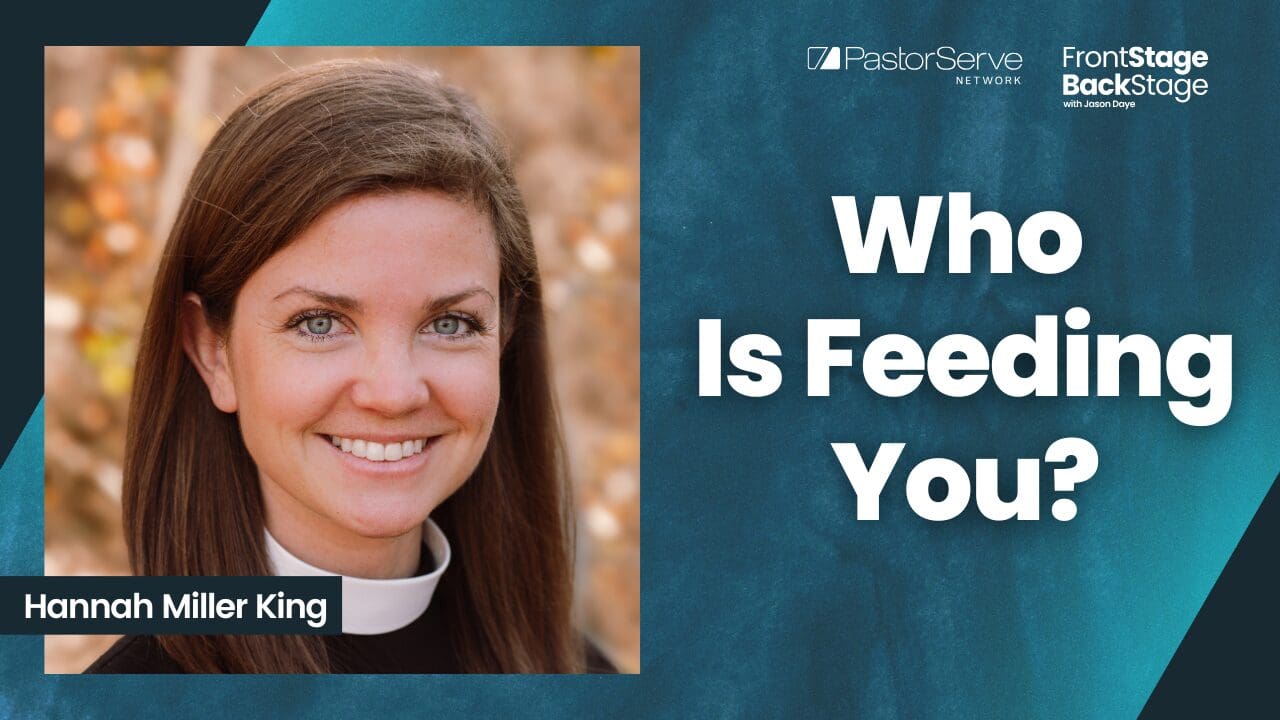
Before you feed others, are you being fed by Christ? Hannah Miller King shares how communion reframes grief, hunger, and the tension ministry leaders carry.
Ministry leaders spend their lives feeding others.
Preaching. Counseling. Leading. Serving.
But who is feeding you?
In this thoughtful and theologically rich conversation, host Jason Daye sits down with Anglican priest and author Hannah Miller King to explore what it means to receive from Christ before attempting to serve others.
Drawing from her book Feasting on Hope, Hannah reflects on how the Lord’s Table has shaped her through profound loss, unanswered questions, and the ongoing tensions of ministry. Together, they discuss how communion reframes hunger, how some longings remain unsatisfied in this life, and why that is not a flaw in the Christian story.
- The difference between functioning in ministry and being truly formed
- Why ministry must flow from overflow, not exhaustion
- The temptation to feed on ministry success instead of being fed by Christ
- How communion reminds leaders they are hungry children before they are shepherds
- Why some hungers remain unsatisfied — and why that’s part of the Christian story
- Sitting with unanswered questions without rushing to a silver lining
- Receiving from God for your own soul, not just for your next sermon
This episode is not about tidy resolutions. It is about faithfulness in the tension.
This conversation is helpful and encouraging for every pastor or ministry leader who desires to bring their hunger to Jesus, not to their sheep.
Connect with this week’s Guest, Hannah Miller King
Weekly Toolkit
Additional Resources
https://www.hannahmillerking.com: Hannah is a priest in the Anglican Church in North America (ACNA). She writes and speaks on topics related to Christian hope, grief and loss, and biblical joy.
Feasting On Hope: How God Sets A Table In The Wilderness: How can we live as people of hope in the midst of unmet longings, unanswered prayers, and seemingly unresolvable pain? Through sharing her personal story of deep loss, Hannah Miller King reflects on how the ancient Christian practice of Communion can reframe our grief by embedding it in a larger picture of gospel hope. Each chapter presents a way in which the Lord’s Supper makes the hope of the gospel tangible, reminding us of God’s present faithfulness and promise of future renewal. With its inviting tone and thoughtful reflections, Feasting on Hope provides solace for those seeking hope amid a world that is not yet restored.
Connect with Hannah on her substack: https://hannahmillerking.substack.com
Ministry Leaders Growth Guide
Digging deeper into this week’s conversation
Key Insights & Concepts
- Those in ministry are called to serve out of the overflow of God’s ministry to them.
- Pain and brokenness are realities of life from which pastors and ministry leaders are not immune. Sometimes leaders may need to take time away from public ministry in order to heal.
- Pastors and ministry leaders need people who are caring for them–safe, confidential mentors with whom they share the realities and burdens of their lives, unfiltered.
- Trusted mentors are willing to speak truth, even when it means saying hard things.
- There is fruitfulness and life in ministering from one’s place of pain. When pastors and ministry leaders are open about their pain, they invite others in their church to share their lives honestly as well.
- Pastors and ministry leaders can model what it looks like to live as broken people who are first and foremost receiving Jesus’ ministry to them.
- Embodied rituals can aid learning in deeper, holistic ways.
- Pastors and ministry leaders can be tempted to push through hard seasons, gloss over doubts, or prioritize ministry above their personal identity as a child of the King.
- Communion can remind them of the reality that the cross–death, loss, waiting–came before the resurrection.
- Jesus is the Bread of Life. He feeds and sustains His people, even as they await His return and feasting with Him face-to-face. Communion is a tangible reminder of this truth.
- Communion can serve as a reminder that the gospel remains true and it is not contingent on one’s current experience.
- Pastors and ministry leaders can be tempted to look to their congregations for validation or otherwise feed their needs, but the Communion table reminds them to bring their hunger to Christ.
- It is tempting to become complacent in one’s spiritual journey. While there are seasons in spiritual growth, pastors and ministry leaders need to prioritize time and space to ask God big questions, to look for where He is working, and to simply spend time with Him.
- With Jesus, there is always enough for whatever He has called one to do.
- Communion is a picture of both fullness and hunger. God brings healing, renewal, and transformation now and yet also leaves some things unhealed and unsatisfied. Believers hunger for Christ’s return.
Questions For Reflection
- How have I received Christ’s ministry in personal ways?
- Am I currently serving out of the overflow of my relationship with Christ? If so, what is helping me do that? If not, what might I need to consider to get realigned?
- How have I experienced brokenness? Am I honest with myself, God, and others about my places pain? How am I allowing God to minister to me in my pain? How am I inviting others into my experience–both as instruments of God’s love for me and as witnesses of God’s work in my life?
- What questions, doubts, or pains am I currently carrying? With whom am I sharing these? Do I have a community of trusted friends and mentors? If not, how can I begin to build one?
- What is my personal view of and experience with Communion?
- How can I help my church see the reality of the gospel in our practice of Communion? How might I help us deepen our understanding of this ordinance?
- How do embodied rituals impact my personal faith walk? What other embodied spiritual practices do I engage in?
- Do I trust that Jesus has enough for what He calls me to? If so, how can I continue to lean into the reality of God’s abundance? If not, what might help me live in the truth of His abundance?
- How can I help those in my church foster a desire for continual spiritual growth? How can I help us be a church marked by hunger for and honesty with God?
- Where do I currently feel like I’m waiting on something (with a big question, a doubt, healing, etc.)? How am I handling this waiting?
- How can I help my church stand firm in the Lord while also being willing to sit with Him in the unknowns of their questions, doubts, and pains?
- How can I come alongside those in my church who are currently experiencing pain or doubt? How can I encourage others in our church to do the same?
- Where do I tend to place my identity and receive validation? Am I looking to my people to feed my needs? How can I honestly evaluate my heart before the Lord? Where do I need Him to satisfy me?
- How am I currently experiencing fullness in God? Where am I currently experiencing a foretaste that is whetting my appetite for final restoration?
- How am I helping my church understand the fullness of God while also helping them hunger for final restoration? How am I helping them know both satisfaction in Christ and hunger for His return?
Full-Text Transcript
Jason Daye 0:03
Hello friends, and welcome to another insightful episode of FrontStage BackStage. I’m your host, Jason Daye, and I’m really excited about this conversation that we’re about to dive into. You see, I have the honor and privilege of sitting down with trusted ministry leaders, and together, we tackle a topic in an effort to help you, and pastors and ministry leaders just like you, really thrive in both life and leadership. Now this week, I’m excited to be joined by Hannah Miller King. Hannah serves as an Anglican priest and a writer in the Anglican Church in North America. She also serves as an assistant Rector at The Vine Anglican Church in North Carolina, and does a lot of writings, as I said, but her most recent book is entitled, Feasting on Hope. At this time, I’d like to welcome Hannah to FrontStage BackStage. Hannah, welcome.
Hannah Miller King 0:57
Thanks so much. It’s great to be here.
Jason Daye 0:59
Yeah. So good to have you; really excited about diving into this conversation together as we as we think about life and ministry, right? Obviously, we have our ministry leadership, and then we have kind of what we call the backstage of life, the personal, less public side of life. But all of life is really kind of all of life, and that’s how we enter into the work that we do. And I would love, Hannah, if you could just start out by sharing a little bit of your own journey and touching on some of the grief, some of the loss, that you’ve experienced, and how that may have shaped or impacted your life and your faith.
Hannah Miller King 1:46
Okay, briefly, I grew up in a Christian home and sensed a call to ministry from a really young age. I also experienced profound loss as a child. My father died of cancer when I was … he was sick from when I was 10, and then he died when I was 14. So my own formation as a Christian was sort of in this, you know, crucible of unanswered prayers, and that really shaped my faith in a way that I think sent me into ministry, ultimately, with a real confidence in God’s goodness, regardless of our circumstances, but also that, you know, has become, and this is a lot of what I talk about in my book. My ministry to others is the overflow of God’s ministry to me, how he has comforted me, fed me, welcomed me, brought healing to me, and also continues to sustain me where it’s still hard, that’s, you know, what I am finding to give to others in my ministry is from the overflow of what God has given me.
Jason Daye 2:56
Yeah, I love that. You know, Hannah as as ministry leaders, oftentimes we, because we’re called to, we continue to serve while, while quietly carrying pain in our lives, right, whatever that loss or that pain might be, that we might be carrying Hannah. How have you found in your ministry, as you’re serving others, that you’re able to best carry that pain, but also show up in ministry for those you’re serving.
Hannah Miller King 3:30
Yeah, well, I feel like there are a lot of layers to that. Because, on the one hand, sometimes we need to take time away from ministry because of our pain, you know, and and that can be scary if you’re already in it. We always need people who are caring for us, who can be those safe, confidential mentors, even if we are continuing in public ministry. You know that we can be completely unfiltered with and who can say those hard things to us. But I also think that, you know, we can find a lot of fruitfulness and life in kind of opening up about our pain and sharing from that, ministering from that, because probably the people in our churches are walking through similar experiences, and so being able to say, this is how God is meeting me, is invitational, it helps them to put down their guard and maybe not pretend as much that everything is fine, but it also, you know, is modeling for them. How, how do we live the Christian life? We live the Christian life as broken people who are always first and foremost recipients of Jesus ministry to us?
Jason Daye 5:00
Yeah, I love, I love that. Hannah, in your newest book, Feasting on Hope, you really lean into the sacrament of communion and share how it has been so formative for you and how it has helped you as you’ve processed grief, as you’ve processed loss, as you’ve processed just even when things don’t — as all of us experience — work out the way we really hope they would work out. I’d love for you to kind of walk through with us a bit about how, how you first began to sense the sacrament of communion, bringing some healing and wholeness into these these times of loss.
Hannah Miller King 5:39
So I’d say it started when I was in seminary, where I was learning all this great theology about Jesus wanting to be united with us forever. You know, the Gospel isn’t just about getting forgiveness or getting heaven. It’s about getting Christ, but it was in taking communion, receiving communion every week, where I began to receive that good news in my body and in my heart in a way that, frankly, was unsettling. It was very vulnerable and it it sort of challenged some of the defense mechanisms I had put up between God and me, you know, I’ll just be God’s employee, right? I’ll just do the stuff for God. And communion was sort of this embodied practice of him saying, No, I just want you to come and be with me. I want you to come and commune with me, apart from anything you do or anything you bring. So that was really the start. And I think since then, communion, the Lord’s table has been my teacher in a lot of different ways, and I’ve also seen it be a helpful teacher for other people in my church. Because, you know, we can we can talk, we can give people ideas, but there’s something about embodied rituals that help us to learn in a deeper and more holistic way.
Jason Daye 7:14
Yeah, I love that. Let’s talk a little bit about that a bit more. How does the sacrament of communion really invite us into something deeper, because, because some people feel a challenge with communion, in that it becomes rote and ritualistic, right, and lose the richness of it. So Hannah, how do we understand that richness? And what are some things we need to keep in mind, as ministry leaders, as pastors, as priests, as we are inviting people into that sacrament to keep it fresh, to keep it life giving.
Hannah Miller King 7:47
Yeah, I think I would say that we don’t need to worry too much about keeping it fresh or about whether it’s working, because I think we can say Jesus told us to do this, so we can trust that he’s at work in it and through it, maybe in ways we can’t see or understand, maybe in ways that are much slower than we would like, but we can trust that if this is a gift God has given us, there is a reason for it. And there’s something that’s going to come from it that, honestly, we’re not supposed to be in charge of, or we don’t need to be in charge of. I would also say that, you know, the different denominations have different ways of understanding or to articulating what’s happening at the Lord’s Supper. What are the elements become? What do they mean? But I think regardless of like your particular answers to those questions, all of us can look at the Lord’s Supper and see in it a really rich, tangible way of understanding the gospel – that Jesus comes to us. He makes himself small. We receive him in the form of bread and wine as a human being. You know, he came in a body, and him being the bread of life means that he’s he’s enough for us. He feeds us, He sustains us even while we’re waiting until he returns and we feast with him face to face. So I think, I think all of that, you know, I think there are a lot of different ways to preach the gospel through the Lord’s Supper.
Jason Daye 9:33
Yeah, I love that. Hannah. Hannah, what are some, some things that maybe in your journey, and as God has continued to reveal Himself through communion, through the sacrament. What are some things that maybe have surprised you, as you’ve been growing in this serving, but also just journeying with Jesus? Are there things that either surprised you, or things that you hadn’t considered that continue to draw you into the depth of what was really happening as you communed.
Hannah Miller King 10:11
I think one thing that has surprised me is how you know the longer you’re in ministry, the more personal ups and downs you have. And you know, when I started out, I was kind of guns blazing and like, this is so true, it’s so good, it’s so you know, it’s good news. But there are days, even in church, when I’m thinking, is this, is this just wishful thinking? And so communion … You know, I’ve been surprised and and blessed by how communion and the story of the gospel and this meal that’s on offer to us, it’s there and it’s something I can taste and something I can receive, even if I’m struggling to believe it on that given day. And so there, you know, it’s this reminder that there’s something outside of me that is solid and that is on offer to God’s people, even when I’m not solid, even when I’m struggling with doubt or weariness, there is still this table that is prepared for me and for them.
Jason Daye 11:22
Yeah, yeah. And when we’re thinking of that, that sacrament, especially from the perspective of of our ministry, and as you said, the world we’re living, things go well, things don’t go well. You know, there are times that we’re challenged. There are times that we’re wondering if what we’re doing is even making a difference. All of those types of things that we in ministry wrestle with. How does, how does the idea of feasting at the table? How does this connect with the ongoing work that God is doing in those who are called to vocational ministry? You mentioned earlier that it it helps sustain us. Can you talk a little bit more about that, that sustaining part?
Hannah Miller King 12:07
Yeah, well, in my tradition, you know, after the priest says the things about communion, then they receive first, they actually feed themselves communion, right there in front of the congregation before they invite everyone else to come forward. And so I think there’s a sense in which, even as the ministers, the people up front doing the things we’re also before anything else, hungry children at God’s table who need to be fed, and we are fed. He does meet our needs, and he does fill us. And so, you know, then, then we have something to give our people, because we’ve, we’ve been satisfied by Christ. I think, you know, kind of taking that down a step, taking that, extrapolating that a little bit. You know, it’s very tempting, I think, for ministers to look to their people as ways to meet their own needs. You know, I’m going to help you, and that’s going to make me feel good about me, right? I’m going to preach this great sermon, and you’re going to give me a compliment, and that’s going to feed me. Keeping the table in the middle reminds me, no, no, I bring my hunger to Jesus, not to my sheep, and I’m feeding them from Christ. I’m not feeding on them to, you know, feed my own ego or to get my own sense of validation or whatever.
Jason Daye 13:43
Yeah, yeah, no, I think that’s so important, because that is one of the temptations in ministry is for us to begin leaning into this idea that, like you said, we’re feeding off of the people God’s entrusted to us. And it’s helping us feel like, okay, we’re doing something now, but keeping communion central, keeping the table central, does help remind us that this is where we’re all being fed, and we’re on this journey together. Hannah, one, I just wanted to tell you I appreciate in your book that how Feast on Hope. You are very vulnerable. You’re very open about your own journey. You mentioned the loss of your father. Your father got ill with terminal cancer when you’re young. You lost him as a teen, young teenager, and but you also share a story about you come from a big family, and you share a story of your brother, Noah, and loss there. Can you talk to us a little bit about that? And again, how, how did, how did Christ help you through that? And specifically, you know, how did this sacrament of communion? What did you learn during that season of life? During that loss,
Hannah Miller King 15:02
Yeah, a couple things. So he died unexpectedly by suicide three weeks before I was ordained as a priest. And so, you know, that really raised the question like, What are we doing in ministry? If sometimes it doesn’t seem to work out for people. And I carried that question very personally, because I loved my brother deeply, and so did my whole family. And also, you know, in at least evangelical spaces, we really want to paint the gospel as like this happy story with a happy ending, and God’s love makes everything good, and it does, but not in the short term all the time. And you know, communion was very precious to me during that season of grief, and in my early ministry as a priest, because it’s the story of Jesus who gave it all for love, and things didn’t work out for him. He offered Himself, and He was rejected. And so sometimes we lose sight of the fact that the gospel is a story of a willingness to lose and to give without being able to see if there’s ever going to be a return on investment. And so sometimes that’s what the call to love is. It’s to give and not understand what happened to that gift, or to seem like it’s, you know, it’s not gone anywhere, but to hold on to that, because we know about the resurrection, and we know that ultimately, Jesus’ gift didn’t return void. It yielded life for everyone who would come to him, and yet we can’t rush to that part. We have to also sit with his willingness to endure the cross and to suffer rejection.
Jason Daye 17:10
So what does that sitting with that in our own lives? Because, because some things you raised there, you know, this idea that oftentimes we are serving, we are loving, we are ministering, and we won’t necessarily see the results or the outcome. You know, it’s not like we’re building a house and when we finish building it, we see the house, and you feel that sense of, yeah. So what? What is that for us? And how do we kind of navigate that, sitting with things that seem unfinished and we may never, never see the completion of that.
Hannah Miller King 17:49
I think, at least for me, it has looked like permission not to rush through the questions and the pain and the confusion, and that’s again, a vote for having those safe people in your life where you can really be completely raw. And, yeah, and just trusting that, you know, you can both not lose your faith and also have real doubts and have real beef with God. You know, I remember in that season having this image of like, okay, I’m still in the room with God, but I have these big questions that are unanswered, and so it’s just me and God and my questions in this room together. And I think it’s really important that we don’t try to push through those seasons, to try to get to like, Oh, here’s the lesson, or here’s the silver lining, or here’s the three point sermon, you know, but to really do that work and to trust that God will meet you in it.
Jason Daye 19:05
Yeah, that’s that’s helpful. Hannah, throughout our conversation, you’ve mentioned at different times this, this idea and this concept. I don’t want us to miss it, and I’d like you to lean in a little bit on, if you could, this idea that we who are serving in ministry. Sometimes we have a tendency to focus more on the ministry, and maybe even almost prioritize that, intentionally or not, above just the fact that we are a child of the King, that we are apart from the ministry, apart from anything else we do, we are on a journey with Jesus. We are loved by Jesus. And I love that, that has shown up throughout this conversation. But Hannah, can you help us, like I said, lean into that a little bit more because our tendency … and usually the longer we’re in ministry, we tend to get more like this. We tend to get focused more on how that might preach, or how we might use this as a teachable moment for someone else, or how, you know, how are we going to, you know, share this with others, as opposed to, well, what is this just between me and God? What is God doing in this for us, how do we continue to nurture that in our relationship with God?
Hannah Miller King 20:29
Yeah, I remember early in ministry, not wanting to read my Bible on my Sabbath day because I was like, Oh, well, that’s work. And early on, either realizing or someone telling me you need to know, you need to learn how to read your Bible for you. And I think that’s one really small way we can practice like, do I have a devotional reading of Scripture? Do I have a devotional life apart from, okay, I need, you know, I need to get the message out of this thing, and that can be daily, that can be weekly, whatever. I also think, you know, because I’ve been reflecting on this a little bit having written this book, which is largely about my adolescence and my young adult years, and like, wow, I felt like I was growing so much during that time. And now I’m in my mid 30s, and I guess I’ve stabilized a little bit. But, you know, it’s very tempting to just plateau and think like, well, I’m good. I’m not really like breaking the law in any part of my life, you know, apart from maybe speeding occasionally. You know, I’m stable in my moral choice that whatever, whatever, and not really making that space to ask the big questions and saying, God, where, where am I missing you? Where am I needing you? How do you want me to grow in this next season and prioritizing the time that it takes to ask those questions and to do that work.
Jason Daye 22:22
Yeah, that’s, that’s good, Hannah. As as I read through Feasting on Hope, obviously, you know you’re tying all these things back to the table, back to communion. You have, you know, men, women, who are serving front lines of ministry, who are watching or listening right now, and I’m curious what, what would you like to share with them, impart to them around the sacrament of communion? And it’s, you know, how do we how do we help really embrace what Christ has for us in communion and invite others into that. What message would you like to leave with them?
Hannah Miller King 23:14
Oh, gosh. I think, you know, the table is a picture of God’s abundance. And I think in ministry, that’s a really important picture to always keep before us. When Jesus fed the 5000 there were 12 baskets left over. So for anyone who’s called to serve to remember that with Jesus, there is enough for whatever he’s called you to do. But I also think I would, I would want Christian leaders to see at the table this picture of both fullness and hunger in the sense that Jesus does feed us in the Gospel right now, he does offer healing and renewal and transformation right now, but he also leaves us a little bit hungry for his return. And so in the Christian life, there will be some things that remain unhealed. There will be some hungers that go unsatisfied, and that’s a feature, not a flaw. So I don’t think we need to try and get everyone to this place of 110% everything’s great. It’s actually good that we’re saying on some level, in some way, come quickly Lord Jesus, because that’s, you know, we’re looking to the future, and we’re longing for his return. And so there’s, there’s a little bit of foretaste in the Christian life that we shouldn’t be uncomfortable with. We should be acknowledging this is part of, part of the story, part of our vocation is to be whetting our appetites for the feast that is to come.
Jason Daye 25:01
Yeah, that’s good. I love how you how you pick up on that tension, right, that tension of fullness, but yes, also hunger and and how that tension is something that helps shape us and form us, and it really invites us into to something deeper. Excellent, excellent. Feasting on Hope, your newest book, helps us really understand and engage and follow along with your story as you’ve shared and and how communion has been a valuable part of your life and part of ministry. Hannah, if people would like to connect with you, with your ministry. You know what you’re doing there at the church, or your I know you do a lot of writing those types of things. What’s the best way for them to to really connect with you?
Hannah Miller King 25:50
So I have a website, HannahMillerKing.com, which is really just a way to click through to my monthly substack newsletter or to contact me. You know my previous works are there, my articles and things like that, but where I’m regularly sharing is through substack. And I’d love to hear from you if you reach out through my website.
Jason Daye 26:13
Awesome, excellent. Thank you so much, Hannah, thanks for making the time to hang out with us. For those of you who are watching or listening, we do have a toolkit that accompanies every single conversation that we have here on FrontStage BackStage. And in that toolkit, you’ll find a lot of different resources, including links to Hannah’s book, Feasting on Hope, links to our website, all those fun things. Also a ministry leaders’ growth guide, pulling some insights out and some questions for you to reflect on from this conversation and reflect on with the ministry leaders at your local church or in your local ministry. You can find that at PastorServe.org/network. So please be sure to avail yourself of that resource. And again, Hannah, thank you so much for making the time to share with us and share a little bit of your journey and how God is guiding you, both in life and leadership.
Hannah Miller King 27:02
It was an honor.
Jason Daye 27:03
Yeah, thank you. God. Bless you.
Transcribed by https://otter.ai
Recent Related Episodes
-

Posted On: July 29, 2025
-
Posted On: December 5, 2023
-
Posted On: July 15, 2025
Right-click, then select “Save Image As…” to download one of the social graphics.