
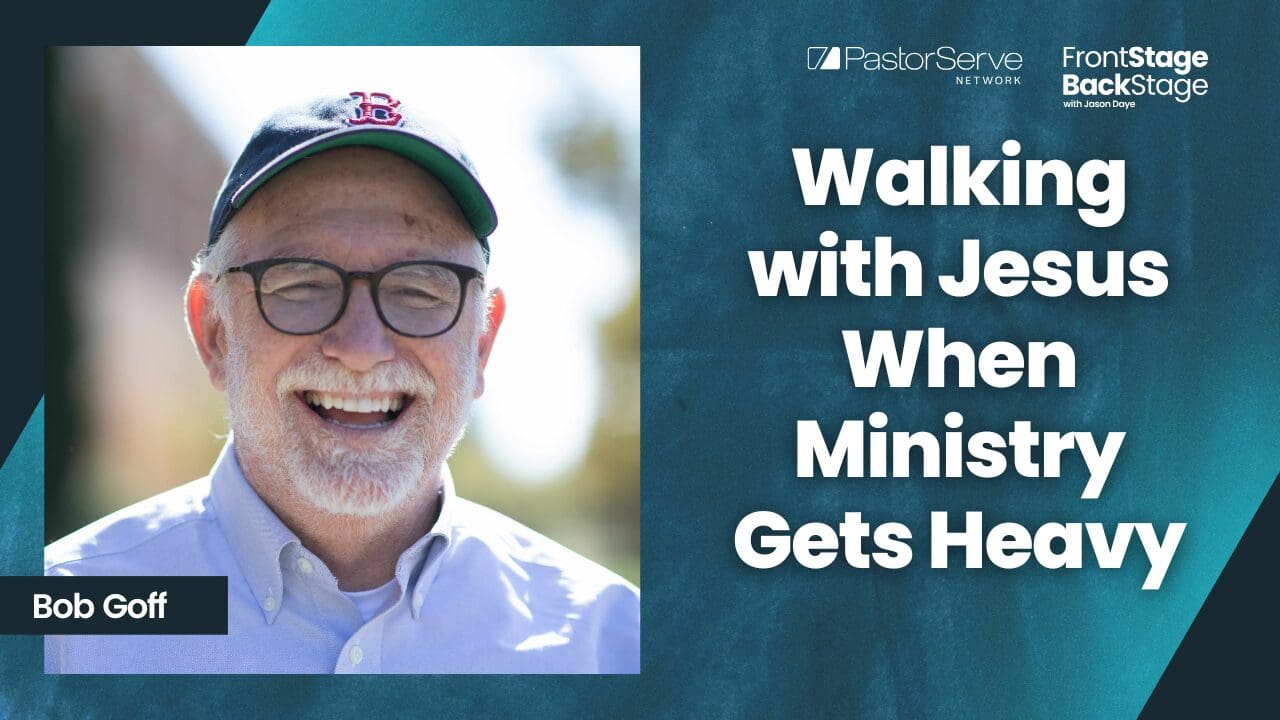
Ministry can feel heavy even when you love Jesus deeply. In this episode of FrontStage BackStage, Bob Goff joins Jason Daye for an honest, encouraging conversation about staying close to Jesus when the work of ministry becomes weighty.
Ministry can be meaningful and heavy at the same time. In this episode of FrontStage BackStage, Jason Daye sits down with Bob Goff for a deeply honest, pastoral conversation about what it means to walk with Jesus when ministry feels heavy.
Rather than focusing on performance, platforms, or productivity, Bob invites pastors and ministry leaders to return to closeness with Jesus, formation over information, and practices that keep faith grounded in real life.
Together, they explore:
- Why ministry often crowds out intimacy with Jesus
- How insecurity and pressure quietly shape leaders
- The difference between agreeing with Jesus and actually following Him
- Why formation matters more than more content
- How small, faithful practices can reshape the way we live and lead
- What encouragement pastors need when they feel tired, discouraged, or uncertain
About Bob Goff
Bob Goff is a New York Times bestselling author, speaker, and longtime advocate for living out a practical, love fueled faith. He is the author of several books, including his latest release, A Journey with Jesus, an interactive guide that invites readers to experience the life and teachings of Jesus through Scripture, story, and filmed experiences from the Holy Land.
This conversation is especially for pastors and ministry leaders who:
- Love Jesus deeply but feel stretched thin
- Are navigating pressure, expectations, and constant noise
- Long to stay spiritually grounded without burning out
- Want to lead from authenticity rather than obligation
FrontStage BackStage exists to care for the whole life of ministry leaders, both the public FrontStage and the personal BackStage, because healthy ministry flows from a healthy, well tended soul. If ministry feels heavy right now, this conversation is for you.
Connect with this week’s Guest, Bob Goff
Weekly Toolkit
Additional Resources
https://www.bobgoff.com/: Bob spent decades as an attorney, trying to figure out how to live a whimsical, impactful life. These days, he calls himself a “recovering lawyer” because after practicing law for 25 years, then becoming the Honorary Consul to Uganda, he gave up his law firm to pursue writing and speaking full time. He’s a New York Times bestselling author several times over, runs a popular weekly podcast, and recently turned farmer at The Oaks just outside San Diego, California.
A Journey With Jesus: With immersive teaching filmed on location in the Holy Land, this 8-week video-led Bible study from New York Times bestselling author Bob Goff invites you to walk where Jesus walked, engage Scripture with fresh eyes, and follow Him with greater love and purpose. Join Bob Goff on a journey across Israel―not as a tourist but as a follower of Jesus.
Ministry Leaders Growth Guide
Digging deeper into this week’s conversation
Key Insights & Concepts
- Formative following of Jesus involves practical action (Matthew 25).
- Society is filled with outward indicators of identification, which often mask the inner realities of the heart.
- Jesus invited His followers on a journey, not on a business trip. Rather than reveal a precise plan, Jesus invited people to “come and see.”
- Acts 2 and 4 demonstrate genuine engagement with others in Christian community, which is vital to spiritual formation.
- “When love has an agenda, it isn’t love anymore, it’s just a program.” Godly love of others involves taking a personal interest and engaging in practical ways.
- Actions demonstrate beliefs. Others will understand what Christians believe by watching what Christians do.
- Spiritual formation is not merely a matter of increased knowledge or additional information, but is shaped through practical, lived experience.
- Community plays a vital role in spiritual growth, creating space for shared learning as Scriptural truth is explored and applied within the realities of everyday life.
- Jesus is accessible to everyone. The church can faithfully uphold sound doctrine while extending an invitational posture to those who do not yet know Jesus, expressed through both words and actions.
- Personal, tangible practices can anchor spiritual lessons in everyday life. When daily reminders are connected to core values or desired attitudes, they support spiritual growth and can invite others to ask deeper questions.
- Attention to how ministry leaders are doing matters. As pastors attend to how they are, awareness of the heart emerges. In that space, the Holy Spirit provides understanding, inviting them to bring their hearts to Jesus and be formed by Him.
- As pastors grow in self-awareness, they are better able to show genuine interest in others. This practice of genuine interest, toward oneself and toward others, is both formative and strategic.
- Asking others “what is it like to be you” can lead to more authentic connections, which can create greater opportunity to point others to Jesus. Pastors can create a safe space for authenticity by sharing vulnerably first.
- ”Other people don’t get to vote on your life.” Pastors are well-served to remember that while a humble, teachable spirit matters, living for the approval of others is untenable.
- When pastors intentionally remember why they serve as they do, joy in the ministry is more easily restored.
Questions For Reflection
- How are the ways I think about Jesus influencing my daily life? In what ways do I not just agree with Jesus, but do something about it?
- How am I encouraging my church body to both know the truth about Jesus and also put it into action?
- Who are the people in my area that need to see where they fit into the bigger story of Jesus? How can I invite them in? How can I mobilize people in my church to invite them in? What might our church need to consider to better love our local community in the ways Jesus loved?
- Who is part of my personal community? With whom do I break bread and share things in common? Am I connected at a heart level with these people? If so, what do I need to do to maintain this community? If not, what first step might I take to build personal community?
- In what ways do I encourage real life engagement within my church body? What practices might our church need to adopt to connect in ways similar to Acts 2 and 4?
- When have I personally experienced the truth of the Bible in a tangible, memorable way? How did that experience shape me?
- What specific practices help me translate my theological head knowledge into practical and lived-out knowledge? How do I allow information to impact my spiritual formation? What in my routines should I keep? What in my routines might need to change?
- How is my doctrine currently impacting the way I engage in daily life? Are there any changes I might need to consider?
- What does it look like for me personally to stand firm in the truths of God and also explain those truths in a way that invites others in?
- What does it look like for me to equip and encourage the church body to know the truth of God? What does it look like for us as a church to equip and encourage our body to live that truth and to explain it in ways that our local community sees Jesus is accessible to them?
- When have I experienced Jesus’ love in a real, embodied way? When have I expressed that love to someone else? How have those moments shaped my heart and the way I see others?
- How often do I reflect on my current experience and the state of my heart? What regular practices could help me know “how” I am? How can I invite the Holy Spirit into this?
- When has showing genuine interest in others created space to point them toward Jesus? What specific moment comes to mind?
- What would it look like for our church body to intentionally cultivate and demonstrate genuine interest in others?
- What practices help me cultivate thirst for Jesus? How might I help those in our church, as well as those in our local community, grow in thirst for Jesus?
- What rhythms help me remember why I pastor? Am I currently experiencing joy in the Lord? If not, what would help me return to that joy?
Full-Text Transcript
Jason Daye  0:00
Bob. Welcome to FrontStage BackStage. So good to have you with us today.

Bob Goff  0:00
I love it. FrontStage BackStage. I can't wait to hear like some of the background, like when you're deciding, what should we call this thing? Tell me about that.

Jason Daye  0:00
Yeah. Yeah. Great question. So when we think of ministry life, we often think of, there's sort of a frontstage, kind of the public side of ministry, but also there's the backstage, the personal side. So we think of both of those things. And so our ministry PastorServe really walks alongside of pastors and ministry leaders, both on the frontstage and the backstage of their lives. So that's, that's where it comes from.

Bob Goff  0:00
Oh, I love that. I hope you have, like, a much bigger backstage than a frontstage. Yes, absolutely. I remember I read in a book once that "bright lights don't need spotlights." And it's just like that idea that we want to, just said, it doesn't matter what it looks like; it kind of matters what it is. They're taking out the garbage today here in San Diego, and there's a guy that put his recycling barrel out, right. But the deal I know for a fact, he doesn't recycle, but he wants it to look like he's recycling, so he puts his green barrel out there. And I'm like, dude, just leave it behind there, like, or recycle or something. But sometimes there's a temptation. It always doesn't come from a dark place, but to say like that we want to appear or meet an expectation somebody has. And so I'm so glad you guys are out there speaking to that.

Jason Daye  0:00
Absolutely. Thank you, brother. Yeah, there's, there's a lot of emphasis on the frontstage of ministry, right? We see that a lot. There are a lot of seminaries, obviously training. There are lots of coaching on frontstage. You know, how to be a better preacher, how? Which are all important things. But we are really committed to, you know, your frontstage can look pretty nice, but if your backstage isn't being tended to, it all crumbles. You know, it all falls at some point.

Bob Goff  0:00
So, yeah, and then also, I'm just thinking about the pressure that people in ministry are under from people that just, you know, anybody with a iPhone is now a journalist, right, right? Anybody with an opinion is now a spokesman. And we just have a lot of people that are pursuing people in ministry, and they're one of these, like, kind of gotchas or whatever. So it's just a lot of pressure that people in ministry are under it. And I want to just thank you guys for doing it, because you could be doing, some of you guys could be running small countries, but instead you're leading small flocks because you want to look like you're following Jesus. You want to actually follow Jesus, and it gets kind of messy.

Jason Daye  0:00
Yeah, absolutely. Thank you, brother. And before we dive into this Journey With Jesus, I love where we're going already, because really a lot of this, the heart behind of a journey with Jesus is about the idea of formation. What does it mean for us to really walk with Jesus and so Bob, just, just for you at this point in your life, I would love to know, what does this look like for you personally walking with Jesus in this season of your life. What? What? What has that been like for you?

Bob Goff  0:00
Yeah, I would say it's more of a stumble with Jesus than a walk. What is that African proverb? "When you trip, you fall forward," right. So stumbling forward with Jesus, think it's moving from agreeing with Jesus to actually doing something about it. And many people listening, man, again, I want to just affirm you for all that you're doing. You don't need words of correction for me or anybody else, but encouragement to just keep it up. And the thing that's been central and super helpful for me is that Matthew 25. It's like I was hungry and he fed me and thirsty and sick and strange and naked, I was in jail, and he came. And then James talks about widows and orphans. But just like to say, how can we actually do that? Instead of saying, you know, you should do nice things for hungry people, go find somebody who's hungry, actually exactly just do it. Like, go get In and Out Burger. We've got ... do they have those where you are,

Jason Daye  0:00
Not where I am, but I've had an In and Out Burger, and I love them.

Bob Goff  0:00
Oh my gosh, I had a double double. I think that's where I came to faith. I'm like, there is a God. So find people. Go drive around 50 In and Out Burgers and just give them away to people who are hungry. I'd rather do that. I know it's hard to find naked people, but you know them when you found them. What I want us to do is move from just agreeing to actually doing that. I was with some guys at San Quentin. I've been teaching a class up there for almost a decade, and so I got back around nine o'clock last night, and I was telling sweet Maria, and there's a guy who has all these tattoos. He's like, Moana, you know, like his tattoos. Have tattoos, and I've seen that, buddy, how do you get ink here in San Quentin? And he says, what he does is he takes a guitar string and he hooks it to the motor of a Sony Walkman radio, and then they burn some soot, and they make a cap full of that in his toothpaste cap. And then they dip the guitar string and that. And I just think of the lengths that he goes to send a message that he identifies with somebody else that's got the same tat on their thumb. And so sometimes, if I apply that to our faith thing that we go to these lengths to show people we identify we have the same worldview as you. It can be a hat that's the same color, or a heart that's the same color, whatever. But what I want to do is to, like, lose all the outward stuff, your frontstage stuff, and to say what's really going on, what's like going on right underneath the surface. And oftentimes it's just a ton of insecurity. I know it is for me, like I'm super insecure, even right now I'm super insecure. I don't come across as insecure, but that is what's actually going on. I've just learned how to cope with my insecurity with a bunch of enthusiasm. And I bet that's what a lot of people in ministry, is that what you're finding? Just find coping mechanisms, like, how do I deal with this onslaught of requests? You're like Pinocchio, and everybody's got a string except you?

Jason Daye  0:46
Yeah, absolutely. And that's that's a good way to put it, because in ministry so often, we are being bombarded in so many different ways and being pulled in so many different directions, and yet we have to stay central to Jesus. And so that's the idea of formation, which you spend a lot of time of encouraging people around. What have you found in your own life that helps you from being stretched in so many directions to getting back centrally to Jesus?

Bob Goff  0:46
Well, I'll tell you. What I'm doing is constantly quitting things all the time. If you've tracked with me, on Thursdays, I quit stuff. Like one thing every Thursday. I'm about to make a phone call to a board of directors I've been on. When they ask, "Why are you quitting?" I'm like, it's Thursday, and it's not because I'm mad. I just, like, try to offload. And so I think of people that do, I don't think of it as ministry. I just think of it as, what do you do on Tuesdays? So what I'm trying to do is, like, lose some of my capabilities. Like, if you can believe it, I was a trial lawyer for 35 years, and I'm capable of it, but that sense of calling, and not in a very mystical way, but just like that, like I think I got more game than that. And so I walked into my own law firm on the 17th floor of a tall building in downtown Seattle where I commuted to from San Diego for 30 something years every day, and I quit. Evyerbody said, why? I'm like, it's Thursday, so I think there's something really beautiful about that. And then I cratered my career by writing a book. And then, because people like the book, I was never doing what I was doing for a day job. And then I started speaking, and that was maybe for 15 years, 110 cities, I think we figured out each year for about 15 years, and then 90 days ago, I quit that. And like I think that is among the things that Jesus, he isn't a business trip that he's invited us on it's this journey. And so when people said, Where are you going? He's like, can't say, Come and see. Wouldn't that blow the minds of all your deacons, elders, if that's who around you say, so what are we going to do next? We like, I can't say,

Jason Daye  0:46
Yeah, yeah. That would go over well, right?

Bob Goff  0:46
And yet, a hope without a plan is just a wish. And so it isn't that we, you know, cover up a bunch of aimlessness with this, like, I'm just trying to be like, Jesus, I really have a plan, I just can't tell you. Like, no, you have no plan. We can have a plan to get there, but I really like that inclusive part of saying, Come and see. Acts 2 and 4. They break bread together, they pound the carbs, and then they have things in common. And I think that's where the best part of what happens backstage is just the breaking bread. And I don't mean in green rooms, I just mean on the parking lot, washing somebody's car before you go to do a 30 minute sermon, and use the offering trays if you don't have a bucket, and there's something really, you'll be covered in suds, and there will be something really kind of beautiful. But don't make a program out of it, you know, because when love has an agenda, ain't love anymore, it's a program. So just do it, because it'd be really cool to do. And then, like, don't tell anybody. I like that. Matthew 16, like, Who do you say I am? And then Simon Peter says, I think you're God. He's like, don't tell anybody. Boy, all my evangelical friends, that just blows their minds. But it's the next verse, like, it isn't flesh and blood that reveals it to you, but it'd be the Spirit of God, and people are going to understand what you believe by seeing what you do.

Jason Daye  0:46
Absolutely, I love that. For pastors and ministry leaders, one of the things that can become a challenge over time is we fill ourselves with a lot of information, right? There's always another book, always another conference, always another you know, this is what's happening. So we have all this information coming in, which isn't necessarily a bad thing, but sometimes we can get more caught up in the information than the actual formation. What would you recommend for us to to to keep balanced in that, to make sure that we are leaning into the formation side?

Bob Goff  0:46
Yeah, I think it's kind of like drowning in chocolate, right? You got all the stuff, and it's kind of feels like you're making headway to know there's four words for love in Greek -- agape, phileo. But maybe, what if you lose all that and instead say, I want to think of a time that somebody loved me well. I want to tell the story of somebody who loved well, I think that's Matthew 13. Why he said he never spoke to anybody without telling him a story, because we remember that stuff. And so getting your head on the swivel, whether it's the guys that's putting tats on his hands with guitar string -- what a bad idea. And I'm going through the list of diseases you could get. In my mind, it's a pretty long list -- yes, but to actually delight in learning from the people around you in the really practical ways, because I met people that have great doctrine and lousy theology, and I want to have, like, great doctrine and great theology and loving people the way that Jesus did. Just start with the, you know, 37 miracles he did, and maybe just work your way through, everybody knows, water into wine. But say, then what's the second miracle he did? And I want to see that for real. Not just agree with that, but say, when have I seen that in someone's life? Even better, when have I seen it in my life? Who's shown up? Man, you start getting your head on a swivel like that, the Scriptures are going to pop. And then the guy in row four that's not really into learning words in another language because he's having trouble mastering English, then all of a sudden it'll make sense. I'm telling you, Jesus, the smartest theologian ever, points to a couple sheep and he says, it's like, one of those gets away, and they're like, Oh, I hate that when that happens. So I'm not saying go light on faith. I'm just say go so so big on Jesus, that idea of seeing him. Acts 1:1 , Theophilus, look for many convincing proofs that Jesus is still alive. Go do that. And my, you're just put rocket fuel in your tank.

Jason Daye  0:46
Yeah, absolutely. I love that. Now. It would be awesome if every pastor, every ministry leader, could make a personal trip to the Holy Land, but that's not always possible, right? That's not always possible. But you made a trip to the Holy Land, and you got really engaged, and you kind of are bringing the holy land back to the rest of us, which is a beautiful thing. Bob, tell me what, what is so important and valuable about understanding, you know, the topography that you know, the reality of where Jesus walked.

Bob Goff  0:46
Yeah the whole idea is to have other layers to your faith, like in a lot of that is experiential. And I don't mean you need to get on a plane and go somewhere, but that you're living out this idea of hungry people and thirsty people and sick and strange and naked like go have an interaction with somebody in prison or a widow or an orphan. And so some people, to your point, aren't going to be able to get on a plane for whatever reason. The important part is the gathering together. That's where I'm a big advocate, because we have so many people. Everybody's got an opinion or two, kind of like yours. Everybody's got a couple except Van Gogh, right? So what I want to do is to say, Can we gather together, tee that up around Capernaum, and then say, what happened here, but not for a second year, like seminary student. I want to reach the guy at the tire store. I want the person to feel welcomed in to say, we're going to break some bread, we're going to have some pizza, we'll load up on the carbs. We're going to watch a little video here. But then the important thing won't be talking about that. It'll be saying, like, what's happening there that is also mirroring what's happening in our life. Like what's happening on Tuesday in your life, because I think that's where their numbers were added to daily when people broke bread together and they had things in common. And so I write books for the guy at the tire store. He's not on row one at the church, and he's not up in a tower across the way, sniping at the church either. He's just church adjacent, and that's the person I want to come. I want it to be the doctrine, the theology, to be sound enough that would pass anybody's like scrutiny, and yet, at the same time, invitational enough that the guy at the tire store would come knowing if you got together, he'd walk away with a better understanding of how he fits in to this great, big, magnificent adventure Jesus has invited us to.

Jason Daye  17:33
Yeah, I love that, Bob. One of the things that is just part of who you are that we all recognize is you are really keyed in on making Jesus accessible, I think is a good way to say you really want to make Jesus accessible to everyone. How has that become a part of just who you are? And how can we as pastors and ministry leaders kind of keep that in the forefront of our minds and our lives of making Jesus accessible.

Bob Goff  18:01
You know what it would be, the thing that makes it real for me are the practices that I have. This practice of availability. We were laughing before we started, because I put my cell phone number in the back of 3 million books and there's somebody calling like right now. That isn't the person caller, that's the fifth call I've gotten while we've been on this podcast. And here's the deal, sometimes availability is I can be feel really costly to you as a person that's out there trying to navigate so many different relationships. So I would say, guard your heart as you're doing that. But for me, my drum beat is going to be available. I don't need to be the smartest guy in the room. I'm not the smartest guy on this podcast, but I want to be the most available guy in the room, right? My first thing, the second thing, is to have a practice that helps, like, solidify the things I'm trying to learn in my life. There's a guy, Kevin, who's been in San Quentin, in this gated community for quite a few decades, and he called me up the other day and he said, I'm on the other side of the wall. I'm like, Oh, dude, tell me you did not tie bed sheets together. He said, No, no, they released me. I was so happy for him, and I said, Kevin, what are you thinking? And he said, I've got pockets. Because in San Quentin, you can't have pockets. You'll like, you know, get into mischief. And so in a moment of clarity, I told him, like, be really careful about what you put in your pocket and carry around with you. And so what was helpful for me is I then took some scissors that night and cut out every left pocket of every pair of jeans I've got, every pair of slacks I've got no left pocket. And so the right pocket is where I keep my keys, and in my left pocket is where it. If I don't want something to hang on to, I just put in my left pocket. Maybe there's somebody that you're doing some like you're doing God's work, and they are in your grill. That sounds like left pocket stuff. Like, if you if I put my keys by mistake in my left pocket, I'm taking Uber home because they're just gone. I don't even know, and if you could move some of the things you're carrying around from your right pocket to your left man, you're going to experience some freedom. The important part for me has been the practice saying I'm going to be available. I'm just going to get my cell phone number out. I'm going to constantly remind myself to unload some of the things I've been carrying around, hurt feelings, envy. You know, it's a really long list, and I'm moving from my right pocket to my left pocket. And don't just agree with that, get the scissors out. Be careful. But like the whole idea is to move stuff from the right to the left. That, for me is a really tangible way to not only teach a lesson, but own a lesson. You walk into your next board meeting and talk about how you don't have a left pocket man, the people will walk away. Change, you'll walk away. Change. That's what I'm doing with the this idea of encountering Jesus. I want to have these daily reminders and a practice that is associated with that so they can really drill it home.

Jason Daye  21:25
Yeah, I love that. Absolutely love that. Now for pastors and mystery leaders today, Bob often inundated with the news cycle, let's just say that, right, so many things going on, and then we have so many people in our flock and outside our flock that all are vying for some sort of a statement or some sort of a stance or some sort of a something around these things, and it can be discouraging at times. It can feel uncertain at times. What what encouragement do you have for pastors who are trying to navigate this, trying to feed the sheep, but but really continue to point people centrally to Jesus?

Bob Goff  22:11
Yeah I think, come up with something that's a reminder. Because, you know, again, we're back to opinions people want, what's your position on this, and what's your position on that? And people ask me that all the time, and just because that's their question doesn't need to be that's your answer. What's the number of questions Jesus asked? Was like 307 and he only answered three in three years of public ministry. That's one per year. So you know, I've already answered my question this year. Say, I got a question for you, which is what Jesus did. Often he'd say, What's it feel like to be you right now? I wear a mood ring. I've been wearing thing. I got it on Etsy for like six bucks. I've been wearing it for 20 years. And so sweet Maria Goff and I don't talk about where I am. We talk about how I am. We didn't talk about being up in San Quentin yesterday. She just knew that as we touch bases, we talk about how I am, and maybe as you're leading with love and the difficult, nuanced ways, start talking a little bit more about where you are and how you are, where you are, but don't just stop at where you are. Just say, like, just say, How am I doing? And take a genuine interest in the people around you. So if I was you and I connected today, what I would say is, What's it feel like to be you and then, and I'm going to ask you in a moment for you to tell me that. But while you're collecting your thoughts, let me tell you what it feels like to be me. It's about 80% anticipation and about 70% insecurity. I know the math doesn't work, but that's what it feels like to be me. What's it feel like to be you?

Jason Daye  23:54
That's a great question. Bob, to be me. I would say I feel majority of what I feel is hopeful, and yet there is a stream of challenge, right? There's a stream of how do I show up best for my wife and my kids? How do I show up best for those that God has entrusted to me and and just a sincere desire, because I don't always get it right, obviously, a sincere desire, though, to to grow into that. So there's a lot of hope. But then there's this, this recognition that there is lack and that I need Jesus to help me with that gap.

Bob Goff  24:40
Yeah, bingo. So for everybody listening in like, once we can see it, then we can understand it, then we can take it to Jesus to fix it. But if we don't stop to see it, then we don't give the Holy Spirit a shot at helping us understand it. So he can take it to Jesus. So we end up saying, how you do? Doing, and they say fine, and be like, You're not fine. There's something that stands for some acronym I'm not smart enough to remember, but it becomes polite. And I don't want to be polite. I want to be a good friend to people. So it's just really practical. After you cut out all your left pockets, after you buy your mood ring, then start asking people, what's it feel like to be you? Don't put them on the stop spot. It's not a deposition. But lead by saying, Let me tell you real quickly what it feels like to be me. It's like 90% puzzled right now, 20% optimistic. You can come up with every the pie doesn't need to be 100% but as you get it that people are going to go a little deeper with you, and that authenticity is where people will see Jesus. Acts 4:13 they saw Peter and John. They knew they were just unschooled ordinary people, but they saw their courage, and they knew they'd been with Jesus. So that whole idea of just like knowing I'm a Bible verse guy, like I do it, and yet I write books and don't put Bible verses in them, because I want the guy at the tire store to feel welcome. And I saw this pattern with Jesus. He didn't always cite a Bible verse. Now, some of the things he said were found in the scriptures, and people who knew the scriptures knew what he was talking about, right? That's what I'm trying to do. So the people that the second year seminary student like that, they're in there, and then don't be hard on one another. Would you stop it, please? Just somebody called me up I was releasing a book, and they said, Are you watering down the gospel again?

Jason Daye  26:37
Oh my.

Bob Goff  26:41
I said, Yes, I am. I want it to be for thirsty people. Man, all hang a salt like at the end of every pew. If you're not thirsty for Jesus, you're not going to understand any of this stuff. But if you are thirsty, and I want to cultivate that in me, thirst and in leadership, you're the vibe like my friend that puts out the can that says recycle and it's empty. The vibe is, if you want to say, like, you know, this stuff's super important to me, Well, just get your head on a swivel. Lead with love. Start talking about, what does it feel like to be you right now? And then, more importantly, ask them show a genuine interest in their wealth, right? Like to be you and say God all the time in the world.

Jason Daye  27:24
That's awesome. I love that, Bob. How do you cultivate that thirst for more of Jesus?

Bob Goff  27:30
Yeah, for for me, it's like being on to myself. You just need to be onto yourself. Yeah, I'm not a poker player, but if I was, and I got four of anything, I would be all smiles. I'd start laughing. I'd start Yeah, I wouldn't be able to, like, cover that up very well. But to be on to yourself, did you ever play when you were growing up? That kids game is called three truths and a lie? Yeah, yep, yeah. So you say three truth rings and one lie. I have sailed across the ocean a couple times. I've jumped out of an airplane 24 times, I used to raise iguanas to harvest them for their pelts. So whatever. So then you'd say which one was true, which one was lie, and the iguanas was the lie. Well, here's what I say. And these are four lies. I always say to myself, I got nothing to prove. I got nothing to lose. I got nothing but time, and I got boat loads of patience. Those are four lies in my life. I'm still trying to prove things to people that have passed like they're dead. And I'm still trying to prove ... maybe you're listening, you got a father you're trying to prove, or an old boyfriend or girlfriend or a teacher who said you weren't smart, and so just to speak that truth, I got nothing to prove. I got nothing to lose, which isn't true at all. But I want to make it true. I'm hanging on to this. I'm hanging on to that and grievances or fears about money or whatever. I've got nothing but time. I don't have nothing but pretty busy guy. Are you pretty busy guy? Jason, yes, over yourself. Every day I got nothing but time, and then boat loads of patience. Man, I make coffee nervous like ah, but I think that's why God made church parking lots so I could, like, like Paul, you know, the worst of the sinners put on display my immense patience, and I don't have it. But I'm trying to make those four things come true, then nothing to prove, to remind myself I've got nothing to lose. I gotta let go of this stuff. I've got nothing but time. Even though people are tugging to me, I don't want to give that vibe that I'm in a hurry to the next thing. And I got both loads of patience, and I don't but I'm asking Jesus, I can see if I can see it, then I can understand it. Now I can take it to Jesus to say, give me what I don't have right now.

Jason Daye  29:58
Yeah, I love that. So good as we think of pastors and ministry leaders Bob, what words of encouragement? And you've shared many, many words of encouragement thus far, but, but what words of encouragement would you like to pass on to those who are serving in the front lines of ministry, who are the men and women who are doing their best, but oftentimes wake up on a Monday and feel like they bombed on, you know, on Sunday, right? By doing this?

Bob Goff  30:26
Yeah, exactly. Yeah. A couple thoughts. First of all, people don't get to vote on your life, and somehow we got in mind that we're the sum of everybody's opinions about us. The fact is, people don't get to vote on your life, so lose that ballot box if you have one silently that you're like doing. Cut out that pocket if you've been collecting people's opinions. I'm not saying be unaware of that, because if somebody has something harsh to say, then there often times is a grain of truth in that, and learn and grow and be humble and all those great things, but you don't need to hang on to that. So that's the stuff you move from your right pocket to your left. I'd say, stop beating yourself up. You're not a pinata when you hit yourself. This is not candy that comes out of you. And so to just remind yourself why you're doing what you're doing. Like, remember Revelations 2 my problem with you is you, you forgot your first love. So if, if faith and life and marriage and all that seems so complicated right now, just go back to like, you know, if you lose your keys, you think, where did I last see those? And then you go back to that spot. So if you feel like you've lost your joy, say, What was the last time I felt joyful in what I'm doing? Return to that place, and you might have to quit your job. I mean, half the people I know are afraid they're going to lose their job, and the other half of people I know in ministry are afraid they're going to keep it. So return your joy. Be aware of how you are. Change up the vocabulary. What's it feel like to be you, show it in your nature. Start in yourself, because a lot of you guys are great at holding up mirrors to other people, and I want you to flip the mirror and just say, How's it feel? That isn't selfish, it's strategic.

Jason Daye  32:23
Love that brother. Man, Bob, thank you for making time to hang out with us here on FrontStage BackStage. Absolutely loved it. It's been a treat for us as well. Absolutely love all that you're doing. Thank you for your encouragement, brother and be well. Thanks a million. All right. God bless you, my friend. Excellent. Thank you.

Transcribed by https://otter.ai
Recent Related Episodes
-

Posted On: April 2, 2024
-
Posted On: January 23, 2024
-
Posted On: June 11, 2024

Right-click, then select “Save Image As…” to download one of the social graphics.