
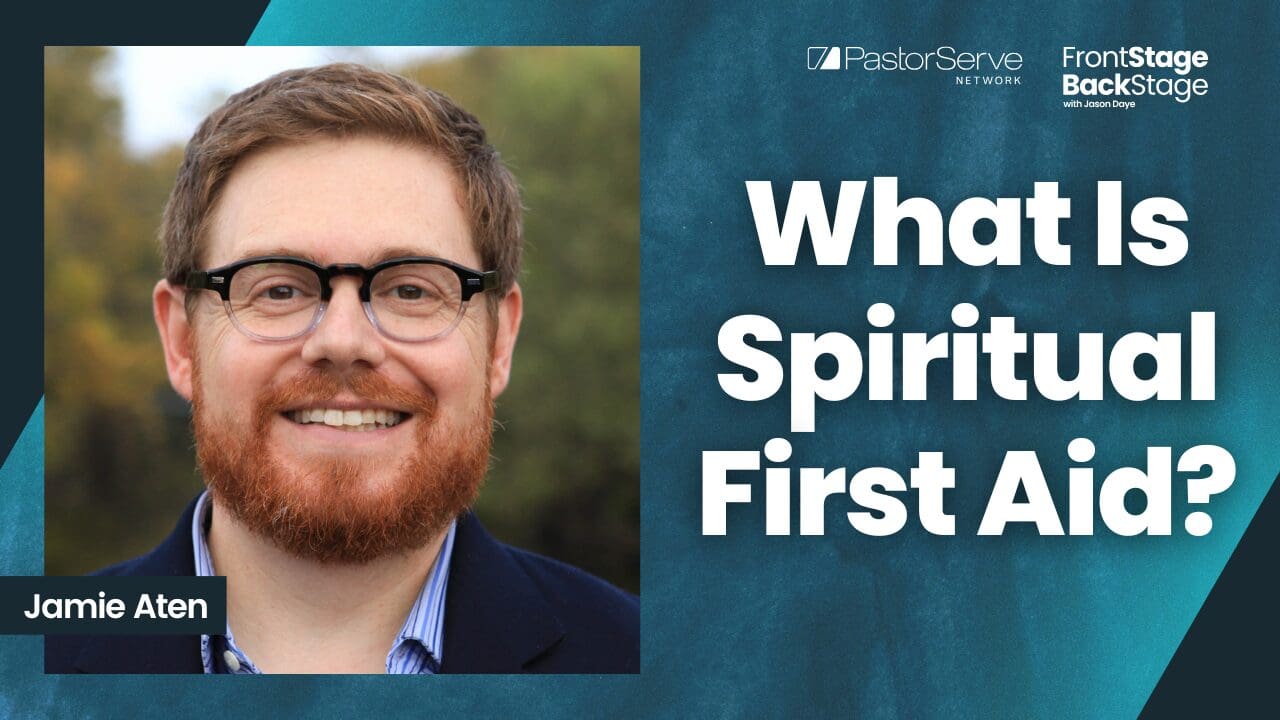
What is Spiritual First Aid, and how can local churches use it to care for people in crisis while also supporting those who serve? Jamie Aten shares practical insights for compassionate, sustainable ministry.
What does it look like for the local church to care well for people in crisis while also tending to the spiritual and emotional health of those who serve?
In this episode of FrontStage BackStage, host Jason Daye sits down with Jamie Aten, co-founder of Spiritual First Aid and a leader in trauma-informed ministry and disaster response. Together, they explore how Spiritual First Aid offers a practical, faith-centered framework that churches can begin using right now to respond to trauma, crisis, and emotional pain in their communities.
Jamie explains what Spiritual First Aid is, why it matters for today’s church, and how it equips both ministry leaders and volunteers to care for others in ways that are compassionate, wise, and sustainable. Drawing from real-world examples, he shares how churches are already using Spiritual First Aid to serve their communities while also strengthening the people who are doing the serving.
They discuss:
- What Spiritual First Aid is and how it works in a local church context
- Why caring for others also requires caring for those who serve
- How churches can respond to trauma and crisis with confidence and clarity
- Practical ways to begin integrating Spiritual First Aid into existing ministries
- Stories of churches making a meaningful impact through trauma-informed care
This conversation encourages pastors and ministry leaders to see care not as an added burden, but as a vital expression of the Church’s calling. By equipping people with simple, Christ-centered tools, churches can become places of healing, hope, and resilience for both their communities and their leaders.
Connect with this week’s Guest, Jamie Aten
Weekly Toolkit
Additional Resources
https://www.spiritualfirstaid.org/: The creators of Spiritual First Aid know firsthand how lonely and overwhelming walking with others through mental health struggles can feel. That’s why they created Spiritual First Aid, so you can make a difference without burning out, and feel confident in the care you give. You’ll gain scriptural insights, jargon-free training, research-backed skills, trauma care practices, field-tested tools, actionable tips, and real stories from the frontlines (including our mistakes so you can avoid them).
Church Mental Health Toolkit – Spiritual First Aid’s toolkit offers practical evidence-based strategies rooted in scripture so you’ll be more equipped to care for others struggling with everything from mild stress to mass trauma. Plus, the toolkit’s online platform makes it easy to find what you need, when you need it. Visit the site to sign up today to get resources on depression, anxiety, grief, burnout, mental health stigma, church hurt, and more!
Ministry Leaders Growth Guide
Digging deeper into this week’s conversation
Key Insights & Concepts
- Increasing amounts of people are turning to the Church for spiritual and emotional care, particularly as related to mental health issues. This is both an incredible opportunity for local churches and a space in which pastors or other ministry leaders may currently feel ill-equipped or overburdened.
- Spiritual First Aid is a training program that can help church leaders and congregants feel equipped to provide peer-to-peer emotional support, turning compassion into practical aid.
- Providing pastoral care does not rest solely on the shoulders of any one person; everyone in the church has a role to play.
- Spiritual and emotional care should be integrated into ministry activities churches do, not as a separate program of the church.
- Spiritual “first responders” function like an “emotional paramedic” who can help with the most pressing need of the moment and usher the person into additional care.
- The “BLESS CPR” method is a useful framework for identifying how to help an individual in a specific moment. The acronym BLESS takes a holistic approach to health by identifying five core areas of interconnected need: biological, livelihood, emotional, social, and spiritual. When any of these is unmet, psychological and emotional distress may result. When any one of these needs is addressed, the other needs are addressed as well.
- Effectively helping someone in distress begins with identifying the most pressing need. Next, provide care through practical presence before providing coping practices. Finally, refer and resource the person for follow-up or more complete care.
- Local churches are not meant to be clinicians. However, they can provide an “ice pack” in acute care needs, as well as ongoing support to those receiving professional care.
- Learning to help others in distress often increases one’s sense of compassion toward others and self.
- A church that intentionally invests in equipping its people to care for others benefits not only from more people feeling equipped to participate in the work of ministry but also from a deeper sense of community, a greater sense of interpersonal understanding, and a shared language.
Questions For Reflection
- Are there ways in which I am currently experiencing emotional or psychological distress? Who am I sharing my burdens with? Who is walking alongside me? Do I need to reach out to someone for help?
- In what ways are the people of my local church and our local community struggling? Where are they currently turning for help?
- How do I usually respond to people expressing an emotional or spiritual need? What do I do as it relates to that person? What internal effect does it have on me?
- When I encounter someone with an emotional need, do I know my role? What tools would help me feel more equipped? What would help me better know my role so that I neither neglect to help nor overstep my bounds?
- How do the people in my local church currently share about their needs with one another? How do they express peer-to-peer care?
- Are there ways in which our church could grow in relating with more authenticity? What would it take to create a culture where people share honesty and are met with truth, compassion, and practical help?
- In what ways does my church currently equip believers, both in the knowledge and practical action of discipleship?
- How could I help members of my church feel more equipped to effectively care for people expressing emotional or spiritual needs, both within and outside our church?
- What are my thoughts on the BLESS needs (biological, livelihood, emotional, social, and spiritual)? Do these resonate as core human needs? How do I see the areas interacting with one another? Do I regularly attend to all these areas in my own life?
- How does our church or ministry currently help others attend to the BLESS areas in their lives? How might we help them pay attention to these need areas in the lives of others?
- What practical tools would help the people in our church and community in the BLESS areas of need? How can we ensure we’re paying attention to the people God has entrusted to us in holistic ways?
- Do I currently feel equipped to resource and refer people who need care beyond what our church offers? If so, how can I share those resources and that referral network with others? If not, how can I, and our church, begin to build such a network?
- What are the current areas of need in our church and community? Would specific training on “spiritual first aid” be of benefit? Who might I need to discuss this with?
- What would “spiritual first aid” look like in our church context? What regular rhythms might it already fit in with? What effects would introducing this concept have on our church? What impact might it have in our community?
- What does the concept of “spiritual first aid” look like in my own life? What is my next step with this information?
Full-Text Transcript
Jason Daye 0:00
Hello friends and welcome to another fantastic episode of FrontStage BackStage. I’m your host, Jason Daye. I have the privilege to sit down with trusted ministry leaders, and together we dive into a topic, all in an effort to help you and pastors and ministry leaders, just like you really flourish in both life and leadership. Super excited about today’s topic and today’s guest, Dr Jamie Aten is the cofounder of Spiritual First Aid. He’s also the founder and codirector of the Humanitarian Disaster Institute, Blanchard, Chair of Humanitarian Disaster Leadership and co-coordinator of the trauma certificate program at Wheaton College. If you find value from this conversation, please be sure to like to subscribe to drop comments below and be sure to share this with another ministry leader. At this time, I’d like to welcome Jamie Aten to the show. Jamie, welcome brother.
Jamie Aten 0:54
Hey, great to see you, Jason.
Jason Daye 0:55
Yes, good to see you. Thank you so much for making time to hang out with us here on FrontStage BackStage. Jamie, I’d love to really dive in when we when we hear this term spiritual first aid, and specifically how we as local churches can lean into this idea of spiritual first aid and and help connect with our communities and serve our communities. What? What are we really talking about when we talk about spiritual first aid, what is it?
Jamie Aten 1:23
Well, Spiritual First Aid is a training program that my colleague Kent and I started about five years ago, and is being used by churches all over the United States and even in a number of different other countries. And what we found, and the reason why we started it was that we were seeing more people turn to the church for spiritual and emotional care, especially around mental health issues, and that there were more people needing care than there were professional helpers available, and that oftentimes people will turn to the local church, but the local church may not feel fully equipped. Of how do we begin to address these things? So we developed Spiritual First Aid to help meet that need to be able to take the guesswork out of providing peer to peer spiritual and emotional support to help churches really turn that compassion they have around mental health issues into effective care.
Jason Daye 2:08
Yeah, I love, I love what you guys are doing, Jamie, because statistics show that not only today are there not enough care experts to provide care for emotional and health, mental health issues that people are wrestling with. But that gap is only going to increase in the years ahead. I mean, statistics show the number of people who are, you know, training as counselors and therapists and those types of services to provide to others, and then amount of people who are experiencing this, that gap is growing. And so Jamie, for the church, to have the opportunity to kind of step in to that gap and to be able to help triage or help people as they’re processing through these things, I think, is incredibly, incredibly beautiful. And so thank you, Jamie, for the work that you guys are doing. So what, what exactly does it it look like for a local church to to really say, okay, there is this gap. There are people, and we’re bumping into them all the time. I know pastors and ministry leaders. You know, whenever I sit down and talking with someone that the things they’re bringing forward, the challenges they’re facing, are big. And so the reality is there. So how do we, practically, as a pastor, as a local church, as a local ministry, begin to prepare ourselves so that we can serve in this way?
Jamie Aten 3:31
Well, what we’ve tried to do with Spiritual First Aid is to make it so that everyone has a role to play, and that makes it possible for everyone to provide care. So one of the things that I’ve experienced working with a number of pastors over the years has been that pastors are already so busy that when you now start to ask, Hey, can you start taking on mental health care as well, that it feels quite overwhelming. And so we’ve made Spiritual First Aid easy enough that the pastor doesn’t have to carry it all themselves. In fact, we normally would encourage that if your main role is not as pastoral care, that instead to think of your role as empowering the other leaders in your church and other lay helpers in your church, to give them the tools that will be able to provide that kind of in the moment, care to others. That helps to use the word triage, that’s actually one of the steps that we teach is like, how do you triage that person’s most basic need and provide that care for others. And so we’ve seen a number of ways that people have used it, and what we found to be most effective is for the local church to think about, what is it we already do well, and how do we start to integrate Spiritual First Aid into what we’re already doing, rather than viewing it as a whole separate maybe a whole new, brand new ministry. Now maybe the church, your church, has the additional staff or volunteers to kick off a whole another ministry. We’ve got groups that are doing that, but for those that may already feel stretched, we find the best places what you already do well, and then find ways to integrate Spiritual First Aid into that.
Jason Daye 4:54
Yeah, Jamie, I absolutely love that, because one of the things that we run into so often is. So we do get excited about these opportunities we have to serve, but then we look at our bench, right, and we look at our team, and we’re like, we already feel like we’re doing so much. So Jamie, let’s lean in a little bit on this. Help us better understand this idea of how you can integrate spiritual first aid into some of the things that your church is already currently doing as they minister.
Jamie Aten 5:23
So one of the things that we’ve tried to do is even the way that we’ve set up our training to make it easy and to fit in with the natural rhythm and cadence of local churches, so that it’s not something that you have to just add on, but even can integrate. I’ll give you a couple examples. So first of all, the overall like our main flagship course that we teach with Spiritual First Aid is our certificate course. And people can do that on demand, on their own, in about eight to nine hours, or it can be done in a small group, again, in person, online. It can be done a hybrid in about 90 minutes, over six weeks. So think about, you know, that gap you’ve got in your Wednesday evening ministry, and you need to fill that six weeks. Well, we’ve created Spiritual First Aid that if somebody on your team can lead a small group or a Bible study, it’s easy for them to lead them through this training. Or there’s going to be others who are like, Okay, we have an annual volunteer training every year. It’s an all day event. We need a way of doing it. Well, that same curriculum, you can think of it that our course is almost like an accordion, right? So if you want to do it on your own, you can, if you want to do it and spread out over six weeks, you can do that, or it can be flipped over and used and done as a workshop. And so it comes with the videos, the resources, where, if, again, like I said, if you can lead a small group or a Bible study, we’ve made it that easy to facilitate this training in a way that it gives you the option to be able to embed it in the ways where you need it embedded. And then what we’ve started to see, just some other examples, is one church that I know of that’s they took a small team of about 10 people through their church together as a small group, and then from there, those individuals started embedding it in other ministries. So one was over their youth ministry, and so that person started using our child course that we have to be able to train all their volunteers of how to provide care and to raise awareness. And then somebody else on that team was actually over the security for the church, and they started teaching all their ushers Spiritual First Aid. So that way, if there was an issue, they knew how to handle or deescalate problems, or maybe somebody showed up who was having an emotional struggle that day, they could be there to to care for them. There was somebody else on that team that was connected to the prayer team in that church. And so now every Sunday, you know, like when you have people that line up at the front are available to pray for others that they all have, like a little spiritual first aid lanyard on so people know that they’re available too, that if you just need to talk to someone, that those individuals are there. And then there’s another congregation, I think about who they started using Spiritual First Aid that then they started seeing how it could be used with their homeless shelter that they had. And then that led them to see how that could be used with their food pantry. And then it just kept snowballing from there. So we’ve really seen the ways that can be used is pretty endless.
Jason Daye 8:09
Yeah, I love that. I love the kind of the integration of this, because it’s not just like another program you have the training and the resourcing, but then how does that fit into the life of of the church? Where does it show up? Where does it help support areas that there might have been gaps or might have been lacking in the past? And I think, Jamie, just as you were saying that and sharing through that, it also raises awareness that this idea of Spiritual First Aid, this idea of whether it’s emotional, mental fatigue or challenges, whatever people might be experiencing or facing, that it is something that is present across the board. It’s not like, it’s not like, it’s just something that’s like, tucked over here, and then it’s like, okay, if you are wrestling with this then here it is, but it’s something that’s just part of the human experience. Jamie, so can you share with us some examples? I love the training. I know you share some examples how it’s being used, but when we get to kind of the the I’m sitting down with with someone in my ministry sphere, whether that’s, you know, our homeless ministry, or that’s our youth ministry. What? What are we seeing take place that, you know, Spiritual First Aid would is showing up. What? What’s happening? Really?
Jamie Aten 9:30
Yeah, absolutely, great, great question. Well, one of the examples, you know, that kind of comes from the name the first aid part is that we draw some parallels and use some metaphors throughout the courses and the training to kind of think of yourself as almost like an emotional paramedic, right? That you’re going about your day. There’s, if you were a paramedic, there’s maybe an accident, you show up, there’s 100 different problems, but you know, you can’t fix everything, so you what do you do? You focus in on the most pressing need that that person has. You bandage them up as best as you can. And then if they need additional care, you help get them to that additional care. And that’s what we’re doing, but in this case, with spiritual and emotional challenges, so we kind of would view you as almost like a spiritual first responder. So you’re going about your day, you might be just walking through the hallway, and you’re having a conversation with a friend, and that person, you can just tell something’s off that, rather than waiting, you know, I’ve got the tools now to jump in. And so what we start to teach people then is what we call the BLESS CPR method. And so we help instead of having to learn all the different mental health problems that are out there. So for instance, I’m a psychologist, and on my bookshelf over here, I’ve got the Diagnostic Statistical Manual, and it’s about like that thick, this giant red book of all the different mental health disorders, right? And so there’s hundreds of them. And then with each one of those, there’s like, hundreds of different symptoms you have to memorize. That’s overwhelming. So what we’ve done instead was to teach helpers just to look for the five BLESS needs that our research shows that when any of these go unmet, cause psychological and emotional distress, and those are biological needs, livelihood, emotional needs, social needs and spiritual needs, and that they’re all interconnected. And when you address one of those, you’re addressing all the other needs at the same time. So it’s really taking this kind of holistic approach to providing care. And again, this is all based on about 150 studies and over $7 million of research over 20 years of studies that is backing up and what helped us to develop this. And so as you’re encountering someone, then that’s what those BLESS needs are. And then the steps are. The first being BLESS triage, so you’re going to help identify that person’s most pressing need. That’s step one. Step two is that you’re going to care with practical presence, so you’re going to provide tangible support. You’re going to be still and listen, and we talk about things, what to say, what not to say, and even how to apologize if you’re like me and tend to put your foot in your mouth. So that’s step two. And then step three is to provide coping practices. So in the course, we introduce about 50 evidence based coping practices that are small things that we can do that research shows make a big difference in the lives of others, and then the last step the R in BLESS CPR, is to refer and resource. So how do I actually help somebody that needs that extra care get to where they need to go? Or how do I get them maybe connected to the right ministry within my church, for example?
Jason Daye 12:18
Hey, friends, just a quick reminder that we provide a free toolkit that complements today’s conversation. You can find this for this episode and every episode at PastorServe.org/network. In the toolkit, you’ll find a number of resources, including our ministry leaders growth guide. This growth guide includes insights pulled from today’s conversation as well as reflection questions so you and the ministry team at your local church can dig more deeply into this topic and see how it relates to your specific ministry context. Again, you can find it at pastorserve.org/network
Jason Daye 12:56
Yeah, that’s, that’s, that’s incredible, and you kind of touched on some of the the other questions that I’m sure those watching and listening might be wrestling with around this, because we know that, you know, mental health issues can be, can be severe. Emotional health issues can can be, you know, traumatic, you know, and and so, and correct me if I’m wrong, Jamie, but what I’m hearing you saying is the Spiritual First Aid course is not something that’s going to replace so much other care that’s out there, but it’s a way for the church to actively step into these situations and these challenges that that people all around us are facing and help them as best that we can absolutely help them, but if, if there’s more, the whole refer side, right? Like, how do we help connect them to someone who, who is trained as a professional? Right to go more deeply. So talk to us a little bit about how that’s showing up in churches. That idea of, you know, this is, this is how we can serve. But then, how are they connecting them to other others? How do you even know who those others are in your community?
Jamie Aten 14:08
Yeah, yeah. No, those are things that that we’ve actually built in, like you pretty much just described the very last of our training sessions, right, which was those exact questions of, like, where do we go? How do we know if we can trust this other group? What are resources, you know? So like, for instance, I grew up in a small, tiny, rural farming community, you know, we had one four way stop. And wasn’t until I got, probably halfway through college even, that we finally even got like a little red blinking light at the four way stop right in the middle of corn fields. So there were no mental health professionals in my community that I grew up, the nearest licensed person was an hour and a half away. So where do you turn to for help in those situations? Right? So those are the types of things that we’re tackling there, and the way that we try to help the church think about these issues is that your role isn’t to be a clinician. I mean, now if you have a license and you’re a professional, sure. But most people aren’t, and that’s okay. We don’t need everybody to be a clinician. Instead, to think about almost like you’re providing that immediate here in the now care, and you’re providing an ice pack, so to speak, where and you can think of counseling as more of like a heat pack, right? So it wasn’t too long ago I was out, and I was live here in the Chicago area, and I was trying to clean out our driveway, and I slipped on some ice, and I hurt my knee, and so first thing I did was I went in the house and I got some ice. Why? Because I searched to bring down the swelling, which, by the way, it wasn’t till I got in the house that I realized I could have just like slightly tilted in the driveway and just iced my leg on the ice I slipped on anyways, so it took the swelling down. It kept it from getting worse. But a couple days go by, and now my knee is still kind of bothering me. I go to see my doctor. He sends me to the physical therapist. What’s the first thing the physical therapist does? They put a heat pack on it, right? Because the heat pack works deep. It goes in, it processes through that muscle. And now I’m having to exercise that. I’m having to go back week after week to keep going. But had I not taken just that quick moment of going in to get ice, it could have resulted in a much more serious injury. And that’s what we’re helping the church do, that we’re teaching you how to provide that ice pack for spiritual, emotional problems, so to speak, and then to be able to help you identify who are those trusted resources. And one of the things that we’ve often found is that oftentimes, even in areas where there’s not a lot of mental health professionals available, that when you get a group of people together, you know, we start doing the training. At the beginning of the training, people are asking, there’s nobody to even refer to, and then by the end of it, they suddenly realize, like, oh, actually, we can be a resource to each other. And I’ve got a friend who knows somebody that can get us connected and starts building those relationships pretty organically.
Jason Daye 16:44
Yeah, that’s awesome. I love that. Now, Jamie, as you’re talking about Spiritual First Aid, it sounds like it really, especially as you think in the local church, it really hits on a lot of lot of things, not just what it does to that person that’s being ministered to, but it’s also providing opportunities for people within the church to engage in ministry. So you’re, you know, building that ministry base. You’re, you’re helping them, even, like you said, going through the training can be through a small group. So you’re giving that opportunity, you’re helping them begin to look for those things outside the community. Jamie talk a little bit about, how does introducing Spiritual First Aid transform a local church? Right, not just for those whom they are now able to serve at a deeper level, but how does, how does it change a local church in other ways? Right?
Jamie Aten 17:44
Yeah, and actually, for me, when I think about Spiritual First Aid, this was something that we weren’t necessarily thinking about when we designed it. You know, we were thinking about, how do we make sure that people are getting the proper care? And the part we weren’t expecting were all the emails and stories that we have heard over the years of how it’s also helping to transform the lives of the helper themselves. And so I’ve seen a few different ways that this has happened. One is that it helps us to have a more compassionate view of each other and ourselves, right? So one of the things that we tried to build into were some different tools and things that the helper can use to also help manage our own stress. And if you’re in ministry, I guarantee you’ve got a fair share of stress, right? And so we’ve tried to, again, make this as simple as we can, but also that it’s tools that we can use ourselves. I had actually with myself, there had been a mass shooting in a town about 30 minutes from where I live, and I got a call from a pastor who said the shooting occurred at a factory. All of a sudden, people have showed up at our church for a vigil. We don’t know what to do. Could you come help? And so I show up. And when I showed up to the church, I could feel my anxiety pretty high, and I could feel myself feeling stressed. And just to pause before I go in to say a prayer and go through just a simple like stress reduction exercise that I was going to go in and teach others, I used it for myself before even going into the church that day, right? Right? So there’s some tools that you can use for yourself. Another thing that we found was we did a study. For instance, there was a number of volunteers that came from churches that were working with a refugee agency, and they were helping to provide care for resettled refugees, and they were having a large turnover of volunteers, where they were getting burnt out. And what we found, one of the big reasons why they were stopping volunteering and that they weren’t still continuing to show up, was that they felt overwhelmed like that they didn’t have the tools to stay engaged, or they didn’t know what to do, so they just withdrew from it. And so what we’re hearing from churches and pastors all over the US right now are people where they’ve had ministries that were maybe kind of tough and had a high turnover, where now people are staying in those ministries longer because they actually feel like I know what to do in these moments. And then we’ve also seen the benefit of it, just having a shared language and culture across the entire congregation itself. So a few examples that happened. It was right before Christmas. I think we had three or so different churches that had reached out. You know, we hadn’t reached out to them like they reached out to us and said, Hey, this is how it’s helping is that, we actually even went through and they shared with us their websites where they had restructured even the way they present their ministries as BLESS ministries. So, for instance, right? Like they had, you know, one church had, it was like a Meals on Wheels program, so that went under their biological needs, right? And then they had spiritual formation. They had a women’s prayer group, so on and so forth. Then they listed those under their spiritual needs. So they even used it and actually restructured the way their entire church talks about everything that they do and that it allows, like, I’ve heard examples from pastors where they might say something of like, you know, there was this congregation member I actually just would struggle. And anytime I would see them come to me, gotta be honest, my stomach would actually kind of sink because I thought, Oh, this is not going to go well. But now I understand where that person was coming from. I understand that this was an emotional need that they have, and if I could just help them to this one small issue now I’d actually look forward to seeing that person. I need them, understand them before.
Jason Daye 21:13
Now at PastorServe, we love walking alongside the pastors and ministry leaders, just like you if you want to learn more about how you can qualify for a complimentary coaching session with one of our trusted ministry coaches, please visit PastorServe.org slash free session. You don’t want to miss out on this opportunity. That’s pastorserve.org/freesession.
Jason Daye 21:38
Yeah, yeah. I love that. So many great examples of how it impacts our local churches, kind of beyond even just thinking about the person who’s receiving the care
Jamie Aten 21:48
It helps with loneliness is another way. Oh, good, yeah, right, because one of the things so we actually, Kent and I in Spiritual First Aid we did a collaboration with GoFundMe about a year ago to help a summit around the loneliness epidemic. And one of the reasons we were helping with that was that we had seen with Spiritual First Aid was that it gives people another reason to get together and to learn how to care and provide for each other, also gives them the skills to better interact. You know, I had somebody one day after one of our trainings said, one of the things I love about Spiritual First Aid is that it just teaches us how to love one another better, right? And sometimes we feel it’s almost like we’ve forgotten how to do that.
Jason Daye 22:27
Right, yeah, yeah, that’s awesome. I love that so very practically speaking, you’ve talked about this, this idea that there’s, you know, there’s training available, you know, get certified, that sort of thing. Help us understand Jamie, like, if I’m a pastor listening in right now, and like, man, this resonates with with something that I think would be very beneficial to our local church and to our community, and help our church to be what God’s calling us to be, very practically speaking, like, what are next steps for a local church? What are, what are some of the resources that you have?
Jamie Aten 23:00
Yeah, so one of the things that we try to do almost every single week is to give away a free resource. And so because for us, we want to make sure that even if you go through our course, that you’re still growing, or if you don’t ever go through any of our courses, that you still have those resources that you need. And so if you go to SpiritualFirstAid.org you can learn more about the whole suite of courses that we offer. But if you go to ChurchMentalHealthToolkit.com. so that’s ChurchMentalHealthToolkit.com. Right away, you’ll get access to about 28 free resources, so from ebooks to fact sheets to tools that you can literally print off and go put them to use in the moment, and then that’ll get you signed up to our weekly newsletter where we’ll be sending out ongoing weekly free resources so we’re not going to be spamming you. We’re going to send you something free that adds value every single week.
Jason Daye 23:50
Yeah, and I can attest to that, because I’ve been getting your emails for quite some time. In fact, Jamie, cool story, just this week, I was having a conversation with a ministry leader and someone on our team. And I was, I was just talking about the fact that you and I were going to be, you know, together, I was gonna be interviewing, you were gonna be in and she asked, she’s like, and I explained, I was like, Jamie Aten, I don’t know if you’re familiar with him or not, but Spiritual First Aid. She was Spiritual First Aid, yes, I, I get their email. She goes, in fact, there’s this one tool that they that I have, that I keep in my resources, that they share. And so anyway, just just FYI, it’s making a difference in those resources are absolutely phenomenal. So I really encourage those you’re listening and watching along, and we’ll have links to everything that Jamie mentioned in the toolkit for this episode, and you’ll be able to get that toolkit at pastorserve.org/network. So those URLs that he shared, those websites he shared, we’ll make sure you have links to them and the opportunity to sign up and get those free resources. So Jamie kind of, the process for a local church is to one jump on. A pastor can begin looking at some of those resources and some of those tools. But then you talked about this idea of, there is this like kind of training program, and it’s talk to us a little bit about more, a little more about that, rather, and you have videos that you guys have created, and all the tools and all the resources. Can any church, you know, take, take people through this. Or do they need some sort of someone that has more, you know, experience in these particular areas? Or what does that look like for a local church?
Jamie Aten 25:32
We’ve tried to make this where as if, again, you know, not trying to just keep repeating myself, but if you can lead a small group or lead a group discussion. We’ve made it that easy to lead people through those resources. So we’ve already done all the heavy lifting for you. And so the way that it’s set up is that there’s the videos that you would stream, comes with a facilitator guide and resources there. We’ve got some videos if you need them as well to help you with some tips. And then even, like on the workbooks and everything that people are going through every week, you would have the same thing. There’s these big orange icons, you know, like pray now, and here’s what you can pray if you want, right? Here’s questions that you can ask. And then you typically start with a devotional and prayer. You watch the video. There’s no main activity, and then you spend time in what we call the helping lab, where people then spend time role playing and practicing the resource that or the topic that they just learned about. And that’s pretty much what it looks like week after week. And it helps people to really kind of get things in digestible ways. It gives you time to as the helper that, if you don’t know the answer right, that we provide a number of different other resources that you can pull from. And then also, our team is here, you know, so we don’t want you to have to walk along this by yourself. So we have a partner success director who’s available as well, who can help answer questions or help you think through things. And then, like I said, we want to help people keep learning. And we also realize not everybody has time to do the full eight hour course. So we do also have some mini courses that take some of those same principles but digest it down so you can run through it in just an hour. And so we’ve got a lot of churches. Actually, there’s a church up in Michigan just a couple months ago, they actually took their entire Sundays, like every single one of their Sunday school classes, they spent a whole Sunday where that Sunday school class, every one of them went through the Spiritual First Aid basics. And then from there they started people saying, hey, I want to learn more. Then they started doing the small groups. And then from there, people said, Oh, we could use this as an outreach. And now they’re running workshops for people that aren’t even from their church in their communities. So it really just is made so it can kind of help keep scaling over time.
Jason Daye 27:41
Yeah, I love that. That’s awesome. Jamie, thank you for all the work you and your team have done to make this accessible as you’re sharing, as you’re talking about this, we think of again, what we started with, there’s a gap, there’s there’s, you know, a challenge that people are facing, that the country is facing, the world’s facing, when it comes to emotional, mental health, trauma, all of these types of things and you’ve provided a resource to help the local church step into that gap, which is awesome. Jamie, what? What is your your hope? What is your team’s hope that Spiritual First Aid would would be and in, in what impact would come from that?
Jamie Aten 28:22
Yeah, for us, that we really hope that Spiritual First Aid will make it so that nobody has to suffer alone. And so often we hear from other helpers that I could tell someone was hurting, but I was worried about what I was going to say or do, and I just didn’t make that next step, and I wonder what might have been different if I could have just taken five minutes and talked with that person. We don’t want people to feel held back. We hope that it helps to unleash that inner helper in all of us, so that we can be the hands and feet of Christ to a hurting world.
Jason Daye 28:54
That’s awesome, brother. Love it. As we’re winding down here, you have the ears and eyes of brothers and sisters serving on the front lines in ministry. What words of encouragement would you have for them?
Jamie Aten 29:06
I just want to say and want you to know that what you do truly matters, and I think it matters more now than maybe it’s ever mattered. There are so many people that are struggling, so many people are there hurting, and I know it’s got to feel at times like, Am I making a difference? Maybe that’s hard for you to sometimes know, but I want you to know you are. The fact that you keep showing up that is making a difference. So thank you for all that you do.
Jason Daye 29:31
Awesome brother man, Jamie, I thank you for all that you do as well. You and your team do some incredible things, opening doors for ministry leaders, pastors, people within the church, local churches, to really lean in and again, to really be the hands and feet of Jesus and something else I was thinking through, and really be kind of the ears of Jesus, shoulders of Jesus, right absolutely near a shoulder to lean on, which I absolutely, absolutely love. So thank you for making time again to be with us here on FrontStag BackStage. For all of those who are listening or watching, again, there will be a toolkit provided for you for this episode. You can find that at PastorServe.org/network. In that toolkit, you’ll find a number of resources, including our ministry leaders growth guide, which actually pulls key insights out of my conversation here with Jamie and some questions that you can work through with your local ministry team to really contextualize this whole idea of Spiritual First Aid and prayerfully think about what those next steps might be. Andthere will be links to all that Jamie mentioned, as far as the resources, the free resources, the certification that you can get, all the details. And of course, as Jamie said, his team is there and ready and willing to help you process through all of this in any way possible. So again, you can find that PastorServe.org/network. Jamie, appreciate you, brother, appreciate all the work that you and the team is doing there at Spiritual First Aid. Thank you so much once again for being here with us.
Jamie Aten 31:05
Well, thanks for having me.
Jason Daye 31:07
All right. God bless you, brother.
Jason Daye 31:10
Here at PastorServe, we hope you’re truly finding value through these episodes of FrontStage BackStage. If so, please consider leaving a review for us on your favorite podcast platform. These reviews help other ministry leaders and pastors just like you find the show, so they can benefit as well. Also consider sharing this episode with a colleague or other ministry friend, and don’t forget our free Toolkit, which is available at pastorserve.org/network. This is Jason Daye encouraging you to love well, live well, and lead well.
Transcribed by https://otter.ai
Recent Related Episodes
-

Posted On: November 8, 2022
-
Posted On: September 3, 2024
-
Posted On: June 17, 2025
Right-click, then select “Save Image As…” to download one of the social graphics.