
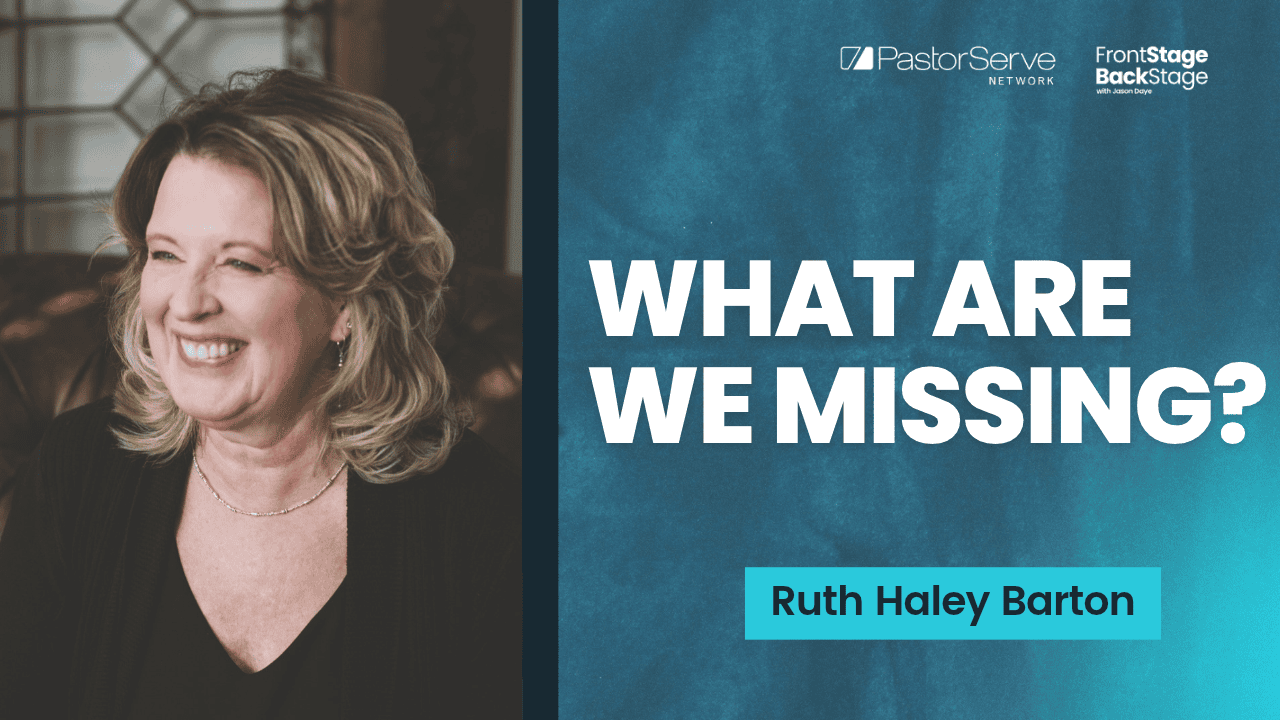
Ruth Haley Barton explores why participation in church does not always lead to deep spiritual transformation and what our churches may be missing.
Pastors and ministry leaders devote their lives to helping people grow spiritually. Yet participation in church does not always result in the kind of deep transformation we hope to see in ourselves or in the people we serve. In this conversation, spiritual director and author Ruth Haley Barton joins Jason Daye to explore what we may be missing.
This question is deeply personal for Ruth. Years ago, she and a group of seasoned ministry leaders realized they needed space outside their own ministry environments to honestly attend to their spiritual lives and pursue the deeper transformation they longed for. That experience became part of a journey Ruth has now spent more than twenty-five years exploring through her work as founder of the Transforming Center, spiritual director, teacher, and author. Her newest book, Leading a Transforming Community, brings that experience directly into the life of the church and asks what it really takes to cultivate communities that are open to God’s transforming work.
Together, Ruth and Jason discuss:
- Why years of faithful participation in church can still leave us spiritually stuck
- What ministry leaders risk when there is no safe place to be honest about their own spiritual lives
- Why genuine transformation may require something very different from making people comfortable
- How some of the ways we do church may actually work against the transformation we desire
- What changes when pastors recognize the limits of what they can produce or control
- Why the transformation of a church may begin somewhere leaders do not expect
This is not a conversation about adding another discipleship program or finding a better ministry strategy. It is an invitation for pastors and ministry leaders to consider what is actually happening beneath all the activity of church life, both within themselves and within the communities they lead, and how we can make room together for the transforming work of God.
Connect with this week’s Guest, Ruth Haley Barton
Weekly Toolkit
Additional Resources
www.ruthhaleybarton.com – Visit Ruth’s website to learn more about her ministry, books, and resources for spiritual transformation, spiritual leadership, and creating communities where people can grow deeper in their relationship with God.
Leading a Transforming Community: Foundations, Practices, and Strategies for Opening to God Together – In her book, spiritual formation thought leader Ruth Haley Barton shares insights from over twenty-five years of guiding leaders through the Transforming Center. She casts a compelling vision for what is possible when a community gathers around the presence of Christ with the shared goal of spiritual transformation.
www.transformingcenter.org – Explore the Transforming Center for resources, programs, and guidance that help pastors and ministry leaders experience spiritual transformation and cultivate communities centered on the presence of Christ.
Ministry Leaders Growth Guide
Digging deeper into this week’s conversation
Key Insights & Concepts
- Most of us can keep up the illusion that we’re doing fine for a surprisingly long time, but the cost is that we become more hidden the longer we maintain it.
- Ministry leaders often long for the very transformation they are working to cultivate in others, and admitting that gap takes a humility that performance-driven environments rarely make room for.
- Desire that is allowed to stay present can deepen into desperation, and that desperation is often what finally frees a leader to tell the truth about their inner life.
- Asking young pastors to carry the spiritual maturity of a seasoned minister is a lot of pressure to place on people whose brains and souls are still forming.
- A safe community is not one where you stay comfortable. It is one where you are loved, listened to, and never abandoned, even when the truth stretches you.
- Safety for the soul grows when people choose listening over fixing, trusting that what most needs to happen in a person’s life is something only God knows and only God can do.
- Believing the right things and being changed are not the same. Facts rarely transform us, but experiences with a loving God and a loving community can.
- Transforming communities do not happen by accident. They take intentional leaders who have first learned from their own souls what makes a community safe and what makes it deforming.
- Discipleship can quietly become a way of staying in control, with boxes checked and certainty maintained, when real formation asks us to loosen our grip and open up space for God.
- Excellence in planning worship is a gift, but a minute by minute run of show leaves no room for a God who does not submit to our schedule.
- A short silence after the Scripture reading says something powerful: what God is saying to your soul matters more than the sermon that follows.
- Leaders who share their own longing instead of a vision brought home from a conference give their people permission to be honest, because that which is personal resonates more deeply with people.
- The hardest question to ask about the Church may be whether an institution, with its built-in survival instincts, can ever truly be a transforming community.
- Spiritual transformation is not a retreat center or an elective offering on the side. If the kingdom of God is available now, it belongs at the center of what the Church is about.
- Formation and mission are not rivals. When the heart of Jesus is being formed in us, we will naturally love the world He gave his life for.
Questions For Reflection
- When I look at my own soul right now, what am I longing for that I’m not finding in the ministry I lead? What would it cost me to say that out loud to someone I trust?
- Where do I feel the pull to look good, to keep things “up and to the right,” even when the backstage of my life tells a different story? What is that performance protecting in me?
- Who in my life knows how I’m really doing, beyond the version I present on the front stage? If no one does, what is keeping me from letting someone in?
- When have I felt desire deepen into something close to desperation? What did that moment teach me about what I was truly hungry for?
- Do I tend to mistake belief for transformation in my own walk with God? What would it look like for me to give myself to an experience with God rather than just a set of convictions? What did I learn from asking this?
- In which areas of my spiritual life am I still trying to stay in control, whether through checklists, certainty, or tight plans? What might it look like to loosen my grip and make room for God to surprise me?
- When I sit with Scripture, am I studying it or opening myself to it? What do I notice God saying to my soul in the quiet? What happens when I let silence linger?
- When someone in my care is hurting or struggling, do I lean toward fixing or toward listening? What would it mean for me to simply be present and trust God to do what only God can do?
- How honest am I willing to be about my own longings and questions when I’m preaching or leading? What might my people be waiting for me to say?
- What do I believe about my own spiritual maturity, and where do I feel pressure to appear further along than I am? How has that pressure shaped the way I pastor others?
- How are we creating a safe environment in our church or ministry team where people can tell the truth about their struggles without fear of judgment? What would our people say if we asked them how safe it really feels? How can we process this with our key ministry leaders?
- In our worship gatherings, where have we built in space for God to move, and where have we planned so tightly that there is no room for the Spirit? What would it look like for us to trust our worship leaders to sense what is happening in the room? What changes should we consider in how we approach our worship gatherings?
- Are we more committed to participation in our church or to transformation? How do we know the difference? What would our people say about what changes in them because they belong here?
- What might our community be experiencing as uncomfortable but necessary in their spiritual development? What might be experienced as deforming? How can we tell? Who needs to be at the table as we discern it together?
- How have we treated spiritual formation, as something central to who we are, or as an elective offering on the side? What would it look like for us to arrange our shared life around opening ourselves to God? How might that shape the way we love the world around us?
Full-Text Transcript
Jason Daye
Hello, friends, and welcome to another insightful episode of FrontStage BackStage. I’m your host, Jason Daye. Each and every week, I have the privilege of sitting down with a trusted ministry leader, and together we dive into a topic, all in an effort to help you and pastors and ministry leaders just like you truly thrive in both life and leadership. We are proud to be a part of the PastorServe Ministry, and this week I’m excited to be welcoming back to the show one of our audience’s favorite guests, and that is none other than Ruth Haley Barton. Now, Ruth has served in pastoral service at many different churches over the years. She’s also written several books, including her latest, which is entitled Leading a Transforming Community. She’s a seasoned spiritual director, a teacher, and a retreat leader. But she is probably most well-known as the founder of the Transforming Center, a ministry which is dedicated to strengthening the souls of pastors and ministry leaders. At this time, I’d like to welcome Ruth back to the show. Ruth, welcome to FrontStage BackStage.
Ruth Haley Barton
Thanks, Jason. It’s good to be with you again.
Jason Daye
Yes, so good to have you back on the show. It’s good to see you. I hope you’re well.
Ruth Haley Barton
I am. Thank you so much.
Jason Daye
Yes, good to have you. Now, Ruth, one thing that really struck me as I was reading through your latest book, Leading a Transforming Community, and this book really is absolutely fantastic, and it seems to be that it’s really pulled together much of the work that you’ve done throughout your ministry, right?
Ruth Haley Barton
You’re absolutely right to observe that, and I feel that as it comes out that it’s sort of a culminating work that brings so much of what I’ve done together in one place towards leading transforming communities that can actually experience transformation in the way that they gather together.
Jason Daye
Yeah, absolutely. Now, one of the things that struck me was that you and several other ministry leaders share a little bit of your story. You were leading churches, you were leading ministries, and when you yourselves were longing for deeper spiritual transformation, you came together. You created a community outside of those environments that you were leading to pursue this deeper spiritual transformation. And so I’m curious, Ruth, what were you longing for that you weren’t finding in the communities that you were already leading?
Ruth Haley Barton
Yeah, that’s such a good question. And by the way, I’ll just say it wasn’t easy to write that because I’m a pastor’s kid. I have been in the church forever and ever, and I really believe in it. And I’m sitting there writing like I don’t want to say this, but it’s the truth, and I have to say it. Well, most of us who gathered were parts of very large, complex situations, and I will say also, we were deep within the contemporary model church and that sort of thing, and so it was a lot of, you could say, inspiration, but also, in some ways, entertainment, but in some ways loud, and big, and very, very busy. And what we were longing for was silence. Some time to hear God deep within. We were longing for a different approach to Scripture, where we could hear God in the Scripture versus somebody else’s three-point sermon. We were longing to do leadership differently, to not be so busy and stressed and burdened, and I remember when I was on staff at a large church, just running through the hallways to get from meeting to meeting. No time to pray in between. No time to say what was going on in that meeting from a spiritual point of view, and what are the discernments needed to come out of that? We were also longing to experience what I would now call corporate leadership discernment or communal leadership discernment, where rather than just talking strategy, we would actually have a practice for discerning what God might be doing, and saying, and calling us forward. The longings were so deep and actually quite specific. And the things that we gathered to do and to be were not what we were experiencing at all in the large, very busy, almost driven settings that we were in, if I could say that.
Jason Daye
Yeah. Now, you say you’re kind of maybe hesitant. It was hard for you to write that, but I am so, I want to tell you thank you for writing that. I’m so grateful that you wrote that because, as I read it, I couldn’t help but think that, and probably so many watching right now and listening resonate with that. Honestly, resonate with and recognize something of ourselves in that story. That reality is that sometimes it is difficult for us as ministry leaders to acknowledge that we might not be experiencing the kind of spiritual transformation ourselves that we’re working hard to cultivate for others, right?
Ruth Haley Barton
Yeah. And when you get clear about that, that’s a dichotomy. Boy, that is a hard place to face, let’s just say. Very hard.
Jason Daye
Absolutely. So, Ruth, I’m curious, what makes it sometimes difficult for us as spiritual leaders to come to that place where we’re doing ministry, we’re really wanting to see the transformation in others, but sometimes it’s hard to acknowledge that we’re not experiencing that transformation in ourselves?
Ruth Haley Barton
Yeah, that’s an important question, and there’s a lot of answers to it. And I’m going to speak from my own experience personally. One thing that was deeply true for me, given the setting that I was ministering in, was that it was very performance-oriented, and I will say, performance-driven. And so, for a leader to say, I’m not doing so well. I’m not experiencing transformation, and furthermore, a lot of the people around me are longing for more, too, and they don’t know where to find it. Now, I’m telling you, no performance-oriented church or ministry wants to hear that. They just don’t want to hear that. It’s a very, I call it a very inconvenient truth in the book, because we want to think everything’s going fine and up and to the right. So there was that, the performance orientation of the setting that I was in, but then, if I could be more personal and say, I think there’s also a lot of ego in that as well. That we want to look good. I mean, that comes from inside us. We want to look good. We want to put forward this face that we’re successful, that we’re doing well, that we’re experiencing the presence of God, and that we’re growing and changing, and there’s a perfectionism that can be layered in there, too. So, for a Christian leader who’s in a very responsible staff role in their church or Christian ministry, it also challenges our own egos to say that kind of truth. To say, you know what, I might look pretty good on the outside, but inside I’m not doing so well. So maybe I’ll just leave it at those two right now. Both the performance-oriented environments that we find ourselves in, where it’s always supposed to be up and to the right, and, of course, even our spirituality as leaders might be even part of our performance review. I mean, it’s part of our performance to be able to say I’m doing well spiritually, so there are the outer pressures, but there are also the inner pressures of the ego, which shows itself in different ways in different personalities, but still very much there. And so, you have to come to a place of almost desperation. I talk about desire and desperation. That there’s desire that can deepen into desperation if you continue to allow yourself to be present to it, and that’s when you’re willing to do whatever. You’re just like I don’t care. I am longing for the more, and I’ll do whatever it takes, including saying this kind of truth, to find what I’m looking for in my life with God. And for a leader to get to that place, it’s humbling. Can I just say that? It’s humbling as well to get to the place where you have to acknowledge that it’s just not going so well on the inside.
Jason Daye
Yeah, absolutely. I mean, our show’s called FrontStage BackStage because we’re talking about the front stage of ministry. You know, looks good on the front stage, but the backstage, there’s a reality there. And when your front stage and backstage don’t match, that’s where you have to get honest with yourself, right? You know, one of the things, Ruth, is that we talk about the performance and having to put that face on, almost. We talk about the ego. There’s another piece is that this idea I think that and this plays into all of it. The spiritual maturity piece. Like we’re supposed to be further along the road than people. It’s like I think back so often to the times when I was a young pastor, and I’m thinking, here I was in my 30s pastoring people that were older than my grandparents. I’m thinking they’re so much more spiritually mature than I was, and how was I their pastor? I almost laugh at myself now. Like, how was I their pastor? So this idea that we’re supposed to be spiritually mature somehow, some way, and yet we’re still on our journey. So there’s that idea of where’s our spiritual maturity? We’re still on a journey, and yet we’re trying, and all those things. What happens to us, Ruth, over time when there isn’t really a safe place for that kind of honesty?
Ruth Haley Barton
Yes, yes. Well, you become more and more hidden. You become more and more living in an illusion. Maybe you’re able to keep that illusion going inside yourself. I don’t know. But you can certainly try for a long time to keep the illusion going on out there, so that people believe you’re doing better than you are. And I think you raise a really good point that when we come out of seminary and whatever training that we’ve gotten to be pastors, I mean, our brains are still forming. You know what I’m saying? Especially if you go right from college to seminary. Like your own brain is still forming. There’s no way in the world you can have in your late 20s and early 30s the kind of maturity you would have in your 50s and 60s. And so, how we set young people up for that is something I think could be considered because it’s an awful lot of pressure to put on a person whose very brain, let alone their personalities, let alone their spirituality, is still in such an early developmental stage.
Jason Daye
Right, absolutely. So this safe place, I mean, you guys created that, Ruth. You know this community, where it was a safer place. You were all kind of feeling this similar thing. So there’s a safety there for you to be honest with one another, right?
Ruth Haley Barton
And it wasn’t our work, so we didn’t have to worry about performance, or anybody, the wrong person finding out how we were doing. That was part of the safety as well, was for it to be outside our work environment, which was ministry, but it was still our work.
Jason Daye
Right, Absolutely, absolutely. So, talk to us a little bit about the safety aspect and transformation. How those two pieces come together. Like, what’s the value of safety within transformation?
Ruth Haley Barton
Yeah. Well, I think to be able to name reality and to be in reality versus in the illusion. And to know that the group that you’re with is safe enough for you to be in the reality versus having to keep the illusion going. And it does help that all of us were at a place where we were willing to be honest and transparent about the deep longings of our souls. That we were longing for more than we were finding in our Christian ministry settings. I also think that somehow many, many churches have adopted sort of a judgmental attitude. There’s a lot of judgment that goes on within Christian Protestantism and Evangelicalism, versus allowing God to be God in each one of our lives. I’ve been starting to think about the word paternalistic. That oftentimes churches and Christian traditions are very paternalistic in terms of telling other people what they think they should be doing, who they think they should be, and judging them for the realities of their life, and things like that. And you know, the soul is very savvy; it can sniff that kind of thing out so easily, and so many, many churches are just not set up to do anything except to say we know how you should be, and this is it. And so, if you don’t measure up, if you can’t affirm it, or you can’t be it, whatever it is, then it’s a pretty shameful situation. You feel a lot of shame inside, and so the idea of the fact that you shall know the truth, and the truth shall set you free. That is part of the safety of a group like this is that the more truth you can tell, the more you know that you are moving towards real freedom in your life, and there’s a deep level of affirmation about that, and even invitation to walk deeper and deeper into truth, because the truth will, in the end, set us free. Now, we all know the joke that it’ll make you miserable first, and that’s true, too. And so you also have to be in a group that can sit with you in the misery of it all, if I can put it that strongly, and who’s able to wait, to listen, and to be with, rather than fix. So I think many, many churches and Christian ministries, Christian-oriented things, are also into the fixing mode. Like you have the problem and I have the answer. So we let go of all of that in a safe group. We know that what most needs to be done in each and every one of our lives only God knows, and only God can do. And so our emphasis is to open up space for God in that person’s life versus fixing them or telling them what we think they should do or sharing our own ideas about what they could do. That’s very safe as well to really set aside this paternalistic, judgmental way of being with each other, just to be present, to be present with each other, and to be present to God on each other’s behalf for what God knows to do for each and every one of us. So those are some of the, you know, the listening instead of fixing, all of that’s really significant to a safe environment versus the environments that Christian leaders find themselves in. Because we would be unrealistic not to name the fact that when we are the pastor or the CEO or a staff person in any of these settings, that the whole constituency isn’t looking at us to make sure that we’re doing what they think we should do, or how they would define mature Christianity. That’s just what leadership is. It’s people looking at you that way and, oftentimes, looking at you through the lens of their own projections about what they think you should be, or their own expectations of what they think you should be as their leader, and that makes it very very hard to be who you really are 100%.
Jason Daye
Hey, friends, just a quick reminder that we provide a free toolkit that complements today’s conversation. You can find this for this episode and every episode at PastorServe.org/network. In the toolkit, you’ll find a number of resources, including our Ministry Leaders Growth Guide. This growth guide includes insights pulled from today’s conversation, as well as reflection questions, so you and the ministry team at your local church can dig more deeply into this topic, and see how it relates to your specific ministry context. Again, you can find it at PastorServe.org/network.
Jason Daye
Yeah, absolutely. You know, it’s interesting when we think of not only ourselves and our journey, but then think of like the focus of your newest book, Leading a Transforming Community. So, we’re being transformed ourselves, but then, how do we lead a transforming community? You know, the idea is self-leadership, and then also, we are. God has entrusted us with a responsibility, right? So, as we’re leading this community, there’s a conversation that those of us in ministry have been having for years, and those who’ve come before us have been having this for centuries, for generations, right? And this is all around this gap between the idea of participating in the life of the church and actually being transformed within it, right? And so, this goes back to why you and your group came together and did it. There’s a difference between participating and being transformed by it. So what, Ruth, have you learned? What has God taught you over these years about that gap?
Ruth Haley Barton
Yeah. I think you’re really right to name that, and it is a real challenge. And the first thing that comes to my mind is that some of us had to want it for ourselves first. When we started the group that eventually became the Transforming Center, we did not have a mission in mind. I want to say we did it purely selfishly. It was for us. We were already doing ministry out there. We needed something that was just for us. So we were leaning in and learning what it meant to be a safe community, to be a community where you experience transformation by being a part of it. We had to learn that for ourselves, and then eventually we thought, well, if this is so meaningful to us, maybe some other people would like to join us, and that’s when we then started to open it up. But that place where it’s for you, and you’re doing something that you know is important for your soul, that’s the most important preparatory phase right there. Because then you’ve got an inner plumb line that says, I know what this is, I know what’s safe and what’s not safe, and so if I’m going to cultivate a community, I am really in touch within my own soul about what makes a community safe, what makes it dangerous, what makes a community transforming versus deforming, which is a key issue that I’m trying to bring out in this book is that I don’t think transforming communities happens by accident. I don’t. I don’t think that’s who we naturally are as human beings. So it’s going to take intentional leadership. And so this book is unabashedly written towards leaders who have the responsibility of cultivating the culture and whatever kind of community they’re going to be. Because we know, we’re in a period of time right now, where the church is under a lot of critique, and the younger generation is being really, really honest about the fact that as much as we might have thought we were about transformation, their participation in some ways was deforming to them. And there are whole groups of people for whom being involved in the church is deforming, not transforming. And so we have to have had our own experience first of longing for the more in community, finding an experience somewhere. Whether it’s like we did, we formed our own. But then there are other places out there that really are safe, and I experienced that, too. Like in my training to become a spiritual director, I experienced a kind of safety and community, and a kind of openness, a contemplative openness to what is. Being with God with what is, versus that judgmental, paternalistic feeling, that then I was drawn into other communities that I could tell were safe for my formation, and it was out of that then that we began you know cultivating something that other people could join, but always staying really connected with our own souls. And, to this day, that’s always my biggest question about anything we do in the Transforming Center is: what keeps us all safe to be on the transformational journey? Now, we’re also very clear to say that being in a safe community doesn’t mean that you’re always going to be comfortable.
Jason Daye
Yeah, right.
Ruth Haley Barton
Because these are days when, if you raise the real issues that are facing us today as the body of Christ on the earth now, it’s not going to feel comfortable all the time. And so when people get, you know, they’re like, well, we didn’t think we were going to go into those tough issues. We thought this was just going to be this warm fuzzy experience with God. We’re like, well, then you don’t know how we’re defining transformation because transformation, by its very definition, is going to make us uncomfortable. It’s going to stretch us. It’s going to ask us to look at some of the beliefs that we’ve held and why, and our fears and why we’re holding on so tightly, and clinging. Like it’s not going to be comfortable the whole way along, but it will be safe in that we will love you. We will not leave you. We will listen to you. You are safe in that sense, but you will be uncomfortable at times. There’s no way to avoid it in a true transformational journey.
Jason Daye
What do we sometimes mistake for spiritual transformation then?
Ruth Haley Barton
Beliefs. I think that a lot of times in Protestantism, anyway, because we are known by what we protest, and it was ideas. That’s just in us from the standpoint of our DNA as Protestants. And I’m sure there’re Catholics listening to us as well. But I’m going to talk to Protestants right now and say it is part of our DNA to be very heady, to be very dogmatic, and to be over and against. I mean, Protestantism has a certain over and against sort of tone in it, and very judgmental. Like, you guys don’t have it; we have it; we have the truth. You don’t. So, that’s a part of who we are, and I think that sometimes we think that transformation happens at the level of cognition or at the level of belief and changing what we believe. And beliefs are very important in that they can undergird what kind of journey that we’re on. So my beliefs about spiritual transformation are significant. I have real beliefs around formation, what it is, how it happens, what the role of the Holy Spirit is within it. Where does it lead? I have strong beliefs about that, but the experience itself is different from just believing something. The experience is giving myself to it and allowing God to change me in really profound and fundamental ways. So, I think we can, as Protestants in particular, think that belief is the same thing as transformation, and facts don’t change us. Experiences with a loving God and with a loving beloved community of faith; those experiences with God and others actually change us as we give ourselves to it. I think spiritual formation also is not the same thing as therapeutic helping. I think that therapy and psychology is a really integral part of our transformation, but the deepest levels of transformation are that mysterious work that only God can do, and so we have to find ways to open to that. So, groups that exist for affinity purposes, or to fix and pastor each other, and all of that. As valuable as they are, or even groups that exist to study the Bible, those are not the same things as groups that might order themselves for transformation.
Jason Daye
Yeah. So, what are some of the specific differences within spiritual transformation groups, just practically speaking, versus some of those other affinity types, or even biblical study type groups? What are some of the nuances there?
Ruth Haley Barton
Yeah, well, groups that I talk about in this book, I talk about arranging our lives in community for spiritual transformation. Now, it’s not just about my own personal sacred rhythms, but now it’s what are we doing as a community to open ourselves to the transforming work of God? And, first of all, it’s not about gaining head knowledge. That’s going to be different. But I want to say very clearly that in the early first half of life, places our spirituality, biblical literacy is really important. Hermeneutic, having a good, clearly identified hermeneutic for how we’re going to handle scripture, scripture memorization, what I would put under biblical literacy, that is very foundational to the formation journey. But it’s not the same thing as transformation. Do you resonate with me when I say that?
Jason Daye
Yes, yes, yes.
Ruth Haley Barton
Okay. So, in the formation journey then, a group that is arranging their lives for that would be arranging their lives around the spiritual practices that help us to open to God’s mysterious work of transformation. It would be even an emphasis on giving up control versus controlling. So in the early phases of the spiritual life, discipleship models also are sometimes very controlling. Like I’ve read through the Bible in three to five years and checked off all the boxes. You know, I’ve memorized big passages of Scripture, which I did, by the way, as a young Christian, and kind of controlling things by having a set of beliefs that’s full of certainty. What we’re doing there is controlling information. We’re controlling the spiritual life, and our discipleship methods can be very much about making sure that we don’t slip off the spiritual path, and we don’t sin, and there are very clear ideas about what sin is and what it isn’t. Whereas formation groups, whether it’s a large congregation, or a ministry community, or whether it’s a small group, it’s going to be very much more around engaging in the practices that help us to give up control, that help us to open to God’s mysterious work of transformation, and give us a way of paying attention with each other to what God is saying to us and how God is speaking to us within those practices. Very much like the disciples on the Emmaus road. You know, did not our hearts burn within us as He was talking to us on the road? It’s that kind of paying attention, where we have taught people and we’re prioritizing spiritual practices that help us to give up control and open up that space for God. And then our gatherings have to do with paying attention to the places where our hearts burned within us, where we felt like Jesus was present with us on our road, or God was at work in some way that was beyond what we could have done, humanly speaking. And another way I like to look at groups that gather around formation is that they gather also with a purpose to help each other cultivate sacred rhythms in their lives. Sacred rhythms of those practices that open us to God’s transforming work, and then that emerges out of desire. So conversations having to do with desire. What is it that you really want? Who is it that you really want to be? Who is it that you believe God wants you to be? And how can you arrange your life for that? So then I don’t love the idea of accountability so much as saying that a formation group is a group that has heard you speak of your desire, that knows the work that you’re doing around arranging your life uniquely for your own process of spiritual formation, and then checking in with you from time to time and saying, How’s that going? How’s your practice of solitude going? What is God saying to you when you sit quietly in His presence? What has God been saying to you as you’ve been open before the Scriptures versus studying the scriptures? In the book, I put forth some ideas for how we can give up control, as it has to do with scripture, both alone and together. Versus controlling scripture to our own ends, and how can we, in our worship gatherings and as a community, have some spaces in there where we’re leaving ourselves open to the mystery of God versus having every single moment so carefully planned and orchestrated like a run of show, almost.
Jason Daye
Right, right.
Ruth Haley Barton
I remember the first time I experienced a run of show when I was participating in a church service. I was blown back. I’m like, are you kidding me? Is this what we’re doing? Are we doing a show here? Let’s be careful with the language that we use because with a run of show, you have set. I remember being in settings where if the Holy Spirit were to blow through the room, nobody would have cared to notice or stop the service and adjust. Because the run of show was what we were all clinging to, and that’s controlling. That is control. I love excellence in planning for worship, but I have a real problem with this run of show idea because in a transforming community, you’re trying to find ways to open to God, and God does not submit to our run of shows.
Jason Daye
Yeah, exactly. Minute by minute.
Ruth Haley Barton
Yeah, like the Holy Spirit’s got 30 seconds to work right here. Now I’m preaching. I know I’m preaching to you, Jason.
Jason Daye
No, I know exactly what you’re saying.
Ruth Haley Barton
You do. I know you do. That’s why I can say it.
Jason Daye
At PastorServe, we love walking alongside pastors and ministry leaders just like you. If you want to learn more about how you can qualify for a complimentary coaching session with one of our trusted ministry coaches, please visit PastorServe.org/freesession. You don’t want to miss out on this opportunity. That’s PastorServe.org/freesession.
Jason Daye
Yeah, Ruth, you know it’s interesting because as I was reading through the book, and as you’ve been sharing here even, there’s this interesting… it’s not attention, because it makes sense. But there’s this piece between this intentionality, because you spoke about this intentionality, there has to be intention behind this. But there’s this intentionality. This intentionality that must exist, but it’s an intentionality that provides open-handedness, right? Oftentimes we think of intentionality and purpose that you know holds something, enforces something, almost. But I would love for you to talk to us a little more. And you’ve been doing well on this, but talk to us a little more about this idea of, I guess I’m trying to get to, what do we need to consider about our environments right now? Our communities, our environments, our gatherings, our worship gatherings, right? What do we need to consider about being intentional so that we can provide the transformative opportunities, right? Like, how do we hold those things together?
Ruth Haley Barton
Yeah, that’s beautiful. It’s a great question, and you only know to ask a question like that if you’ve been involved in planning worship, right? Yes, and I appreciate it. I think it’s actually okay to use the word tension because there are going to be some places of tension that we’re going to have to live in. And when I think about creative tension, the way that Peter Senge talks about it, if you’re willing to remain in the creative tension, then I would, because I’m a Christian, say that’s where the Holy Spirit of God can come in and guide us into a third way that we could never have envisioned. So I think this place of creative tension is really a deeply spiritual place, to be willing to sit. So, I wouldn’t shy away from the word tension because there is a tension in it. For me, and you know, we in the Transforming Center worship eight times when we’re together for two and a half days. We practice fixed hour prayer and worship services, and so I’ve done a lot of worship planning in that setting over the years, hundreds and hundreds of services that we plan together, and this is a question that we are with as well when we plan. And the reason that I’m involved in our worship planning is I show up as a spiritual director in those worship planning sessions. I’m the teacher, but I’m also a spiritual director. I’m also always asking this one question: What does the soul need at this moment in our retreat? Given what’s happened in the session before it, given where we are, what does the soul need? What is the soul going to need to say to God? Where will they need space for God to say something back to them? And so we’ll actually look at the worship that we’re planning, even looking for those places. So we have a great deal of intentionality. We pray liturgically, which means that we have the whole thing written out. But we’ve also named places where we know the souls are going to be tender, like if there’s a place where we acknowledge grief or lament, then we say right here is going to be a really important moment because we don’t know what’s going to happen in the room at this moment. When we open it up for people to be present with their grief, or for us to be present to the practice of lament, as it has to do with what’s happening in our culture around race and things like that, this is a moment where a lot could happen, and we want to leave it open. And then the worship leader’s role is going to be to sense the moving of the Spirit there, and we give that worship leader complete freedom. We trust that person to feel the spirit and what’s really happening in the room, and not to rush us on if the Holy Spirit is really active in that moment. So, that’s one way. Another thing I’ll say is that we practice holding silence after the scripture reading. It’s not the only place that you could hold silence in a service, but it’s the place where we do it. And the reason for that is to, after the scripture reading, give God the opportunity to speak to souls of the people that are in the room the way God would want to speak to them and to their life uniquely, that silence is really significant because what we’re saying with that silence is the most important thing is what God is saying to your soul in and through that scripture. The most important thing is not the sermon that comes after that scripture reading. The most important thing is what God is saying to your soul through that scripture, and we will leave space for that. So these are some ways in which you can have a plan, but you can have built in spaces for God, and also you build in, I would say, permission, but also empowerment to the leaders who are on stage. You don’t have a run of show. Instead, you say this is a place where the spirit could be mightily at work, and we want to be ready for that. And worship leader, the person that’s leading in that moment, you have the freedom to feel it and to guide us and to lead us in that moment as you are responsive to the spirit. So we wouldn’t have just any worship leader come and lead worship for us. It has to be that leader who’s able to feel what’s going on in the room and is able to be responsive. So every worship leader that I’ve worked with in the Transforming Center, I have felt that I could trust them completely to feel that. I’m often in a different, like in a liturgical leadership role. The worship leader is often the one behind the instrument or whatever, praying underneath an experience that we’re giving. But I would not work with a worship leader that I could not trust to discern that moment. And then I’m communicating to them: you have complete freedom right now to do what that what you feel is happening, how you discern the spirit in the room, and so it’s always very exciting because you just never know. Sometimes we might name a place where we think something’s going to be happening, and it happens somewhere else. And then the team who’s leading has to really be trusting each other. That when that happens, we’re there. We try to recognize it and try to go with the spirit, and what God’s doing in the souls of the people gathered. Does that help at all? Did I respond?
Jason Daye
Yeah, no, I love that. For the pastor who’s pastoring a local church, and they resonate with this. They like what they’re hearing, and they would love to see this within their local church. What would you encourage that pastor to be paying attention to in their own soul as they kind of begin this journey of leading their church into a transforming community?
Ruth Haley Barton
Well, the very first thing is to pay attention to your own longing and desire, which is a more vulnerable place to lead from than leading from vision. And it’s not like I don’t want people to have vision, but if you just foist some new vision, congregants are used to this. Leaders coming back from a leadership conference and foisting a new vision on them. That’s not what we’re talking about here. It’s the leader who is in touch with their own longing, their desire, their own questions, the places where they’re longing for more. I mean that’s the phrase. And they work with desire, and then from that place they start to open up the conversation about desire in and through their own life. So people say, sometimes they’ll ask, well, how do we help people get in touch with their desires? Well, first of all, the pastor and the leaders have to get comfortable with their own desire and with talking about that to other people, even in their sermons and things, and that normalizes this experience of desire. When I was “saved” as a four-year-old in my family devotions with my dad, who was in seminary preaching to us in devotions, I thought that if I became a Christian, I would no longer have any more desires. That having Jesus in my heart would mean that all of my desires would be fulfilled, and that is of course not true. And I have been really surprised at the significance of the role of desire in the spiritual life and in my spiritual life even to this day. And I’ve learned to trust it, and I’ve learned to trust, as Henry Nouwen says, that what is most personal is most universal. So, if we, as pastors and leaders, could lead the way in talking about our own longings and desires, we will find that the people out there have just been waiting for somebody to be that honest. And then from there, you can create space for the congregation or the ministry to get in touch with shared desire or communal. What do we want for our community? What do we want for our lives together? And that becomes what guides us into what may be next. But I just don’t think we can skip that part. Otherwise, it’s just going to be another vision that somebody got at a leadership conference, and the congregation says, Oh, here we go again. Instead of bringing them along in the way that you’ve been brought along by God’s grace.
Jason Daye
Yeah, I love that. Absolutely love that. Obviously, as you’ve poured into Leading a Transforming Community and poured your life and your ministry, obviously, into all of this, this was written with a lot of hope, and you see that throughout the book. We’ve heard this in this conversation. As you’ve looked at the church, you’ve even spoken to this, and even young people, what they’ve seen, you said they’ve sensed this. They sense this idea that there is a deeper sense of transformation that the spirit’s inviting us into, right? And maybe some of that’s been missing. What gives you hope, Ruth, that our churches really can become communities where this kind of transformation is taking place?
Ruth Haley Barton
Yeah, you know, I gotta pay attention. I got teary when you said that, when you said that the book has hope in it because when I first wrote the manuscript, some of the input that came back from the readers was that it wasn’t hopeful enough. That I was too hard on the church, if you will, and so I worked on that. So the fact that you said that means that that’s true. That somehow, by God’s grace, I was able to do it while telling the truth. Because I think that was the challenge, was to tell the truth about where we are as a church right now, but to do it with some sense of hope. So thank you for naming that. That’s really meaningful to me. It means that you’ve really engaged it in a meaningful way. Because there’s an epilog in the book where I raise a really, really tough question. Did you look at the epilog?
Jason Daye
Yes.
Ruth Haley Barton
Yeah, and the tough question is: Can institutions, or the institutionalized church really be a transforming community? And that was the question I carried through the whole writing of the book. And then at the end I thought, I’m not going to be honest if I don’t put this question out there. Because by its very nature, the institution of the church or the institution that a ministry organization can become can, in many ways, without us even knowing it, work against transformation because once something becomes an institution, it’s got its own survival mechanisms built in. It’s just the way it works. So, I mean, honestly, one of the things I would say is what gives me hope is what I’ve experienced in the last 25 years in the Transforming Center. That even though some of us as leaders had to go outside the church, and then the leaders who come to us are clearly going outside the church, but hopefully many of them are going back. I mean, that’s the dream: is that if we give them this safe place where they get in touch with desire and they begin to experience the more in their own lives, then they go back into their setting and they start to lead differently. I mean that’s the hope. It’s always been the hope, and I think I also really do believe that the promise of spiritual transformation is central to the message of the gospel, and therefore, central to the mission of the church. But I don’t think we’ve made it central. I don’t. And in fact, we’ve made it a retreat center. We’ve made it a set of elective offerings. We’ve made it something else other than being central. But Jesus, when he talked about the kingdom coming, he wasn’t talking about the afterlife. He was saying that the kingdom of God is present now if you can figure out how to open to it. If you can figure out how to sell everything you have, so that you can buy the field that has the treasure, then the kingdom of God is here for you now. And I think, to me, and I can feel my own shivers as I say this. To me, the idea that the kingdom of God could come in our lives now, before we get to heaven, but now, and in heaven, but now in my life, and the idea of spiritual transformation. That we can become like Christ, that we can become participants in the divine nature, as it talks about in 2 Peter. Think about that. Not just imitators, not just imitators of Christ, but participants in the divine nature. I believe that’s possible. It’s in the theology of it, but you have to find ways to open. And I’ve seen pastors and leaders start to lead differently and intentionally once they’ve attended to their own journey of transformation in very raw and vulnerable ways. And we hold people in that space. People say often, When I came to you guys, I was in such rough shape, or you were the last knot on the end of my rope. I was about ready to leave ministry, but coming into this safe space brought me back to some sense of belief in what we can be about in the church. And so, I’ll be honest, I don’t know if we as human beings can fully carry this off, but I’ve seen enough of it that I know that when communities organize themselves for this, when communities arrange their lives for this as their ultimate priority, that God can do amazing things. And maybe the last thing that I would say here is that I think that the very definition of transformation makes a community missional. That one of the things I’m also trying to do in this book is to debunk the false dichotomy between formation and mission, because a transforming person, a transforming community, by definition, is going to find God at the center of their being. Our lives hidden with Christ in God. Then we’re going to seek out community with other people who are also experiencing their lives hidden with Christ in God, and then from there we discern how to be in God for the world. And that if it’s Christian formation at all, it’s going to be forming the love of Christ for His world into our hearts and into ourselves and into our bodies, and so I think transformational communities are missional by definition. Because if it is the sacred heart of Jesus that’s being formed in us, then we will love the world that God gave His very best for, and we will love the world that Jesus gave His life for. That will be part of what’s being formed in us, and we will be out there loving that world as a very natural outcome of our transformation.
Jason Daye
I love that, absolutely. I love that. Well, sister, this has been an amazing conversation. Absolutely, I love it. Absolutely love it. Thank you so much, Ruth.
Ruth Haley Barton
Yeah, and Jason, thank you for reading the book. You know, not every interviewer reads the book as carefully as you did, and I think that’s why I kind of teared up a little bit because you felt the struggle that I had in writing this. You felt the struggle, and yet you said we came out on the side of hope, and I’m like, oh well, thank God.
Jason Daye
Yes, I sensed it. I sensed it. I journeyed with you on it, so it was amazing.
Ruth Haley Barton
My heart is full. Thank you for preparing so carefully for this conversation. I appreciate it.
Jason Daye
Well, it was an excellent book. Absolutely, I’m so grateful that you have given your life to this, and that God has used you so beautifully through it. And for those of you who are watching and listening, I highly recommend Ruth’s latest book, Leading a Transforming Community. Absolutely beautiful book, and something that I believe will help you in your ministry, help you personally, help you in your ministry in your local church, in your ministry organization, and you can find links to the book in the toolkit for this episode. We create a toolkit for this episode and every episode. You can find that at PastorServe.org/network, and there you’ll find links to the book.
Ruth Haley Barton
And there’s a study guide. I don’t know if we mentioned that. Oh yeah,
Jason Daye
Oh yeah, awesome.
Ruth Haley Barton
There’s a study guide for leadership groups to go through together. So yes, you’ll want to know that.
Jason Daye
Okay, we’ll include the study guide as well. So you’ll have the book. You’ll have the links to the book and study guide as well, and there we’ll have a toolkit. In the toolkit, we’ll also have our Ministry Leaders Growth Guide, which has insights from this conversation that Ruth and I just had, along with questions for you and your ministry leaders to go through so you can dig more deeply into this conversation. Including links to the Transforming Center, and all kinds of other great things. So be sure to check that out at PastorServe.org/network. Ruth, it’s always a pleasure to have you on the show. Thank you. This was a wonderful conversation.
Ruth Haley Barton
Love being with you, Jason. The Lord bless you and your work as well. Thank you.
Jason Daye
I appreciate it, Ruth. God bless you, sister.
Ruth Haley Barton
Take care.
Jason Daye
Here at PastorServe, we hope you’re truly finding value through these episodes of FrontStage BackStage. If so, please consider leaving a review for us on your favorite podcast platform. These reviews help other ministry leaders and pastors just like you find the show, so they can benefit as well. Also, consider sharing this episode with a colleague or other ministry friend, and don’t forget our free toolkit, which is available at PastorServe.org/network. This is Jason Daye, encouraging you to love well, live well, and lead well.
Recent Related Episodes
-

Posted On: January 7, 2025
-
Posted On: February 25, 2025
-
Posted On: July 23, 2024
Right-click, then select “Save Image As…” to download one of the social graphics.