
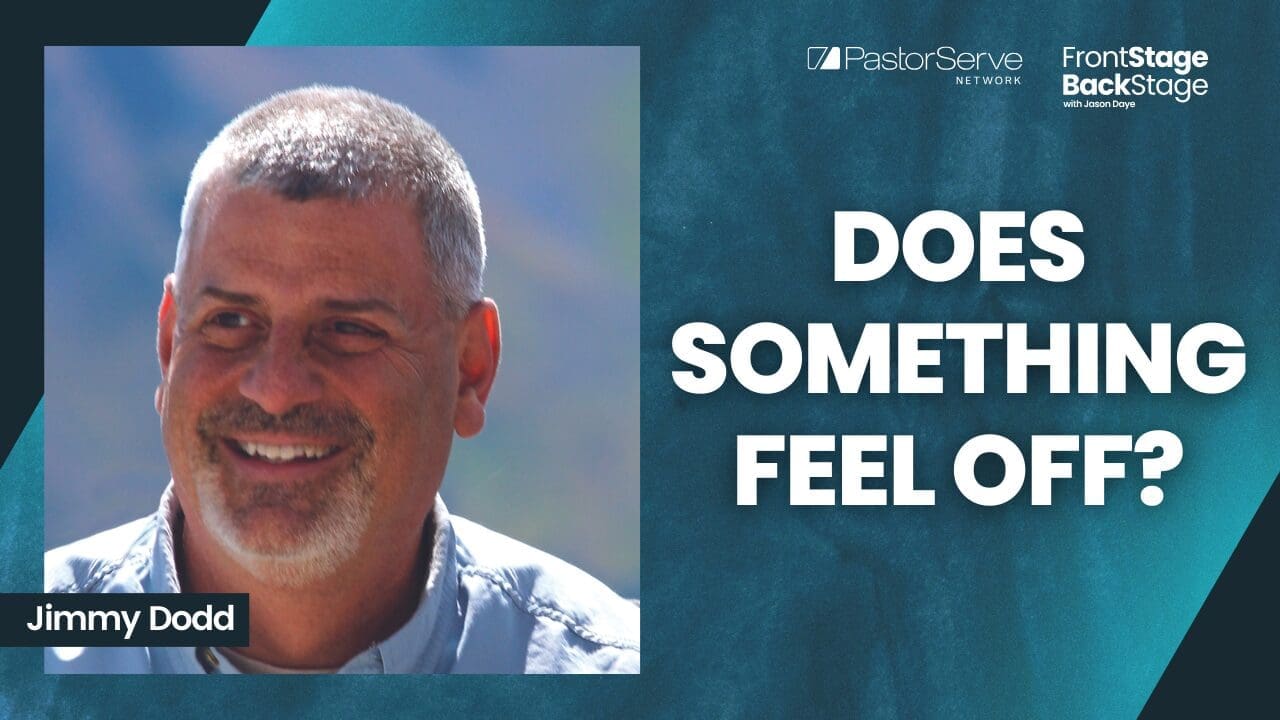
What if the most dangerous season in your ministry is when everything looks like it’s going well? Jimmy Dodd talks about the quiet drift that can happen beneath the surface and how to respond before it leads somewhere you never intended.
In this episode of FrontStage BackStage, Jason Daye sits down with Jimmy Dodd, founder of PastorServe, to explore a reality many pastors experience but rarely name. There are seasons in ministry when things appear to be working. The church is moving forward. People are engaged. From the outside, it looks like health.
Yet beneath the surface, something can begin to shift.
Jimmy shares from years of walking closely with pastors, along with his own story, to talk about how drift does not usually happen all at once. It forms slowly, often hidden beneath effectiveness and reinforced by responsibility, affirmation, and the steady demands of ministry life. Because things still seem to be working, the deeper questions often go unasked.
This conversation invites a different kind of awareness. It is an invitation to pay attention to what is happening within, not just what is visible around you. It also reframes those moments when something feels off. Rather than ignoring them, they can become meaningful points of reflection and realignment.
They discussed:
- How ministry success can quietly cover over personal drift
- Why pastors often miss what is happening beneath the surface
- The subtle signs that something deeper may be shifting
- How responsibility and affirmation can reinforce unhealthy patterns
- Why moments of awareness can lead to realignment and renewed health
This episode will resonate with pastors and ministry leaders who sense that something is not quite right beneath the surface. It offers space to reflect, to be honest, and to take a step toward greater alignment, health, and dependence on Christ.
Connect with this week’s Guest, Jimmy Dodd
Weekly Toolkit
Additional Resources
www.pastorserve.org – Explore Jimmy’s biography page to discover his ministry story and the ways he leads and supports others at PastorServe.
Survive or Thrive: 6 Relationships Every Pastor Needs – In his book, Jimmy reveals that the majority of pastors are not known-by anyone. They purposely isolate themselves from both staff and congregation so their insecurities, doubts, and failures aren’t exposed. Yet confiding in the wrong person can be a dead-end at best and disastrous at worst. Jimmy explains how those in pastoral ministry can receive ongoing support, accountability, and restoration from a boss, counselor, trainer, mentor, coach, and good friend. Discover how you can move from surviving to thriving with the six relationships every pastor needs.
Ministry Leaders Growth Guide
Digging deeper into this week’s conversation
Key Insights & Concepts
- When ministry is thriving and the budget is healthy, the last thing most leaders want to do is ask hard questions, but that comfort is exactly when the hard questions matter most.
- Frontstage success can quietly become a shield that protects backstage dysfunction from ever being examined.
- Inviting honest feedback is only meaningful if you can actually receive it without getting defensive. The first time you shut someone down, you have closed that door for good.
- Spiritual drift rarely announces itself. It may look a lot like busyness, success, and a calendar full of good things.
- When a pastor only opens the Bible to prepare a sermon, something important has already been lost.
- God declared his love and pleasure over Jesus before a single miracle was performed. Ministry that flows from that kind of security looks completely different than ministry driven by the need to earn it.
- The six relationships every thriving pastor needs, a boss, trainer, coach, counselor, mentor, and friend, are not a luxury for early career ministry leaders. They are a lifelong necessity, and thinking you have outgrown them is itself a warning sign.
- Satan does not need a large toolbox. His most effective lie is simply that if people really knew you, they would not want to be around you, and that lie keeps leaders isolated and hiding.
- Waking up and thinking today is on me is not ambition. It is drift.
- A wake-up call, whether it comes through pain, failure, or a gut punch from someone you love, can work like a lightning strike on a dark night. For just a moment, everything becomes clear.
- Tracking your hours honestly is one of the most practical ways to see where your life has actually gone, not where you intended it to go.
- The most exhausting way to live is pretending to be better than you actually are. Honesty is not weakness. It is the thing that sets you free.
- Unrealistic job descriptions are not just an HR problem. They are a spiritual problem, because they quietly set pastors up to fail before they ever get started.
- People are not sitting in churches and at conferences desperately needing more information. They are longing for genuine relationships, and leaders who understand that will create space for stories instead of just delivering content.
- Preaching the gospel to yourself every morning is not a warm-up routine. It is the whole foundation. Everything else you do that day either flows from that truth or quietly drifts away from it.
Questions For Reflection
- When things are going well in my ministry, where am I tempted to stop asking hard questions about my personal life? What parts of my backstage am I avoiding simply because the frontstage looks healthy?
- How are we creating a culture in our church or ministry where honest feedback is not just welcomed in theory but actually practiced? Do the people closest to us feel genuinely safe to push back? How can we process this with our key ministry leaders?
- When someone in my life does push back on me, how do I actually respond? Am I creating a space where that can happen again, or have I quietly closed the door without realizing it?
- If I look honestly at the six relationships every thriving pastor needs, a boss, trainer, coach, counselor, mentor, and friend, which ones are missing from my life right now? What story am I telling myself about why I do not need them? What will I do to develop these key relationships?
- How are we handling expectations in our ministry context? If we asked our board or key leaders to estimate the hours required by my job description, what would the honest total reveal? How can we process this with our key ministry leaders?
- When I open my Bible this week, what is driving me there? Am I coming to prepare something for others, or am I genuinely coming because I need time with Jesus for my own sake? What adjustments do I need to make?
- Where is the drift in my life right now? Not the dramatic kind, but the quiet kind, the kind that shows up in my schedule, my habits, and the questions I have stopped asking myself?
- How are we making room in our gatherings and staff rhythms for real relationship and honest conversation, rather than just transferring more information? What would it look like to build that into our regular routine?
- What secrets am I carrying right now that I have convinced myself I cannot share with anyone? What is it actually costing me to keep carrying them, and what might change if I finally put them down? What next steps do I need to take?
- When I wake up in the morning, what is the first thing on my mind? Am I starting from a place of rest in God’s love, or am I already thinking about what I need to pull off today?
- How am I doing at asking the people around me about their stories rather than defaulting to sharing my own? When I walk into a room, am I more focused on being seen or on genuinely seeing others?
- How are we doing as a ministry team at building in regular rhythms of honest reflection, asking what we got right, what we got wrong, and what we are learning together? How can we process this with our key ministry leaders?
- When I preach grace to my congregation, do I actually believe it is true for me personally? Where is the gap between what I proclaim from the stage and what I am living out behind the scenes?
- If I honestly tracked my hours this week, not the way I wish they looked but the way they actually are, what would the picture tell me about where my life is out of balance?
- How are we creating opportunities for the people we lead to share their stories with one another rather than simply receiving content from us? Do we genuinely believe that relationship is what people are longing for most? How can we process this with our key ministry leaders?
- How am I ensuring I am staying aware of drift, or potential drift, in my life? Specifically, what does this look like for me?
Full-Text Transcript
Jason Daye 0:00
Hello, friends, and welcome to another exciting episode of FrontStage BackStage. I’m your host, Jason Daye, and I have the privilege of sitting down with trusted ministry leaders, and together, we engage in a conversation in an effort to help you and pastors and ministry leaders just like you, truly thrive in both life and leadership. Now, I am really excited to be welcoming back this week one of our favorite guests, the CEO and founder of PastorServe. Jimmy Dodd is joining us again this week. Jimmy has had a lifetime of ministry. He has served as a pastor and as a church planter. He has really given his life to coming alongside pastors and ministry leaders across the US and really around the world. He has been an advocate, has been a voice, and has been one who has really come to be a person who cares genuinely for pastors and ministry leaders. He’s a thought leader. He has written extensively. He has shown up in so many ministry spaces to share and care for pastors and ministry leaders. We’re excited to have Jimmy joining us on the show once again. Jimmy Dodd, welcome to FrontStage BackStage.
Jimmy Dodd 1:19
Good morning, Jason. Thank you for that very kind introduction.
Jason Daye 1:23
Hey, it’s good to see you, brother. Love you. Appreciate you. Thank you for all the work you do on behalf of pastors and ministry leaders, and truly, you are one who has a big heart for those who are serving Christ’s Church, and really excited for the conversation that we’re going to dive into. It’s an important conversation because we know that there are lots of times as pastors and ministry leaders, we’re recording this, by the way, just after Resurrection Sunday, just after Easter. We know that’s a big Sunday for those of us who have pastored over the years, those of us who are pastoring right now. It’s a Sunday of great celebration, great excitement, obviously, because we’re proclaiming the most incredible thing that’s ever happened in the history of humankind, the resurrection of Jesus Christ. For lots of pastors, it’s a Sunday of great excitement. For some pastors, it’s a Sunday that can be disappointing. Things sometimes don’t go exactly the way that we had hoped. There are some pastors who are on the mountaintop. There are some who are in the valley, and it could be because of just things going on in their personal lives. There are some pastors who this is the end of a season for them. For some pastors, this is the beginning. And, oftentimes, when we’re talking about the life of a pastor or ministry leader, we’re talking about these seasons that we’re going through. Sometimes we’re talking about these challenges that we face. But there are times when everything seems to be working, everything seems to be going incredibly well. And yet, in those times, Jimmy, we know that we need to be paying attention when everything’s going fantastic. In fact, sometimes those seasons when everything seems to be going amazing can be dangerous, and we need to be vigilant. So, Jimmy, talk to us a little bit. Why do we need to be paying attention when everything seems to be working so well?
Jimmy Dodd 3:28
Yeah. It’s a great question. And it’s interesting because I think the statement that I make more than anything, which I probably make almost every day, is people ask me, what is the number one issue with pastors these days. And I say, I think the number one issue is we make backstage assumptions based upon frontstage performance. And I think that’s especially true when things are going well, when the church is thriving, when your ministry is thriving, when things are growing, and when the budget is healthy. It’s incredible how we begin to make assumptions about, man, God is blessing us. I want to guess that our leader has a really strong marriage, that they have a really strong personal life, and that they’re walking really closely with the Lord. It’s so fascinating how, when things are going well, we don’t, oftentimes, take a real hard look at the backstage. We don’t start to ask questions about our leader. When things are not going well, all of a sudden, the things that have been there all along become major issues. There are 1000 illustrations. One that comes to mind. I did some Chaplain work for the Kansas Jayhawk football team back in 2008-2009, and you know what? They were really good. They won the Orange Bowl that year. They had some great years. And there was a coach, I won’t mention his name, but he’s very easy to find. Anyway, he was a pretty rough coach, and I think he was very rough on the players. And he won. So nobody really examined it. Nobody really looked at it. And then they had a season where they began to lose some games, and when they began to lose, they started to look at the backstage and found out, wait a second, he’s a little bit cruel to players. Not just rough on players, but cruel to players, and he was fired because of that. It was like nothing had changed; they just didn’t want to look at it when he was really successful, but when it started to have some issues, all of a sudden, everybody wanted to ask questions. I don’t think that’s that much, really, unlike the church, in that when things are going really well, I think there’s a mindset of, man, let’s not rock the boat. I mean, we’re doing great in our budget, our church is growing, our ministry is thriving. Let’s not rock the boat. Then, all of a sudden, when things don’t go all that great, you start to ask a lot of questions. And the challenge is, how do you ask those questions when things are going well? And I think that that’s what we have to do. Because I do think that there can easily become drift in our personal lives because we aren’t asking ourselves the hard questions, and when things are going well, we don’t want to ask ourselves, we don’t want to really dig deep when things are going well. We just assume, man, God’s just blessing this because I guess I’m a good person. No. The only reason God ever blessed you was because of His abundant grace. But it’s just important, even in the best of times, to ask yourself some hard questions because we can’t make the assumption that things are going well backstage just because it looks really good on Sunday morning.
Jason Daye 6:43
Yeah, that’s good. Let’s lean in there a little bit with this idea of personal drift and those reflective questions. So, if we’re in a season of when things seem to be going well, what are some of these practices, some of these questions, maybe, some of this reflection that you would recommend, or you have recommended to the many pastors whom you’ve coached over the years? What are some things that we need to begin to bring into our lives to process through, so that we don’t get too caught up in our own good press, right? Too caught up in the things that are going well, that we don’t find ourselves down the road to have drifted so far from what God’s called us to do and who God’s called us to be. What are some things that we can begin to practice in our own lives? What are some questions we need to be asking ourselves?
Jimmy Dodd 7:41
I mean, I think that probably the first main question is, do I allow people to push back on me? I mean, like, have I gotten to a point where people feel like they cannot come to me and say some really hard things and say, Hey, I realize this is going well, but something about this just feels wrong, and something about this is just not right? And I’m watching this in your own personal life. And if we don’t allow people to push back on us, we have some big, big issues. And, I mean, I have a way, way, way too many stories of pastors who get to that point where they think that they have become so successful that nobody can just push back on them and say hard things. So, if you don’t have anybody in your life, and I think, in one sense, you almost have to actually give permission to people. You have to say, Hey, listen, you’re with me every day. You watch me. You see me. You know how I act. You know what I’m doing. If you see things that you think are just kind of out of alignment, you know what, I want you to come to me and push on me. But it’s crazy how so many people get to that point where they don’t invite anybody in anymore, and that just takes them deeper into a self-isolation, where nobody’s really asking them hard questions. I think that that’s one thing. I think that there’s another thing. I think that we get to a hard place when we think that we’re so big that we want to constantly tell our story, and we find that we ask less and less people, Hey, tell me your story, and I just want to sit and listen. And I go through lots of seasons with, like, a favorite quote. Right now, my favorite quote is by Jerry Root, who’s probably the world’s expert in CS Lewis. He’s absolutely wonderful. But I love this quote. “Pride walks in the room and says, Here I am. Humility walks in the room and says, There you are.” And I want to be the type of person who walks into a room and focuses on the other person, not asking them just to look at me. And I think that it’s a drift when we come to that place where, man, I’m not asking people anymore about their stories. I think I’m such a big deal that I just expect somebody to come in and just soak up my wisdom, and I’m not doing a good job of just saying, Man, I really want to hear about you. I think that that’s another sign. There are many more. But I’ll give you a chance to give some feedback as well there because I know that you also watch these things every day, Jason.
Jason Daye 10:15
Yeah. I think the ongoing practice of inviting feedback is important. I think back to my years of pastoring on a weekly basis. Even so much as the idea of having a weekly time with your staff, your key leadership, and asking them, and having this built-in weekly staff meeting built into the agenda of saying, Okay, what did we get right? What did we get wrong this past week? That is something that I remember literally having built into our staff meeting. And I remember whenever I would bring on new staff people and they would say, I’ve never seen this before. I’ve never had a lead pastor who asked, who openly said, Okay, what did I get wrong as a lead pastor? What did I miss? And having that feedback loop. I think inviting that, because if you bake it in, then you can’t avoid it, right? If you standardize it, then it’s there. Then you never have to worry about trying to come back to it because it’s baked in. It exists, and so you have it built in. You don’t have to worry about trying to bring it up at some point because it’s just part of your rhythm. And if we can incorporate those things into the regular rhythms of our ministries, then it’s going to protect us in those seasons when we might get a little full of ourselves, whenever we do have those times where things are going really well, and they’re really exciting, and we’re like, man, you know? And so I think those rhythms are important, not only for our own spiritual growth, but those feedback loops that are established and standardized, and we’re also modeling for others on our team that this is a healthy way to lead. This is a healthy way. So, that modeling is important, and it opens the dialog. It creates a safe space where people feel, as you said, giving that permission because, oftentimes, just because of the power dynamic, even if you’re the most humble leader, and you think you’re the most humble leader, and you can be the most humble leader, power dynamics exist.
Jimmy Dodd 11:05
Yeah, and then you have to respond with openness. You can’t be defensive. If you ask for this, and if the first time you do it, if you’re defensive, it’s never going to happen again. And you can ask week after week, and people are like, I’m not going to be the one. You know what? I was in a, this is years ago, I was in a doctoral class with a great teacher, RC Sproul. So he says, Okay, to start a class on day one. Would somebody open up in prayer? So this guy prays. He says, Lord, thank you. Where two or three are gathered, you’re here with us. Thank you, Lord, use this class, on and on and on. Be with us. Amen. And then, Sproul just tears in his prayer and says, are you saying if there was only one in the class that God would not be with us? You prayed for God’s presence. You don’t think that God is present? He just goes through and just destroys this guy’s prayer. Day two of the class, would somebody open up in prayer? Everybody just sat there like, I’m not going to pray. No way, no way. So it’s like, Hey, you thought it was great to ask people to pray. But, I mean, you know, he’s actually very funny. He could have been a stand up comedian. But if you’re going to do it, you better be ready for what comes next. You can’t be defensive. You can’t push back. You have to receive it. Because I see guys at times, and I think they’re kind of asking for those things, and yet their response is pure defensiveness. And it’s like, man, you just destroyed what you just did, which was really good.
Jason Daye 11:48
Yeah, absolutely. Like people who have an open door policy, but then people walk into the open door, and they blast you, and then they wonder why have an open door policy, no one comes in. Well, that’s because the first time they stepped in, you blasted them. It doesn’t matter if you’re an open-door policy, you can feel good about your open-door policy, but if you blast someone the first time they come in, everyone else knows there’s no reason to ever walk in.
Jimmy Dodd 11:48
By the way, God bless RC Sproul, one of the greatest teachers ever. I mean, he was so fun. He was amazing.
Jason Daye 10:16
So, if we’re thinking about this idea of personal drift, what are some of the early warning signs, Jimmy, that we might recognize in ourselves? That we might be, beneath the surface, drifting, if we’re not really paying attention. What are some things we might notice that, Oh, I need to pay attention to this?
Jimmy Dodd 11:04
Yeah, and, you know what? I think that it’s really good to talk about this because I think it’s a lot like a riptide. There’s going to be stuff underneath the surface that you often times can’t see. And it’s like, Man, I think that there are just some red flag warnings, right? It’s like, you better check your life to see if there’s some red flags because there might be some things underneath that might very, very dangerous underneath the surface. And so, one thing that we talk about constantly, I mean, look at PastorServe, as you know, is we say that everybody who’s going to be really thriving in ministry has six key primary people in their lives: boss, trainer, coach, counselor, mentor, and friend. I think a sign of drift is that you come to that place where you think you have outgrown one of those relationships. You’re at that point where you think, you know what? I had a coach when I was in my 20s, or whatever it might be, but now I’m 52. I don’t think I need that coach anymore. I think I’ve learned enough. Whatever it might be. And I think that when you get to the point where you think you have outgrown the need for those relationships, man, that is drift, because I don’t care how old you are, you’re going to need those things. I’m 65 years old. I have a boss, and her name is Catherine, and you know her well, Jason. We have a board. I have a great coach who has worked with me for years and years, Andy Hakaba. I’m very, very open about that. I have a counselor, mentors, friends. But I think that if you get to the point where you think things are going so well and you’re so big and you’ve had so many years, I’d say there’s all the more need to have a boss, trainer, coach, counselor, mentor, and friend, because I think it’s very easy to get very, very stagnant, oftentimes, in the way that we think, in the way that we preach, and the way that we lead, and I think it’s good to have outside voices just really speaking truth to us. So when we think that we have outgrown those things, I think that we are in big, big trouble.
Jason Daye 17:14
Hey, friends, just a quick reminder that we provide a free toolkit that complements today’s conversation. You can find this for this episode and every episode at PastorServe.org/network. In the toolkit, you’ll find a number of resources, including our Ministry Leaders Growth Guide. This growth guide includes insights pulled from today’s conversation, as well as reflection questions, so you and the ministry team at your local church can dig more deeply into this topic and see how it relates to your specific ministry context. Again, you can find it at PastorServe.org/network.
Jason Daye 17:49
Yeah, that’s good. Other warning signs? Other things that we need to be paying attention to that might indicate that we are drifting, even when things are going well. Are there other things that you can think of?
Jimmy Dodd 18:06
Yeah, you know what? I think that there are a lot of spiritual aspects. When you start to spend time in God’s word only for your sermon preparation, and when you start to pray, and your prayers are, Lord, help me to preach strong this weekend. Help me to lead strong this weekend. And it’s just very, very much about you. When those things become so focused on your vocation, and you feel like you’ve just kind of lost that personal sense of worship. I think that that is a big, big drift. It bothers me massively when, especially pastors of large churches, do not participate in corporate worship. I feel like that’s a drift at times. I refuse to sit in green rooms and then come out right before I preach. I’ve just refused over the years. It’s like, no, I want to be out with God’s people and worship with God’s people. But when, all of a sudden, you feel like I don’t need to be involved in corporate worship, I don’t need to be involved in corporate prayer, when I spend time in God’s word, it’s only as far as a sermon, I think that’s spiritual drift that you have to be very, very cautious of. When you begin to use the same messages over and over again, and there’s really no fresh new, I mean, revelation. If there are no new things that you learn, if you stop reading, if you stop listening to podcasts, and if you stop growing in that way. I think that’s a dangerous, dangerous sign. I’ve got a pastor who I’m very close with this guy, and I’m pushing him to read a book. He hasn’t read a book in like 15 years. It’s like, Dude, there are some really good things out there right now. There’s some great information. There are some very gifted authors who write about things that you deal with every day. It’s going to be good for you to read something, and it’s just so critical that we help people just stay very actively engaged in those relationships, but just stay engaged in corporate prayer, in corporate worship, and then just spending time with Jesus for nothing more than the sake of spending time with Jesus. And if you’re beyond that, then you’re in a very, very dangerous place.
Jason Daye 20:19
Yeah, that’s good. That’s really good. One of the things that I think we kind of process through is what a wake-up call might look like for a pastor, and maybe a pastor’s experience kind of a wake-up call, a disruption. And I’m sure there are some who are watching or listening right now who, you know, things were going well in ministry, and all of a sudden, they realized, man, personally, I have drifted, and there was a wake-up call. It might not have been a massive scandal. Might not have been, but like, realized, wow, I have drifted off course. In those moments, Jimmy, you’ve walked with many, many, many pastors who’ve experienced a bit of a wake-up call. Talk to us a little bit about in those moments, there can be feelings of failure, of you know, I’ve been an incredible disappointment. But then there’s this whole other piece of grace in the midst of all this, right? And, as pastors, I think we wrestle with this maybe at a deeper level because this is something that we’re preaching, it’s something that we’re sharing with everybody else, right? But, we often have, I think, trouble understanding this personally, although we can theologically talk about it till we’re blue in the face. Jimmy, help us, for those who might be watching or listening along, who might find themselves in this place right now, or have experienced this wake-up call, how do we process this failure and understand this bit of grace as well?
Jimmy Dodd 22:12
Yeah, gosh, that’s a great question. When I think of wake-up calls, failure, and grace, I think very, very much about my own story first. And a thing that we talk about a lot at PastorServe, which I wish I would have heard as a young, young pastor, is that we get a lot of phone calls, and there’s this tension of, hey, I’m struggling right now between my ministry and my family, and I can’t find the right balance. I’m trying to find how I balance family and ministry and how much time I spend in each. We say the same thing every time, right? We say that’s the wrong paradigm because all of life is ministry, and your family is your primary ministry. And we believe that. Your family is your primary ministry. So, if you find your self-worth in your church and not your walk with Jesus, not your marriage, and not your kids, then you’re in a very, very dangerous place. If your worth comes from, Man, it’s me as a leader at the church, and people recognize me. Man, if that’s your self-worth, then that’s a very huge drift. So, for me, I was in a church that I think was very successful, and God brought a massive wake-up call. And the wake-up call was my son, Mark, who was only, I think he was about nine years old, made a statement. Which was, it was the biggest gut punch in my life. There’s not even a close second. The gut punch in my life was that my son said, I have no idea what I want to be when I grow up, but I know what I don’t want to be. I don’t want to be a pastor because I don’t want to be anything like my dad. Now, for a dad to hear that, it’s devastating, and, I mean, it was devastating, and let me just jump way, way ahead. Here’s God’s amazing grace. Mark’s a pastor. He’s a pastor very close to me. He’s a pastor at a great church, and he’s just about to plant a church in September. And my wife and I are going to leave the church that we’ve been very, very, very engaged with for a long time. We’re going to leave that church for good reasons and go with Mark to be a part of his core team at this new church plant. So he will be my pastor, which is really fun, that my son, who said, that’s the last thing in the world I want, that’s the one thing I don’t want to do, and he’s going to be my pastor. That’s grace right there. That is full circle, incredible, God’s grace. But I think you have to understand that when we have wake-up calls, and it can be 100 different things, and I pray it’s not a tragedy, but oftentimes a wake-up call is tragedy. I just found out I have cancer. My spouse has cancer, my child had a car accident, and they’re in the ICU. I mean, we could just go on, and there are a lot of wake-up calls that come through pain. And I think the thing that we’re just praying for is, God, bring people wake-up calls even when they’re in the midst of great success and great applause, their church is thriving, and their ministry is thriving. Lord, if they need a wake-up call, bring it to them. And maybe you’re watching this podcast, and your life is great right now, but deep down inside, there’s a drift right now. There is a drift underneath the current, and you’re starting to go off a little bit, and this is your wake-up call. I think that you have to understand that God has grace for you. To have a wake-up call is one of the most amazing things in the world because I think it’s like a lightning strike. I think in wake-up calls, you see things clearly. You know what I mean? Like, it’s a dark night, you don’t know where you’re going, and there’s a lightning strike, and just for an instant, everything becomes very clear. I think a wake-up call is like a lightning strike. Things can become very, very clear. It’s like, wow, I have ignored my wife. I have not prioritized that. I have not prioritized my husband. I’ve not spent time with my kids. I’m very out of balance in life. I think it’s a drift, if you start to realize I’m just out of balance when you think about your work life and your vocational life, your need to eat, your need to sleep, your need to work, or your need to work out. I mean, like your time with your spouse and your children, your hobbies, and your time with the Lord. If you start to find, wow, you know what? All of a sudden, I’m working a whole lot more and sleeping a whole lot less. And when that happens, I have to eat a lot more on the run. So I eat a lot more fast food. I don’t have time to exercise. That means that your life is out of balance. And when you’re out of balance, that’s drift, those are things we have to look at and say, Man, I’m going to a place I don’t want to go. Where am I way out of balance? And, oftentimes, you’re way out of balance because you’re spending way too much time at work. I have dealt with 1000s and 1000s of pastors over the years at PastorServe, and I can think of maybe two or three where I said, Hey, you probably need to work a little bit more. You probably should put in a few more hours. 99.9% of the time it’s, man, you should stop working 90 hours, and you need to get back to, like 55 hours. I mean, because there’s just so much intensity. I mean, like, around Easter, I’m sure pastors worked like 90-hour weeks last week because it’s just around the clock. But when you work that many hours, you’re going to be out of balance. You’re not going to have time to exercise, you’re not going to have time to spend time with your family. You’re not going to know your spouse’s name anymore. I mean, you’re just going to go so hard and so fast. There has to be balance. So, I think it’s always good just to track your hours. Where am I spending my time? And that can be a way to really look at the drift in your life and say, wow. Or maybe you’re spending 32 hours a week and 29 hours in the gym. You know what? That’s out of balance as well. But you just need to really track your hours and just kind of say, where am I out of balance? And if I could just say a word to like the elder boards, the bishops, and the district superintendents. Make sure that your pastors have a job description that is realistic, so that they can work a normal week and still accomplish the things that you ask them to do. Because I see job descriptions, it’s like, that’s failure right there. I mean, it’s day one that person will fail because they have a job description that is so unrealistic, there is no way that they can possibly fulfill it. So I do think that at times, in drift, I think that boards, elder boards, and Deacon boards, I think that they do, at times, play a role in the drift because they are just asking for more than anybody could ever, ever actually give and still remain healthy.
Jason Daye 29:12
At PastorServe, we love walking alongside pastors and ministry leaders just like you. If you want to learn more about how you can qualify for a complimentary coaching session with one of our trusted ministry coaches, please visit PastorServe.org/freesession. You don’t want to miss out on this opportunity. That’s PastorServe.org/freesession.
Jason Daye 29:33
Yeah, yeah. That’s good. That’s good, man.
Jimmy Dodd 29:38
We’re talking about a lot of things. I don’t know if we’re way off track here.
Jason Daye 29:41
No, no, that’s helpful. I’ll give a little practical tip on that because this is something I did when I was lead pastor at three different churches, and in each church I did this. With the elder board, with the church board, kind of in the beginning of my ministry, I took the job description with the primary responsibilities that I had, I distributed it to the board. I said, Hey, I just want you guys to take this, and just to help me out to kind of get a good understanding is just next to each of these responsibilities. Just so I can get a gauge. How many hours in a work week would you recommend that I contribute to each of these different responsibilities? So, I had them all do that, and I collected them the next month, next board meeting, and I took, I calculated what everyone said.
Jimmy Dodd 30:37
I want to guess. I want to guess. I’ll guess 132.
Jason Daye 30:41
Oh, yeah. It is like at each church. It was insane, right? And, basically, I came back and said, Hey guys, thanks for the feedback. This is really helpful. I said, however, just so you all know, if I put in the hours that you guys recommended for all these things, I would be working. It was always more hours than the week had even. And it was just helping them understand expectations and those types of things. Of course, I have six kids, so I would always say, Hey, I’ve got a wife and six kids, too. And I know you guys want me to love my wife and my kids, so it’s just a good way to have that conversation. Just a little practical way to work through that is eye-opening. And everyone was on board, and they’re like, Okay, yes, we need to kind of realize all of our individual expectations. Then you multiply that from you have 10 people on your board, or whatever it is, you multiply that by 400 people in the church, or however many people in the church, and then you’re like, hey, let’s think about this. It’s just a good way to have those kinds of conversations. Because it is important to think through that because if we’re not careful with these expectations, and expectations are not only what people put on us, but what we put on ourselves, Jimmy, we talk about this a lot, right? We put expectations on ourselves. That’s why we often overwork ourselves, because, especially when things are going well, we tend to put more expectations on ourselves because good is not good enough. We just have to keep going, and keep going, and keep going, and keep going. And that pushes us into this drift. Jimmy, if someone is recognizing that they’re in this personal drift, what would you recommend? As you have multiple times, just sitting down with a pastor, and they’re like, man, things are going well, but I know that inside I’m not where I need to be. What are the first couple of things you would suggest for them that they need to realign?
Jimmy Dodd 32:39
Yeah, I would say the first thing that you could do, which is so practical, is get a coach and tell him what you’re thinking and just ask him to help you walk that through. I just believe everybody needs a coach. I don’t care who you are. I believe it’s wise to have somebody who you can go to who’s going to ask you a lot of questions and is going to help you process things in a way that can be very helpful. So I would find a coach, and you can use a coach at PastorServe. We have incredibly gifted coaches at PastorServe, amazing coaches. I would find a coach and just say, You know what? I think that there’s some drift in my life. And just voice that. And, you know what? I think that there are some things I have to make sure are actually aligned. I feel like I have a backstage that nobody actually really, really knows. I feel like there are some things in my life that aren’t, and just be open with that. It is so freeing. I’m telling you there, you know, I mean, like, as we say, lots of times, Satan has a small toolbox. He has very, very few tools, and his primary tool is that he whispers lies into our ears, and we believe those lies. And I think that there are lies that you can’t be honest with anybody, because if they really knew you, they wouldn’t like you. That’s his ultimate lie. And so that keeps us isolated, right? It’s like, okay, I’ve got these things in my life. I’ve got these secrets. I can’t talk about these things with anybody. Just another sports illustration, which is very close to my heart. I love Gary Woodland. He’s a great golfer. Phenomenal golfer. Won the US Open in 19, then he had to have brain surgery, and after that, he went through a terrible time of PTSD, he has anxiety, and just these incredible fears. But he hides them. He hides them for years. I mean, just a few people know. Just a few people, his friends, his caddy, and his family, but nobody else knows, and it creates this pressure, and he can’t perform under the pressure, it’s too much, because he’ll just start to weep in the middle of a round. And so, finally, just a few weeks ago, he finally is like, I can’t live like this anymore. I’ve got this secret in my life. I’ve got to tell people. So he says, Hey, Golf Channel, I want you to come and interview me because I’ve got to just get this off my chest. And he gives one of the most raw interviews. It was, I mean, I’m just watching it going, nobody talks like this. He was so real and so honest. And after doing that, he finished 14th the next week, and then the next week, he won at the Houston Open. And he was like, I’ve got this weight off my back that’s just been crushing me, because I’m carrying these secrets, now the secret’s out, now everybody knows. I don’t have to pretend anymore. Because when you pretend, it is spiritually, physically, and emotionally exhausting to go through life pretending that you’re better than you actually are. It’s the most freeing thing in the world to say, I’m a complete mess. I’ll just be honest. I mean, I’m a mess. I’m just not saying this rhetorically. I mean, me. That’s very true. I mean, like I’m a mess. I mean, like I had huge issues in my life, I know, and day by day, it has to be God’s grace. But it’s like, God, I want to be open. I don’t want to keep these secrets. But Satan just screams in our ears. He whispers in our ears, keep your secrets. I think he whispers in our ears, hey, for all you do for my kingdom, for all you do for me, for all you did over Easter, you deserve to engage in this particular sin. I have spoken with pastors for many, many years. What night is the hardest for you as far as the temptation that Satan might bring to you? And it’s that’s an easy question. Sunday night. Because it’s like, look at all I did for God today. Look at all I did this week for God. And Satan’s like, you know what? You probably deserve this for all you did this week. And man, when you start to listen to those lies of Satan. That’s drift. That is drift. When all of a sudden, man, Satan has a foothold in my life, and I’ve got to get rid of this. I’m not sure if I answered your question.
Jason Daye 37:17
So, the best way to combat those lies with Satan, then, Jimmy. The best ways to combat those lies. What would you say?
Jimmy Dodd 37:24
Look, it’s the truth of the gospel, and I think that you have to wake up every morning and preach the gospel to, I mean, like, your own heart. I’m worse than I know. I’m worse than I will ever admit. I’m an absolute mess, but I’m more deeply loved by Jesus than I will ever possibly comprehend. God loves me. God cares for me. God will never, never, ever, ever leave me. There’s nothing I can do today to make God more proud of me because he’s already proud of me. He already affirms me. He has forgiven me. He has redeemed me. I have his righteousness, and he’s going to give me his wisdom all throughout this day. That’s the only hope I have today. It’s the only hope I have. And you preach the gospel just to yourself every day. And then I think you have to have people who are your friends, who preach the gospel to you as well. I think you need to make sure that you’re with friends and people who can really speak truth to you, who can speak some deep truth to you. And I think that those need to be friends because I think it’s helpful if they’re friends who don’t always look just like you. I think it’s really good to be with younger people, other genders, and other races of people. It’s like, okay, you know what? I’m going to be in this corporate group, and I’m going to allow other people to give me perspectives on how they think about the Lord, and how they think about Jesus, and I want to get to know Jesus better if I’ve got these other perspectives in my life.
Jason Daye 38:50
Yeah, it’s good. That’s good. And on that note of being reminded of the gospel personally every day, I think, and this is something we talk about at PastorServe all the time, especially with pastors and ministry leaders, is the idea that before we do anything in ministry, we’re reminded that we’re God’s beloved. We’re a son, or we’re a daughter of the Lord, right? Because ministry can become so performance-oriented, and we get caught up in the performance of ministry, and we forget that, first and foremost, before we ever preach a sermon, teach a Bible study, lead a worship, or disciple someone, before we do anything for God, we are first and foremost a child of God. And sometimes we get that flipped, and we become high on performing. And when we become high on performing, we forget what the gospel truly is for us. Like you were saying. We need to start there.
Jimmy Dodd 39:49
I completely agree with that. So, yeah, it’s like, okay. So, Christ has his life, and through three intense years as far as ministry, although we think his whole life was ministry, and then the cross, the crucifixion, and the resurrection. And we think, okay, God’s going to say, Wow, way to go. I’m so proud of you. You’re my son. I love you. Oh, this was incredible. He does say that, but he says it at the baptism, right? He says it in Mark chapter one. Jesus hasn’t done anything yet publicly. He hasn’t healed anybody, hasn’t preached. I mean, he hasn’t even launched his ministry. And God says, Hey, you know what? I want to make very, very clear, this is my son. I love him. I’m proud of him. With him I’m well pleased. It’s like, okay, the security that that creates to be able to go out and minister, knowing I’m not trying to earn God’s love at the end of the day, God says, I love you at the start of the day, and I believe it’s true. There’s nothing we can do to make God love us more. There’s nothing we can do to make God love us less. God is for us, and if we could just remember that at the start of the day. Man, you love me. You’re proud of me. You’re for me. I’m yours. You’ve adopted me. That’s the truth at the start of the day. And nothing you do that day is going to change that truth. If we could live out of that truth and really, really minister out of that truth, it’s transformational.
Jason Daye 41:15
Amen. Love it, man.
Jimmy Dodd 41:18
And if you don’t do that, you know what? And if you start the day by just saying, okay, this is me today, man, I gotta go. This is on me today. I gotta be my best today. If that’s the way you start your day, you’re drifting, and you will crash, you will hit the rocks, and it won’t be good. Yeah, that’s a huge sign of drift when you wake up, and the first thing is me, as opposed to, Okay, Lord, I desperately need you today.
Jason Daye 41:49
Absolutely. Love it. Great conversation, brother. As we’re closing down, as always, you’ve got the ears and eyes of brothers and sisters serving in the frontline of ministry, Jimmy. What words of encouragement would you like to leave with them?
Jimmy Dodd 42:07
I would say that people are not looking for more information. They’re looking for relationships. And I think that we’ve learned that a lot, Jason, as we do more and more retreats. It’s more and more simply facilitating a chance for them to share their stories. People are looking more and more, they want relationships, and not more and more information. And I would say that if you’re in that place where you go to conference after conference, you hear a speaker up front speaking to you, and here’s all the information you need, you’re taking 1000 notes, and you’re putting one more binder up on the shelf. I’d say, maybe cut back on one conference and find a place where you can go that simply facilitates relationships, or invite PastorServe to come in to do a soul care retreat for your church or your staff, because we’re going to facilitate conversation for you to share your stories with each other. And people don’t want more information. We have so much information. We can find anything on the internet. Anything you can Google. It’s unbelievable. People are longing to have just genuine relationship. And if you’re in a place where you have a voice, and you lead, then just simply facilitate more opportunity for people to share their stories, because people don’t want more information, they want relationship.
Jason Daye 43:31
Yeah, I love that. I love that, Jimmy. And with that, I want to invite you guys with every episode we do, including this episode, we create a toolkit that complements this conversation. You can find that toolkit at PastorServe.org/network for this episode. In that toolkit, there are a lot of resources, but we create a Ministry Leaders Growth Guide. In that growth guide, there are insights that are pulled out of this conversation that Jimmy and I just had, along with questions for you to engage in. And just like Jimmy said, relationship. You can take these questions, and the reason, every single week, our team creates this toolkit, is so that you can have these sorts of conversations with the key leaders in your local church or ministry, with your staff, and have these relational conversations about the things that we talk about each week in these episodes. So you can have these relational conversations around these topics, dig in, and reflect on what’s going on in your lives, what’s going on in the life together of your church or your ministry. So be sure to check that out. Download those questions. Have those conversations and dig deep. PastorServe.org/network, you can find it there. So be sure to check that out.
Jimmy Dodd 44:53
It’s a great toolkit. You need to use this. I mean, this is an incredible resource that is free. There’s no charge for this. And it’s such an incredible resource. If you just took this podcast, this one right here, and sat down with the questions and walked them through with your team, I mean, it could be revolutionary. It could be transformational for your team just to talk about these things. And it’s a great toolkit, great questions. Use it. It’s right there for you.
Jason Daye 45:25
Awesome, yeah, free resource. We provide it for you every week. Use it. Go for it. We do this for you guys because we love you. We appreciate you. We’re here for you. Awesome, brother. As always, it’s a joy to hang out. Love you, appreciate you, and your heart for the church, for pastors, and for ministry leaders. Thanks for hanging out, brother.
Jimmy Dodd 45:44
Love hanging out with you. Last week, we got taken out face-to-face.
Jason Daye 45:44
I know it’s always fun when we get to do that.
Jimmy Dodd 45:48
Did you like the barbecue better or the sushi better? Which one?
Jason Daye 45:52
I tell you what, KC is known for barbecue. But I’ve been dreaming about that sushi. That was phenomenal sushi. I tell you what, phenomenal sushi.
Jimmy Dodd 46:00
I love it.
Jason Daye 46:02
Yep, I’ll see you in like a week or week and a half. Very soon. All right. God bless you, my friend.
Jason Daye 46:10
Here at PastorServe, we hope you’re truly finding value through these episodes of FrontStage BackStage. If so, please consider leaving a review for us on your favorite podcast platform. These reviews help other ministry leaders and pastors just like you find the show, so they can benefit as well. Also, consider sharing this episode with a colleague or other ministry friend, and don’t forget our free toolkit, which is available at PastorServe.org/network. This is Jason Daye, encouraging you to love well, live well, and lead well.
Recent Related Episodes
-

Posted On: September 5, 2023
-
Posted On: November 1, 2022
-
Posted On: July 11, 2023

Right-click, then select “Save Image As…” to download one of the social graphics.