
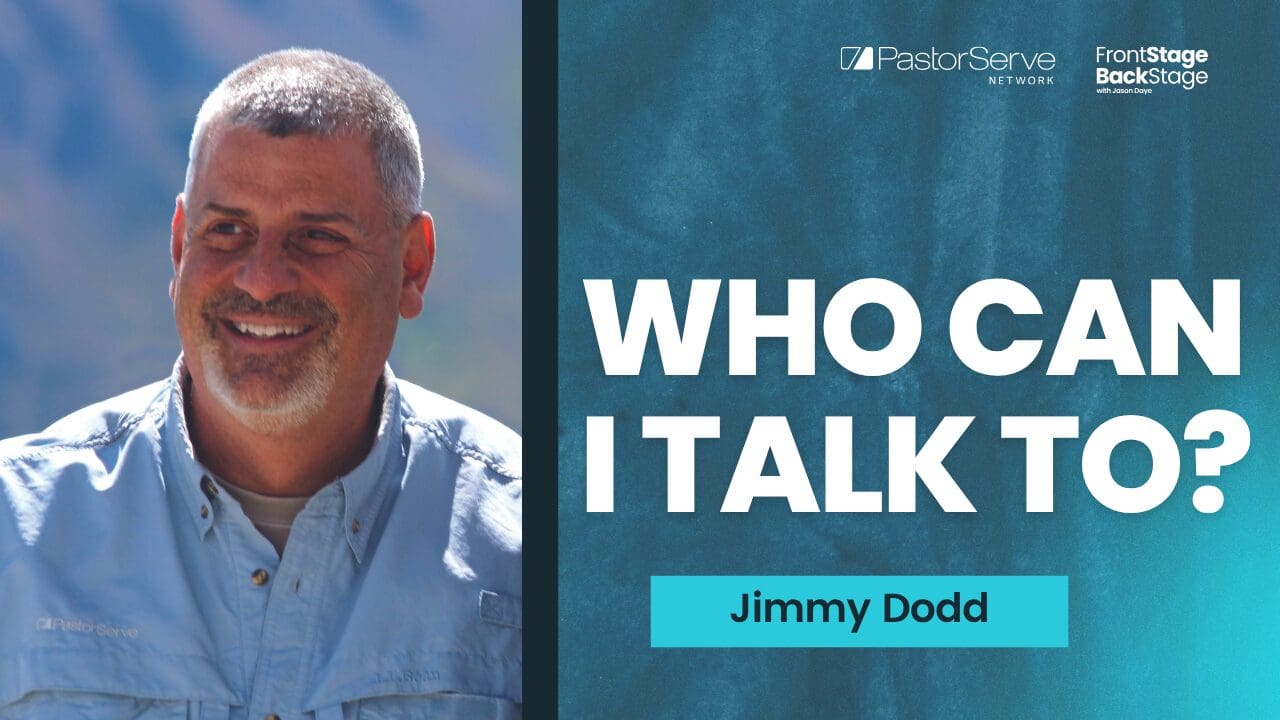
PastorServe founder Jimmy Dodd joins Jason Daye to explore why pastors and ministry leaders need trusted people to turn to before ministry challenges become crises.
What happens when a pastor needs help but doesn’t know who to trust? In this week’s conversation on FrontStage BackStage, PastorServe founder Jimmy Dodd joins host Jason Daye to explore why pastors and ministry leaders need safe people to turn to before challenges become crises.
Ministry can leave leaders carrying things they are unsure how to name or where to take. It may be conflict, feeling stuck, strain in a marriage or family, leadership pressure, or something far more serious. Yet the very nature of pastoral ministry can make it difficult to raise your hand and say, “I need help.”
Jimmy knows that tension personally. After years as a pastor and church planter, he reached a point when his public ministry looked healthy while his private life was unraveling. Finding a healthy path through that experience helped shape the vision that eventually became PastorServe, which for more than 27 years has walked alongside pastors and ministry leaders through coaching, soul care, consulting, and crisis support.
Together they discuss:
- Why pastors can struggle to know whom they can safely talk to
- What we risk when we keep carrying something because it does not yet feel serious enough to ask for help
- How ordinary ministry strain can quietly become something much harder to navigate
- What may be happening when the front stage no longer matches the backstage
- Why we can reveal almost everything while still holding back what we fear most
- What churches can do to make it easier for pastors to seek help before they reach a crisis
If you’re a pastor or ministry leader who feels stuck, overwhelmed, isolated, or simply needs someone outside your immediate ministry context to help you process what you’re carrying, you do not have to wait until things fall apart. Sometimes the healthiest next step is simply having someone trustworthy to talk to.
Connect with this week’s Guest, Jimmy Dodd
Weekly Toolkit
Additional Resources
www.pastorserve.org – Visit Jimmy’s biography page to learn more about his ministry journey and how he serves and encourages pastors and ministry leaders.
Survive or Thrive: 6 Relationships Every Pastor Needs – In his book, Jimmy reveals that the majority of pastors are not known-by anyone. They purposely isolate themselves from both staff and congregation so their insecurities, doubts, and failures aren’t exposed. Yet confiding in the wrong person can be a dead-end at best and disastrous at worst. Jimmy explains how those in pastoral ministry can receive ongoing support, accountability, and restoration from a boss, counselor, trainer, mentor, coach, and good friend. Discover how you can move from surviving to thriving with the six relationships every pastor needs.
Ministry Leaders Growth Guide
Digging deeper into this week’s conversation
Key Insights & Concepts
- The gap between how a pastor appears on the frontstage and what is really happening backstage is often where the deepest damage quietly takes root.
- A person’s sense of worth built on being liked and needed by the church is a fragile foundation that eventually collapses under its own weight.
- Unrealistic job descriptions do not just set pastors up to struggle; they practically guarantee failure before the work even begins.
- The calls that hurt the most for a ministry like PastorServe are not the crises themselves but the realization that many crises may have been avoided, or pain may have been lessened, but the ministry leader did not know who to reach out to when they were first experiencing the struggle.
- Confession is rarely all or nothing. People often share just enough to feel unburdened while still protecting the darkest part of the story.
- The lie that keeps people trapped is the belief that if others truly knew everything, they would walk away, when the opposite is usually true.
- Real freedom does not come from confessing some of what a person is hiding, it comes from finally holding nothing back.
- Isolation is rarely the starting point people notice, but it is almost always the soil where shame and secrecy grow strongest.
- Firing someone the moment they confess a struggle teaches everyone watching that honesty is dangerous, which only drives the next struggle further underground.
- What looks like a moral failure on the surface sometimes began as an untreated medical issue like anxiety, depression, or trauma that no one ever addressed.
- Restoration should never be rushed to serve an institution’s need to fill a ministry role or smooth over appearances or get a pastor back into the pulpit again; it has to be measured in true transformation which takes the investment of years, not weeks.
- Genuine repentance and simply hating the consequences of getting caught can look identical at first, and only time reveals which one is really what the person is experiencing.
- Restoration is first and foremost about being brought back to Christ, and only much further down the line, if ever, about being brought back to a role.
- The most healing moment in ministry care often comes with the same simple phrase: I have never told anyone this before, followed by the relief of finally being known.
- Every pastor and ministry leader must recognize that they can turn to a trusted person when they are stuck or struggling, and the sooner they do so, the healthier they become. (If you need to connect with someone confidentially, visit www.PastorServe.org today)
Questions For Reflection
- Where is the gap widest right now between how my ministry looks on the frontstage and what is actually true backstage? What is that gap costing me?
- Is my sense of worth quietly tied to being liked, needed, or admired by the people I serve? How do I know?
- Am I holding back a piece of my story right now, telling people enough to feel unburdened but not everything? If so, why am I holding back?
- What lie have I believed about what would happen if someone truly knew everything about me? Where did that lie come from?
- Who in my life actually knows the full truth of what is going on in my heart and my home, not just the polished version? If no one does, what is keeping me from that? (To connect with a trusted ministry coach at PastorServe, visit www.pastorserve.org/freesession)
- Have I been trying to treat a medical issue like anxiety, depression, or unprocessed trauma on my own, in ways that have quietly turned into something more destructive? How can I pursue deeper help for this issue?
- When was the last time I said out loud to someone, I have never told anyone this before? What happened afterward? What does that tell me about what I might still be carrying alone?
- Am I confusing hating the consequences of my sin with actually repenting of it? What is the difference in my own life right now?
- If I am honest, is my identity rooted in being a pastor or ministry leader, or in being a beloved son or daughter of the Father first? How would my week look different if I truly believed my identity as God’s beloved?
- What would it take for me to reach out for help today instead of waiting years like so many others have? What is actually stopping me?
- As a ministry team, have we created a real, proactive plan for how we care for staff who are struggling, or are we waiting until a crisis forces our hand? How can we process this with our key ministry leaders?
- How are we helping our staff and team members proactively as they develop in life in leadership? What resources are we providing for them? How might we need to reevaluate this to better care for our ministry leaders?
- Does our ministry’s HR policy make it genuinely safe for someone to come forward with a struggle? Does our culture quietly signal that confession leads to punishment? What evidence do we have either way? What changes do we need to make?
- Are the expectations we have placed on our pastor or staff realistic, or have we written a job description that all but guarantees failure? How would our pastor or staff answer that question honestly?
- If someone on our team confessed a serious struggle tomorrow, would our first instinct be restoration or removal? What would need to change for restoration to genuinely come first?
- How are we, as a board or leadership team, defining what a real restoration process looks like, versus a quick fix that just gets someone back in front of people? What would it cost us to do this the slow and faithful way instead? Do we have outside resources that we have identified for our team members to turn to in times of struggle?
Full-Text Transcript
Jason Daye
Hey, friends, and welcome to yet another insightful episode of FrontStage BackStage. I’m your host, Jason Daye. I have the distinct privilege and honor of sitting down with a trusted ministry leader each and every episode, and together we engage in a topic to help you and pastors and ministry leaders just like you really thrive in both life and leadership. We are blessed to be a part of the PastorServe ministry, and this week I am especially excited to be welcoming back to the show one of my favorite guests and a dear friend, Jimmy Dodd. Now, Jimmy Dodd is the founder of PastorServe, and he has had the privilege of walking alongside literally thousands of pastors and ministry leaders. And PastorServe is a ministry that is really dedicated and committed to journeying alongside pastors and ministry leaders, and really helping them in so many different ways. Jimmy Dodd has served as a church planter and as a pastor for many, many years. But God did something incredible in his life and called him out of local church ministry to really serve the greater church by making sure that no pastor walks alone, and that has been for over 27 years now, the ministry of PastorServe. At this time, I would like to welcome my friend Jimmy Dodd back to FrontStage BackStage. Jimmy, welcome to the show.
Jimmy Dodd
Hey, thanks, Jason. Great to be on with you. Thank you for that very kind introduction. Although when you said he’s had the privilege of walking alongside, and then you said pastors, I thought you were going to say he’s had the privilege of walking alongside me for the past five years. I thought that was going to be a little, you know, promo for you. But you’re very humble, but it has been a joy to walk alongside you for five and a half years or whatever. It’s been great.
Jason Daye
Yeah, well, thank you. The joy has been all mine, Jimmy. I’ve learned a lot from you over the last five and a half years, and our friendship goes back beyond that. Jimmy, over 27 years now, PastorServe has been doing Ministry, and it’s been a unique ministry. And every time that you have the opportunity to share the story, and I’ve been with you many times around the world, as we’ve been serving pastors and ministry leaders, and every time you get to share a little bit of the story of PastorServe, it’s always an encouragement to me, just to hear and just to see ministry leaders kind of say, “Wow! Like PastorServe is a ministry that is caring for those who care for and serve people.” It’s like one of those ministries that people really don’t think about. So, talk to us a little bit about, over the past 27 years, what exactly is PastorServe doing? What was the genesis of PastorServe? Just briefly, I know you’ve told the story a million times. But for those who may not be completely familiar with Pastor Serve, because it is a unique ministry that most people don’t think of, and it is something that impacts so many pastors and is so important when it comes to the overall ministry of the church.
Jimmy Dodd
Yeah, thanks, Jason. Yeah, I pastored for about 17 years. Pastored in Chicago, Boston, South Carolina, and then Kansas City, and I got to a point in my life of pastoral ministry where I was a very broken person. But I think I was very, and it’s a skill that’s not a good skill. It was a skill of hiding. I became very good at hiding, posing, and pretending. My problem was that my self-worth was very much in the church. Self-worth was very much I want you to like me. I want you to think I’m there for you. So church grows quickly. We spin off daughter churches. It’s a great ride, but the frontstage and the backstage don’t match because on the frontstage it looks very good. On the backstage, I’m arrogant. I’m prideful. I’m fearful. I’m jealous. I’m envious. On and on, which just led to a pathetic work schedule, not being a good husband, not being a good dad, and then there was just a crisis point. And the crisis point was my son, Mark, who at that point was about 10 years old, made the statement, “I don’t know what I want to do when I grow up, but I know what I don’t want to do. I don’t want to be a pastor because I don’t want to be anything like my dad.” And God’s incredible redemption is, my son is now my pastor, so I attend my son’s church, Sycamore Church in Kansas City, which is incredible. That’s just God’s kindness. So I just came to this point of just knowing I had to make a massive change in my life. I did not know what to do. Reached out to four men and said, “It looks good on the frontstage. It is not good on the backstage.” And just had the privilege of having men pour into my life. The two primary men that changed my life were a guy named Jack Miller and then also Tim Keller. And we were all in the same tribe at that point, and Tim was a church planter about eight years ahead of me, and he was also in my group, and so I reached out and said, Help. And those guys both poured into my life and changed my life. I will be forever grateful. But I just began to see the need. Man, I wish that I would have had some place to go, very proactively, to say it’s a mess right now. I don’t know what to do. I don’t know where to go. I’m not sure who to call, and I just begin to think somebody needs to do more to care for pastors. And that was on my mind for probably two and a half years until God just pressed in, tapped me on the shoulder, and said, Launch this ministry, and I’m telling you, it’s been the power of the Holy Spirit that is growing this work because I’m not smart enough to grow it, but God has brought amazing people like you and others that have just gone to a very, very different level that I can only say it’s glory to God because I could not have ever done this.
Jason Daye
Yeah, it’s an amazing story. Now it’s been over 27 years that PastorServe has been doing the work. And talk to us a little bit about the work that PastorServe does is exactly what you’re saying. It gives pastors and ministry leaders who feel stuck, who might feel in a situation where maybe the frontstage of their life, as you said, isn’t matching the backstage. Like things might look good, and they might feel like they’re in some sort of a crisis situation. It may be just a situation where they feel stuck. Maybe they feel challenged, right? Maybe the growth of their ministry is outpacing the growth of their character. Could be that, right? Or it could be that maybe the growth of their ministry isn’t really happening. They’re questioning, hey, I’m trying to honor God, and I feel stuck. I just need someone to walk alongside me. So it doesn’t have to be something crazy or scandalous that we’re reading in the headlines. It could just be that I need someone to walk with me. So talk to us a little bit, Jimmy, about what are some of, over the last 27-plus years, our team has grown naturally. We’re all over the world now, which is crazy to think, right? I’m sure you probably didn’t dream of that 27 years ago. But what are some of the ways, Jimmy, that PastorServe is walking alongside pastors? Like, what are some of the things that pastors are experiencing and saying, Hey, I need someone to talk to, and those types of things?
Jimmy Dodd
Yeah, I mean, look, I think that there are just everyday, very normal challenges in pastoral ministry. It is hard. Pastoral ministry is hard. You have a lot of bosses. You have a lot of people that think that they have a huge voice in your life. You know, oftentimes I think that expectations are massively unrealistic. I mean, I see more and more job descriptions that you just say This is completely unrealistic. This is impossible. This can’t be done. And you know that pastors will for sure fail because they can’t live up to these unrealistic, crazy job descriptions, and so there’s a lot of work in those areas. There’s lots of work, actually, with boards to help them to know how to best care for their pastors. And I tell you, I hope we talk about some things just in this episode that pastors pass along this episode to their boards because I think the boards need to hear what we talk about. And I think that there are times in which boards can be very much aligned and very much in touch, and then there are other times that we meet with boards and they have massive, unrealistic expectations and create a situation where their pastor will fail. It’s not if; it’s when. But we do a lot of coaching of pastors, obviously. We do lots of leadership formation. We do a lot of consulting, and we love to do soul care. And I think that that’s becoming more and more of a huge part of PastorServe, which I love. And then there’s crisis work that we do, and crisis work can be things like, yeah, you know what? I feel lost, I feel incompetent, I was asked to do a wedding, and I’ve never done a wedding, and I don’t know what to do. It can be very easy calls like that, and then it can be much more serious. Where there’s been, you know, some type of a moral failure, there is an addiction, and those are the ones that really break our hearts. When we have the calls from people saying, yeah, that there’s a bigger, bigger issue. But we take those calls, and we serve, and we love those. The calls that break our heart the most are calls that come about five years late, and somebody says, “I would have reached out for help, but I didn’t know where to go.” I didn’t trust my own denomination. I didn’t trust my elders. I didn’t trust whoever it might be – my bishop or my district superintendent. I didn’t know where to go, so I called nobody, and I’ve suffered in silence for the last five years with whatever it might be. Those are the calls that are the most heartbreaking calls of all.
Jason Daye
Yeah, absolutely. You know, it’s interesting. I just had a call last week with an elder from a church, a good church, and they’re going through some challenges. They’ve had two pastoral transitions in less than four years, and the most recent one was a younger guy who was on staff in another role and actually transitioned into the lead role. And good guy, good heart, but had some challenges when he made that transition. Ended up resigning from that role. And in talking with the elder, there was some hurt and some frustration through that whole process, and in talking with that elder, and of course they found out about us after all that happened, right? They found out about PastorServe after all that happened. And one of those things that was brought up in that conversation, the elder said, Man, I wish we would have known about PastorServe in the midst of that. Because we felt if we could have had a PastorServe coach and had some conversation, even the pastor working with the elder board and with that pastor together, that it would have helped that entire situation, and he probably would not have. There wouldn’t have been the frustrations. Probably wouldn’t have been the resignation because they really, really loved that pastor, and there was so much opportunity there. And there probably wouldn’t have been as much of the pain. And that’s what’s so fascinating to me is for pastors and ministry leaders who are listening or watching right now, so often, as you said, the stories that we run into are stories that kind of come too late. And like one of the things that our team, again, across the U.S. and Latin America and Europe, you know, one of the things that we’re working so hard on is saying, Hey, listen. It’s kind of like all of us have been in ministry. I’ve pastored. You’ve pastored for years. Our entire team’s been pastoring for years. All of you who are in ministry right now, it’s like we’ve all counseled people who have had marital issues. All of us have done this, right? I mean, I can’t tell you the number of couples I’ve said, Man, I wish you would have reached out two years ago, right? I wish you would have come and talked to us two years ago, because it happens where it’s almost like you’re waiting so long that they’re informing us after they’ve already decided that they’re going to divorce one another or whatever. It’s like, let’s get it early on where a lot of help can be, and that’s really what you’re saying, Jimmy, is how can we be thinking about, proactively, some of these preventive things? The best way to take care of our health, we know this, is before there’s an issue, right? The best way to maintain our cars, right? Anything in life is taking care of things before the crisis. So, Jimmy, talk to us a little bit about the heart behind PastorServe, but helping prevent crises before they ever happen. What does that look like? And what are some things that, over the last 27 years, we’ve experienced at PastorServe, you’ve experienced, the teams experienced some of those stories, maybe even: what does it look like to get ahead of the crisis, right?
Jimmy Dodd
Yeah, gosh, that’s a huge question. You know, first of all, I would say. You know what? I would really encourage boards to write in PastorServe to include in your HR policies. It’s like, we will provide coaching and care for you. If you have any issue that you feel like you cannot talk about with us, call PastorServe. I think that should be in every HR manual. I will say to every elder board, there are times in which I think that statement causes fear, and I can understand why. But let me just address the fear. PastorServe is not the HR black hole, and so you can’t call PastorServe and say, hey, I’m in the midst of an affair. I’m doing drugs, and I’m about to do this and this and this. I feel so much better that I finally confessed this. Okay, thanks very much. Goodbye. No, if you call PastorServe and there’s, you know, I mean, it might be alcohol, drugs, gambling, pornography, or adultery. I mean, like whatever it might be, we’re going to walk with you, but we’re going to eventually walk with you into your board, your elder team, your bishop, or your district superintendent because that’s going to have to be a part of the process at some point, but we’re going to do that with you gently and carefully. And it’s a little bit bizarre, but only one time in 27 years have we had a guy who called with a massive confession. And he just said, you know, and he pastored a large, well-known church. It was heartbreaking. He said that my wife has cancer. I’m not being fulfilled by my wife, so I’m going outside of the marriage with prostitutes. I’m doing all of these things, and there’s no way that I could tell my board or my wife because she’s going to die soon, and it would absolutely destroy her at the end of her life. We pressed in consistently for a year, and just said, “Man, you know what? You’re living a lie. You’ve got to confess this. And after one year, he just wouldn’t do it. And so we just said, Okay, you know what? We’re done. That’s only happened one time. It’s amazing, and there have been guys, and there have been men and also women who’ve just said, I cannot, I can’t do this. I cannot confess this. And oftentimes, there’s some time and some work, but we just encourage them. If you’re going to really live a life of repentance, you know what? We’re going to have to talk about this. And gosh, there are lots of examples of how these things often happen. But kind of the way I like to think about this is zero, 50, 98, and then 100. So zero is a person who just lies about everything. And let’s just say, for example, that they have a drinking problem, and they just say, I don’t have a drinking problem. I don’t. I don’t drink. I don’t have a problem. I don’t drink alone. You know what? I’m a teetotaler. I don’t ever drink. It’s just an outright 100% lie. Then there’s the person, and this gets very, very dangerous, where it’s like a 50%. It’s like, yeah, you know what? Hey, pray for me because I have a problem with drinking, and so I’ve confessed a little bit to you. I’m not going to tell you everything, but I make myself feel better when I say, Well, you know what? I confessed to somebody. You know what? I have a drinking, I wouldn’t say it’s a drinking problem, but there are times when I drink probably too much, and I just want to be open with you and just very accountable. So I mean, I just want you to know that. That’s a common thing. The most dangerous thing, by far, is that 98% confession. It’s a person who comes in. It can be pornography, alcohol- I mean, it can be all sorts of things. But they say, Listen, I’ve got a massive issue, and here’s my massive issue. You know what? I get drunk all the time. I’m drunk every night. You know what? I’m a day drinker. But there’s a piece of it that’s the darkest piece of it, and they hold back because they have convinced themselves that if I confess everything to you, there’s no way that you’re going to still love me. If I confess everything to you, there’s no way that you will still walk with me. And so they believe that lie from Satan, which is just his biggest lie. If people really knew you, they wouldn’t like you. And so, in the context of that fear, people test that out by confessing a lot, but not everything, to see Okay, is this person going to walk away from me? And it might be that if we say, Listen, we love you. We’re going to walk with you. Okay, if that’s the case, I actually didn’t confess everything. There’s a little bit more. So often, over three to four times, it’s unfolded, and then at the very end. Okay, here’s that last 2% that I’ve held back for so long. But those are the dangerous things because oftentimes people feel better. It’s like, oh my gosh! I confessed almost everything to Jason. I told Jason everything about my life. I confessed everything, but you didn’t confess everything. You held back. And I think that we can become skilled at sharing so much that we have friends who are so impressed, saying, Oh man, I met with Jimmy. Man, he confessed everything to me. It was dark. It was incredible how much he confessed to me. But the truth is, I didn’t confess everything. But I’ve become very good at confessing enough to convince you that I’ve come clean on everything. And I can promise you that there are pastors watching this right now, and you have become 95% people, or even 98% people. You have confessed so much of your life and your sin, but there is that shame. There’s that deep shame that is so embedded in you; you can’t confess that last part of it because it’s the dark part. It’s the dark part of when I get stoned drunk, I go visit prostitutes. When I get stoned drunk, I walk the streets, and I touch women. Both of those we’ve dealt with in the past week at PastorServe. If you think that those are just random examples, those are not random examples. Those are very real examples. But I think that we just get so trapped in isolation, and I think that that’s where it starts. It’s isolation. And we just are convinced that I can’t tell anybody the truth about my life, and my heart breaks for those pastors because I know that every day of their life they’re miserable, they’re miserable, and they’re constantly thinking, Is today the day that they find out my secret? That’s a tough way to go through life.
Jason Daye
Hey, friends, just a quick reminder that we provide a free toolkit that complements today’s conversation. You can find this for this episode and every episode at PastorServe.org/network. In the toolkit, you’ll find a number of resources, including our Ministry Leaders Growth Guide. This growth guide includes insights pulled from today’s conversation, as well as reflection questions, so you and the ministry team at your local church can dig more deeply into this topic and see how it relates to your specific ministry context. Again, you can find it at PastorServe.org/network.
Jason Daye
So, for pastors and ministry leaders who are living in this reality, where they’re serving in the local church, they’re serving in a ministry, and yet they have this going on backstage, right? And they have this fear of being found out. How can they move to this place where they feel that there is a safe space, like with PastorServe, for example, with some place that they can trust, where they can move from the 50%, or even the 95%, the 98%, to really release that? Because, as you said, Jimmy, you and so many on our team over the last 27 years have seen the freedom. As scary as it might sound, right? Because you’re living in this, and you feel that you have to hold it back, but there’s this tremendous freedom that we’ve witnessed time and time and time again that men and women can experience. But it almost seems like, because we’ve seen this so many times, it seems like there’s no way I can move there. There’s no way I can experience a place that is safe enough. How has PastorServe, how has our team, created that safe space and walked pastors and ministry leaders into that safe space over the years?
Jimmy Dodd
It’s a great question. Yeah, and it’s one of the things I think is a mystery in one sense because I don’t think you feel it. I think that you just eventually, hopefully, actually experience it. You actually experience it, and I can think of so many examples of people just saying, All right, I cannot tell you. I can’t tell you everything, because if I tell you everything, there’s no way you’re going to want to still be my friend. I can think of a guy who was deep into the darkest same-sex attraction things you can think of. I mean, dark, dark, and he had just convinced himself, I can’t come clean. So actually, it’s in my book Survivor or Thrive. We met at a restaurant, and he confessed all of these things. And I knew. I knew it was about a 60% confession. I mean, I could just tell from his whole countenance. And after he was done, I was like, you know what, dude? Listen, I love you, and man, I’ll walk with you. I don’t think you’ve been honest with me. I think you’re scared to death to share your story because you’re convinced that if you share everything, I’m going to walk away from you. Okay, so here’s the deal. I want to assume that what you just shared with me is probably 10 times worse, because I think you held back, and I promise you, PastorServe is going to walk with you and care for you and love you. It’s a famous story now at PastorServe. He stood up in a crowded restaurant and yelled at me and said, I was told this was a place of grace. I was told that you would help me with my shame. All you’ve done is make me feel worse. And he stormed out. He walked out, and I thought, Well, that didn’t go well. And that night, he called me and said, Dude, I didn’t know what to say. He said, I didn’t know what to say. You’re right. There’s a lot more. And if you will really, honestly love me, can I have another chance? We met at the same restaurant in the same booth the next day, and I think he shared everything, and it was dark. And then he said to me, I’ll never forget this. He said, You’re one in a million. And I said, That’s another lie from Satan. I said, Listen, we have a lot of mutual friends. Here’s what we’re gonna do. I want to call these mutual friends, and we’re gonna come back here tomorrow, same booth, same time, and you’re gonna share this story with some other men that I know will walk with you. I know they’re gonna care for you because what you’re in the midst of, it’s gonna take more than just PastorServe. It’s going to take a group of men committed, and so for the third day in a row, we met in the same place, and he shared everything with this group of men, and every man said, Man, we hate the sin, but we’re going to walk with you. We’re going to love you. But he had so convinced himself, I mean, I can’t tell anybody. If I tell anybody, it’s going to be, man, they’re going to reject me. And I think Satan has so convinced people that you cannot tell this, and we get so deep in lies that we just are convinced. And what’s heartbreaking is that a lot of times, people finally convince, you know, that they actually confess because they get caught. Then it’s like, okay, you know what? I got caught, so now I have to. That makes the confession so much worse. But there’s a beautiful thing when you proactively come and just say, man, this is going to be really hard for me. But I have to confess. Now, here’s where I would stress to the elder boards: there are way too many stories of people who have come and confessed things and been immediately fired as a result. And sometimes things that I don’t think are offenses that you should be fired for, and I mean, like the extreme example was a pastor, and we were very involved in this church, so I know it’s a true story. We were deeply involved. Pastor goes and confesses to his ward. I would like to have a short leave of absence to go to a counseling intensive place with my wife to get some intensive counseling work on our marriage because I spend so much time with my secretary that I have developed a crush on her. I have not acted on this in any way. I’ve done nothing. She has no idea that I have a crush on her, but just because I’m with her so much, I have developed feelings for her. I know that’s wrong. I need to work on my marriage. Two weeks later, that church fired him, and in that community where he was fired, you know what? The word spread, and you know what the pastor said? I’m not talking to my elder board. And it’s just like Oh, it’s heartbreaking. And so I would say, “Gosh, you know what? Elder boards have a proactive plan because, you know what? If you’re in a church that has staff, especially a large staff, you have staff members struggling with alcohol, with gambling, with pornography; we could go on and on. There are some struggles. How are you going to deal with those struggles? You need to have a proactive plan. And if you’re like, well, we don’t know what to put in our whatever it might be- call PastorServe, and we can help you create a proactive plan for your staff to get care, and for people just to walk with them through these hard things. But don’t wait until the crisis, and then especially don’t wait. And then once the crisis comes, you just say, “Well, you know what? You’re done. You’re fired, and we just have to move on. Those are Heartbreaking stories.
Jason Daye
Absolutely, and I want to tag on there because, yes, you have people who are struggling with alcohol, gambling, pornography, those things, but you also have people who are struggling with financial stress that puts stress on the marriage, and we know Jimmy. You and I both know a couple, personally know a couple, who are a great couple. Both love Jesus, but just have have had recent friction in the marriage and are just trying to process a young marriage together. And to the point where there was so much stress in the marriage that the marriage was, and they both are people who love Jesus, but the marriage was having so much stress under it that potentially that marriage was not going to make it. And these are people who are serving in ministry, and literally their marriage could not have made it, right? And this is reality. This is reality, and this is what everyone watching, listening, and maybe you’re experiencing this. You could be a pastor right now who’s serving in ministry who is trying to do everything right, and yet your marriage is strained right now, and it could be just because of how you and your spouse, baggage that you’re carrying from your own lives, and you’re trying to figure life out, and your marriage is strained, and you’re trying to do everything right, but you are feeling crushed for whatever reason, and you don’t know how to process that. And you are afraid to raise your hand and say our marriage is strained because you’re trying to put on a happy face. And I’m telling you, this happens so often. We deal with this all the time at PastorServe, and people are afraid to say that because our marriages are supposed to be great. Our families are supposed to be great. We’re supposed to be awesome parents. Our kids are supposed to be incredible, and yet there’s so much strain in families, and I’m telling you, there’s fear of saying there’s a strain in our marriage because something might happen, and we’re supposed to be fantastic. And so, elder boards, church boards, I’m telling you, your staff, your pastors feel that pressure. And it may not be something crazy and scandalous. It may be just life. I mean, think of the strains that your marriages are going through, and then put the pressures of being in ministry on top of that, and trying to demonstrate that everything’s great and everything’s fantastic. They need people to talk to, and oftentimes they’re afraid to raise their hand and say, Hey, we’re having our own struggles, because they don’t know what’s going to happen. And so, if that’s you, if you’re a pastor, ministry leader who has those stresses and those strains, we’re here for you. PastorServe is here for you. Reach out to us. If you’re struggling with challenges just in ministry and navigating things. If you’re struggling with conflicts, even with staff, this is a big thing that we run into, or conflicts with people within your church, even. Jimmy, we run into this all the time. Our coaches run into this all the time. All of us. I mean, if you’ve been in ministry for more than a month, right? I mean, we all know this. You run into, I mean, ministry is with people. You’re going to run into people who are hard to navigate, and so it’s good to have someone outside that you can talk through, you can process through, because you try to confide and talk with people within the church, then hey, they might say something even without ill intent, right? They may say something that kind of gets to someone else. So, if you want to talk to one of our coaches, right? I mean, talk a little bit about some of those things that aren’t quite as, you know, how do our coaches help pastors and ministry leaders process through things that are just part and parcel of what it means to be in ministry?
Jimmy Dodd
Yeah, and you know that there are lots of coaching groups out there. There are thousands of Christian coaching groups. It’s very interesting that when PastorServe first coached in 1999, I mean, there was no other Christian coaching group. I mean, there weren’t books out there on Here’s how you’re a Christian coach. There’s a ton of them now. So we’ve been at this for a long, long time. But I think the thing that makes our coaching extremely unique is it’s not just FrontStage coaching. It’s also backstage. The vast majority of coaching, and you know what? It’s wonderful. There are some great coaches out there, but it’s going to be a lot about Hey, here’s how you grow your church, here’s how you grow your staff, here’s how you start small groups in your church, or whatever it might be. Whereas we will do those things as well, but we will also press in on what’s the state of your soul? How’s your marriage? How’s your walk with Jesus? Where are you spending time in God’s Word? I mean, we’re gonna press in on the backstage because that’s the most important place. So, I would say it is so critical for every pastor, and I think every ministry leader, to have coaching that deals with both frontstage and backstage, and I think that makes ours extremely unique. But oftentimes, as you talk through backstage, that presents a chance to be open and honest with your coach and say, there are some things I haven’t talked about. And we understand there’s guilt and there’s shame and there’s embarrassment and there are all of those things. And you know what, Jason? I mean, the ones that make me so sad are, I’m very aware that every time you have an issue, and we could go through a thousand of them. I mean, hand-in-hand is always going to be lying, right? Because it’s like, okay, I’m doing these things. I have to lie about this. I want to lie to my spouse. I want to lie to my church, and so I see pastors let go because of the moral issue of lying. Here’s what breaks my heart. There are a lot of issues with pastors that start as medical issues. It’s anxiety, depression, or PTSD. You could go on and on. It’s a medical issue, and so they’re trying to treat this issue, and so they start to take way too much Ambien, and they start to drink way too much. They start to, I mean, like to self-medicate in all sorts of different ways, and at that point, I mean, it really becomes a moral issue. But there are a lot of issues that pastors struggle with, and it didn’t start as a moral issue; it started as a medical issue. And yet, there’s even shame in, like, the medical issues, which just breaks my heart. And pastors don’t feel like they can go and say, Hey, I dealt with this one situation, and you know what? In our church, it was so dark and so awful that, as a result of that, I’ve got PTSD, and I don’t know what to do. I don’t know how I can start to self-medicate, but I’m telling you, I am dying on the inside because I’m having dreams about this now. And I’m telling you, there are a lot of pastors struggling with PTSD because of things that they’ve had to work through with other people and with other couples, and at times, some horrifically dark things, but it’s undiagnosed. It can start to cause depression and massive anxiety. They start to drink as a result; they start to drink a little bit more, and then they’re found out, and the church fires them because they’re alcoholics. And you want to say, Let’s go back and really examine what’s going on. I mean, put the person on leave for a month or two. I completely understand that. But let’s dive into this a little bit, and let’s understand where this started, and the fact that so many pastors go down this road, and they-I mean, even at the very early stages- feel like there’s nobody who I can talk to. That is what breaks our heart at PastorServe because we want to care for pastors. We do all these things, but the most primary thing we do is care, and we do care. We care about you. We care about your situation. We care about your story. And if you reach out to us, you’re going to use a phrase that we have heard 10,000 times, and that phrase is, I’ve never talked about this with anybody, but… and then it comes out, and you will feel freer and lighter if you have that conversation. And we’ve got wonderful staff throughout the country, throughout the world, that would love to have a conversation with you and give you a safe place to talk about things you’ve never talked about in your entire life, but they’re destroying your soul, and you know they are. You know they are. And Satan loves the fact that they’re destroying your soul. And Satan, even now, is just whispering in your ear, “Don’t believe Jimmy Dodd, because if you tell PastorServe everything, they’re going to reject you. They’re going to say, Well, we’ve got boundaries, and you’re way outside the boundaries. That’s a lie from Satan. Let me just say, listen, after 27 years, there’s no way that you’re going to share anything with us that we haven’t heard before. Trust me, we’ve heard. So you know, you’re not going to shock us. You’re not going to surprise us. We’ve heard a lot of things; even, I mean, with AI now, we’ve already had a lot of confessions about things that people have dived into with AI that are horrific.
Jason Daye
At PastorServe, we love walking alongside pastors and ministry leaders just like you. If you want to learn more about how you can qualify for a complimentary coaching session with one of our trusted ministry coaches, please visit PastorServe.org/freesession. You don’t want to miss out on this opportunity. That’s PastorServe.org/freesession.
Jason Daye
Yeah, one thing I was thinking of doing when you were telling the story, to back up a little bit, when you were telling the story of the guy that you were talking with in the restaurant, and I was thinking of one thing as people are listening that story thinking, Oh well, that’s a one off story of a guy going through it in that confession. And bringing in a group of people that, you know, his friends that he confessed to, and walking alongside them. That story has been repeated again and again and again and again and again and again over the past 27 years, and there are people who have come and confessed. And that is one of our practices in these situations, these restoration processes, is that confession, and then we gather a group of close friends who love Jesus and love that person, who walk with them through the restoration process. I mean, and it’s a beautiful thing to see. These people who care about this person, this man or this woman, who walk with them through that process as we, as PastorServe, walk with them through this process, and you just get to see Jesus and God through this entire restoration process. And it’s just beautiful to see the beauty of the grace of God, the work of the Spirit in someone’s life. It’s incredible. One thing I do think that’s important to share is the idea- and this is just a huge part of the work that we do- is the idea of restoration, and the focus of restoration to Christ, Jimmy. And I’d love for you to talk about that idea of, and the difference between, restoration to Christ and restoration necessarily to ministry, because that is very important to us. And I’d love for you to talk a little bit about that, the importance of that, and how we approach that at PastorServe.
Jimmy Dodd
We are involved in lots of restoration processes with pastors and ministry leaders, and it always begs the question: restored to what? That’s always a big question. And we make it very clear, in this order: restored to Jesus, restored to your spouse, restored to your children, restored to your friends, you know, friends and loved ones. I mean, in that order. In some cases, restored to some type of usefulness in ministry, but the goal is not to get a person back into a place of ministry. The goal is not, Hey, I need to be back in the pulpit ASAP, so I need to go through this restoration process so I can be back up there in six months. We’ve had some large churches and some very well-known names, as you know, Jason, reach out to us and say, Would you lead a restoration process for a pastor? Because we need him back in the pulpit ASAP. And the answer is always no. No, because that’s not a true restoration process. That’s a bunch of elders saying that we’ve lost our golden goose, and we’ve got to get the golden goose back in the pulpit ASAP, or this place falls apart financially. And you know what? We want nothing to do with that. And we have turned down some huge paydays, as you know, huge paydays, because it’s like, no, that’s not a restoration plan. We have a restoration plan that is oftentimes years. We don’t even use the word repentance for at least a year. And you’re thinking, what? Why? Because we have learned that to hate the consequences and to actually repent, they look exactly the same for a time, and then time always separates them. But just this week, with a dear friend, and it’s like I’m not going to say he’s repentant because I’ve watched people jump through hoops for months, and in some cases even years, but they were not repentant. Because when you’re repentant, you understand my sin is primarily against God and God alone. Psalm 51:4, Against you, O Lord, have I sinned. And so we have a slow, careful restoration process. It’s beautiful when we get back to a point of saying, we believe that this person probably shouldn’t be back in the same role, but there’s a place of usefulness in ministry, and it’s not a short process. I think of a guy named Tom who was in our process. He is, I mean, he is now back in ministry. He’s not in the same role. It took him seven years in a restoration process. Seven years. But Jason, you know what? I hope that in nine months you’re going to have a guest on this show that’s a person that’s been in the PastorServe restoration process, and they will have come through it at that point, and they’re going to come on and talk about it. I believe that’s coming. It’s a person who’s been in our process now for about a year and a half, making unbelievable strides, and it’s going to come to a point where they will share their story. But yeah, it is not a fast process. So if anybody wants a quick fix, listen, there are groups out there. Trust me.
Jason Daye
Yeah, yeah.
Jimmy Dodd
I mean, like, I know of one group that just said We don’t need PastorServe because our pastor went through this extensive process. I said Wonderful. Could you share the name of that person who was in charge? They said, Yeah. And it just so happened that I’m very good friends with that person. I called that person. Hey, you know, I just want to check in just to make sure that you actually did a restoration process with this person. And he laughed, and he said, Jimmy, we had lunch one time, and that’s what this one church is calling a full and complete restoration process. That’s a harm to the body of Christ. And so the PastorServe process- it is involved. There are a lot of boundaries. There are a lot of reports. There’s a lot of reading. It’s hard to do it. And it’s massive accountability. Massive accountability. But man, if you go through it, God’s going to use it to radically change your life. I can promise you.
Jason Daye
Yeah, that’s what the journey is all about. Our journeys are with Christ, and we say this all the time at PastorServe. We say first and foremost, you’re a beloved son or daughter of the Father, before you’re a pastor, before you’re a ministry leader, before you’re anything else, and that’s our identity. Our identity isn’t wrapped up in the fact that we’re a pastor, the fact that we’re a worship leader, the fact that we’re a minister. Our identity’s wrapped up in Christ, and that’s first and foremost, and that’s how we serve at PastorServe, and that’s the focus. So, yeah, we would love to serve you. If you are watching, if you are listening, and you’re facing any type of struggle, any type of challenge, and it could just be like Jimmy was saying, it could be something where you’re just serving at a local church, and you’re like, hey, man, I I would love to have someone else to bounce some things off of, to process, to grow, to develop. I’m looking to develop myself in ministry. Our team would love to talk with you. The thing that Jimmy mentioned that I absolutely love is that we do, you know, the frontstage. We do the kind of ministry coaching that you see all over the place. But we almost, as Jimmy was saying, we refuse to just do the frontstage stuff, the ministry stuff, without doing the backstage stuff, because it all ties together. It all ties together. So, if you’re interested in talking to one of our team members about just a challenge you’re facing, you want to just have a conversation, or if it’s something deeper, if there’s something you are going through, and it’s something deeper, and you want to have a safe third space, someone trusted, one of our team members would love to talk to you. You can reach out at PastorServe.org/freesession to have a conversation with one of our trusted ministry coaches. They’d be happy to have a conversation and start to unpack some things with you. Again, PastorServe.org/freesession, or you can call 877-918-4746. If you want to learn more just about our ministries, all the things that we get to do, as Jimmy mentioned: leadership formation, soul care. We do soul care retreats, which is awesome. We get to do those not only across the U.S. but in Italy. I just had the opportunity to do them with ministry couples from across Europe. We do them across Latin America. We have a team in Haiti that does them. Does amazing work in Haiti as well. PastorServe.org. You can learn about all the different ministry things that we do: staff and culture assessments. We work, as Jimmy mentioned, with elder boards and church boards, which is a huge ministry that we get to do. Sabbaticals. We help coach you through sabbaticals if you’re taking a sabbatical. We work with elder boards, church boards, and help them understand the importance of a sabbatical. That’s a big thing that we get to do, so lots of different things that we do to help serve pastors and ministry leaders. That’s our heart. We’ve been doing it for over 27 years. Jimmy, as we’re closing down this conversation, it’s been absolutely incredible and very, very helpful. What encouragement do you have for men and women who are serving on the front lines of ministry? What words would you like to leave with them?
Jimmy Dodd
Yeah, thank you. Gosh, I would just say that there’s one person watching right now, and you’ve tried a couple of times to click off this, but something just compelled you to stay on and listen. And a couple of times in this conversation, you’ve had a little tear in your eye, and you just thought, I know I need to take a step, but I’m so close to being okay. I don’t think I need to. And you’re playing the 98% game. And I think it was Spurgeon who said, the challenge is not to find out what’s right versus wrong. The challenge is to find out what is right versus almost right. You know, it’s that last 2% that’s killing you. And I would say, if that’s you, reach out to PastorServe today. We’re going to care for you. We’re going to love you. It’s not going to cost you anything. We just want to walk with you. And I would just say, call and get a free coaching session. Call PastorServe. We care. We genuinely care, and our hearts break that so many people are walking through this in complete isolation. Please come out of isolation. Reach out and just say, Man, I’m a 98% person. I’ve been there, and there’s a final 2% I can’t trust with anybody, but it’s killing me, so I want to trust you. And I’d say, please call us.
Jason Daye
Absolutely, love it. Pastors, you can register for a complimentary coaching session at PastorServe.org/freesession, or you can give us a call at 877-918-4746. Please be sure we’re here. Care about you, love you. Jimmy, as always, it’s a pleasure to hang out with you. For those of you who are watching or listening along, for this episode and every episode, we create a toolkit that complements this conversation. Inside, you’ll find a ton of resources, including a Ministry Leader’s growth guide. In there, you’ll find some insights and some questions that you can process through yourself and with your ministry team at your local church or ministry. You can find that at PastorServe.org/network. So please be sure to check that out as well. Brother, love you. Appreciate you. Thank you for your heart. Thank you for leading us well at PastorServe and for your love for pastors, ministry leaders, and the kingdom. Love you, brother.
Jimmy Dodd
Thank you, my friend. Always an honor to talk with you. You do an incredible job. Thank you.
Jason Daye
Thanks, my friend. God bless you.
Jason Daye
Here at PastorServe, we hope you’re truly finding value through these episodes of FrontStage BackStage. If so, please consider leaving a review for us on your favorite podcast platform. These reviews help other ministry leaders and pastors just like you find the show, so they can benefit as well. Also, consider sharing this episode with a colleague or other ministry friend. And don’t forget our free toolkit, which is available at PastorServe.org/network. This is Jason Daye, encouraging you to love well, live well, and lead well.
Recent Related Episodes
-

Posted On: September 16, 2025
-
Posted On: December 2, 2025
-
Posted On: October 10, 2022


Right-click, then select “Save Image As…” to download one of the social graphics.