
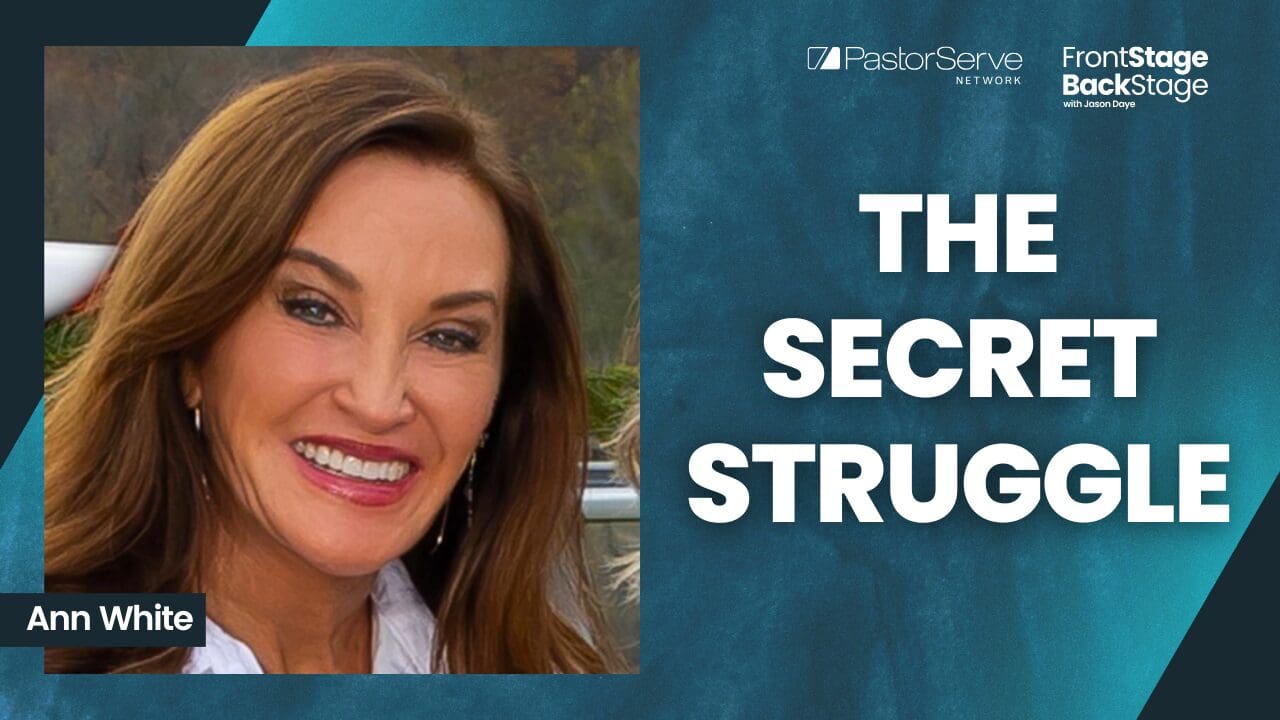
Pastors and ministry leaders often carry hidden struggles behind the scenes. Ann White shares her journey of bringing those struggles into the light and discovering healing, courage, and freedom in Christ.
Pastors and ministry leaders often carry hidden struggles that few people ever see. Behind faithful ministry can be private pain, fear, shame, and the pressure to keep everything together while continuing to serve others.
Author and founder of Courage For Life, Ann White, joins host Jason Daye to share her deeply personal story of confronting hidden struggles and discovering the courage to bring them into the light.
During a pivotal moment while traveling in Israel, Ann found herself overwhelmed by the reality of her situation. In a quiet hotel hallway, she made the courageous decision to step out of secrecy and begin telling the truth. That moment became the beginning of a journey toward healing, restoration, and freedom.
Together, Jason and Ann explore:
• why many pastors and ministry leaders feel pressure to hide their struggles
• how shame keeps ministry leaders trapped in secrecy and isolation
• the courage it takes to bring hidden struggles into the light
• the real fear pastors face when honesty could impact their role in ministry
• how receiving and extending grace opens the door to healing and freedom
This conversation will resonate deeply with pastors and ministry leaders who carry private struggles while faithfully serving others. If you have ever felt the tension between what others see and what you are actually experiencing, this episode offers encouragement, wisdom, and hope as you take steps toward honesty, healing, and freedom.
Connect with this week’s Guest, Ann White
Weekly Toolkit
Additional Resources
www.courageforlife.org – Explore Ann’s website to learn more about her ministry and her book, and access thoughtfully designed resources to help you grow in your relationship with God.
Courage For Life: Discover a life full of confidence, hope, and opportunity! – In her book, Ann shares with authenticity and raw emotion the story of how she walked away from a life steeped in dysfunction to a life restored in God’s grace. With honesty, kindness, and vulnerability, she provides step-by-step direction and proven guidance through seven intentional, doable steps that will ultimately alter your life, no matter what difficult situation you’re experiencing.
Ministry Leaders Growth Guide
Digging deeper into this week’s conversation
Key Insights & Concepts
- Everyone carries baggage from their past. When unaddressed, this can contribute to present-day struggles. Bringing one’s true heart before the Lord, rather than stuffing pain or attempting to hide the brokenness that comes from sin, is a path to experiencing the healing and freedom believers have in Christ.
- Discipleship is not simply a matter of head knowledge, but of full-life engagement with God and others. Pastors and ministry leaders do well to engage in ministry training. Yet they must be especially diligent not to neglect, or attempt to hide, the backstage of their lives in doing so.
- Shame is a weapon the enemy uses. Many times people feel afraid to truly be known in church, perhaps out of fear of judgment or rejection. But church should be the safest place for broken sinners to go; it is the place where believers should be able to be most real.
- Leaders can sometimes adopt a pattern of isolation out of fear of being judged, fear of losing their ministry, or an assumed responsibility to appear a certain way to reflect well on God. Yet this hiding is damaging for leaders who end up further isolated or mired in shame. It’s also damaging for others in the church.
- Attempting to appear perfect creates a barrier for others. When leaders put on a mask, those under their teaching experience something false. This creates a cycle in which leaders feel further pressure to pretend and others feel increased pressure to perform.
- Courageous faith is choosing to do what God says, even when it feels risky, and trusting Him with the outcome.
- Sharing one’s reality, past and present, with another trusted believer is a first step in becoming real. Letting others know the backstage story can have a powerful impact on the sharer and on his or her ministry.
- Making the bold step of sharing the reality of one’s life, especially when it feels like a mess, requires courage. Pressures to be perceived as perfect, fear of negative consequences, prior bad experiences, shame, and the like can hinder a ministry leader’s willingness to be fully honest with someone else. Yet allowing oneself to be known is key to fully experiencing the love and healing of Christ.
- Healing from past wounds so as to better engage with one’s present-day realities often requires assistance from someone like a counselor. In counseling, it is important to remember that a person can only control him or herself, not anyone else. Counseling might be helpful in identifying and exploring wounds, exposing false beliefs, embracing scriptural truth, extending compassion and forgiveness to others, growing in trust of God and others, and learning to establish appropriate boundaries.
- Believers, including pastors and ministry leaders, were not meant to live the Christian life alone. Genuine, transparent fellowship with other believers is vital to fulfilling the “one anothers” of Scripture, experiencing the fullness of Christ, and reflecting the truth of the gospel to the world. Living with such honesty requires willingness to walk alongside one another in grace, and this requires both receiving and giving grace.
- Learning to live with courageous faith requires commitment to change, identifying and overcoming obstacles to that change, replacing worldly lies with scriptural truth, and embracing a life of grace.
- Courage and commitment are daily choices.
Questions For Reflection
- Am I aware of my emotional wounds and scars? What baggage do I carry? What healing have I experienced? How do those wounds, and that healing, continue to impact me?
- How do I tend to process my pain and brokenness? Have I been taught to hold everything in? What does it look like for me to engage personally and honestly with God over my brokenness–including both when I have been hurt by others and the brokenness of my own sin? Might I need to seek help in processing? If so, from whom?
- Who do I trust in my life? With whom do I share transparently? If I can name someone, how I am intentionally investing in this relationship? If I cannot name someone, what would it look like for me to foster this type of relationship? What step can I take this week toward that end?
- How do I react when others share vulnerably and transparently with me? How can I foster an attitude of grace, rooted in the truth of the gospel? How can I welcome others with the love of Christ and also point them to His truth?
- What is the general culture of our church when it comes to engaging honestly and deeply with one another? Is our church characterized by grace, mercy, and truth? If so, how can we continue to encourage this posture of honesty and humility? If not, how can we create a culture that more readily reflects Christ?
- What about my life am I most tempted to hide? What masks am I most tempted to put on? Are there certain situations that especially tempt me to wear a mask? What one step could I take this week to begin to engage more honestly in these areas?
- Do I fully embrace the truth of the gospel for myself? How do I demonstrate that in the ways I lead? How do my actions encourage others to embrace the reality of the gospel and engage in whole-hearted authenticity with God?
- Do I feel pressure to have it all together? If so, what are the sources of this pressure? What biblical truths speak into this pressure?
- Does our church engage in whole-life discipleship? How are we encouraging believers in both their knowledge of God and their experience of true life in Him? How are we as a community reflecting God’s love and truth to one another?
- Are my fronstage and backstage in alignment? Who knows the real backstage of my life? Do I encourage others to be honest about the backstage of their lives?
- How do I identify trusted believers? What does it look like for me to have discernment and right boundaries while also not getting trapped in isolation? How can I help others in my congregation do the same?
- What are some obstacles to my ability to live with courageous faith? What steps can I take to begin to overcome these?
- What false beliefs tend to trip me up? Where does the Enemy most engage my shame response? How can I embrace scriptural truth instead?
- Is there someone in my life whom I have not forgiven? What would it look like for me to embrace a posture of understanding toward this person?
- What about this podcast most impacted me? Is there a step of courageous faith God is prompting me to take? Is there something in my ministry that needs to change? Do I know someone who would benefit from listening to this podcast?
Full-Text Transcript
Jason Daye
Hello friends, and welcome to another episode of FrontStage BackStage. I’m your host, Jason Daye. Each episode, I have the privilege and the honor of sitting down with a trusted ministry leader, and together we tackle a topic in an effort to help you, and pastors and ministry leaders just like you really thrive in both life and leadership. If you’re joining us on YouTube, please give us a thumbs up and drop your name and the name of your ministry in the comments below. We love getting to know our audience better. We’ll be praying for you and for your ministry. And whether you’re joining us on YouTube or your favorite podcast platform, please be sure to subscribe, to follow, to do all the things. Share this with someone else. We do not want you to miss out on any of these great conversations. And I’m excited this week, I’m joined by Ann White. Ann is an internationally known author, speaker, Bible teacher. She is the founder and CEO of Courage For Life, an incredible ministry. And at this time, I’d like to welcome Ann White to the show. Ann, welcome to
Ann White
Hi Jason
Jason Daye
Yes, well, hello, hello. Welcome to FrontStage BackStage. So good to have you with us.
Ann White
Thank you for having me. It’s a pleasure and an honor to be here.
Jason Daye
Yes, yes, yes. Very excited about this conversation. And we know that people in general, we struggle with this, this concept of shame. It is just something that we don’t like our dirty laundry to be aired, right? That’s just kind of human nature. And even more so, I think those of us in ministry, even more so, right? We keep things hidden. We keep things close. And that is, we know, one of the tactics of the Enemy — tries to keep that shame as a big, as a really big part. It’s a weapon used against us, keeps us from experiencing God’s best in our lives. And that can be a challenge. We’re going to talk about that today, and you, you have shared, in fact, your life’s work in many ways, your ministry, Courage for Life, really, you’ve dedicated your life to helping people overcome a lot of that in their lives so they can experience God’s best. And you’ve, you’ve done that really out of your own journey, your own story. And so I’d love to start there, if we could, and if you would, if you would share a little bit of your own story with us so we can better understand this, this idea of shame, and how we can overcome it through the power of Christ.
Ann White
Certainly Jason. And you know, I don’t think any of us escape our childhood or our teenage years without some scars, some mistakes, some stumbles. And we carry that baggage with us throughout life, unless we unpack it, unless we know how to process it and how not to let it hinder our current circumstances and our future, we just continue to build those, really, obstacles in our lives. So for me, I wasn’t saved till I was 19. And I had a very dysfunctional childhood, so I really packed a lot of baggage in those 19 years that Satan could use his darts and his just condemnation. For me, throughout those years, what I learned as a child was, you stuff it, you don’t show it. My mom was very codependent. My dad was a very strong personality, and had some abusive in his past, but also brought it into our lives. And so my mom was always the one who tried to just make everything work together. She was what, who I saw. Not only dad is a leader, but mom was a leader in that she helped the household run. She protected us, you know, from a lot of that harm at times. But in doing that, she really taught me to stand up strong, but hold everything in. I never shared anything with my friends at school. Rarely had them come over to spend the night, that sort of thing. So when I was saved at 19, I really had a change of heart, a change of direction, but I didn’t have a change of life, per se. My “want tos” changed, but I really didn’t know what was next, and I wasn’t being discipled. So I spent the next, probably 20 years, just kind of floundering in my faith, doing all the things we do with raising a family, being married, young married, so forth and so on, supporting my husband’s career, having a career of my own. And it wasn’t until I really got to the end of myself, continuing to carry that baggage, and realizing that I was broken to the core inside, and that I was not being useful in my current relationships, or even in my work, that I was doing by that time at church. So I say that to say this, there can be a pattern of isolation. That was me. You don’t want to share your dirty laundry because you’re afraid of being judged. I’ve often said that church and our Christian congregations should be the safest place for broken sinners to go, but so often it is the last place they want to go because they are afraid of being known. And as leaders, I think we have that even at a greater sense, because we feel like we have to put on this good front for the Lord. We have to do this so that other people will come alongside and feel like they can come in. But what it does it creates a barrier for those who sit under our teaching when we’re not transparent, and we’re not real, they really begin to feel like, well, there’s no way I could live up to that, because it’s not real. What they’re looking at is kind of like what we see on social media, seeing only the best, seeing nothing of the reality.
Jason Daye
Yeah, that’s so true, and it’s interesting, because we create the cycle almost. We feel like we have this expectation that we have to have it all together, and then we’re creating this false reality that everyone else thinks, oh, well, we need to somehow have it all together then. And like you said, that the church is the place where everyone should be able to live in their brokenness and find that healing. And in your own story, you come to a point where this all kind of comes to a crescendo, in a way. Can you talk to us a little bit about that experience for you?
Ann White
Certainly. So as I began to get desperate for the Lord … and you know, things in my relationship with my husband weren’t going well, was having a difficult time with our older son, who was going through a really rebellious stage in his teenage years, and, you know, just really seeking hope and help and just Okay, God, what? Where can I find you? I began to study His Word. I began to sit under the teaching of Kay Arthur, and I began to see that my relationship with the Lord and His Word, how His Word would build strength in my life and hope. And so I spent about 10 years really diving into God’s Word, and I began teaching His Word, began going to seminary, and just hungry and thirsty, right? But even at that point, I was not dealing with the emotional baggage that was still being drug along through the whole process. It was in 2012 when I really, well, I would say not I, the Lord allowed me to get to the end of myself. I mean, I was literally at the end of my rope. My marriage was struggling severely. I didn’t know what to do next. You know, there was just nothing but arguments at home. But yet, I’d go into church, and I would teach, and everything’s wonderful, right? Everything’s beautiful. We are the perfect, little happy family. I remember it was, and I talk about this in my book Courage For Life. I really give that transparent story, because I’d been hiding for years and years and years, and we had been great friends with our pastor and his wife at that point for 15, 16 years, traveled with them so forth. So I’m in Israel with my oldest son, praying that he gets saved. Okay? God just radically change him, right? And this is, this is what this trip is all about. But when I’m there, I’m broken inside, and my personal life is falling apart. And I finally, we’re actually in a hotel room overlooking the Sea of Galilee, and that night we came back in from touring, I just collapsed on the floor. I literally just laid out prostrate on the floor and said, God, I don’t know what to do. I don’t even know how to take the next step. Will you please just tell me? Where do I go from here? And the Holy Spirit spoke to me in no uncertain terms and said, I want you to write down the reality of what’s going on in your life and what you’re dealing with on the hotel letterhead, and I want you to take it to your pastor and his wife. And I did, and that was the beginning of my walk of courage instead of fear and choosing to do what God says, not being worried about the outcome. Because to me, that is true courageous faith. Courageous faith can be defined by taking a necessary risk and trusting God with the outcome. So that’s what I did that very night, I wrote down my past, my present, and everything that was going on, on front and back of several sheets of little note paper that was there, and I carried that down to their room. I speak of that in the book, and telling about the just being almost, you know, resolute. And it was just almost in a trance, because had I have stopped to really even allow myself to doubt or think through this at all, I wouldn’t have done it. So I just went down the hall, I got in the elevator, I went to their floor, I went to their door, knocked on the door. Janet answers the door, and I said, here, I need you to have this, and I need you to pray for me. And she was, she’s her cheerful self, inviting me in. And I’m like, No, I really need to go back to my room. I just need to give you this. And I left. I mean, it was just that abrupt, right? And so that really was the beginning, the turning point of becoming real, letting someone in my life know what a mess I was, and it really changed the course of my life. And God has used that story, that experience and the counseling that came after that to make a powerful impact on the lives of those we minister to, leaders all the way down to inmates throughout 38, 39 prison systems in the United States.
Jason Daye
Hey, friends, just a quick reminder that we provide a free toolkit that compliments today’s conversation. You can find this for this episode and every episode at PastorServe.org/network. In the toolkit, you’ll find a number of resources, including our ministry leaders growth guide. This growth guide includes insights pulled from today’s conversation as well as reflection questions so you and the ministry team at your local church can dig more deeply into this topic and see how it relates to your specific ministry context. Again, you can find it at PastorServe.org/network.
Jason Daye
Wow, wow. And now, now I don’t, I don’t want to miss this because, and here you are at that point when you’re in Israel. You are someone who’s serving in ministry actively in your local church
Ann White
Absolutely.
Jason Daye
Right. You’re someone who is, I mean, you’re leading women in Bible study. You are, you’ve been going to seminary. You are, I mean, you’re, you’re all in. Like, you’re not just someone who’s showing up at church. You’re someone who is serving actively in ministry, and you’re doing what I’m sure a lot of people who are watching or listening along can resonate with this. You’re doing all the ministry things, but you know that there are things that are on the backstage of your life, right, that are … your front stage is looking good. Everyone’s looking at your front stage. You got it all together. On the backstage, things are a mess, right? Things are, things are crumbling. And you know this, but not everyone else knows this. And so you’re in this moment, you’re in the hotel room, and you’re having this experience with the Holy Spirit. And you know, this is a moment that I’ve got to be obedient. And you write this all out. You walk down the hallway, you give it to a dear friend. Right, you know? And say, Hey, here’s, here’s the back, here’s what’s going on the backstage of my life right now, and you walk away and in that – that took a lot of courage, as you said, fortunately, you didn’t stop to think about it too much, because you might have, might have talked yourself out of it, right?
Ann White
I would have 100% yes.
Jason Daye
So help us understand because that is a big, bold step that a lot of people, I’m sure, have gotten close to taking but then back out, right? So how do, how can we make the walk down the hallway in the hotel and hand over that paper? How, since then, have you helped other people that you’ve ministered to to take that courageous step? What are some things are holding us back? And how do we overcome some of those things so we can experience that same first step toward the freedom that Christ wants in our lives?
Ann White
Great, great question. Because yes, I was, I was serving on Sunday mornings, I was teaching two in depth Bible studies in the mornings. I was teaching in the afternoons, teaching teachers to teach the Bible, right? You know, giving, giving, you know, just encouraging them and lifting and building them up. I was working with another seminary professor in that respect at our church. And on Wednesday nights, I mean, I was all in and but no one knew the brokenness that I had. And so yes, in that moment, I would have changed my mind if I’d allowed myself to even go there or think. But I knew so I was resolute. So the first step. How do we take those steps? The first step is we have to make a commitment. You know, courage is not something we get and we wake up, and then from now on, we’ve got it. Every single day, it’s a choice. Do we, are we going to have a courageous faith, or are we going to simply go through the motions and put on the pretty face and, you know, hope that people don’t see what’s on the backstage? As I was going through counseling, because my, the next day, I’ll tell you what I did the next day. As I got up the next morning, and my son and I go down to breakfast, we, you know, I set us over way far away from anybody that I knew, and the whole church crowd was there, right? But I definitely sat away from our pastor and his wife. And then we get on the bus, and we’re headed to Gideon springs. And, you know, we get there. And of course, I’m, you know, come on, Blake, let’s get in the back of the bus, backseat Baptist. But I was a backseat bus rider, and a Baptist at the time. So, long story short, we get to Gideon springs, and I avoided Johnny and Janet like the plague. I really did. It was like, I don’t want to see them. I feel like the Emperor with no clothes on, right, right? So ashamed. And you talked about shame. That is one of the key things that Satan uses against us. You go all the way back to Genesis, Adam and Eve, they fall into sin. What do they do? They’re ashamed. They hide from God. So I was hiding. And so it was Johnny and Janet who sought me out and and just forced me to face them and said, We love you. You know we love you dearly. Doesn’t matter what you, where you are, what you’re going through, what you’ve done, what you’ve been through, none of that matters. We love you unconditionally, and we’re here for you. We will help you get help in any way that we that we need to. And so fast forward a little bit. All of that began. I went into some in depth counseling. My husband, as a courageous man that he is, thank God, wanted to heal our family and heal himself as well. We both came from broken backgrounds, so he joined me. We went into counseling and, but I really focused on myself, because I can’t change someone else. I’ll talk about that here in just a little bit, but I know there’s one person that I could make changes in, and that was me. And so whether my husband went with me, or whatever, I knew I had to make a change, the first step was that commitment. And as I went through counseling and came out on the other side, I said to myself, as we often do as leaders and in ministry, we say, I can’t be the only one experiencing this, although that’s what Satan wants us to believe, that we are alone in what we’re going through. We are not, matter of fact, as leaders, we are more vulnerable, I believe, than any other Christian out there, because Satan wants to take us down, because we have influence, because we have, we’re working for the Lord, and he’s after us as hard as he can go, and he will throw everything in our way to lead us off track. So I went through the counseling, came out on the other side. God said, birth a ministry. And actually, I was in the midst of counseling, when God said, I want you to birth a non profit. And I was like, this is not the time. When you’re in counseling and those wounds have been opened back up from your childhood, your teenage years. You’re really at the lowest point. It’s hard, it’s hard to even think about how you could give back in that moment. But I knew that God was telling me to birth a ministry. Didn’t know what it would look like, but I did. So I filed my nonprofit, did all of that, began praying about the name and so forth. And fast forward a couple of years, when God said, I want you to take your journal notes, which are pretty raw and pretty, you know, you do your writing and you don’t want anybody to see them, right, in your life. And he said, I want you to take those and I want you to write a book. And I was like, No, that’s not happening, Lord. But of course, it happened. And I finally came into agreement with the Lord. And I said, God, if I’m going to write this book, I don’t want to just write a book just to sell a book. I don’t want anything to do with that. What I want to do is write the book that I needed to read. And so that’s where it began. And I said, Lord, help me. I was on the other side by this point, you know, and doing so much better. I said, Help me define the steps that I took to go from fear based decision making to true faith based decisions, and the first step, and it’s all contained in the word courage, because I knew that was my message. God had given me the courage to step out of my comfort zone, out of hiding and into a world of transparency and reality, and it’s changed my life and many lives around me. So the first step in courage is that C step, which is commit to change. We have to make that commitment, or it’s never going to happen, right? Say, God, I’m putting my yes on the table. I’m going to make this change that you’re calling me to make, and I’m going to start taking steps in that way. But then we get to the O step, which is exactly what you mentioned, and that’s overcome obstacles, and through our program at Courage For Life, through the book, through everything that we do and everything we teach is we help to identify what obstacles are in the way. Are they self imposed obstacles? Our stinking thinking, our shame and self condemnation, our codependency, whatever that might look like. Is it another person in our life that doesn’t want us to change, they’re happy with where we are and who we are? There’s a lot of obstacles out there, and so whatever those obstacles are, they need to be identified and begin to break those down and learn how to overcome them, so that we can begin to make that change.
Jason Daye
At PastorServe, we love walking alongside of pastors and ministry leaders, just like you. If you want to learn more about how you can qualify for a complimentary coaching session with one of our trusted ministry coaches. Please visit PastorServe.org/freesession. You don’t want to miss out on this opportunity. That’s PastorServe.org/freesession.
Jason Daye
Yeah, that’s good, and that really helpful. And those obstacles, those are those strongholds, sometimes, those habits that we’re stuck in, that we sometimes don’t even realize that they’re habits. We just think that’s how life is. But they’re things that we have, you know, clung to, that we have to identify and then break so we can experience something deeper with God, right?
Ann White
Yes, 100%
Jason Daye
Absolutely. One of the things that I noticed as I was reading through the book and just reflecting back and thinking about all the conversation in my own life in ministry, all the conversations that I have and our team has with pastors and ministry leaders, is the propensity that we have, especially in ministry. I mean, this is common with everyone, but in ministry, like you’ve said, it kind of intensifies a little bit, this idea of covering things up, because we want to put on the good face. We want to make sure that you know we’re looking good, just this idea of protecting, talk to us a little bit about that, this covering, things up. What’s what’s going on there? How do we, how do we address that? How do we identify that, and even make ourselves aware that that’s really what we’re doing? We’re covering things up in our lives.
Ann White
Well, I think we have to, we really have to break it down. I looked at all the masks that I was wearing, and I talked about that as well, you know, and kind of just going through what masks are we wearing as we’re going into public, as we’re going into church? But let’s talk about why we wear those masks, because, especially in a Christian community, we are afraid of being judged. We’re afraid of losing our ministry, and we really, at the heart of who we are and what we want to do, we want to serve God, and we want to serve him well. So we want to to do everything right that we can. But we’re human. We’re human, and we have an enemy that’s after us at every turn. And so as we go through this, we’ve got to really have others around us to help us, others we can trust. I call them safe sisters for me, safe, safe brothers, safe brothers and sisters in Christ, that we need to surround us, to help us with accountability, and to be able to be real with. We have to have those people in my life, in our lives. I didn’t have that at the time, and so that fear of being known, that fear of being judged and being rejected or losing something, whether it be the ministry, for example. I had no clue, once I revealed that to my pastor, if I would be teaching again, you know.
Jason Daye
Right, right.
Ann White
Would you? Are you going to allow me to continue teaching my classes? Don’t know that I need to be, you know, help me figure out what that’s supposed to look like. But, you know, even my pastor and his wife had been through that very same about 10 years later, of just a downfall in their life and in their ministry, and it was devastating. And I think the reason that many of us, myself, and I can’t speak for my pastor and his wife, but I I believe, the reason that they didn’t come out and say, Hey, we’re struggling, or hey, this is happening in my life, this temptation is here, is because people will leave us. People will reject us. People will strip us of our ministry. And that’s the last thing that needs to happen. What needs to happen is that grace and mercy that Jesus Christ shows, that true love for one another. And if we as pastors and leaders and ministry leaders throughout our country and the world can come alongside people who are fallen, who have fallen, as ministry leaders, instead of kicking them to the curb and saying, How dare you. That is what keeps us in bondage. And Satan loves that our pastor lost 50% of his very best friends. When this came out, they just cut him off completely, and have never spoken to him again. Didn’t even call him. And so that was shocking, because they were people. They were ministry leaders that I knew, that we were, you know, my husband and I were all so close to and so to do that is to say, well, you’re seeing that happen to this leader. Why in the world, as a leader, would you come out and say anything about what you’re experiencing or what you’re struggling with? Because I see what happened to this one. He lost everything. So I don’t want that to happen to me. I can handle this on my own. You can’t. We can’t do this on our, we were not meant or created to do this on our own. There wouldn’t be as many one anothers in the Bible, those passages where God tells us, you know, we’re supposed to be there and lift one another up, pray with one another that we might be healed. Well, we can’t pray with one another that we might be healed if we don’t know what those prayer requests are.
Jason Daye
Yeah, that is, that is so good. And this idea of grace, I think, is something that we really need to lean into a little bit more. And I’d love to hear you you talk a bit more about this, because they’re kind of two sides to grace. There’s one side of receiving grace, and sometimes it’s hard for us to receive grace even, because of the shame we feel. And so we feel we don’t deserve grace, and so we struggle with receiving it. So I’d like to hear your thoughts on that, but also extending grace. Kind of what you just touched on is, how do we extend grace to to others? So talk us through. Talk us through this idea of grace, both receiving and extending grace.
Ann White
That’s why it had it became the E step, because it is critical that, you know, embrace a life of grace. And that’s receiving grace, having grace for ourselves. To me, I look at it as three separate aspects of grace. Number one, I have to give myself grace, and then I have to receive God’s grace for me, you know, and truly receive it, and let that free me to be everything that he truly wants me to be. And so it doesn’t matter what the world says. That’s that R step reject, excuse me, replace worldly lies with scriptural truth, and we do reject those lies and replace it with God’s truth, which is healing and comforting and grace filled and loving to the core. But when you get to that E step, it’s a very important step, because once we’ve embraced grace for ourselves, we have to give it to others. And so there in my life, there were several people that I needed to have grace for. One was for my father. He was deceased at the time, but I still carried around a lot of pain and a lot of anger, you know, toward the years of hurt and the scars. And so it dawned on me, as I’m going through counseling, that I had thought I had forgiven, but I had really not let that go. You know, he was deceased at the time, and so it was time to truly let that go. But I had to embrace the grace in order to do that. And what I’m talking about is, I began to see my father as that broken vessel that he was. We’re all broken. We’re all sinners in need of a Savior. I I don’t care where we are in ministry, or how how much we’ve achieved, or how good we think we are, and how somebody else’s sin is a lot worse than our sin. No, we’re all sinners. We’re all in this together, and the quicker we can embrace that fact. When we work with people in prison, it’s the same way. All of them have been wounded in their lives. It was either family member or someone that they have trauma scars from. And what we do when we’re breaking down these steps, and we get to the E step, and I call that the forgiveness step, and they embrace grace for someone else, begin to see that person and try to learn as much as you can. What I learned in the process of counseling through other family members were things that I did not know. I knew my dad had grown up in inner city, Charlotte. He was the baby of nine kids to a very poor family. Just grew up a fighter, but his dad was an alcoholic and extremely abusive, and so some of the things he threatened to do but didn’t go through with were things that actually happened to him. And I didn’t know that he’d been beaten, tied up and beaten before. It was just horrific, the things that I learned from another family member who knew the stories, but I never knew them. So it didn’t excuse the things that happened in my childhood, and I was never beaten to like, like that, ever. It was more verbal and emotional abuse. You just never knew what you were going to get. And as a little girl, I was just scared to death of anger, and I took that into the rest of my life. And there were other things, the shame, you know, feeling stupid, you know, you’re not good enough, those sorts of things. So I say that to say, once I learned about the background and his background, I thought that doesn’t excuse it, but at the same time, helps you understand it, right? And so I really, truly began to have grace for my father. Now, he did get saved at 60 years old, and I saw a change in the last nine years of his life that was beautiful, and I talk about that in Courage For Life. But there were still the scars. I hadn’t let them go because I didn’t understand. And so I think what we have to realize is we have to either understand someone’s background that’s hurt us, or we have to assume, if we don’t know the stories, and we can’t figure out the stories, well, let’s just accept the fact that most likely, the things that they were throwing at us were things that they had endured or experienced, and possibly a lot worse than what they put us through. And so set a healthy boundary with that person if they’re still in your life, but at the same time, let it go. Let it go because they are broken to the core. Say a prayer for them. Don’t hold and harbor that anger. And we know that as leaders, but knowing it and applying it to our lives are two different things.
Jason Daye
Yeah, yeah. That’s so true. That’s so true. That’s excellent, and this has been an incredible conversation. Thank you, thank you so very much. I would love to give you an opportunity – you have the eyes and ears of brothers and sisters who are serving in ministry. I would love for you to just share some words of encouragement. What would you like to leave with them in regard to what we’ve discussed today?
Ann White
Well, I think what I would like to leave is that if you’ll take small steps. As a leader, you know the steps to take, you have that relationship with the Lord. Listen to his voice. Don’t shut him out. Don’t be afraid of what’s going to come. Have the courage to take whatever risk he’s asking you to take, and trust him with the outcome. Over the 12 plus years of ministry, that has been a new ministry for me at Courage For Life, we have worked with leaders. We’ve worked with, like I said, all the way down, you know, everyone from the top all the way to those who are incarcerated and addiction clinics and so forth, walk through those seven steps to courage and release that baggage. We know that emotional health and spiritual growth go hand in hand, and if we don’t break down the barriers, we can’t give God our best. And so we create donor funded resources that go out to the those that are the most needy, and our resources are available. God has allowed me, in 12 years, to do things I could have never dreamed of, and I was serving prior to that, doing great things prior to that, and you know, just pouring in to people for the Lord. But we’ve created two audio Bibles that are female voice for our women who’ve experienced trauma, and our men are loving that as well. We’ve created workbooks that go into the prison system, addiction clinics and so forth. And then with Tyndale, not only have we done those audio Bibles, we’ve created two Courage For Life study Bibles that are true, discipleship Bibles. Nothing I ever dreamed of being a part of. And now we’re beginning to work on a teen study Bible that has practical teaching at the bottom of every single page. So discipleship matters. We need to be pouring into others as we’re doing. But I pray that you will ask God what you need to change today, make that commitment and start taking steps in that direction, to look at what obstacles are stopping you from doing that. And let’s break those down, and let’s move forward, because God wants to truly do amazing things in our lives. And sometimes those barriers we are allowing to stay in place keep us from even taking those steps or allowing those door to open.
Jason Daye
Yeah, absolutely. And this has been an incredible conversation. Thank you so much, and thank you for your openness and vulnerability through your book, through the conversation today, certainly appreciate it. For those of you who are watching or listening along, we’ll have links to Ann’s ministry, to the resources that she mentioned, to her book Courage For Life. It’s entitled the same as her ministry, Courage For Life. And we’ll have all that in the toolkit that accompanies this episode. And we have those toolkits for every episode. You can find that at PastorServe.org/network. And there you’ll find a ton of resources, including the ministry leaders growth guide, which has insights and questions to complement this conversation, to help you and your team at your local ministry dig more deeply into our conversation. And it’s been an absolute pleasure. Once again, thank you for sharing your story and for encouraging us on how we can move through the shame that we often cling to and experience God’s absolute best and really embrace the courage that he offers us. So thank you so much.
Ann White
You are so welcome, and I really appreciate your time today.
Jason Daye
All right, thank you, Ann. God bless you.
Ann White
God bless you.
Jason Daye
Here at PastorServe, we hope you’re truly finding value through these episodes of FrontStage BackStage. If so, please consider leaving a review for us on your favorite podcast platform. These reviews help other ministry leaders and pastors just like you find the show so they can benefit as well. Also consider sharing this episode with a colleague or other ministry friend. And don’t forget our free Toolkit, which is available at PastorServe.org/network. This is Jason Daye encouraging you to love well, live well, and lead well.
Recent Related Episodes
-

Posted On: September 26, 2023
-
Posted On: April 2, 2024
-
Posted On: January 28, 2025

Right-click, then select “Save Image As…” to download one of the social graphics.