
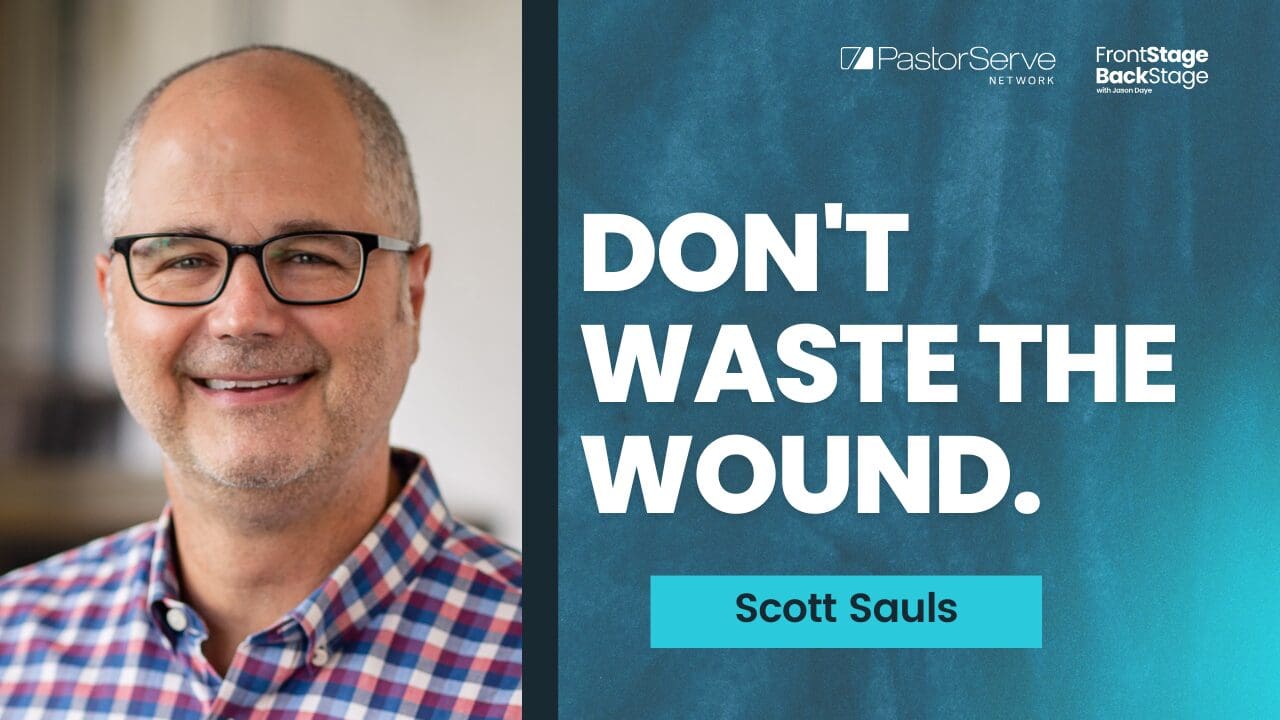
Pastors and ministry leaders often carry wounds that shape far more than their ministry. Scott Sauls shares why some of God’s deepest work happens not through our strengths and successes, but through our struggles, weaknesses, and dependence on Christ.
Pastors and ministry leaders facing ministry hurt, leadership wounds, discouragement, or seasons of suffering will find encouragement in this conversation with Scott Sauls. Together, Scott and host Jason Daye explore why some of God’s deepest work often happens not through our strengths and successes, but through our weaknesses, disappointments, and dependence on Christ.
In ministry, it can be tempting to push through pain, ignore wounds, and measure our effectiveness by visible outcomes. We often believe the next accomplishment, opportunity, or milestone will bring the fulfillment we long for. Yet many ministry leaders discover that success alone cannot sustain the soul.
In this conversation, Scott Sauls and host Jason Daye discuss a different path. Drawing from Scripture, personal experience, and themes explored in Scott’s book The Mercy King, they explore how ministry begins not by giving, but by first receiving from Jesus. They reflect on the reality of ministry hurt, the subtle dangers of defining ourselves by success, and the surprising ways God uses suffering to deepen our wisdom, maturity, and dependence upon Him.
Rather than viewing wounds as obstacles to overcome, Scott invites ministry leaders to consider how God often meets us most deeply in the very places we would rather avoid. The struggles we seek to escape may become the places where Christ forms us most profoundly.
Together they discuss:
- Why we cannot give what we have not first received from Jesus
- How pastors and ministry leaders can navigate hurt and disappointment in ministry
- The hidden dangers of defining ministry success by influence and accomplishment
- Why suffering often becomes one of God’s greatest tools for growth and wisdom
- What leaders can learn from Paul’s thorn in the flesh
- How healing and dependence on Christ can deepen ministry effectiveness
- Why some of God’s most transformative work happens through weakness rather than strength
If you’re a pastor or ministry leader carrying disappointment, ministry hurt, leadership fatigue, or questions about your effectiveness, this conversation offers a refreshing reminder that God often accomplishes His deepest work through weakness rather than strength. Scripture repeatedly reveals that God forms His servants most profoundly through the very struggles they would never choose for themselves. Whether you’re navigating ministry wounds, spiritual fatigue, or a difficult season of leadership, you’ll discover encouragement to receive from Christ, depend more fully upon Him, and find renewed strength for long-term faithfulness in life and leadership.
Connect with this week’s Guest, Scott Sauls
Weekly Toolkit
Additional Resources
www.scottsauls.com – Check out Saul’s website to learn more about his ministry and book, along with tools and resources built to support you on your journey toward a deeper relationship with God.
The Mercy King: How the Kindness of Jesus Heals Your Sin, Shame, and Weakness – In his book, Scott invites you to encounter Jesus as he actually is–gentle, welcoming, and full of mercy–and discover that it’s in your weakness, not your strength, that he draws near to heal, forgive, and make you whole.
Ministry Leaders Growth Guide
Digging deeper into this week’s conversation
Key Insights & Concepts
- We can only give away what we have, so leaders who skip their own feeding on the truth of Christ will eventually run dry, no matter how gifted they are at ministering to others.
- Scripture consistently puts identity before instruction, telling us who we are in Christ long before it tells us what to do, and ministry that reverses that order is unsustainable.
- The healthiest seasons of leadership are not always the ones with the most impressive metrics; sometimes the small, unnoticed church is doing more good for a pastor’s soul than the larger one.
- Success can quietly become an addiction, and the danger is that it often looks like faithfulness right up until the moment the body and mind refuse to keep pace.
- Pedestalizing a pastor sets them up to either believe their own press or live in constant fear of being found out, and neither outcome is healthy for the leader or the church.
- Every pastor needs consistent, professional coaching and counseling, because that kind of care costs far less than losing a leader to burnout.
- The bar we set for our pastors is sometimes higher than the one Scripture sets for spiritual leaders, and that mismatch quietly crushes people we claim to support.
- Sometimes God’s answer to our prayer for healing is not the removal of the thorn but a deeper sufficiency of grace that we would never have asked for on our own.
- Weakness is not the interruption to a leader’s calling; it is often the very place where God’s power becomes most visible and most needed.
- People trust wisdom that has been tested by suffering far more than wisdom that has only been studied, which is why leaders who have struggled often carry more credibility than leaders who haven’t.
- Recovery movements succeed where some church programs fail because they deliver transformation through lived example rather than just through content delivered from a stage.
- Coming to the end of yourself is not a defeat; it is the doorway every meaningful transformation seems to require.
- Romans 7 describes the struggle honestly, but it was never meant to be a permanent address; the freedom of Romans 8 is where a discouraged leader is invited to actually live.
- Isolation feels like the safest response to shame and failure, but it is always the opposite of what a struggling leader actually needs.
- Having close friendships inside the church you lead can seem complicated and may invite criticism, yet the alternative, complete isolation, is even more costly to a pastor’s soul.
Questions For Reflection
- When I think about my own walk with Christ right now, am I running on empty and still trying to give to others out of that emptiness? What would it look like for me to actually receive before I try to serve?
- What shortcuts have I been taking in my own discipleship lately, telling myself I’ll catch up on that later? What is that costing me right now, even if I can’t fully see it yet?
- How would I describe the version of ministry success that I am currently pursuing? Am I chasing the version of ministry success that looks impressive from the outside, more staff, more services, more campuses, without asking whether it’s actually good for my soul? How do I know?
- How are we as a leadership team managing our expectations of our pastor? Are we quietly asking them to be something closer to a hero than a fellow struggler in need of grace? What evidence do we have to support this answer?
- Where in my life have I been pleading with God to remove a thorn instead of asking Him what His grace might be trying to teach me through it?
- When I’m at my lowest point as a leader, do I tend to camp out in my own failure and shame, or do I let myself walk forward into the freedom of no condemnation? What does that tell me?
- Who in my life has earned the right to speak into my struggles because they’ve actually walked through suffering themselves? Am I letting them in close enough to do that?
- What would it look like for me to stop isolating the next time I feel like a failure? Who is the actual person I would call?
- Do I have an “expensive friend,” a counselor, therapist, or coach I meet with regularly? Am I waiting until a crisis forces me into that kind of care? What could change if I started now? (Visit pastorserve.org/freesession for a no-obligation complimentary coaching session with a trusted ministry coach)
- As a ministry team, are we creating a culture where our staff and our pastor can be honestly flawed? Have we built a system that quietly demands perfection? How can we process this with our key ministry leaders?
- When I imagine the leaders who have shaped me the most, was it their competence that impacted me most, or was it their honesty about their own weakness? What does that tell me about the kind of leader I want to be?
- How am I preaching the gospel to myself on a daily basis? Am I skilled at preaching it to everyone else, but unable to accept it for myself? If so, how can I open myself up to the gospel once again?
- In seasons when our church has been through drama or decline, have we as leaders rushed toward the next win before we allowed real healing to take place? What might we be missing by moving too fast?
- What does my inner ring actually look like right now, the two or three people I could tell everything to without fear of being rejected? If that circle is empty, what has kept me from building it? What changes do I need to make in this area?
- As a church, how are we caring for the whole person of our pastor, not just their output and performance, but their marriage, their mental health, and their walk with Christ? What is one concrete way we could improve that this year?
Full-Text Transcript
Jason Daye
Hello, friends, and welcome to another exciting episode of FrontStage BackStage. I’m your host, Jason Daye. Each and every episode, I have the privilege and honor of sitting down with a trusted ministry leader, and together we dive into a topic to help you and pastors and ministry leaders just like you, really thrive in both life and leadership. I’m excited to be welcoming Scott Sauls back to FrontStage BackStage. Scott is an incredible ministry leader. He has spent over 30 years in pastoral leadership, leading churches in New York City and Nashville, and as a church-planter in Kansas City and St. Louis. He is the founder of Healthy Leaders and the Sycamore Community. He has written a number of books, including his latest entitled The Mercy King. At this time, I’d like to welcome Scott Sauls back to FrontStage BackStage. Scott, welcome to the show, brother.
Scott Sauls
Hey, thanks, Jason. Good to be with you.
Jason Daye
Yeah, brother. So good to have you. Really excited for our conversation today. You know, Scott, I was thinking as I was reading through your new book, The Mercy King. I was just reminded how, as we enter into ministry as pastors and ministry leaders, so often it seems that our perspective of ministry is really kind of focused on this idea of activity, of striving. That’s kind of our perspective, and you kind of invite us to recalibrate a bit this invitation of really receiving. So I’d like us to really start there. To begin to think of our ministry experience, not so much just diving into the idea of striving, of activity, but what does it mean to receive? Because as we’re called into ministry, we often think of, yeah, we’re called to serve, we’re called to minister, but what does it mean for us to maybe start with this idea of receiving, Scott?
Scott Sauls
Well, we can only give away what we have. There’s no way to give away what we don’t have, and that certainly includes our walk with Christ, and it’s in there. It’s in the scriptures. Paul says in one of his letters, “I delivered to you that which I first received from Christ, and even the pattern of the New Testament letters starts with what the theologians and the grammar people call the indicatives, before they get into the imperatives. They talk about who you are in Christ, and with Paul especially, he goes on sometimes for several chapters, talking about who you are in Christ. You’re adopted, you’re accepted, you’re forgiven, you’re beloved, etc. Before he starts getting into the to-dos and how should we then live? That’s not at all to diminish the call to discipleship. That’s not at all to diminish the importance of living faithfully and seeking to imitate Paul as Paul imitated Christ, and so on, and to be imitators of Christ, as the New Testament tells us. Jesus says to his own disciples, “It is enough for the servant to be like the master”, and of course, that’s an impossible bar for any of us to live up to. But it’s certainly an important goal of growth to be aiming for all of our lives. But again, it all goes back to the fact that we cannot give people a drink of water from an empty well, and so, taking shortcuts in our own discipleship, taking shortcuts in our own feeding and self-nourishing on the truth and beauty of Christ will always bite us some sometime down the road, and it will always benefit us if we lean in and don’t take those shortcuts.
Jason Daye
Yeah, I love that. Scott, as we think of the different attributes of Christ, there’s a lot to study. There’s a lot to lean into. You have focused on this idea of the Mercy King in your latest book. I would love to hear what led you to hone in on The Mercy King, this idea of mercy, and even coupling it with this idea of the Mercy King, because I loved that as I dug into the book. What brought you to the Mercy King?
Scott Sauls
So, it is the book I’ve always wanted to write. As early as I started thinking about writing books, it’s the book I’ve always wanted to write. A book about who Jesus is and what He’s like that’s accessible to people. And the reason is that those are the kinds of books that have had the most profound impact on me. Return of the Prodigal Son by Henry Nouwen, The Ragamuffin Gospel by Brennan Manning. Both of them Roman Catholics who had a profound understanding of grace and a very practical understanding of how grace applies to the human heart and to community and so on, and both of them were very broken individuals as well. And I relate on all of those levels, and yet, Tim Keller said something. I remember this. When he was 59 years old, he came out with a book called The Reason for God, which was his second book. He’d written a book about being deacons in the church, which was really more just for the people at Redeemer and the leadership at Redeemer. But his first popular trade book was Reason for God, and I remember being there at Redeemer in New York when Tim was kind of beginning his, what some would call, author career, and somebody in the room asked him Why’d you wait until you’re 59-years-old to write your first trade book? Because for many, many years people were asking him to write books, publishers were pursuing him, etc. And he said, “I wanted to wait until I was old enough and had accumulated enough wisdom to write a book that I wouldn’t regret writing later. And so I wanted to wait until I was around 60 years old.” So I didn’t follow that advice. I think I wrote my first book when I was, I don’t know, 46 or 47. But this is the book that I’ve delayed because I believe it’s the most important book because I write more directly about Christ, and the whole book is really an invitation to know Christ and to follow Him, and I wanted to get that as right as I possibly could, and so I waited until now. But it also comes out of a season in my life where I’d spent, as you mentioned in the introduction – I appreciate the gracious introduction, spent 30 years planting churches, leading churches, and getting to serve at the church and alongside the leader that I’ve looked up to for so many years, also got to serve with Jimmy Dodd. Jimmy Dodd, your colleague there at Pastor Serve, was the first one to believe in me enough to offer me an ordained role in the church that he had planted in Kansas City. So I have all of these wonderful mentors over the course of years. But when we got to Christ Presbyterian here in Nashville, they were in a season where they needed renewal. They’d been through some pretty serious church drama and church decline over the course of about five years, and it wasn’t the first time in their history that they had been through a season like that. But the wounds were pretty fresh, and yet, it was a church that was well positioned for potential renewal, and so we got to spend almost 12 years, which would probably be the sweet spot years of our pastoral ministry. Just having the privilege of being part of a thriving ministry that was, in so many ways, moving from strength to strength for 11 solid years, and all the growth metrics. We went from being one congregation to four congregations spread throughout the city, from one service to seven services, and from a 15-person staff to an 85-person staff. So all the kind of typical church growth metrics, we were hitting all of those, and meanwhile I didn’t realize how addicted I was to all of that, and I don’t use that term lightly. There is such a thing called a work addiction. And when I was approaching the end of my time, the ministry in so many ways was flourishing, and yet internally, I was anxious. I had insomnia. I was having trouble just accessing the piece of the gospel that, for whatever reason, I could effectively help others access, but I was struggling to access it myself, and just hit a wall and had a really difficult time, especially the last six months. It’s not to say that there weren’t difficulties leading up to that, but my last six months in particular, just a lot of different factors, internally and externally, led me to the place where I knew it was time to step away, to resign, and to take a break. So, that season is now three years in the rearview, and since that time, you mentioned in the intro, I’ve started a nonprofit called Healthy Leaders Inc., which is my avenue to care for pastors. Not nearly to the degree that your organization does, and oftentimes, I will refer pastors to PastorServe because of your resources, experience, wisdom, and expertise. So in many ways I’m kind of a prelude to PastorServe for a lot of pastors who haven’t heard of you yet. But my for-profit version of that is called the Sycamore Community, and the idea for that was given to me by a friend named Donald Miller, who I’m sure some of your listeners at least would know who Don is, wrote a breakout book many years ago called Blue Like Jazz, and since that time has founded a marketing organization called Story Brand which I know a lot of pastors and church teams use their resources, as well as businesses, and such. But Don invited me to be what he called his coach. But what he really wanted was pastoral coaching and pastoral leadership that was dialed into what it means to be a founder, what it means to be a high-level leader of a large organization such as his. And that one conversation led to another conversation with another five or six leaders, influencer types, from around Nashville, which ultimately led to year one of the Sycamore community, where I had 36 founders, leaders, influencers, athletes, you know, stage performers, songwriters, etc. in a concentrated, essentially, discipleship program that has now become the main thing I do in terms of hands-on in-person ministry. I still write books, hence this podcast conversation, and still travel and do speaking at churches and conferences, and pour into leadership teams who desire that from me and from my experience. But all of that was born out of a time and a season where I just acutely felt my need for the mercy of Christ. I think I cried uncle, probably for the first time, really cried, uncle. I was able to do a lot of what many would call successful ministry, operating out of a combination of the spirit and the flesh, which is not sustainable, and so really trying to lean into spirit-only driven ministry, and so I hope I’m doing well with that. But in any event, we’re in a good place, and thankful to be able to have conversations like this.
Jason Daye
Hey, friends! Just a quick reminder that we provide a free toolkit that complements today’s conversation. You can find this for this episode and every episode at PastorServe.org/network. In the toolkit, you’ll find a number of resources, including our Ministry Leaders Growth Guide. This growth guide includes insights pulled from today’s conversation, as well as reflection questions, so you and the ministry team at your local church can dig more deeply into this topic and see how it relates to your specific ministry context. Again, you can find it at PastorServe.org/network.
Jason Daye
Yes, Scott. So, take us back to that time because when we think of Jesus as the Mercy King, one of the key elements of that is, as you’ve mentioned, and even your own personal story in ministry, none of us are immune from hurt, right? So, take us back to when we experience these hurts in ministry. What did that look like for you for Jesus to show up as the one who brings that healing? What is that experience for us? Speaking to those who are watching right now or listening right now, who find themselves in ministry. Maybe, more than likely, Scott, honestly, not in a season of outward ministry success like you’ve probably experienced. Most of us don’t experience that type of outward success, right? But experiencing a time of maybe hurt where they need that healing.
Scott Sauls
Yeah. I would say this: don’t give in to the fantasy of thinking that the ministry that I just described and all of its so-called success metrics is the answer to anything you’re struggling with right now. The healthiest I’ve ever been, and the most grounded I’ve ever been, prior to the current season, is when I was leading small churches and gutting it out, planting churches, and there’s just something about mega that I don’t think the human soul is designed for, and particularly in the American landscape. If you are the lead person at a mega church, and by mega church I mean a church over 2000 people, it is virtually inescapable for people to pedestalize you, and for you to start believing your own press. Or, if you’re more dialed into reality, for you to be living with imposter syndrome and struggling with the pressure you feel to live up and to measure up to this external standard of what a large church pastor is supposed to be. You know, something just shy of Jesus, really, in some people’s minds. Where you’ve got to be one of the best preachers in your city. You’ve probably got to have a writing career or a podcasting career as well, because that’s what large church pastors do. You’ve got to be an excellent organizational leader, which none of us were trained for in seminary. You’ve got to be emotionally intelligent. You’ve got to have unflappable poise, not get rattled, and have impeccable character. You’re set up in many ways, just by the system, to have to walk in the shoes of a hero while knowing deep down that the only hero is Jesus, and yet, how do I sustain this? And I’m sure you’ve had plenty of pastors with much more in-depth insight on this on your program, but I would just say to embrace the life of struggle, because that’s where the rich stuff really happens, you know? Read through the Bible, and I can’t think of a person in the Bible except the miserable writer of Ecclesiastes, who was winning in life by the world’s metrics. And I’m afraid that we’ve put a lot of the world’s winning metrics on the contemporary American pastor. The other group I would want to get through to on this is those who are in church leadership who aren’t the lead person. And that is just to manage your expectations and to recognize how deeply your pastor needs community and needs friendships and needs somebody other than an expensive friend. And when I say an expensive friend, I’m talking about therapists and counselors. I believe that everybody, every pastor, I believe every church elder board should support their pastor getting weekly counseling, in good seasons and in not good seasons. It’s just a great sustainability practice, and it costs a lot less than it does to replace a pastor for burnout. But let him or her be flawed. And if the apostle Paul was permitted to say things like “Wretched man that I am, I can’t get over my coveting, and you know who will rescue me from this body of death? Thanks be to God through Jesus Christ our Lord.” And if Peter can deny Christ three times and then be reinstated by Christ Himself, man, our bar is higher than Jesus in some respects in terms of what we expect our leaders to be. So, I would just say, elders, manage the congregation’s expectations, manage your own, and manage the staff’s expectations. We want a person with consistent character and consistent growth in the gospel virtues and the fruit of the Spirit, while also realizing that our pastor is just like us, needs grace, needs care, needs a break, needs forgiveness, and needs support.
Jason Daye
At PastorServe, we love walking alongside pastors and ministry leaders just like you. If you want to learn more about how you can qualify for a complimentary coaching session with one of our trusted ministry coaches, please visit PastorServe.org/freesession. You don’t want to miss out on this opportunity. That’s PastorServe.org/freesession.
Jason Daye
Yeah, I love that. I love that, Scott. That’s so vitally important, and obviously something that we agree upon, and it’s a drum that we beat often at PastorServe. As I was reading through The Mercy King, I was thinking about this idea of healing because it’s one of the things that you speak of and write of in there, and just the importance of how Jesus brings that healing, and how important that is for us to kind of slow down and allow that healing, to receive that healing, and to accept that healing. Because I think in our culture, and you’ve touched upon this in this conversation, we often want to move kind of quickly beyond the healing. I was just in a conversation literally yesterday with an executive pastor at a church, and they’ve been going through a season, multiple year season, and their elders are like looking at, hey, we need to get some wins under our belt, and we really need to focus on mission, vision, and all this stuff, and we were talking about the idea that sometimes rather than looking at how can we take the hill, we need to like circle the wagons, and focus on this idea of taking care of ourselves, and that healing is an important part. Scott, how do we need to consider this idea of healing in our churches? Where does that play into how we lead our churches, how we lead ourselves, and how we lead our churches? Where does that come in? How can we lead better around this idea of healing up and against the idea of the next thing that we need to be going after as a local church?
Scott Sauls
Yeah. I mean, Paul’s thorn in the flesh comes to mind, and his interpretation of his thorn is a significant marker for this conversation, right? He says three times, “I pleaded with the Lord for a surface-level healing, that God would take my thorn away from me, that it wouldn’t be a problem, that it wouldn’t be agitating me anymore. Three times I pleaded with the Lord, but the Lord said to me, “My grace is sufficient for you”, which is a different kind of healing. It’s easy to look at that passage and think, Well, God didn’t heal Paul. Well, yes, He did. He gave him a more significant healing than the one he was asking for. You know, in the same way that Jesus says to the paralytic before He says, “Rise, take up your mat, and walk”, He says, “Your sins are forgiven.” He gives the big healing first, and then he gives the secondary healing. Oh, also, I want to heal your body. Yeah, but that body is going to die again, and the healing you’re going to need is the first healing that I gave you when that time comes. But, Paul goes on to say, “There was given me a thorn in my flesh to torment me.” And the word “given” is from the Greek word “karizomai”, which shares the same root as the Greek word “karis”, from which we get the word grace. And so, it says to us there was grace for me. The implication is that it came from God. There was grace to me, a messenger of Satan to torment me, but it was graced to me, and so Job comes to mind, right? Where all this stuff is happening in the invisible world, where Satan is trying to destroy Job with the very afflictions that God is going to use to redeem, restore, and elevate Job. And you’ve got the same thing playing out, and that’s why Paul says, “That’s why I delight in weaknesses, insults, hardships, persecutions, and difficulties. For when I am weak, then I am strong.” When I am weak, that’s when the power of God kicks in and really rests on me. And I’ll tell you, Jason. I’ll just give an illustration. I mean, I’ll ask anybody listening how much wisdom, how much hope, how much depth have you experienced from somebody that you were looking to speak into your life who had never personally struggled in any significant way? Every single person that’s ever had a significant impact on me, on my character, on giving me hope when I felt like I was in a hopeless situation, or on challenging me to grow in areas where I needed to grow, I needed to know they’ve suffered. I needed to know that they’ve walked the path, right? That’s why the recovery movement is so effective. That’s why AA, Narcoholics Anonymous, Workaholics Anonymous, Overeaters Anonymous, or Sexaholics Anonymous. Those 12-step programs, you have non-Christians who are a lot more fruitful in accomplishing change in their disciples than Christian pastors often are, because what we do is we become masters at delivering content, and what recovery programs do is they deliver transformation by example, and the first thing that needs to happen, and it’s in the 12 steps, in the first four steps you need to basically come to the end of yourself. You need to recognize that you are powerless to change yourself. That you need a power outside of yourself, and where we would part ways, of course, as Christians, Jason, is that we definitively believe that that power is Jesus Christ. Period. And especially when we’re talking about character transformation, but there’s some kind of power there in the recovery movement where you’ve got a whole, say you’re a newbie there, you’re walking into an entire community of people who are a little bit ahead of you in this journey of what you call healing, what you call recovery, what some people call repentance, restoration, and repair, all of which are also part of this 12-step program. So, I think that all of that is translatable, and Paul’s kind of one of the OGs of this. Peter is, too. You know, where else can I go, Lord? You have the words of eternal life, and yet, Lord, go away from me, Lord, because I’m not worthy. I’m a sinful man. You are without sin, and yet somewhere in there is the answer to it all, to this healing question, which is really a transformation question.
Jason Daye
Yeah, absolutely love that, Scott. What words would you have for the pastor or ministry leader who finds themselves in that struggle, finds themselves in the midst of hurt, in the midst of pain, or in the midst of questioning? Maybe has some doubts or some uncertainties. What encouragement, Scott, do you have for them in the midst of all that?
Scott Sauls
Well, I mean, personal encouragement. The gospel is always true, and it never stops being true. You know, the indicatives are always first before the imperatives, and Paul said it himself. There’s nothing in all creation, that includes us, that will ever be able to separate you from the love of God in Christ. And I would just say, immerse yourself. I think, when we’re at a low point, when we’re at a discouraged point, we tend to immerse ourselves in Romans 7. You know, wretched man that I am. Whereas, what I think Christ wants us to do is realize Romans 7 is just a setup, you guys. Where the action is is in Romans 8, where it starts, “There is therefore now no condemnation for those who are in Christ Jesus”, and it begins no condemnation, and it finishes no separation. Nothing can separate you from the love of God in Christ. So, as the late Jack Miller used to famously say, preach the gospel to yourself on a daily basis. You become a master, you become educated, and you become very skilled at preaching the gospel to other people. Just don’t ever forget that it is equally as true for you as it is for everyone else. That’s kind of the no-brainer stuff. But the practical advice that I would say, the number one is don’t isolate, which is the most tempting thing to do. Because, typically, when a pastor feels down, feels like a failure, or feels discouraged, there’s a shame element that goes with that. There is a regret element that goes with that. And wherever there’s shame and regret, we want to go into hiding. We want to isolate. And what we need to do is the opposite of that. But it’s also important that the community we find, and that the community that we surround ourselves with in terms of our inner ring, as C.S. Lewis called it, our two or three, have to be trusted people that we can tell all to, and know that we’re not going to be rejected or turned away. And for some of us, that’s a therapist. Some of us, we just can’t find those people. They’re not immediately accessible to find a good therapist. And some would say, Well, I’m in a small town, and there aren’t a lot of good therapists, and the ones that are here aren’t very good. Then they’ve got online resources like BetterHelp.com, where you can get a really good therapist that specializes in working with pastors at a reasonable rate, on a sliding scale. So, just to find that person or that small group of people, so you’re not alone in your struggle. And the sad thing is that most pastors cannot find those people on their elder boards or in their churches. And I used to just balk at that when they said in seminary, Don’t count on having close friends at your church. And I have had close friends at the churches that I’ve led, but I also understand why they say that. And having close friends at the church that you’re leading opens up some complexities because you get other people envying those people, or criticizing you for playing favorites just because you have friends, and so it’s lose-lose. You’re either isolated and lonely, or you get criticized for the friends you have, if you’re public with your friendships. Which, how do you not be public with your friendships? But the other thing I would say is, man, take the next step with PastorServe. Don’t just listen to the podcast. Hire them. Ask your elders to support you. And if your elders won’t support you, I’m sure PastorServe has some kind of mechanism where you can get care, or be in a cohort, or benefit from life-on-life services that good organizations like PastorServe have.
Jason Daye
Yeah, thank you, brother. Yeah, and we’d be happy to, and you guys can register for a complimentary coaching session, and we didn’t ask you to set that up. Look at the website, PastorServe.org/freesession.
Scott Sauls
I’m gonna sign up for a free session myself.
Jason Daye
Yeah, do that, brother. Yeah, we’d be happy to help you guys out with that. So, that wasn’t pre-planned, but we appreciate you, brother, and we’re here to help, obviously.
Scott Sauls
I mean, I need to say this. Look, I’m one of those rare guests. I’ve known Jimmy Dodd longer than you have, probably.
Jason Daye
Oh, yeah. You have.
Scott Sauls
I’ve known Jimmy since he was in his 20s. Jimmy was one of my pastors when I was a student in college, and only later became my boss. And then after that, we’ve done some partnering things here and there with pastors and other ministry leader types. But I know Jimmy, and because I know Jimmy, I also know PastorServe really well as an organization with integrity, as an organization with skill, that has the skill to speak into, and minister and serve into the most complicated, and in some ways the most hopeless feeling situations, for those in ministry leadership. So, I don’t like the credential myself, but one area where I have good credibility is that I know PastorServe, and I know how helpful this organization has been to countless pastors.
Jason Daye
We appreciate that.
Scott Sauls
Take them up on it. Take them up on it.
Jason Daye
Thank you, brother. We appreciate that. Scott, as always, it’s a pleasure to hang out with you, brother. Appreciate your heart for the kingdom, your heart for brothers and sisters who are serving the kingdom, and your voice to the church. And for those who are listening along, The Mercy King, Scott’s latest book, is absolutely fantastic, speaks of the kindness of Christ. Beautiful book for you and for those you serve. I encourage you guys to check that out, and you can find the toolkit that accompanies this conversation, so you can dig more deeply into the conversation that Scott and I just shared, and there you’ll find a lot of resources, including a Ministry Leaders Growth Guide to help you and your team dig more deeply into this conversation at PastorServe.org/network. So, please be sure to check that out. I encourage you to look into that, and I love you guys. Appreciate you all. Thank you for tuning in. And again, Scott, thank you for hanging out with us on FrontStage BackStage. God bless you, my friend.
Scott Sauls
Thanks, Jason. Appreciate it.
Jason Daye
All right, have a great one.
Jason Daye
Here at PastorServe, we hope you’re truly finding value through these episodes of FrontStage BackStage. If so, please consider leaving a review for us on your favorite podcast platform. These reviews help other ministry leaders and pastors just like you find the show so they can benefit as well. Also, consider sharing this episode with a colleague or other ministry friend, and don’t forget our free toolkit, which is available at PastorServe.org/network. This is Jason Daye, encouraging you to love well, live well, and lead well.
Recent Related Episodes
-

Posted On: November 12, 2024
-
Posted On: February 17, 2026
-
Posted On: December 12, 2023
Right-click, then select “Save Image As…” to download one of the social graphics.