
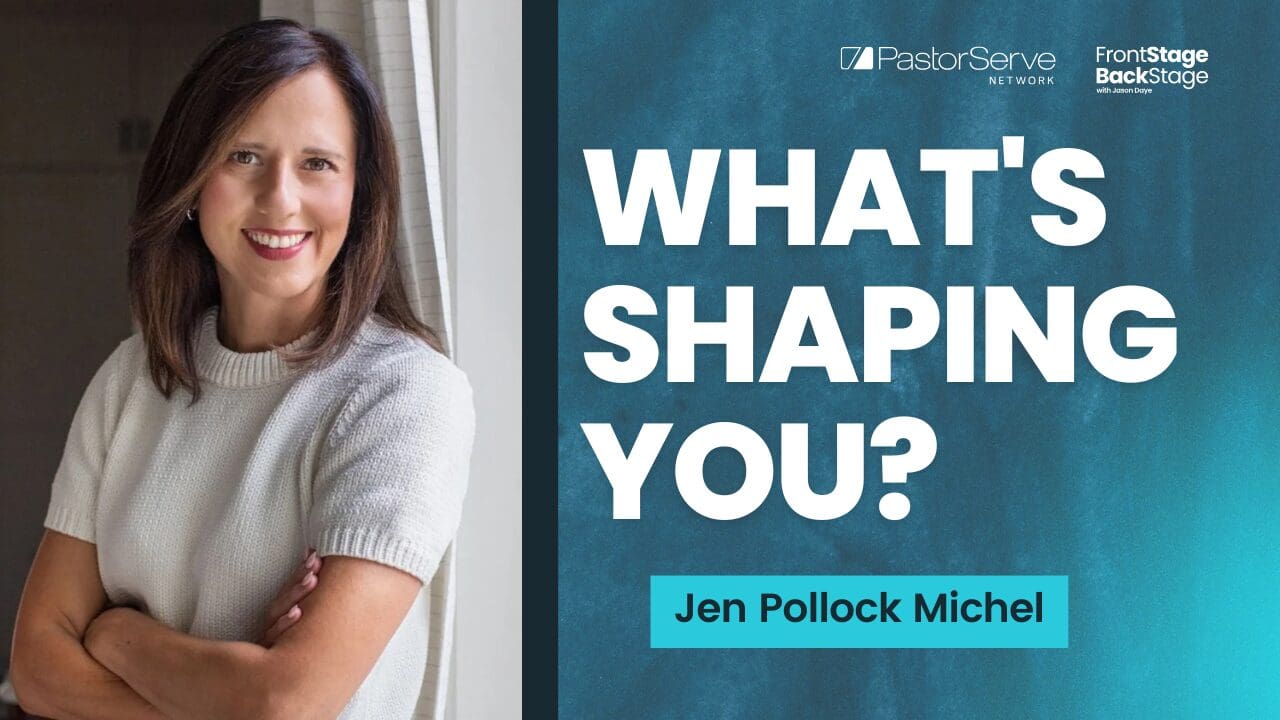
Pastors spend so much time thinking about what God has called them to do. But who are we becoming while we do it? Jen Pollock Michel joins Jason Daye to explore the often-unnoticed forces shaping us in ministry and how we can become more intentional about being formed by God.
Who are you becoming while you lead? In this week’s conversation on FrontStage BackStage, award-winning author Jen Pollock Michel joins host Jason Daye to explore how pastors and ministry leaders are being spiritually formed, often without even realizing it.
Those of us in ministry spend enormous amounts of energy thinking about what God has called us to do. We lead, disciple, preach, care for people, and respond to the seemingly endless demands of ministry. But in the midst of all that activity, how much attention are we giving to who we are becoming?
Jen is a sought-after speaker whose writing has appeared in Christianity Today, The Dispatch, and The Christian Century. She also leads retreats and workshops focused on developing a Rule of Life, and her latest book, *A Rule for the Rest of Us*, explores how we can live more intentionally as we seek to be formed by God.
Jen and Jason explore the forces quietly shaping our lives, why spiritual formation can feel frustratingly slow, and how we can resist simply drifting through ministry and life.
Together they discuss:
- Why ministry leaders can become more focused on what we’re doing for God than how we’re being formed by God
- Why productivity often feels more satisfying than the slow work of spiritual formation
- How rest can become an expression of trust in God rather than simply time away from work
- How individualism, self-protection, and our desire for comfort can quietly shape our lives and churches
- Why our phones can make us more solitary in community and less capable of genuine solitude
- How a Rule of Life can help us resist drift and live more intentionally with Jesus
If you’re a pastor or ministry leader who spends much of your life thinking about the people you’re leading and the work God has entrusted to you, this conversation offers an important invitation to consider your own formation. Faithful ministry isn’t only about what God is accomplishing through us. It also means paying attention to who God is patiently forming us to become.
Connect with this week’s Guest, Jen Pollock Michel
Weekly Toolkit
Additional Resources
www.jenpollockmichel.com – Visit Jen’s website and learn more about her ministry, book, and encouraging resources to help you know God more deeply and walk with Him each day.
A Rule for the Rest of Us: An Ancient Practice for Making the Daily Decisions that Shape Faithful Lives
– In her book, Jen shares an accessible, five-step framework for writing a rule of life, transforming this ancient practice into a grounded way of living faithfully in a distracted world. Rather than a rigid list of spiritual disciplines that can leave you feeling guilty when you fail, a rule of life offers a grounded way of living faithfully in the chaotic world we inhabit.
Ministry Leaders Growth Guide
Digging deeper into this week’s conversation
Key Insights & Concepts
- The greatest danger in ministry may be waking up years later to realize the activity of serving quietly shaped you into someone you never intended to become.
- The decision itself often matters less than the formative process of making it, since that process reveals what we already know about ourselves and about God.
- Ministry leaders are often skilled at helping others become who they’re meant to be while neglecting their own becoming in the process.
- Like an iceberg, most of a person’s life happens beneath the surface. When the visible public life grows disproportionate to what’s underneath, formation suffers.
- Genuine spiritual formation requires both hidden, private disciplines and honest community. We rarely see clearly how we’re being shaped without people willing to reflect the truth back to us with grace.
- The people who matter most in our formation aren’t those who criticize from a distance but those who ask permission to speak into our lives because they love us enough to stay committed.
- Culture teaches us to equate a productive day with a good day, but plenty of good days are unproductive, and plenty of productive days aren’t actually our best.
- Ministry carries a unique temptation toward achievement because the eternal significance of the work can quietly shift our focus from faithfully serving God to feeling responsible for what our service produces.
- Scripture consistently shows that God works slowly, whether through Abraham’s centuries-long promise or the quiet growth of a mustard seed, yet we chronically underestimate how much time formation actually takes.
- Our own spiritual growth can feel frustratingly invisible. Often, since we can’t measure it the way we measure a finished project, we’re tempted to invest less in it.
- Compulsive overwork often masks a deeper illusion, that if we stop working for even a moment, everything we’re holding together will fall apart.
- Rest is less about doing nothing and more about physically releasing our grip on outcomes and trusting that our frantic activity was never really solving the problem in the first place.
- Different people carry different postures toward the world, so trust can look different depending on whether your instinct is to lean in and fix things or to step back and let God work.
- A pervasive sense of living in an unsafe world has quietly reshaped what people expect from church, leading many to believe God would never lead them somewhere uncomfortable.
- Constant digital fragmentation has trained us to be only half present everywhere we go, so that even prayer and community start to feel understimulating compared to the noise we’re used to.
Questions For Reflection
- If I woke up ten years from now and looked honestly at who I’d become, would I recognize myself as someone shaped by Jesus or someone shaped mostly by the demands of ministry? How do I know?
- What does my visible, public life look like compared to what’s actually happening beneath the surface? Is there a gap growing between the two, and if so, what’s feeding it?
- Who in my life has permission to ask me a hard question and know I’ll actually listen? If I can’t name someone, what does that tell me? What will I do about it?
- As we think about our staff and key leaders, who are the people around them who can speak honestly into their formation, not just their performance? Are we cultivating that kind of community intentionally or just hoping it happens? What changes do we need to make?
- When I measure whether a day was good, am I quietly equating it with how productive I was? What would it mean to let go of that measurement for a season?
- Where in my ministry am I overestimating how quickly I should see results, whether in a person, a program, or in my own character? What would it look like to give that more time?
- What are the same sins, the same impatiences, the same struggles I keep circling back to? Instead of feeling discouraged by that pattern, how might I bring it honestly to God today?
- Do I have a consistent, protected rhythm of rest, or does the idea of stepping away make me anxious about what might fall apart? What does that reveal about what I actually believe about who’s holding things together?
- Am I someone who instinctively leans in to fix every problem, or someone who tends to hang back and observe? Either way, what would it look like for me to trust God more fully in that particular tendency?
- How are we, as a ministry team, structuring our calendars and expectations in ways that either reflect trust in God’s timing or quietly resist it? Is this something we should be looking at more carefully? How can we approach this process?
- What hidden forces, whether it’s a search for safety, comfort, or control, might be shaping my expectations of what following Jesus should feel like? Where did I pick those expectations up? What may I need to address?
- When was the last time I truly sat still with God without reaching for my phone or my to-do list? What does my honest answer say about my capacity for presence right now?
- As a church, are we creating space for people to practice real, undistracted presence with God and with each other? Or are we unintentionally reinforcing the same fragmented attention people already bring in from the world?
- What are the good, God-given desires I’ve been ignoring lately? What are the destructive habits I’ve been avoiding naming honestly, even to myself? What can I do with these?
- If I were to write down the values and practices that actually govern how I spend my days, would they line up with what I say I believe matters most? Where’s the biggest gap? What is one small, intentional step I could take this week to close it?
Full-Text Transcript
Jason Daye
Hello, friends, and welcome to another insightful episode of FrontStage BackStage. I am your host, Jason Daye, and it’s a privilege each and every week that I have to sit down with a trusted ministry leader, and together we really dive in and tackle a topic to help you and pastors and ministry leaders just like you, really thrive in both life and leadership. And this week, I am really excited to be joined by Jen Pollock Michel. Now, Jen is an amazing ministry leader. She has a really exciting job opportunity in ministry where she gets to travel and lead these retreats where she teaches workshops focused on Rule of Life, and she does this with hundreds of people across various life stages. It’s really absolutely amazing. She has the opportunity to contribute. She’s a gifted writer. She contributes to a number of different publications, including Christianity Today, The Dispatch, and The Christian Century. She also is a sought-after speaker at colleges and universities, churches, conferences, and retreats. She’s an award-winning author. She’s written a number of books, including her latest, A Rule for the Rest of Us. And at this time, I would like to welcome Jen to FrontStage BackStage. Jen, welcome to the show. So good to have you with us.
Jen Pollock Michel
Thanks, Jason. This is going to be great. I can’t wait.
Jason Daye
Yeah, super excited to dive into this conversation. There’s a lot of conversation really around ministry, really what people are facing in ministry, and one of those conversations has been this idea of burnout. And as I was reading through your book, your latest book, and just really thinking about what a lot of those of us on the front lines of ministry are facing, and we talk about the great dangers of ministry burnout, and I was wondering if maybe one of the greatest dangers in ministry isn’t necessarily burnout, although it’s really big out there, but maybe it’s waking up 10 years, maybe, down the road, and realizing that the activity of ministry maybe has quietly made us someone we never intended to become. Maybe that’s the greatest danger, and as I was thinking about that, Jen, I’m really curious as to what your thoughts are on that, given the work that you do so passionately.
Jen Pollock Michel
Sounds like a conversation I actually just had with somebody today. I’m in ministry at my local church, even leading a discipleship group. I lead that with a friend, and we’ve been talking with this group of young women that we’ve been leading about their decisions whether or not to continue into the next year. And we were talking to one young woman about the decision to continue or to not continue, and the difficulty of making that decision. And I was telling her that the decision is important, but what’s probably even more important is the process of making the decision. The decision, the formative process of making the decision. Like, what do you already know about yourself, about God, and about the ways that He is revealing His will in your life? What do you know about your own pitfalls for making decisions? What can you learn in the process? I think that’s sort of almost what your initial question is sort of prompting me to think about. The activity of ministry. We think about the ends of ministry, the outcomes of ministry, and the things that we produce and achieve, even though we might feel a little bit nervous about those words, and neglecting in the process who we become in the midst of that. And I think the real interest of my own spiritual life and the ministry that I’ve been doing is so much around formation. How do we become the kind of people who can carry the heavy burdens of ministry? And that could just be ministry to your family. Parenting is a burden, caregiving to aging parents, loving your neighbors, just going to a job you don’t love, or ministering to a cantankerous congregation; these are heavy burdens. How do we become the kind of people who carry, with just a deep abiding trust in Jesus, those burdens through His Spirit? So yeah, I think formation is a huge part of what I’m interested in talking about.
Jason Daye
Yeah, absolutely. And Jen, oftentimes, even when we’re preparing for ministry, going into ministry, whatever that preparation looks like, oftentimes, a lot of the focus is on the doing, the activity of ministry, and rightly so because there’s a lot involved in the ministry, right? In the serving part. But the idea of who we’re becoming as we minister. We focus a lot on the people we’re serving and who they’re becoming, right? I mean, that’s part of the discipling process, right? That’s part of the ministry process. But sometimes we are more focused on our activity and how we’re helping other people become than we are on becoming ourselves. How do we begin to switch that up and begin to slow down, maybe, and think about who we’re becoming?
Jen Pollock Michel
Yeah, I mean, I think that’s a lot of things. You know, I think that certainly it’s kind of below the surface sort of spiritual disciplines and habits. You think about the very typical cliche metaphor, but it’s a good one because, and actually, I just recently saw an iceberg. Traveled to Newfoundland with some friends, and you see the iceberg above the water. And, of course, all of us have a kind of public life, the aspects and dimensions of our lives that are visible to other people. But then we know that underneath the surface of the water, an iceberg is really, really big. There’s a lot of ice underneath the surface of the water. And I think what happens for a lot of people in ministry is that your visible public life becomes outsized, disproportionately outsized, to sort of what’s underneath the water. So I think, first of all, for formation, it’s just what are your private, quiet, invisible, hidden spiritual disciplines? What is your right hand doing that your left hand doesn’t even know that it’s doing? Where’s your prayer closet? It’s nurturing just the basic stuff. An abiding life in Jesus in a very daily, moment-by-moment way, so that you’re doing your ministry life with Jesus. You have kind of, yeah, you’re communing with the Spirit, and so nurturing those disciplines that help you do that throughout the day. But I also think it’s community. Like I think it would be a misstep to say, “Wow, we could just imagine that we will be rightly formed if we just do all of the sort of invisible, quiet, private, personal, hidden disciplines.” I think we have to be living in community. I don’t think that we know how we are being formed until we have people in our lives who are willing to reflect back honestly, with grace and truth, the reality that they see in us, and that’s not easy to receive. But I don’t only think that we should be receiving it with humility. I think we should be inviting it with humility. So, I think anybody in ministry has to be cultivating relationships where they can be honest, where people can be honest with them, and that’s often not necessarily people within your own congregation or your own ministry. Maybe it’s somebody that you met while you were in seminary. Maybe it’s somebody adjacent to your ministry in some way. Maybe it is somebody, a very well-trusted friend within your immediate ministry circles. But those two things: the private, quiet, under-the-surface sort of disciplines, but also, who are you living alongside? Who has permission in your life to say, “Can I ask you a question?” And that’s always such a beautiful way for accountability to really happen. Not just somebody coming in and telling you that you’re doing it all wrong, because I think in ministry we’re already facing discouragement. We already have plenty of people maybe lining up to offer criticism. But who are the people who are going to throw an arm around your shoulder and say, “Man, could I offer an observation or could I ask a question? And I’d love for you to know that I offer this observation or ask this question because I love you so much. I’m so committed to you.” And, of course, those are the kinds of relationships that take a long time to form.
Jason Daye
Hey friends, just a quick reminder that we provide a free toolkit that complements today’s conversation. You can find this for this episode and every episode at PastorServe.org/network. In the toolkit, you’ll find a number of resources, including our Ministry Leaders Growth Guide. This growth guide includes insights pulled from today’s conversation, as well as reflection questions, so you and the ministry team at your local church can dig more deeply into this topic and see how it relates to your specific ministry context. Again, you can find it at PastorServe.org/network.
Jason Daye
Yeah, absolutely, and I love that because oftentimes when we think of this idea of formation, we do get kind of stuck in kind of the quiet, you know, kind of in it ourselves. We forget about the relational aspect. And for us at PastorServe, relationships are super key. That’s one of the things we talk about. Every ministry leader, every pastor, needs to have these distinct, important relationships in their lives in order to really be healthy. It’s absolutely key. So I love that you bring that out. When we think about this idea of pastors and ministry leaders, we often focus in on this question of what is God calling me to do, and spend a lot of time in that. I love that you bring out that it’s not just this question of what is God calling me to do, but who is God inviting me to become, and those questions sometimes are in tension with one another because we can get kind of fixated on what is God calling me to do. Jen, why do you think that sometimes those who are called into ministry are naturally sometimes drawn more toward productivity rather than formation? Like, we kind of get kind of stuck in this productivity mindset or this activity-driven world. Why do you think that’s kind of a natural thing for those in ministry?
Jen Pollock Michel
Yeah, that’s an interesting question. Like, is it sort of exclusive to people in ministry? Is that kind of the cultural zeitgeist? Everyone wants to kind of have a measure of their worth and their value, and even just the value of a day. You know, what did I do today? And so often, you’ll hear people sort of making synonymous, like, “Well, I had a really productive day, so it was a really good day.” Well, you know, I don’t know. We don’t know. You know, maybe there are a lot of good days that are unproductive days. Maybe there are productive days that really aren’t our best days. So I think there’s a temptation, just because culturally, that’s sort of forced upon us. I mean, there are lots of metrics and measures in every aspect of life, and certainly in work life, where we want people to be achieving kind of material, measurable output from their work. But then you can sort of see, like with ministry, it’s not just that you’re doing this for your paycheck; you’re doing this for God, and so it’s like you’re raising the stakes almost on your productivity and your achievement. I think we could really sort of appreciate that. I think it’s underappreciated, I should say, how much time God takes to get His work done. If you think about it, you think about all kinds of stories in the scriptures. God coming to Abraham and saying, “I’m going to call you, and you’re going to become a great nation.” But hundreds of years from now, after a short period of slavery in Egypt. I remember reading Marilynne Robinson, her book on Genesis, and just saying that time is an essential ingredient to God’s story, and I think the parables that Jesus tells would bear that out. The seed working through dough, I mean, sorry, the yeast working through dough, and the mustard seed that is going to grow into a tree. A tree is one of my favorite metaphors in Scripture. But gosh, if you try to rush the growth of a tree, like that’s silly. Trees just grow so slowly over many, many years, and hundreds of years in some cases for some species. So we almost underappreciate. I think we overestimate our ability to just kind of accomplish great things in a short amount of time, and we underappreciate how slowly God works, and sometimes our own formation. I’ll just also say this: that our own formation can be so slow and so frustrating, and maybe we feel a certain consolation when I did something. I created this thing or my church is growing in this way. So I see something out there, and it feels real because I can put my hands around it, or I can measure it in some way. Whereas my formation, gosh, we would all sort of admit to day-by-day feeling the frustrations of I’m lagging behind, even my own desires to walk with Jesus. I’m not where I want to be. I’m struggling with the same sins. I’m impatient in the same ways with the same people, and that’s another kind of barrier to investing in our formation. We don’t always see how well we’re doing, and it’s sort of the two steps forward, one step back that feels like a frustrating cycle.
Jason Daye
Yeah, it’s interesting, Jen, because even in the work, obviously, that we do in ministry, not only with our own formation, but formation of others, it’s that challenge. It’s not like going out and mowing the yard or painting a wall. You do it. It’s done. You step back, and wow, I accomplished something. It’s like formation is something that you know, How far along are we? You can’t stop and go like, Wow, we did this. And as you said, sometimes it is one step forward, two steps back. It’s that messiness of it all. So, sometimes it feels like, man, are we really getting anywhere? And that can be a challenge, and yet you balance that with the fact that God’s in it all, God knows it all, and God’s okay with it. Sometimes it’s hard for us to remember that God’s okay with this, like God sees it and knows it. Jen, how do we better find a place where we can rest in that? Rest and just kind of be okay, not in a complacent way, but in a way that we can trust that in God’s timing, that God is patient, that we can be okay. We can take that deep breath in the midst of all of this.
Jen Pollock Michel
Well, rest is a key discipline, isn’t it? I mean, I think that compulsive overwork is kind of one of those telltale signs of, I can’t take a day off, I can’t keep a consistent boundary around the end of the day, my weekend hours, or whatever it is. Whatever boundaries can feel pretty reasonable for anybody, which doesn’t mean you won’t disappoint people, and it doesn’t mean that needs never arrive on the day that you’re taking off. And, of course, pastors have to do all kinds of things; they have to be incredibly flexible. So, I’m not suggesting inflexibility, but I am suggesting a regular practice of rest. However that can look sometimes. I can even just remember when I had small children. It felt like, well, what is a Sabbath when you have five little ones running around? And it was just Sunday nap time. Everybody’s down for a nap, including mom, and doing something easy for dinner. And so, I think ways that we kind of, when we rest, I should say this, we really do sort of mortify the part of us that wants to be God. Why does God say be still and know that I am God? Because sometimes when you’re frantically running and pedaling, it’s because you’re bearing, and you still are living under the illusion that you are God. And if you step off the gas or the pedals or you stop your motion, that things are going to fall apart. So I think rest is a key part of that. I had a friend, a conversation with a ministry leader recently, who’s a very good friend, and we were talking about how I do think different people have different stances in the world. I think that there are some people who have a very active stance towards the world. There’s a problem, and they rush to solve it. They lean in to solve it, and so trust for that person is sometimes just, it’s not a doing nothing, but it’s a very sort of almost physical kind of sense of like I’m prying my hands off this thing, and I’m saying, Lord, I see that my frantic activity is probably not solving this thing, and I need to know your wisdom and your guidance. And is it just time for me to watch you work, or is there another way in which I can be more meaningfully involved in this situation? So, for people who are naturally kind of like they lean in and they problem solve, I think that kind of stepping back and into a kind of prayerful trust. I mean, all activity should be prayerful, but sometimes for the people for whom activity can be kind of prayerless, stepping back or stepping away can be an invitation to prayer. I also think though there are the kinds of the people who kind of spectate on the sidelines, and they’re a little bit more of the passive observer of the world, and sometimes they do, they’re being called to sort of lean in, and their trust is leaning in instead of like, oh, I don’t want to be involved in these kind of messy affairs. So, I may be describing personality profiles even in my own family, but I think the point, though, for your question, what does it mean to rest? I think we kind of have to know ourselves, too. I mean, Sabbath is obviously a practice that’s good for everybody, but what does rest look like in particular as a particular expression of trust? There might be some more personal examination there.
Jason Daye
At PastorServe, we love walking alongside pastors and ministry leaders just like you. If you want to learn more about how you can qualify for a complimentary coaching session with one of our trusted ministry coaches, please visit PastorServe.org/freesession. You don’t want to miss out on this opportunity. That’s PastorServe.org/freesession.
Jason Daye
Yeah, no, that’s good. That’s super helpful. Jen, one of the things that I appreciated about your book A Rule for the Rest of Us is really how you touch on this idea, basically this truth, that we’re all being shaped by something. We’re all being formed by something, and this is just a reminder of what’s going on around us. Whether we realize it or not, our lives are really teaching us what to value, what to pursue, and even what to love. I’m curious: what do you see as some of the maybe hidden forces that might be shaping pastors today?
Jen Pollock Michel
Here I’m going to have to – and if you haven’t had him on your show, you should definitely have him on. It is Brad Edwards and his book on the church, which I cannot remember the title right now, but basically about individualism, and man, that book was a really huge kind of aha moment for me. I mean, I’ve thought about individualism, and of course, I know that we live in an individualistic society. But the way he kind of unpacks that, for example, there’s one part of the book a little bit later in the book where he talks – I think he’s actually citing Mark Sayre’s work from Australia – about kind of the creed by which people sort of live today. That the world is a scary place, and that I, above all things, must keep myself safe and protect myself kind of as an individual. I thought, oh wow, our search, so it’s not just individualism, but it’s sort of the way in which, as an individual, you feel really afraid in the world. It’s a really big world, and all of these kind of malevolent forces that we all see, whether they’re political, geopolitical, I don’t know, Silicon Valley, or whatever it is, you sort of feel embattled as an individual, and you feel deeply unsafe in the world, and the way that that then causes a kind of self-protection and actually distorts your expectations for church, and even just for the Christian life, and of God. That God, for example, would never draw you into anything where you wouldn’t feel safe. And we just kind of know we’ve probably lived long enough that while God is, of course, our refuge, our strength, and our ever-present help in trouble, how would we grow if we never encountered a situation where even just our sense of not feeling safe was just that I don’t feel familiar with this particular context, or I’m not feeling very confident in this with my skills in this new thing? So it’s just such a great book. So I think the hidden forces of individualism, the way that self-protection kind of comes from that. I would also say just our, in general, and this is nothing new, I don’t think I’m saying anything new, but just the deep search for, and this is related, search for comfort, and search for convenience. I think that in the past it was easy to sort of relate that to consumerism. That we’re all just padding our lives with nice things so that we feel comfortable. But I think we’re seeing it on a social scale right now, and related with relationships, that there’s a difficulty with which people reconcile their relationships. People have a hard time moving toward another person when there has been a misunderstanding, a miscommunication, or when maybe there’s just been somebody who sinned against you, or you’ve sinned against somebody else. So, I think that kind of just all sort of relates to I want to feel safe in the world. I don’t want to feel uncomfortable, and gosh, if we’re talking about formation, if we prioritize that, I think we’re not going to be willing to take the way of Christian discipleship, to follow the way of Jesus. I mean, the way of Jesus is the way of a cross. So, yeah, I guess I would point to that initially. That’s my first thought.
Jason Daye
Yeah, that’s good. That’s super helpful. Talk to us a little bit about the way that our phones, our calendars, even the way we structure our days, the way we structure our weeks, our rhythms, and those types of things. How are those shaping us in ministry in the ways that we kind of structure our lives, our availability, and those types of things?
Jen Pollock Michel
Yeah, we’re suffering like an incredible attentional crisis. I mean, just all of the research is out about this. That our media habits, our habits of relating to our phone and all of our devices, break up our attention into these tiny little slivers of presence, essentially, and so we’re not able to sustain presence with God. How many times are you like Ah, I’ve prayed, and it feels like it’s been half an hour. Oh, it’s been a minute and a half. Church can feel incredibly understimulating. It’s almost like we’re so overstimulated by switching our task or switching our focus. Somebody was recently telling me, actually, that Netflix has been telling their screenwriters that they have to constantly repeat the jokes or just repeat the way that you actually write a screenplay or whatever for a sitcom. You have to continually repeat the narrative because people are only paying half-attention. It’s being assumed now that even when you’re binging your Netflix show, you’re probably scrolling. So, there is a way. I think there’s an invitation for the people of Jesus to resist this kind of world of fragmentation. Like, I’m half here, but I’m kind of half not because I’m on my phone. Somebody – and I don’t remember who said this – but I had said it to my son, and he recently said it back to me, and I was like, that was good. I can’t remember who said that, though. Just that technology makes community more solitary, and solitariness, like good solitude, less alone. Essentially, so like if you’re in a crowd, you could still feel deeply lonely, because maybe you’re not really participating in the life of the community because you’re on your phone. So you could be in a crowd and yet feel very lonely and solitary, and yet, you could be in a solitary space and wanting to practice solitude, but it can be interrupted by the crowd because you let them in through your feeds and whatever else you’re doing. I think that’s deeply dangerous.
Jason Daye
Yeah, no, that’s so good. So, when we think of this idea of a rule of life, which is just something you’re incredibly passionate about, how does this kind of counterbalance everything that the world is kind of trying to use to shape us? How does this help shape us in a healthy way that really grounds us, right?
Jen Pollock Michel
Yeah, so very, very briefly, just distilling the book. I mean, I think the first, I talk about five steps in the book, and they’re not like five steps to your best life now. I would say it’s five steps toward a more intentional walk with Jesus and embodied life with God’s people. So the first step is practicing those kinds of hidden, quiet disciplines that we talked about. Abiding in God. So, that’s already a step of resistance right there. Creating some space in your day. Doesn’t have to be at 5 a.m. Doesn’t have to be half an hour. Maybe somebody who is just starting out, and obviously we’re talking to pastors, but this would be pastors talking to their congregants as well. Sometimes people are just overwhelmed at the idea of rethinking their entire schedules. It’s like, okay, right now in your day, I bet you could think about the 5 minutes, the 20 minutes that you scroll at some point in the day. What if you replace that with just a breath prayer, the Lord’s prayer, a psalm? But for pastors too, of course. It’s a bit of just resisting the to-do list, the demands of the crowd. I can be with Jesus, and I can really get my cues for the day. The next part is just really taking stock of our current life context, and the thing I would maybe just point out about that is it also means taking stock and inventory of your limitations. So, I don’t think that the world right now – I mean, the technological promise is that you can always do more with less. If you just endlessly speed yourself up and make use of all the tools that are available to you, you’ll get more done, and you’ll never have to say no to anything. Whereas I think a human life is a limited life, and a rule of life asks us to get pretty realistic about what I can give in this particular season of life, with God’s help, of course? But don’t imagine that God is calling you to just constantly live beyond your limits. Just don’t think that’s a wise way to live. And then in desire, the next step is just examining our desires. Good desires that we should follow and pursue, and bad desires that we need to flee from. So, that could be getting really kind of serious about, yeah, I need to be honest about my pornography habit, my binge shopping, my binge watching, my numbing out with alcohol, or whatever it might be. It might also be that I have such a deep longing to be known. A rule of life is a practice; it’s a way of saying, “What are your deepest God-given longings, and then the next step is how could you intentionally sort of lean toward that?” We can’t control our lives. We can’t just wish away our limitations or some of our circumstances. But I think within the context of the life that God has given to us, how can we be more faithful, more intentional, and really be actively moving toward the things God has for us? Those are some of the key invitations of a rule of life. The nice thing about it, I mean, I talk in my book about the rule of Saint Benedict from the sixth century. I’m not a Catholic. I’m not a nun, so it’s a bit of an odd sort of text in some ways, but so incredibly beautiful in a way where you see a community of people who say, “Hey, here are the values we care about, and they’re all based on scripture. We want to follow Jesus, we want to obey his voice, and here’s how it’s gonna look when we sit down for meals, when we fast, when we feast, or when we greet our guests. And it’s almost like this kind of like pre, yeah, it’s like choosing before the moment of choice. Imagine if we got to be more intentional in that way, so that we’re not just sort of drifting along, wherever the algorithms kind of take us. Which I think we can all sort of think about the moments in our day where you pick up your phone, all you’re doing is looking up someone’s contact information. 20 minutes later, you don’t even remember what you were doing. So, we drift into that kind of inattention. A rule of life says, Hey, what would it look like to create some formative habits to become the kind of person that God’s calling you to become?
Jason Daye
Yeah, I love that. Absolutely love that. Jen, this has been a great conversation. Really talking about how we’re being formed, paying attention to that because, as we all know, in ministry we can get so focused in on the activity, which is important. What God’s calling us to do, how we’re doing it, all the demands of ministry, and how we serve, that we can sometimes miss out on being intentional about how we’re being formed. So, we’re so grateful that you help us slow down and think about those things. Jen, you have the ears and eyes of men and women who are serving on the front lines of ministry. What words of encouragement would you like to leave with them?
Jen Pollock Michel
I would love to leave with them, at the end of 1 Corinthians 15, it’s like don’t give up, don’t get weary in doing good, because God rewards those who just continue to seek Him and pursue Him. And I’m paraphrasing that verse very badly. But I think it’s the virtue of fortitude. The ancient kind of virtue of fortitude. It’s just keeping on. You keep praying so that you can keep praying. You keep serving so you can keep serving. You keep loving so you can keep loving. You keep forgiving so you can keep forgiving. And I think, in ministry, it’s easy to sort of give up because you don’t always see that those things are maybe reaping the rewards that you’re hoping. But I think that scripture – I think it’s 1 Corinthians 15:58 – says don’t give up because God sees, because God does reward, and because God is faithful, and it really does matter. So I hope that’s a word of encouragement.
Jason Daye
Awesome, sister! I certainly appreciate that. Guys, I really encourage you to check out Jen’s book, A Rule for the Rest of Us. It’s a book that’s inspiring in one way, very encouraging and inspiring in and of itself, but it’s also very practical, as she shared. It really helps you wrap your mind and heart around what this looks like in very practical ways to really engage with a rule of life that, it’s not overburdening, it’s not this craziness to walk into. But it’s a very encouraging, enlivening, and refreshing way to walk through life that helps with that intentionality piece that Jen has shared as we’ve talked today about what does that mean to think about what is shaping us. That’s very important for us in ministry and in life. It’s important for us. It’s important for the people that we’re called to serve that God’s entrusted to us. So, I encourage you to check that out. And for this episode, and every episode, we have a toolkit that complements the episode. It provides resources for you to dig more deeply into the conversation that Jen and I just had. You can find that toolkit at PastorServe.org/network, and there are a ton of resources, including a Ministry Leaders Growth Guide that includes insights and questions for you to go through yourself and with the ministry leaders at your local church or ministry. I encourage you to download that at PastorServe.org/network. You’ll find links to Jen’s book, A Rule for the Rest of Us, as well as a ton of other resources. So, please check that out at PastorServe.org/network. Jen, again, thank you for making time to hang out with us here at FrontStage BackStage. It’s a joy to have you with us. God bless you, sister.
Jen Pollock Michel
Thanks so much, Jason.
Jason Daye
All right, thank you. Have a great day.
Jason Daye
Here at PastorServe, we hope you’re truly finding value through these episodes of FrontStage BackStage. If so, please consider leaving a review for us on your favorite podcast platform. These reviews help other ministry leaders and pastors just like you find the show, so they can benefit as well. Also, consider sharing this episode with a colleague or other ministry friend, and don’t forget our free toolkit, which is available at PastorServe.org/network. This is Jason Daye, encouraging you to love well, live well, and lead well.
Recent Related Episodes
-

Posted On: December 19, 2022
-
Posted On: March 12, 2024
-
Posted On: January 14, 2025
Right-click, then select “Save Image As…” to download one of the social graphics.